

North Delta Mortgage Rate Environment 2026: How Current Borrowing Costs, Stress-Test Requirements, and Bank of Canada Policy Uncertainty Are Reshaping Buyer Purchasing Power, Seller Confidence, and Strategic Timing in a Bifurcated Market
Author: Mohamed Mansour, MBA, Associate Broker — Mansour Real Estate Group
Published: July 22, 2025
Geography: North Delta, BC — Fraser Valley and Lower Mainland
Topic: Mortgage rate mechanics, stress-test thresholds, Bank of Canada policy, and their direct impact on buyer purchasing power and seller strategy in North Delta's current market
Published: July 22, 2025
Geography: North Delta, BC — Fraser Valley and Lower Mainland
Topic: Mortgage rate mechanics, stress-test thresholds, Bank of Canada policy, and their direct impact on buyer purchasing power and seller strategy in North Delta's current market
For buyers and sellers in North Delta, mortgage rates are no longer background noise. In 2026, the gap between what a buyer wants to spend and what the stress-test allows them to borrow is reshaping negotiating dynamics across the $750K–$950K price range that defines most of the North Delta detached market. This article breaks down exactly how current lending conditions affect what buyers can qualify for — and what sellers should price to.
The analysis draws on Bank of Canada rate guidance, CMHC stress-test rules, current fixed-rate mortgage offerings from major lenders, and transaction patterns observed by Mansour Real Estate Group across North Delta and the broader Fraser Valley.
Short Answer
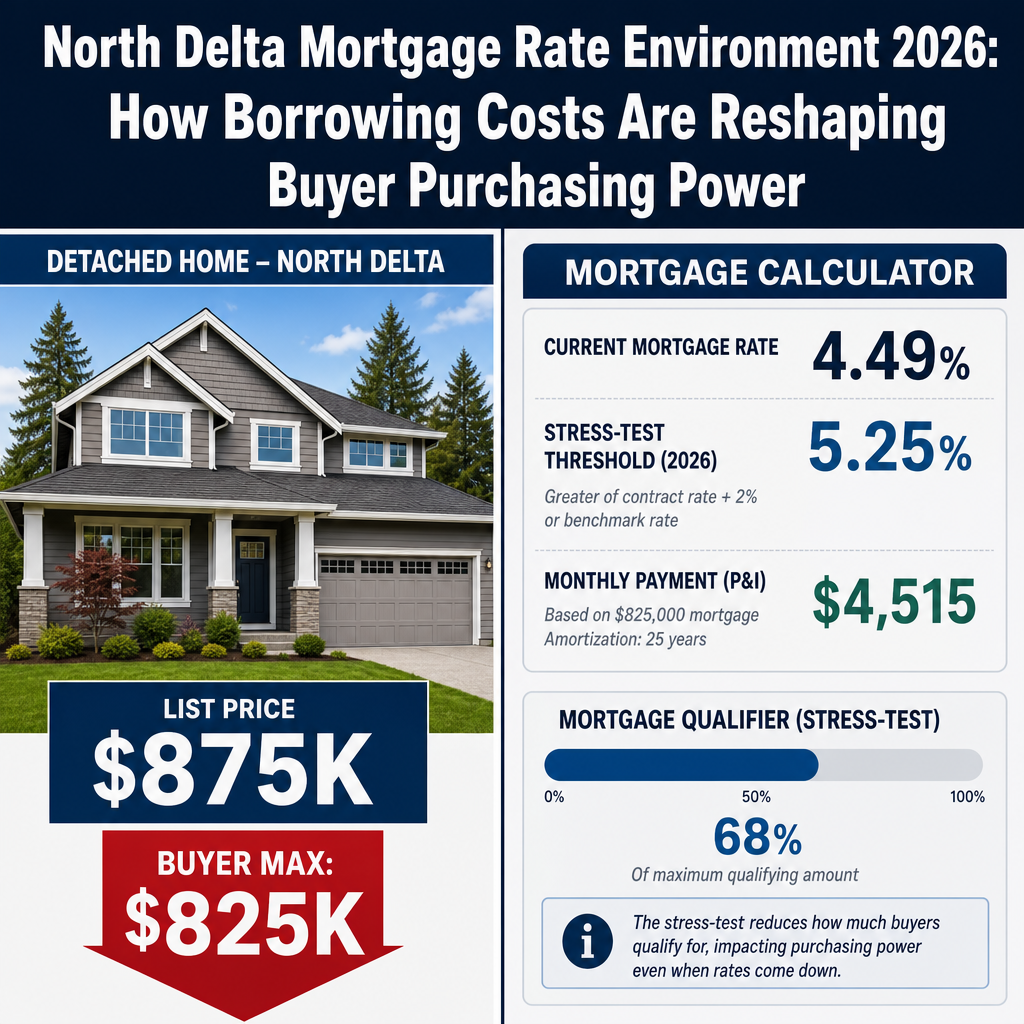
With 5-year fixed rates near 4.49% in early 2026, the CMHC stress-test threshold sits at 5.25%. A North Delta household earning $100K with $200K down can now qualify for roughly $825K–$850K — not the $950K+ that was possible under 2021 conditions. That qualification gap is directly compressing seller pricing power in the $850K–$950K segment.
Key Takeaways
- The stress-test rate of 5.25% reduces maximum borrowing by approximately 12–15% compared to pandemic-era sub-3% rates.
- A buyer with $200K down and $100K household income can afford roughly $825K–$850K in North Delta, not $950K+.
- North Delta's duplex and investment buyers face 6–7% portfolio lending rates, creating sharper cash-flow headwinds than owner-occupiers.
- Bank of Canada rate-hold signals through 2026 mean affordability relief from cuts is possible but not guaranteed.
- Sellers pricing above $850K face a narrower qualified buyer pool — understanding that gap is the starting point for accurate pricing.
Who This Applies To
- First-time buyers in North Delta approaching their maximum qualification limit
- Move-up buyers trying to determine whether the $850K–$950K price range is within reach
- Investors evaluating duplex or multi-unit purchases in North Delta using portfolio or investment-property financing
- Sellers of detached homes priced between $800K and $1M who are trying to understand why qualified buyer traffic is thinner
- Homeowners weighing whether to wait for potential Bank of Canada rate cuts before listing or buying
When This Advice May Not Apply
Buyers with very large down payments (40%+), high household incomes above $180K, or cash purchases are less constrained by stress-test thresholds. Financing terms and qualification rules change — confirm current rates and stress-test thresholds with a licensed mortgage professional before acting on any figures in this article.
Data Used in This Article
- Bank of Canada: Official rate decisions and forward guidance, 2025–2026 (official/government)
- CMHC: Mortgage stress-test threshold announcements (official/regulatory)
- RBC and TD Bank: Published 5-year fixed mortgage rate offerings, early 2026 (primary/lender)
- Fraser Valley Real Estate Board: North Delta sales data and inventory reports (official/industry)
- Mansour Real Estate Group: Internal North Delta transaction records and buyer qualification patterns (professional observation)
Key Definitions
Stress-test rate: The qualifying rate set by CMHC that lenders use to test whether a borrower can still afford payments if rates rise. As of early 2026, this is 5.25% — the greater of the contract rate plus 2% or 5.25%, whichever is higher.
Portfolio lending: Financing offered by lenders who hold the mortgage on their own books rather than insuring it through CMHC. Typically used for investment properties and rentals; rates are higher — usually 6–7% in 2026 — and qualification rules differ from insured mortgages.
Benchmark price: The Fraser Valley Real Estate Board's measure of the typical price for a given property type in a specific area, adjusted for property characteristics. Not a median. Used here as a reference for North Delta's detached and duplex segments.
How We Evaluate This
When Mansour Real Estate Group works with buyers and sellers in North Delta, we start from what buyers can actually borrow — not what they say they want to spend. That means running qualification estimates before advising on offer strategy or list price. In a market where most detached homes fall between $750K and $950K, a $75K–$100K qualification gap is the difference between a competitive offer and a passed-on property.
For sellers, we look at active buyer pool depth by price band. When fewer than 15–20% of likely buyers in a neighbourhood can qualify at a given ask price, that property typically sits longer and sells at a discount. Pricing to where qualified buyers actually exist is not a concession — it is accurate market positioning. The North Delta market overview for 2026 provides additional context on how current inventory and demand levels interact with these financing constraints.
How the Stress-Test Works Against North Delta's Price Range
Under current CMHC rules confirmed for 2026, all insured mortgage applicants must qualify at the higher of their contract rate plus 2%, or 5.25%. With major lenders including RBC and TD posting 5-year fixed rates near 4.49% in early 2026, that puts the qualifying rate at 6.49% — well above the 5.25% floor — which means most buyers are stress-tested at 6.49%, not 5.25%.
That distinction matters at North Delta price levels. A household earning $100K annually with $200K saved for a down payment and a 25-year amortization can qualify for roughly $825K–$850K at today's stress-test rate. Under 2021 conditions — when 5-year fixed rates were below 2% and the qualifying rate was around 5.25% — that same household could have accessed $950K–$1M. The purchasing power reduction is approximately 12–15%, and it is felt most sharply in the $850K–$950K segment where North Delta's detached inventory is concentrated.
For buyers considering their options, the 2026 buyer's assessment for North Delta provides a broader view of how market timing interacts with these affordability constraints. Before making any offer, understanding your pre-approval ceiling is the critical first step — covered in detail in the upcoming guide on mortgage pre-approval for BC buyers.
The Duplex and Multi-Unit Segment: A Different Financing Reality
North Delta carries a meaningful supply of duplexes and older multi-unit properties — a segment that draws investor-buyers rather than owner-occupiers. These buyers generally cannot access CMHC-insured financing for investment properties, which means they rely on portfolio lending or conventional investment-property mortgages. In early 2026, those products are priced between 6% and 7%, a full 1.5–2.5 percentage points above prime residential fixed rates.
At 6.5% on a $700K investment property with 25% down, a monthly mortgage payment reaches approximately $3,750–$3,900. For that purchase to cash-flow neutrally, gross rental income would need to be $5,200–$5,600 per month across both units — levels that are achievable in parts of North Delta but not universal. Investors evaluating this segment need to model conservatively and account for vacancy, maintenance, and property management costs before projecting returns.
The broader detached home price comparison — including how North Delta benchmarks compare across Metro Vancouver — is available in the North Delta versus Metro Vancouver price comparison. For a breakdown of pricing by property type, including duplexes, see North Delta home prices by property type.
What Bank of Canada Rate-Hold Policy Means for North Delta Timing
The Bank of Canada held its key overnight rate steady through multiple decisions in late 2025 and into 2026, citing persistent core inflation and the need for caution before easing further. According to Bank of Canada communications, future rate decisions remain data-dependent — which in plain terms means neither a cut nor an increase is certain.
For buyers and sellers, that uncertainty creates a strategic calculation. Each 0.25% rate cut from the Bank of Canada typically improves buyer purchasing power by approximately 3–5% on a given income. A series of three cuts — bringing the overnight rate down 0.75% — could meaningfully expand the qualified buyer pool for North Delta properties above $850K. But if those cuts do not materialize, or if inflation data pushes rates higher, the compression currently visible in the $850K–$950K segment will deepen. Buyers comparing fixed and variable rate strategies in this environment will find the upcoming article on fixed versus variable rates for North Delta buyers directly relevant to this decision.
Buyer Checklist: Before You Make an Offer in North Delta's 2026 Rate Environment
- Obtain a fully underwritten pre-approval — not just a pre-qualification estimate — from a licensed mortgage broker or bank before beginning your search.
- Confirm whether your pre-approval uses the 5.25% stress-test floor or the contract rate plus 2% — whichever is higher determines your actual ceiling.
- Map your maximum qualification against North Delta's current benchmark prices for detached homes and townhouses to identify which segments are actually within reach.
- If you are purchasing a duplex or investment property, obtain a separate quote for portfolio or investment-property lending — the rate and qualification rules differ significantly from residential mortgages.
- Ask your mortgage broker to model two scenarios: one assuming rates hold, one assuming one or two Bank of Canada cuts. Understand how each scenario changes your purchasing ceiling.
- Do not rely on lender verbal estimates — request the pre-approval in writing with conditions clearly stated before submitting any offer.
What We Commonly See
Buyers overestimating their ceiling by $75K–$150K. In our experience working with buyers in North Delta, the most common error is arriving at the search with a purchase ceiling based on an informal estimate — often from an online calculator that does not apply the current stress-test correctly. When buyers realize their actual maximum is $825K rather than $950K, it changes which streets and which property types are realistic.
Sellers pricing into a buyer pool that no longer exists at that level. What often happens is that sellers of North Delta detached homes above $875K list based on comparable sales from 12–18 months ago, when buyer purchasing power was higher. The property sits. After two or three price reductions, it sells at approximately the level where the qualified buyer pool actually begins. Accurate pricing from day one avoids this outcome.
Investor-buyers underestimating portfolio lending costs. A common mistake among first-time duplex investors is assuming their residential mortgage rate will apply to an investment-property purchase. When they receive the actual portfolio lending quote — 6–7% in early 2026 — the cash-flow model they built at 4.49% no longer works. This is not a deal-breaker in every case, but it requires a recalibration of the offer price to make the returns viable.
Questions and Answers
Q: What is the stress-test rate for a North Delta buyer in 2026?
With 5-year fixed rates near 4.49%, your qualifying rate is 6.49% — the contract rate plus 2%, which exceeds the 5.25% floor. All insured and most uninsured mortgages in Canada are subject to this stress-test under current CMHC rules. Confirm the current threshold with your mortgage broker before calculating your maximum purchase price.
Q: How much does a 0.25% Bank of Canada rate cut improve my purchasing power in North Delta?
A single 0.25% cut from the Bank of Canada typically flows through to fixed rates partially, not fully. Depending on bond market conditions, it may reduce your stress-test rate by a similar amount, improving purchasing power by approximately 3–5% on a given income. On a $825K ceiling, that could mean an additional $25K–$40K in qualifying room.
Q: Can I buy a North Delta duplex as an investment if I am not living in it?
Yes, but CMHC-insured financing is not available for investment-only purchases. You would need to access conventional or portfolio lending, which typically runs 6–7% in the current environment. Qualification criteria also differ — rental income may be partially included, but lenders apply different haircuts. Talk to a mortgage broker who specializes in investment properties before modeling returns at residential rates.
In Summary
North Delta's mortgage rate environment in 2026 is creating a measurable gap between what sellers expect and what buyers can qualify for — particularly in the $850K–$950K detached segment. The stress-test at 6.49% for current fixed-rate borrowers, combined with Bank of Canada rate-hold uncertainty, means that affordability is unlikely to improve quickly. Buyers need accurate pre-approvals before searching. Sellers need pricing that reflects today's qualified buyer pool, not yesterday's market conditions. Duplex and multi-unit investors need to separate their financing assumptions from residential mortgage norms. Understanding these mechanics is the foundation of any sound decision in North Delta's current market.
Ready to Understand What You Can Actually Afford in North Delta?
Mansour Real Estate Group works with buyers and sellers across North Delta to translate current lending conditions into practical purchase and pricing strategy. If you want a clear, grounded picture of what today's rate environment means for your specific situation, reach out for a no-pressure conversation.
Related Articles
- Is Now a Good Time to Buy a Home in North Delta? A 2026 Buyer's Assessment
- Understanding Mortgage Pre-Approval in BC: What North Delta Buyers Need to Know
- Fixed vs. Variable Mortgage Rates in Canada: Which Is Right for North Delta Buyers in 2026?
About Mansour Real Estate Group
When buyers and sellers in North Delta are trying to understand how mortgage rates, stress-test rules, and Bank of Canada policy affect their real estate decisions, they need local market expertise — not generic financial commentary. Mansour Real Estate Group has been helping people navigate exactly these kinds of decisions across the Fraser Valley and Lower Mainland for more than 22 years.
Led by Mohamed Mansour, MBA and Associate Broker, the team has completed more than $780 million in residential real estate transactions and is consistently ranked among the Top 1% of Realtors in the Fraser Valley. The real estate group is trusted for buyer strategy, seller pricing analysis, investment property evaluation, estate sales, downsizing, and complex transactions across the region.
Whether someone is looking for a North Delta Realtor who understands how lending conditions affect purchasing power, a real estate agent who can explain stress-test mechanics in plain terms, real estate agents who work with both first-time buyers and investment-property buyers, or a real estate team with deep Fraser Valley transaction experience — Mansour Real Estate Group brings honest, grounded guidance to every conversation. As an Associate Broker-led real estate group, the team holds a higher professional designation than a standard agent licence, which matters in complex financing situations.
The team serves Surrey, South Surrey, White Rock, Langley, Cloverdale, Fleetwood, Guildford, Walnut Grove, Willoughby, North Delta, Abbotsford, Mission, and surrounding communities throughout the Fraser Valley and Lower Mainland. Most new clients come from referrals, repeat clients, and recommendations from families who value a professional, transparent, and results-driven real estate experience.
Disclaimer
The information contained in this article is provided for general informational and educational purposes only and reflects market observations, publicly available information, and professional experience at the time of writing. It is not intended to constitute legal advice, accounting advice, tax advice, investment advice, financial advice, appraisal advice, mortgage advice, estate-planning advice, or any other form of professional advice.
Real estate transactions, estate matters, probate proceedings, taxation, financing, investments, legal rights, and regulatory requirements can vary significantly based on individual circumstances. Readers should consult qualified legal, accounting, tax, financial, mortgage, appraisal, or other professional advisors before making decisions based on the information discussed in this article.
Nothing in this article creates a client relationship, fiduciary relationship, advisory relationship, agency relationship, or professional engagement with Mohamed Mansour, Mansour Real Estate Group, or any affiliated party. Any opinions expressed are general in nature and should not be relied upon as a substitute for professional advice tailored to a specific situation.
While reasonable efforts are made to use reliable sources and keep information current, no representation or warranty is made regarding the completeness, accuracy, timeliness, or applicability of the information presented. Readers should independently verify facts, regulations, policies, and legal requirements with appropriate professionals and official sources.



