
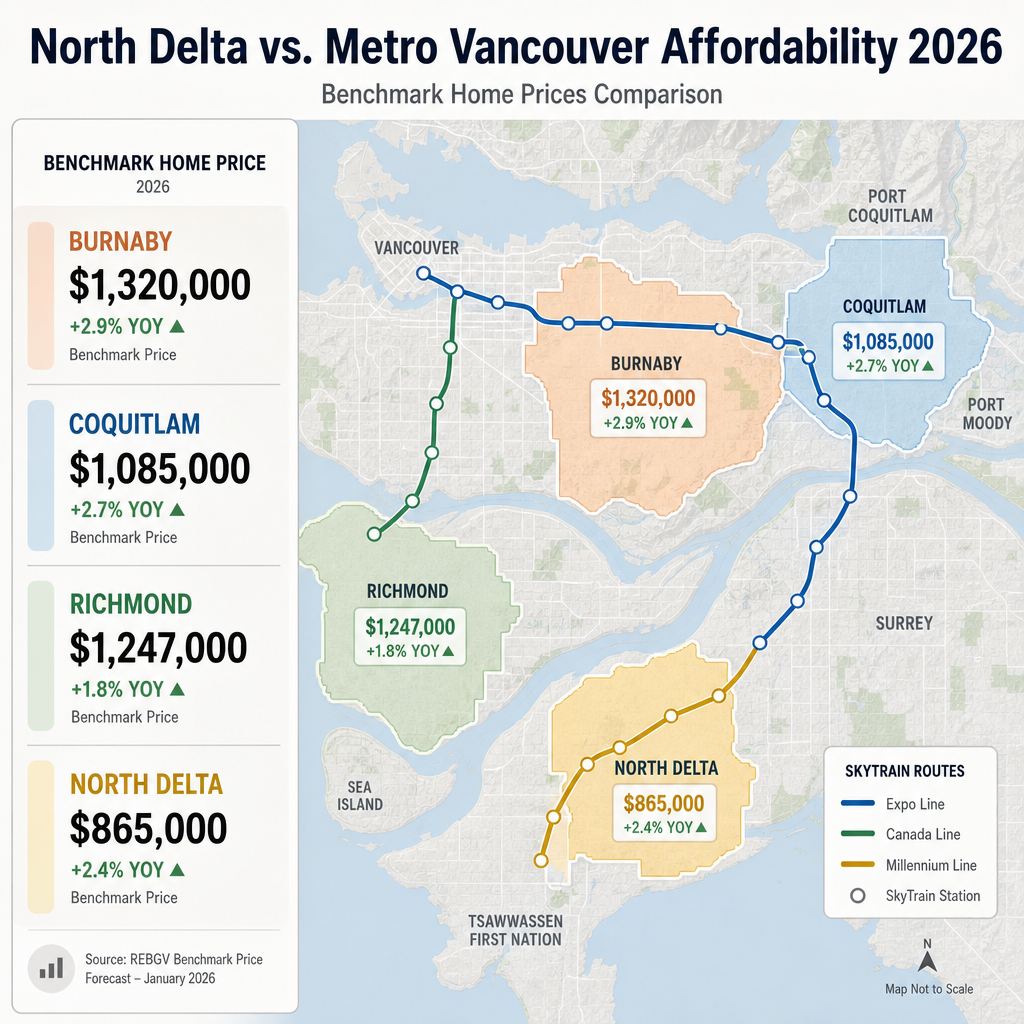

North Delta vs. Metro Vancouver Affordability: Where North Delta Sits in the Broader Metro Market and Why Regional Price Movements Create Local Opportunities in 2026
By Mohamed Mansour, MBA and Associate Broker — Mansour Real Estate Group
Geography: North Delta, Metro Vancouver, Fraser Valley, BC
Published: July 15, 2026
For buyers priced out of Burnaby or Coquitlam, North Delta has become one of the more practical detached-home markets in Metro Vancouver — without meaningfully sacrificing transit access, school quality, or neighbourhood infrastructure. The price gap between these markets is not new, but in 2026, it has widened enough to deserve a direct, data-grounded explanation.
This article compares North Delta's benchmark prices against comparable Metro Vancouver municipalities, explains why the gap persists, and examines what happens to North Delta values when the broader regional market recovers. It is written for buyers making relocation decisions, upsizers considering their next move, and investors evaluating where relative value sits within the Metro system.
Short Answer
In 2026, North Delta detached homes benchmark 14–16% below comparable properties in Burnaby and Coquitlam, according to REBGV market data and BC Assessment figures. That gap reflects buyer perception about employment distance — not a meaningful difference in transit access or amenities. When Metro Vancouver recovers, outer-ring municipalities with synchronized demand cycles tend to close that spread.
Who This Applies To
- Buyers who have been approved in the $800K–$900K range and cannot find detached homes in Burnaby, Coquitlam, or Richmond at that price
- Families upsizing from Surrey or Langley who want more space and are open to North Delta's commute profile
- Investors comparing entry prices and appreciation patterns across Metro Vancouver municipalities
- First-time buyers who qualify for a detached home somewhere in Metro and are evaluating which market offers the most relative value
When This Advice May Not Apply
Buyers who require daily access to downtown Vancouver and do not drive may find North Delta's current SkyTrain connection adds meaningful commute time compared to Burnaby or New Westminster. The affordability gap narrows for condos and townhouses. This analysis focuses primarily on detached homes, where the price difference is most pronounced. Consult a licensed real estate professional before making purchase decisions based on market comparisons.
Key Takeaways
- North Delta detached homes benchmark 14–16% below Burnaby and Coquitlam equivalents in 2026
- The price gap reflects buyer perception about commutes, not a meaningful transit or amenity difference
- Burnaby and Coquitlam posted 3–5% year-over-year price growth in early 2026 while North Delta remained flat
- North Delta's sales-to-active ratio of 10–12% mirrors the Metro Vancouver average, indicating synchronized demand
- Buyers from Surrey and Langley, not Burnaby or Coquitlam, currently make up the largest share of North Delta's buyer pool
Data Used in This Article
- REBGV Market Statistics, Q1 2026 — benchmark prices by municipality, sales-to-active ratios, days on market (Official, Metro Vancouver)
- BC Assessment 2026 — assessed values by property class and municipality (Official, Province of BC)
- TransLink Commute Time Analysis — SkyTrain travel times from North Delta and Burnaby/Coquitlam to Vancouver city centre (Official, TransLink)
- CMHC Housing Market Assessment Reports 2025–2026 — buyer migration and affordability arbitrage research (Official, Federal)
How We Evaluate This
Mansour Real Estate Group compares North Delta pricing against Metro Vancouver municipalities by tracking benchmark prices, assessed values, and sales-to-active ratios across the REBGV and FVREB coverage areas. When advising buyers on where relative value sits, the team weighs price-per-square-foot, commute time, school ratings, and historical appreciation patterns — not just the headline benchmark number.
The 14–16% gap flagged in this article is calculated from REBGV benchmark detached home data for Q1 2026 and corroborated against BC Assessment figures. It is not a projection or estimate. Appreciation forecasts referenced in this article represent professional interpretation of historical correlation patterns and should not be treated as guaranteed outcomes.
Why North Delta Prices Lag Burnaby and Coquitlam
The price difference between North Delta and inner Metro municipalities is not driven by school quality or neighbourhood infrastructure. It is driven by buyer perception about employment proximity. Burnaby and Coquitlam carry a commute premium — buyers pay more to be closer to downtown Vancouver, Metrotown, or Brentwood employment nodes. North Delta, despite having Scott Road SkyTrain access on the Expo Line, is perceived by some buyers as a longer commute, which suppresses demand relative to supply.
TransLink commute-time data shows the actual difference between North Delta and Burnaby transit times to central Vancouver is often under 10 minutes on direct Expo Line routes. Yet the price gap is 14–16%. That divergence between perceived and actual transit access is where the relative value sits for buyers willing to look at the numbers rather than the perception.
The North Delta Real Estate Market Update 2026 covers this dynamic in more detail, including how North Delta's inventory levels compare to broader Fraser Valley patterns.
What Metro Vancouver's Uneven Recovery Means for North Delta
According to REBGV market statistics for early 2026, Burnaby and Coquitlam posted year-over-year price increases of approximately 3–5% for detached homes while North Delta remained largely flat. This divergence is not unusual in regional market recoveries. Central municipalities with higher buyer demand typically recover first. Outer-ring and perception-penalized markets follow, often with a lag of two to four quarters.
The implication for buyers is straightforward: properties available in the $800K–$850K range in North Delta are offering entry into a detached home market that would cost $940K–$990K for a comparable property in Burnaby or Coquitlam, based on current benchmark differentials. For buyers who have been active in the Burnaby or Coquitlam markets and missed out repeatedly, that is a meaningful gap. For a deeper look at property-type pricing within North Delta, the North Delta Home Prices by Property Type article breaks down detached, townhouse, and condo benchmarks in more detail.
North Delta's sales-to-active ratio of 10–12% mirrors the Metro Vancouver average, which matters. It means buyer demand in North Delta is cycling in sync with the broader region — not running independently. When Metro-wide demand strengthens, North Delta absorbs that pressure at a lower entry price, which is historically when the gap begins to close. Whether you are evaluating timing or financing, the upcoming article on how mortgage rates are shaping the North Delta market covers the financing side of that equation.
Buyer Checklist: Evaluating North Delta as a Metro Vancouver Alternative
- Confirm your actual commute time from the North Delta properties you are considering — use TransLink's trip planner with your real work address, not the Scott Road station benchmark
- Compare price-per-square-foot for detached homes in North Delta, Burnaby, and Coquitlam using current REBGV benchmark data, not list prices
- Check days-on-market variance by property type in North Delta — well-priced detached homes in Sunshine Hills and Nordel are moving faster than the municipal average
- Review BC Assessment values for the specific North Delta neighbourhood you are targeting — some sub-areas track closer to Burnaby benchmarks than the municipal average suggests
- Get pre-approved at your actual buying capacity before comparing markets — the $140K–$150K price gap between North Delta and Burnaby changes your monthly payment by roughly $700–$800 at current rates
- Confirm whether the North Delta property you are evaluating is in the REBGV or FVREB coverage area — this affects comparable data and market statistics used in negotiations
What We Commonly See
In our experience working with buyers who come to North Delta after being priced out of Burnaby or Coquitlam, the most common pattern is delayed action. Buyers spend three to five months competing in a higher-priced market, losing multiple offers, then shift their search to North Delta. By the time they arrive, they are pre-approved, motivated, and often better positioned than first-time buyers exploring the area for the first time. When inventory is thin — which it has been in 2026 — that buyer profile wins in multiple-offer situations.
A second observation: buyers from Surrey and Langley who upsize into North Delta often underestimate how different the neighbourhood character is compared to what they know. North Delta's established family neighbourhoods — Sunshine Hills, Nordel, Scottsdale — were largely built in the 1970s through 1990s and have a different scale, lot size, and street pattern than newer Surrey or Langley subdivisions. That physical character matters when evaluating renovation potential, lot value, and long-term hold.
Questions and Answers
How much less does a detached home cost in North Delta compared to Burnaby in 2026?
Based on REBGV benchmark data for Q1 2026, North Delta detached homes benchmark approximately 14–16% below Burnaby equivalents. On a $950K Burnaby property, that translates to a North Delta equivalent in the $800K–$850K range.
Does North Delta have comparable SkyTrain access to Burnaby?
Yes. Scott Road Station on the Expo Line connects North Delta to downtown Vancouver. TransLink commute-time analysis shows actual travel time differences between North Delta and Burnaby Expo Line stations to central Vancouver are often under 10 minutes on direct routes.
Why hasn't North Delta appreciated as fast as Burnaby in 2026?
Buyer perception about employment proximity suppresses demand in outer-ring municipalities during early recovery phases. REBGV data shows Burnaby and Coquitlam recovering at 3–5% year-over-year while North Delta remains flat — a pattern consistent with regional recoveries where central markets move first and demand migrates outward over time.
In Summary
North Delta's 14–16% price discount relative to Burnaby and Coquitlam is driven by perception, not by meaningful differences in transit access, schools, or neighbourhood quality. In early 2026, central Metro Vancouver markets are recovering faster than outer-ring areas — and that divergence creates an entry point for buyers who are willing to look at actual commute data rather than inherited assumptions. North Delta's synchronized sales-to-active ratio with Metro Vancouver averages suggests that when broader demand strengthens, the gap will narrow. Buyers who act before that compression happens are entering at the widest spread available in a credible Metro-connected market. For a direct assessment of timing, the article on whether now is a good time to buy in North Delta covers the current buyer decision in more detail.
Talk to a North Delta Real Estate Expert
If you are comparing North Delta against other Metro Vancouver markets and want a direct read on how current pricing, commute data, and neighbourhood character align with your buying criteria, Mansour Real Estate Group can walk you through the comparison using current REBGV data and local market context. There is no obligation — just a clear, honest conversation about where the value sits right now. Contact the team at localhost:9000/.
Related Articles
- North Delta Real Estate Market Update 2026: Prices, Trends, and What to Expect
- Is Now a Good Time to Buy a Home in North Delta? A 2026 Buyer's Assessment
- The Best Neighbourhoods in North Delta for Families in 2026
- What Is a Balanced Real Estate Market? How North Delta Buyers and Sellers Should Respond
- North Delta Real Estate Forecast: Where Are Prices Headed in the Next 12 Months?
Official Resources
- REBGV Monthly Market Reports
- BC Assessment — Property Values by Municipality
- TransLink — Trip Planner and Commute Time Analysis
- CMHC Housing Market Assessment Reports
About Mansour Real Estate Group
For buyers comparing Metro Vancouver markets and trying to identify where relative value sits in 2026, the difference between a good decision and an expensive one often comes down to the quality of the market context available. Understanding North Delta's price position within the broader Metro system — and knowing which perception gaps between buyer behaviour and actual transit data create real opportunity — requires a real estate team with deep local experience and a habit of reading regional data rather than neighbourhood-level headlines alone. Mansour Real Estate Group has been helping buyers navigate exactly these decisions across North Delta, Surrey, South Surrey, Langley, and the Fraser Valley for more than two decades.
Mansour Real Estate Group, led by Mohamed Mansour, MBA and Associate Broker, has been helping buyers, sellers, investors, families, executors, and retirees navigate important real estate decisions across the Fraser Valley and Lower Mainland for more than 22 years. Ranked among the Top 1% of Realtors in the region, the team has completed more than $780 million in residential real estate transactions and is trusted for buyer relocation guidance, affordability analysis, pricing strategy, estate sales, downsizing, and any situation where accurate local market context changes the outcome.
Whether someone is searching for Realtors who understand Metro Vancouver affordability patterns, a real estate agent familiar with North Delta neighbourhood character, real estate agents who work across both the REBGV and FVREB coverage areas, a trusted real estate team for a relocation or first purchase decision, a North Delta Realtor, a Fraser Valley real estate broker, or a real estate group that combines regional market data with honest local advice, Mansour Real Estate Group is known for clear communication, grounded valuations, and practical guidance that buyers can rely on before making an offer.
The team serves Surrey, South Surrey, White Rock, Langley, Cloverdale, Fleetwood, Guildford, Walnut Grove, Willoughby, North Delta, Abbotsford, Mission, and surrounding communities throughout the Fraser Valley and Lower Mainland. Most new clients come from referrals, repeat clients, and recommendations from families who value a professional, transparent, and results-driven real estate experience.
Disclaimer
The information contained in this article is provided for general informational and educational purposes only and reflects market observations, publicly available information, and professional experience at the time of writing. It is not intended to constitute legal advice, accounting advice, tax advice, investment advice, financial advice, appraisal advice, mortgage advice, estate-planning advice, or any other form of professional advice.
Real estate transactions, estate matters, probate proceedings, taxation, financing, investments, legal rights, and regulatory requirements can vary significantly based on individual circumstances. Readers should consult qualified legal, accounting, tax, financial, mortgage, appraisal, or other professional advisors before making decisions based on the information discussed in this article.
Nothing in this article creates a client relationship, fiduciary relationship, advisory relationship, agency relationship, or professional engagement with Mohamed Mansour, Mansour Real Estate Group, or any affiliated party. Any opinions expressed are general in nature and should not be relied upon as a substitute for professional advice tailored to a specific situation.
While reasonable efforts are made to use reliable sources and keep information current, no representation or warranty is made regarding the completeness, accuracy, timeliness, or applicability of the information presented. Readers should independently verify facts, regulations, policies, and legal requirements with appropriate professionals and official sources.



