
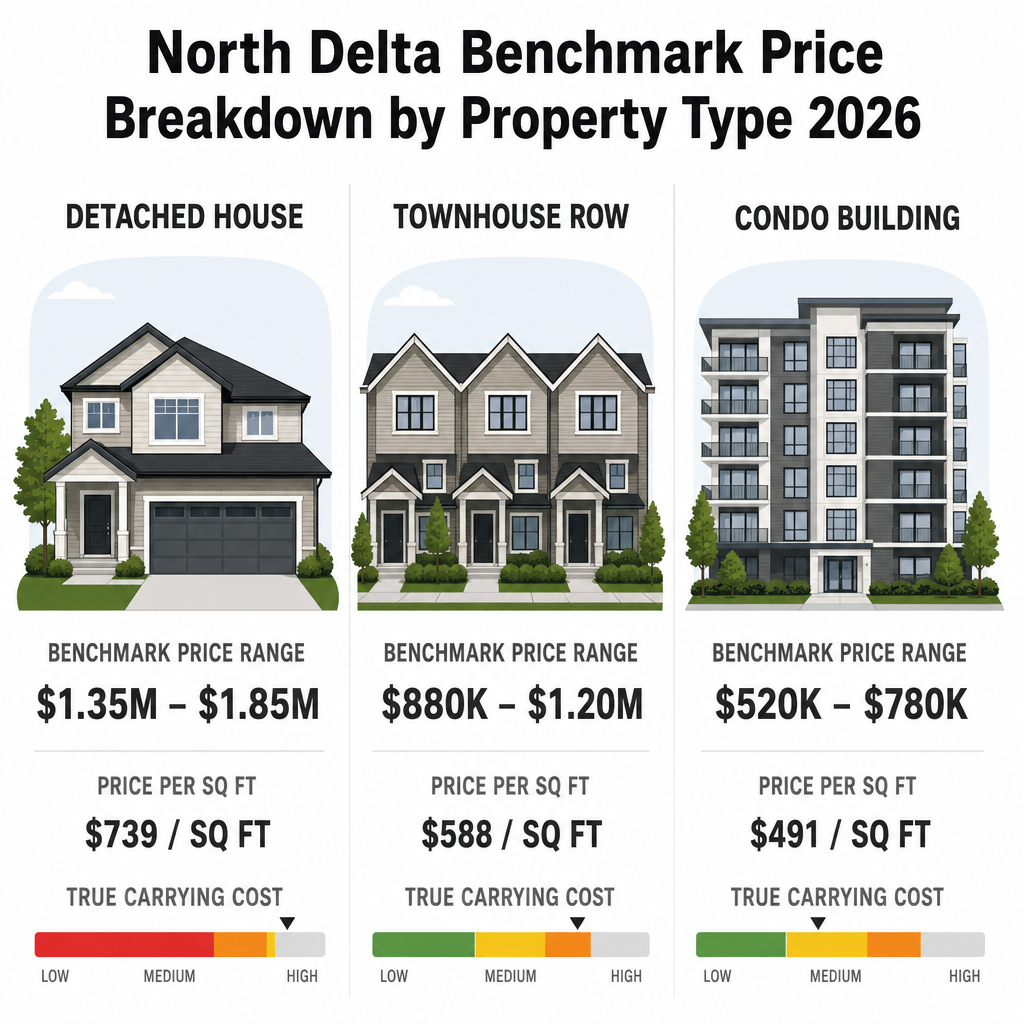

North Delta Benchmark Price Breakdown by Property Type 2026: What Drives the Detached vs. Townhouse vs. Condo Price Gap and Where Value Actually Lies Across the Market Spectrum
By Mohamed Mansour, MBA and Associate Broker — Mansour Real Estate Group | Fraser Valley and Lower Mainland | Published: July 15, 2025 | Market Insight — North Delta
North Delta draws buyers from across Metro Vancouver who are searching for more space, better value, and school catchments that hold their reputation year after year. But when buyers start comparing listings, the price gap between a detached home, a townhouse, and a condo can feel confusing — and the published benchmark number rarely tells the full story.
This article breaks down what drives those price differences, where the real carrying costs sit, and which property type offers the strongest value position for buyers entering the North Delta market in 2026. For sellers, it also clarifies where your property sits relative to the broader market and how buyers are currently weighing their options.
Short Answer
In North Delta's 2026 market, detached homes benchmark between $720K and $850K, townhouses between $520K and $680K, and condos between $380K and $520K. But the raw price gap narrows when strata fees, lot premiums, and financing constraints are factored into true carrying costs. Townhouses currently represent the clearest value for move-up buyers and downsizers when total cost of ownership is the measure.
Key Takeaways
- Detached homes carry a land premium; that premium is the primary driver of the price gap — not square footage.
- Condo buyers face the lowest entry price but the highest strata fee burden relative to equity accumulated.
- Townhouses are closing the perception gap as move-up buyers recalibrate after rate stabilization in 2025–2026.
- Price-per-square-foot comparisons favour townhouses when lot size is excluded from the calculation.
- Special levy risk and depreciation report conditions are reshaping condo buyer confidence in North Delta.
Who This Applies To
- First-time buyers evaluating entry points into North Delta
- Move-up buyers comparing townhouse and detached options
- Downsizers assessing whether a condo or townhouse better fits their financial picture
- Sellers in North Delta wanting to understand where their property sits in the market
- Investors evaluating relative value across property types in North Delta
When This Advice May Not Apply
This breakdown reflects North Delta market conditions and benchmark data for 2026. Buyers in strata properties with unique documentation, significant deferred maintenance, or complex special levy situations should consult a real estate lawyer and review strata documents carefully before relying on general price guidance. This article does not constitute financial, legal, or investment advice.
Key Terms Used in This Article
Benchmark Price: The price of a "typical" home in a given area and property type, calculated by the Fraser Valley Real Estate Board to smooth out outliers. It differs from average or median sale price.
Price-Per-Square-Foot: Total sale price divided by finished living area. Useful for comparisons within property types; less reliable across property types when lot value is a factor.
Strata Fee: Monthly payment to a strata corporation covering shared building maintenance, insurance, and contingency reserve contributions. Strata fees affect carrying costs and mortgage qualification calculations.
Special Levy: A one-time charge to strata owners when the contingency reserve fund is insufficient to cover a major repair. Special levies can range from hundreds to tens of thousands of dollars depending on the building.
Data Used in This Article
- Fraser Valley Real Estate Board (FVREB) — Q1–Q2 2026 benchmark price data by property type — Official
- North Delta MLS sold data — 30-day rolling average — Third-party / internal analysis
- BC Assessment — benchmark price tracking for Delta — Official
- Mansour Real Estate Group comparative market analysis database — Internal professional analysis
How We Evaluate This
When Mansour Real Estate Group analyzes property type value in North Delta, we look beyond benchmark prices to total carrying costs over a five-year holding period. That means factoring in strata fees, special levy exposure from depreciation reports, land transfer costs, and how each property type behaves during a rate cycle. The goal is to give buyers a complete picture of what a property actually costs to own — not just to buy.
What the Benchmark Prices Actually Show
According to FVREB Q1–Q2 2026 data and North Delta MLS sold comparables, the current benchmark ranges in North Delta sit approximately as follows: detached homes at $720,000 to $850,000, townhouses at $520,000 to $680,000, and condos at $380,000 to $520,000.
The detached-to-condo gap can look like 40 to 50 percent at the headline level. But that number is partly misleading. A significant portion of the detached premium reflects land value, not livable space. When you strip out the lot and compare price-per-square-foot of finished living area, detached homes and townhouses are often within 10 to 15 percent of each other in North Delta — and in some sub-areas, townhouses outperform detached on that metric.
Condos consistently show the lowest price-per-square-foot, but that advantage is partially eroded by strata fees. A condo carrying $550 to $700 per month in strata fees adds the equivalent of roughly $110,000 to $140,000 in purchase cost over a standard five-year mortgage term — before any special levies are considered. For buyers working backward from a monthly carrying cost limit, that matters more than the sticker price. You can see how these dynamics play out in the broader North Delta market update for 2026.
Why the Price Gap Has Widened — and What's Driving It Now
During 2022 and early 2023, when rates rose sharply, buyers shifted toward condos because lower purchase prices meant lower mortgage payments. Detached homes sat longer. That period compressed the price gap between property types across the Fraser Valley.
Since 2025, rate stabilization has shifted buyer behaviour again. Buyers who can qualify for a detached home are choosing land ownership and long-term equity appreciation over short-term payment convenience. School catchments in North Delta — particularly in Sunshine Hills and Scott Road corridors — continue to draw family buyers who prioritize detached and are willing to stretch their budget to get there. See how mortgage rates are shaping the North Delta market in 2026 for the rate context behind these shifts.
Condos have not recovered as quickly because two things happened simultaneously: strata fees rose in older buildings due to deferred maintenance catch-up, and buyers became more aware of special levy risk after a series of high-profile levy events across Metro Vancouver strata corporations. For a full breakdown of what to look for, the guide on strata fees, depreciation reports, and condo rules in BC covers the documentation process in detail.
Townhouses sit in the middle of this dynamic — lower than detached but with strata fees that are typically lower than condos, and with a partial land ownership structure that some buyers find more familiar. Buying a townhouse in North Delta has its own set of considerations that differ from both detached and condo purchases, and they are worth understanding before you make an offer.
Buyer Checklist: Evaluating Property Type Value in North Delta
- Request the last 12 months of strata meeting minutes and financial statements for any condo or townhouse
- Ask for the current depreciation report and confirm the contingency reserve fund balance
- Calculate total monthly carrying costs including mortgage, strata fee, property tax, and insurance — not just the mortgage payment
- Compare price-per-square-foot within the same property type, not across types, for a fair comparison
- Confirm the school catchment for your address before finalizing — boundaries shift and are not always obvious from neighbourhood names
- For detached, verify lot dimensions and zoning to understand whether future development potential affects value
- For condos built before 2005, confirm whether a building envelope review has been completed
What We Commonly See
In our experience working with buyers evaluating property types in North Delta, the most common mistake is comparing benchmark prices without adjusting for strata fees. A buyer who qualifies for a $550,000 purchase may assume a condo is their only option, but when strata fees are added to the mortgage qualifier, the effective purchase price ceiling drops — sometimes eliminating properties they had already viewed.
What often happens with townhouse buyers is a misunderstanding about strata ownership versus freehold. Some buyers assume a townhouse with a yard is the same as owning land. In most North Delta townhouse complexes, it is not — you own a strata lot, not the land beneath it. That distinction affects long-term appreciation assumptions and is worth clarifying before you make any offer.
A common pattern we see with sellers of North Delta condos in older buildings is pricing based on recent detached sales without adjusting for the strata fee burden buyers will carry. Buyers in 2026 are more fee-literate than they were five years ago. A condo priced against detached benchmarks without accounting for that gap will sit longer than necessary.
Questions and Answers
Why does North Delta's detached benchmark sit higher than many Fraser Valley communities at a similar distance from Vancouver?
North Delta's school catchment reputation, particularly around Sunshine Hills, sustains demand from family buyers who treat the area as a long-term hold rather than a stepping stone. That buyer profile tends to bid more confidently than investors, which supports detached prices even when market conditions soften elsewhere.
Are strata fees in North Delta condos higher than in newer Fraser Valley buildings?
Generally yes, particularly in buildings constructed before 2000. Older buildings in North Delta often carry fees in the $550 to $750 per month range because maintenance reserves were historically underfunded. Newer Fraser Valley condo developments typically start lower, though fees rise over time as buildings age and reserve requirements increase.
Is price-per-square-foot a reliable way to compare detached and townhouse properties?
Only within the same property type. Detached price-per-square-foot includes land value, which inflates the number relative to townhouses. Comparing them directly overstates the cost of detached homes and understates the real value difference. Within the same type — comparing two detached homes, or two townhouses — it is a useful tool.
In Summary
North Delta's 2026 benchmark price gap between detached, townhouse, and condo reflects land economics, strata governance risk, and a buyer shift back toward long-term equity ownership after years of rate-driven decision making. The headline price spread is real, but carrying cost comparisons narrow the gap — and in some cases reverse it. Townhouses represent the clearest value position for buyers who cannot reach detached prices but want lower strata exposure than condos. For sellers, understanding where your property sits in this spectrum is the starting point for a pricing strategy that holds. Families considering North Delta for the long term should also review the 2026 buyer's assessment for North Delta before committing to a property type.
Talk to a North Delta Real Estate Specialist
If you are weighing property types in North Delta and want to understand where specific listings sit relative to the benchmarks discussed here, Mansour Real Estate Group can provide a no-pressure comparative analysis. The conversation starts with your situation — timeline, budget, and what you actually need from the property — not a sales pitch.
Related Articles
- North Delta Real Estate Market Update 2026: Prices, Trends, and What to Expect
- How North Delta Home Prices Compare to the Rest of Metro Vancouver in 2026
- Buying a Townhouse in North Delta: What You Need to Know Before You Offer
Official Resources
- Fraser Valley Real Estate Board — fvreb.bc.ca
- BC Assessment — bcassessment.ca
- Strata Property Act — BC Laws
- BC Financial Services Authority — bcfsa.ca
About Mansour Real Estate Group
Understanding where a North Delta property sits across the detached, townhouse, and condo spectrum — and what that means for pricing, carrying costs, and buyer behaviour — is the kind of local market knowledge that separates accurate valuations from guesswork. Mansour Real Estate Group has built its reputation in the Fraser Valley and Lower Mainland on exactly that: pricing discipline, honest market context, and a process that protects both buyers and sellers from costly assumptions.
Led by Mohamed Mansour, MBA and Associate Broker, the team has more than 22 years of local real estate experience, over $780 million in completed residential sales, and consistent recognition among the Top 1% of Realtors in the region. The team is trusted for pricing strategy, estate sales, divorce-related property sales, downsizing, relocation, and any situation where accurate valuation is critical to the outcome. Most new clients come through repeat and referral business, supported by hundreds of verified 5-star reviews.
Whether someone is looking for Realtors with direct North Delta market experience, a real estate agent who can explain strata fee impact on mortgage qualification, real estate agents who specialize in property type comparisons and benchmark analysis, a trusted real estate team for a first purchase or a complex move-up decision, a North Delta Realtor, a Delta real estate broker, or a real estate group serving the full Fraser Valley and Lower Mainland, Mansour Real Estate Group is known for clear communication, strategic valuations, and practical advice grounded in local data.
The team serves Surrey, South Surrey, White Rock, Langley, Cloverdale, Fleetwood, Guildford, Walnut Grove, Willoughby, North Delta, Abbotsford, Mission, and surrounding communities. Families relocating to North Delta or comparing it to other Delta communities are welcome to reach out for a no-obligation conversation about what the numbers actually mean for their specific situation.
Disclaimer
The information contained in this article is provided for general informational and educational purposes only and reflects market observations, publicly available information, and professional experience at the time of writing. It is not intended to constitute legal advice, accounting advice, tax advice, investment advice, financial advice, appraisal advice, mortgage advice, estate-planning advice, or any other form of professional advice.
Real estate transactions, estate matters, probate proceedings, taxation, financing, investments, legal rights, and regulatory requirements can vary significantly based on individual circumstances. Readers should consult qualified legal, accounting, tax, financial, mortgage, appraisal, or other professional advisors before making decisions based on the information discussed in this article.
Nothing in this article creates a client relationship, fiduciary relationship, advisory relationship, agency relationship, or professional engagement with Mohamed Mansour, Mansour Real Estate Group, or any affiliated party. Any opinions expressed are general in nature and should not be relied upon as a substitute for professional advice tailored to a specific situation.
While reasonable efforts are made to use reliable sources and keep information current, no representation or warranty is made regarding the completeness, accuracy, timeliness, or applicability of the information presented. Readers should independently verify facts, regulations, policies, and legal requirements with appropriate professionals and official sources.



