

By Mohamed Mansour, MBA and Associate Broker · Mansour Real Estate Group · Metro Vancouver and Fraser Valley · Published July 15, 2026 · Market Insight
Metro Vancouver Seasonal Real Estate Cycle 2026: When Sellers Historically Achieve Peak Prices, Maximum Buyer Activity, and Shortest Days-on-Market — And Why 2026's Buyer Hesitation and Inventory Surplus Are Reshaping Traditional Spring-Peak Patterns
For sellers in Vancouver, Burnaby, Coquitlam, and the North Shore, one question drives almost every listing decision: when should I list to get the best result? The answer has historically been March through May. Spring brought buyers, competition, and stronger prices. In 2026, that equation is more complicated.
Metro Vancouver's seasonal cycle is still real — but its effects are no longer uniform. Property type, neighbourhood, and pricing accuracy now shape outcomes more than the calendar. This article explains what the seasonal data shows, where the traditional patterns still hold, and where 2026's conditions are rewriting the rules.
Short Answer
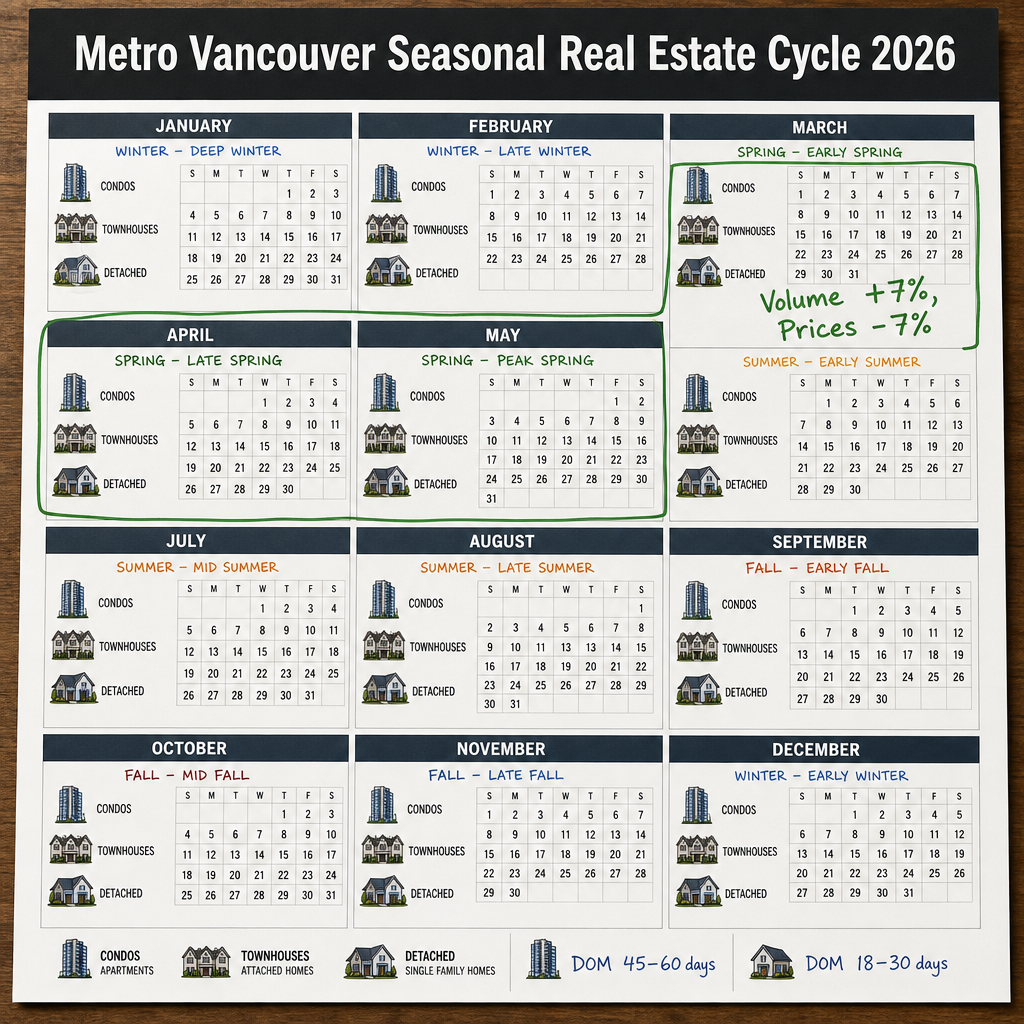
Spring remains Metro Vancouver's highest-volume selling season, but in 2026 it no longer reliably delivers premium prices. According to REBGV data, spring sales volume grew 7% year-over-year while benchmark prices fell 7–8%. For sellers, the seasonal calendar is a starting point — not a strategy. Property type and pricing discipline matter more.
Key Takeaways
- Spring 2026 generated more sales volume but lower prices than prior-year spring peaks, meaning buyer volume does not automatically produce seller leverage.
- Townhomes are the only property type showing seller-side sales-to-active ratios in 2026, with 15–23% versus 10–11% for detached and condos.
- Days-on-market variance across Metro Vancouver neighbourhoods now spans 30–80%, making hyperlocal conditions more predictive than seasonal timing alone.
- Winter 2025–2026 did not show the typical inventory collapse, suggesting structural oversupply is dampening the seasonal volatility sellers have historically relied on.
- Bank of Canada forward guidance uncertainty is suppressing the psychological urgency that drives competitive spring offers, particularly for higher-priced and condo listings.
Who This Applies To
- Homeowners in Vancouver, Burnaby, Coquitlam, Port Moody, or the North Shore deciding when to list in 2026
- Sellers of detached homes, townhouses, or condos evaluating seasonal timing relative to price expectations
- Investors or estate representatives choosing between an immediate listing and a delayed spring or fall campaign
- Sellers who listed in spring 2026 and are evaluating whether to relist in fall
When This Advice May Not Apply
Sellers with firm timelines driven by estate, divorce, or relocation obligations cannot choose their season freely. In those situations, pricing strategy and preparation matter more than timing. See our guide on how to price your home to sell in Metro Vancouver's 2026 buyer's market for a framework that works regardless of season.
Key Terms
Sales-to-active listings ratio: The percentage of active listings that sell in a given month. Below 12% typically favours buyers. Above 20% favours sellers. Townhomes sit at 15–23% in 2026; detached and condos sit at 10–11%, according to FVREB property-type data applied across the broader region.
Benchmark price: The price of a typical home in a given category, adjusted for differences in size and features. Used by REBGV as the primary price measure.
Days on market (DOM): The number of calendar days from listing date to accepted offer. Lower DOM signals stronger demand relative to supply in that segment.
Data Used in This Article
- REBGV Monthly Market Reports, Q1–Q2 2026 · Official board data · Sales volume, benchmark prices, days on market
- FVREB Sales-to-Active Listings Ratios by Property Type, Spring 2026 · Official board data · Seller/buyer market classification
- Bank of Canada Forward Guidance and Rate Hold Announcements, 2026 · Official central bank communications · Rate environment and buyer psychology context
- REBGV Historical Seasonal Trend Analysis, 2021–2025 · Five-year board data series · Baseline seasonal pattern comparison
How Metro Vancouver's Seasonal Cycle Has Worked Historically
Across five years of REBGV data, Metro Vancouver's spring window — March through May — has consistently generated 35–40% of annual sales volume. Listing inventory rises in February, buyer activity accelerates through March, and competition peaks around late April. Sellers who list in this window historically face the most buyers and the least negotiating pressure from their side.
Summer brings a secondary surge in June, followed by slower absorption through July and August as buyers step back. Fall offers a shorter rebound from mid-September through October. Winter — December through February — has traditionally meant sharply reduced buyer activity, higher days-on-market, and more price softness.
That pattern held reasonably well through 2023 and into early 2025. But the 2026 market update shows a meaningful divergence from that baseline, driven by inventory levels not seen in over a decade and a buyer pool that is present but cautious.
What 2026's Spring Data Actually Shows — And Why It Matters
Spring 2026 produced a 7% year-over-year increase in sales volume, according to REBGV monthly reports. On the surface, that sounds like seasonal strength returning. But benchmark prices fell 7–8% over the same period. More buyers transacted — at meaningfully lower prices. That is not the dynamic sellers hope for when timing a listing to coincide with the spring peak.
The explanation lies in buyer psychology. As discussed in our analysis of Bank of Canada rate decisions and Vancouver mortgages, the rate hold environment is creating forward-guidance uncertainty. Buyers who are active are motivated — but they are disciplined on price. The seasonal urgency that historically pushed buyers into competitive offers is muted when those buyers believe rates could still move and job markets remain uncertain.
With Metro Vancouver inventory above 10,000 listings, buyers face no shortage of choice. They do not need to outbid competitors in the way they did during 2021 or 2022. Spring 2026 brought buyers to the market, but it did not bring desperation — and it is buyer desperation that historically produces premium prices.
Sellers deciding between listing now or waiting should read our data-driven analysis: should I sell my Vancouver home now or wait.
How Property Type Splits the Seasonal Story in 2026
Not every seller in Metro Vancouver is experiencing the same market. The townhouse segment has posted sales-to-active ratios of 15–23%, according to FVREB property-type data applied across the broader Metro region. That range sits at or above balanced market territory — meaning townhouse sellers still carry meaningful negotiating leverage regardless of season.
Detached homes and condos tell a different story. Both sit at 10–11% sales-to-active ratios — firmly in buyer's market territory. For condo sellers in particular, days-on-market is running 45–60 days or longer in many buildings, compared to 18–30 days for well-positioned detached homes in tighter micro-markets. Listing a condo in March versus October produces a different volume of inquiries — but not necessarily a different outcome on price, because supply remains high across the season.
For detached sellers, spring still concentrates the most qualified buyers. But as noted in the detached market analysis, "bringing buyers back" in 2026 has meant accepting lower prices, not recovering 2022-era values. Seasonal timing concentrates the buyer pool — it does not override fundamental pricing pressure.
Fall 2026: Is There a Second Window Worth Waiting For?
Fall has historically offered a shorter but legitimate selling window — roughly mid-September through late October. Buyers who did not transact in spring often re-enter, motivated by year-end timelines. Inventory typically begins declining as sellers pull listings, reducing competition slightly.
In 2026, the fall window carries a specific dynamic worth watching. If the Bank of Canada signals rate movement — in either direction — post-summer, it could unlock some of the buyer hesitation described above. Sellers who missed spring or who are testing price in spring and finding soft results may find fall more productive if rate clarity improves buyer confidence. However, this depends on conditions that are not yet settled. Waiting for fall is a calculated bet, not a guaranteed improvement.
Seller Checklist: Timing a Metro Vancouver Listing in 2026
- Confirm your property type's current sales-to-active ratio before choosing a season — townhouses and detached homes in tight areas behave differently than condos.
- Pull neighbourhood-specific days-on-market data for comparable sales, not Metro-wide averages. Micro-market variance in 2026 is wide enough to change your strategy.
- Price from sold comparables, not list prices. In a buyer's market with high inventory, list prices around you are not market evidence — only accepted offers are.
- Review your home's preparation strategy before committing to a season — a poorly prepared listing in prime spring inventory compounds the pricing pressure.
- Evaluate whether seller concessions are appropriate for your segment — in buyer's market conditions, concessions can move a deal that pricing alone cannot.
- Set a review point 3–4 weeks after listing. If DOM is climbing past segment averages without offers, reassess price before the listing goes stale.
How We Evaluate This
At Mansour Real Estate Group, seasonal timing is one input in a multi-factor analysis, not a primary driver. When a seller asks when to list, we look at their property type's current sales-to-active ratio, neighbourhood-specific days-on-market from the past 60–90 days, active comparable inventory, and the seller's financial and timeline flexibility. We then map those factors against the seasonal calendar to identify where the risk-return balance is most favorable.
In 2026, that analysis often leads us to a different answer than "list in March." For a well-priced townhouse in a tight East Vancouver or Coquitlam micro-market, spring timing still adds value. For a condo in a building with 12 active comparable listings, adding one more in March does not create competition — it joins a crowded field. The honest conversation with that seller is about pricing and preparation first, then timing.
What We Commonly See
Sellers anchored to spring as a price floor. In our experience, sellers who list in spring 2026 expecting prices to hold based on seasonal strength are often disappointed. The buyer pool is larger in spring — but so is competing inventory. Without a pricing and preparation advantage, seasonal timing alone does not move a listing.
Condo sellers waiting for a season that behaves like detached. What often happens is condo sellers apply detached home logic — "spring brings offers" — to a segment where supply overwhelms seasonal demand patterns. The condo market in 2026 requires a pricing strategy built around inventory levels, not a calendar.
Underestimating the cost of DOM accumulation. A common mistake is listing at an ambitious price in spring with the plan to reduce later. Listings that accumulate 30–45 days on market during the strongest buyer-activity window signal a problem to buyers — and those buyers become more cautious, not less, as DOM rises. Getting the price right at launch is more valuable than capturing the spring window at the wrong number.
Questions and Answers
Is spring still the best time to sell in Metro Vancouver in 2026?
Spring generates the most buyer activity, but 2026 data shows it is not producing premium prices across all segments. Townhouses benefit most from spring timing. Condo and detached sellers need pricing accuracy more than seasonal positioning.
Does it matter which neighbourhood you are in when timing a listing?
Yes. Days-on-market variance across Metro Vancouver neighbourhoods spans 30–80% in 2026, according to neighbourhood-level REBGV data. A listing in a tight Coquitlam or East Vancouver micro-market behaves differently than one in a high-inventory Burnaby building. Neighbourhood data should anchor your decision, not regional averages.
What happens to Metro Vancouver inventory in winter — and should sellers avoid it?
Winter 2025–2026 did not show the typical inventory collapse seen in prior years, suggesting structural oversupply is cushioning seasonal variation. Listing in winter still means fewer active buyers — but also fewer competing listings. For a well-priced property, winter exposure can produce a cleaner transaction than competing in a crowded spring field.
In Summary
Metro Vancouver's seasonal real estate cycle is still a useful framework, but 2026's buyer hesitation, record inventory, and property-type divergence mean it can no longer carry the weight sellers have historically placed on it. Spring concentrates buyers — it does not guarantee price outcomes. Townhouses carry seller-side leverage year-round in tighter markets. Condos face structural supply challenges that no season fully resolves. For sellers, the most important variables in 2026 are accurate pricing, strong preparation, and a clear-eyed read of their specific segment — not a March listing date.
Ready to Talk Through Your Timing?
If you are deciding when to list in Metro Vancouver or the Fraser Valley and want a second opinion grounded in current neighbourhood data, Mansour Real Estate Group is available for a no-pressure consultation.
Related Articles
- How to price your home to sell in Metro Vancouver's 2026 buyer's market
- Should I sell my Vancouver home now or wait? A data-driven answer for 2026
- Seller concessions in Vancouver's 2026 market: what to offer buyers to close the deal
- How to prepare your Vancouver home for sale in a buyer's market: a room-by-room guide
- Pent-up demand in Metro Vancouver: could sidelined buyers trigger a market recovery?
About Mansour Real Estate Group
When homeowners across Metro Vancouver and the Fraser Valley are deciding when to list and how to position a property in a shifting market, the quality of local market analysis they rely on determines the outcome. Mansour Real Estate Group has helped sellers in Vancouver, Burnaby, Coquitlam, the North Shore, Surrey, White Rock, Langley, Abbotsford, and across the Lower Mainland navigate exactly these decisions for more than 22 years.
Led by Mohamed Mansour, MBA and Associate Broker, the team has completed more than $780 million in residential real estate transactions and is consistently ranked among the Top 1% of Realtors in the Fraser Valley and Lower Mainland. The real estate group is trusted for seller strategy, pricing analysis, estate sales, divorce-related property sales, downsizing, relocation, and complex transactions requiring careful coordination.
Whether someone is searching for a Realtor who understands Metro Vancouver's seasonal market dynamics, a real estate agent with property-type expertise across detached homes, townhouses, and condos, real estate agents who explain pricing strategy without pressure, a Burnaby Realtor, a Coquitlam real estate broker, a Vancouver real estate team, or a real estate group serving the full Lower Mainland, Mansour Real Estate Group is known for clear communication, accurate valuations, and practical guidance grounded in current local data.
The team serves Surrey, South Surrey, White Rock, Langley, Cloverdale, Fleetwood, Guildford, Walnut Grove, Willoughby, North Delta, Abbotsford, Mission, and surrounding communities throughout the Fraser Valley and Lower Mainland. Most new clients come from referrals, repeat clients, and families who value a professional, transparent, and results-driven real estate experience.
Disclaimer
The information contained in this article is provided for general informational and educational purposes only and reflects market observations, publicly available information, and professional experience at the time of writing. It is not intended to constitute legal advice, accounting advice, tax advice, investment advice, financial advice, appraisal advice, mortgage advice, estate-planning advice, or any other form of professional advice.
Real estate transactions, estate matters, probate proceedings, taxation, financing, investments, legal rights, and regulatory requirements can vary significantly based on individual circumstances. Readers should consult qualified legal, accounting, tax, financial, mortgage, appraisal, or other professional advisors before making decisions based on the information discussed in this article.
Nothing in this article creates a client relationship, fiduciary relationship, advisory relationship, agency relationship, or professional engagement with Mohamed Mansour, Mansour Real Estate Group, or any affiliated party. Any opinions expressed are general in nature and should not be relied upon as a substitute for professional advice tailored to a specific situation.
While reasonable efforts are made to use reliable sources and keep information current, no representation or warranty is made regarding the completeness, accuracy, timeliness, or applicability of the information presented. Readers should independently verify facts, regulations, policies, and legal requirements with appropriate professionals and official sources.



