

BC Property Tax Calculation and Budget Planning: Assessed Value vs. Market Value, Mill Rates Across Metro Vancouver Municipalities, and the Home Owner Grant Explained for 2026 Buyers
By Mohamed Mansour, MBA and Associate Broker — Mansour Real Estate Group | Fraser Valley and Lower Mainland | Published: July 15, 2026 | Topic: Legal & Process
Property tax is one of the largest annual costs of homeownership in British Columbia, yet it is routinely missing from buyer affordability calculations and seller net-proceeds estimates. For buyers weighing a purchase in Metro Vancouver or the Fraser Valley, understanding what property taxes will actually cost — and why that number differs from what BC Assessment shows — matters as much as knowing the mortgage payment.
This guide explains how BC property taxes are calculated, what mill rates apply across Metro Vancouver and Fraser Valley municipalities, how the Home Owner Grant reduces your annual bill, and what happens to property tax at closing — for both buyers and sellers.
Short Answer
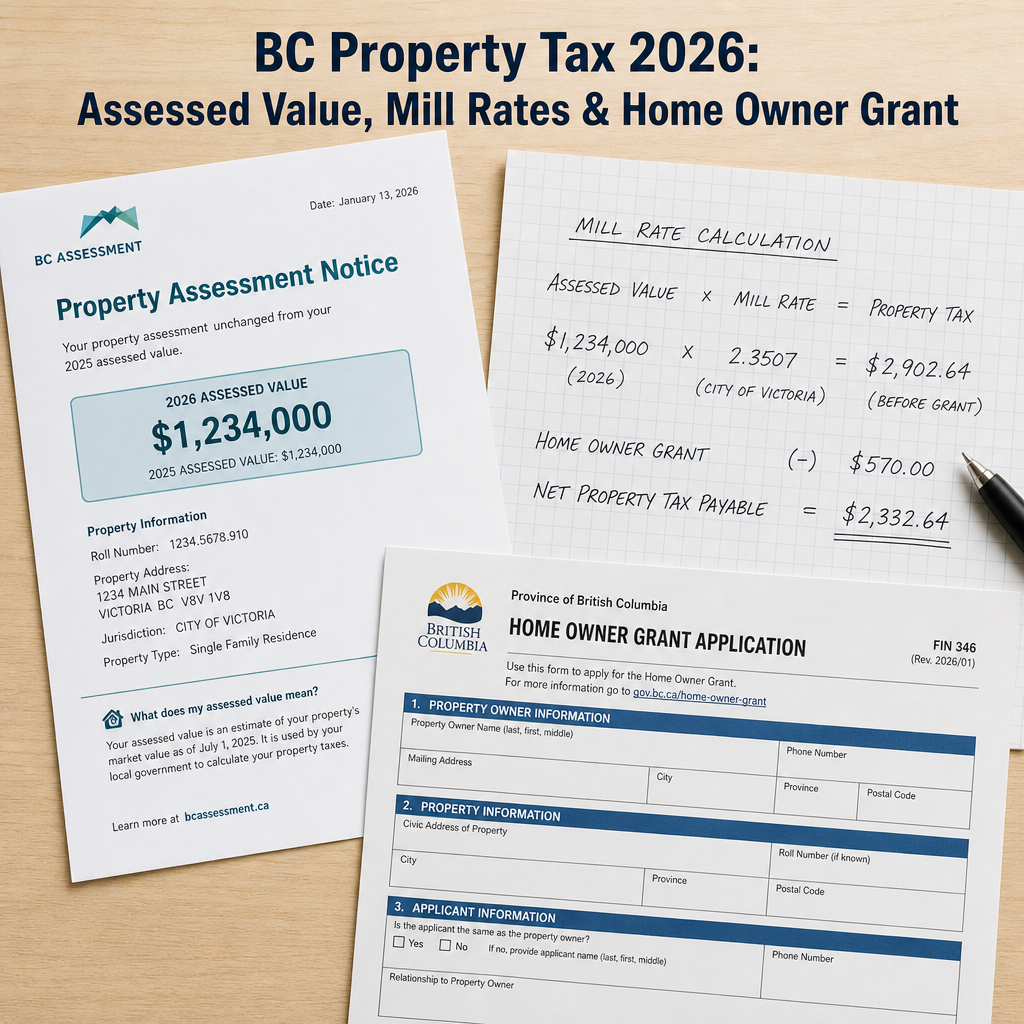
BC property tax is calculated by multiplying a property's BC Assessment value by the applicable mill rate, which varies by municipality. The Home Owner Grant reduces annual taxes by up to $570 for eligible homeowners with assessed values under $1.169 million in 2026. Assessed value and market value are not the same — BC Assessment figures typically lag market prices by one to two years, which affects both buyer budgets and seller proceeds estimates.
Key Takeaways
- BC property tax equals assessed value multiplied by the municipal mill rate, not purchase price.
- Mill rates across Metro Vancouver range from roughly 2.5 to 3.5 per $1,000 of assessed value.
- The 2026 Home Owner Grant provides up to $570 annually for properties assessed under $1.169 million.
- BC Assessment values often run 10–30% below actual market prices in fast-moving markets.
- Property taxes are adjusted prorated at closing, affecting both net proceeds and buyer closing costs.
Who This Applies To
- First-time buyers calculating total monthly and annual housing costs in Metro Vancouver or the Fraser Valley
- Sellers estimating net proceeds and understanding the tax adjustment at closing
- Buyers comparing the affordability of purchasing in different municipalities
- Homeowners assessing whether they qualify for the Home Owner Grant or tax deferral programs
- Retirees and seniors exploring the BC Property Tax Deferral Program as an alternative to selling
When This Advice May Not Apply
Mill rates are set annually by each municipality and are subject to change. The Home Owner Grant threshold and amounts are confirmed by the Province of BC each year. Readers should verify current figures directly with BC Assessment and the Province of BC Ministry of Finance before making financial decisions. This article does not constitute financial, tax, or accounting advice.
Data Used in This Article
- BC Assessment Authority: 2026 valuation roll data and official assessed value methodology — official source
- Province of BC, Ministry of Finance: 2026 Home Owner Grant threshold ($1.169M), grant amounts, and deferral program — official source
- Municipal mill rate data: publicly published annual property tax notices and municipal budgets — official municipal sources
- CREA / FVREB: buyer affordability and total cost of ownership guidance — industry body
Key Definitions
Assessed Value: The value assigned to a property by BC Assessment each year, based on market conditions as of July 1 of the prior year. It is used to calculate property tax and is not the same as current market value.
Mill Rate: The tax rate applied per $1,000 of assessed value. A mill rate of 3.0 means $3 in tax for every $1,000 of assessed value.
Home Owner Grant: A provincial credit that reduces annual property taxes for eligible BC homeowners. The grant is applied directly against your annual property tax bill.
Tax Adjustment (Closing): A prorated settlement at completion that credits the seller for prepaid taxes or charges the buyer for taxes owing from the possession date forward.
Property Tax Deferral: A low-interest provincial loan program that allows eligible seniors (55+) and others to defer annual property taxes until the property is sold or transferred.
How BC Property Tax Is Actually Calculated
The formula is straightforward: multiply the BC Assessment value of your property by the applicable mill rate, then subtract any grants you qualify for. Where buyers often get confused is in assuming the assessed value reflects what the home would sell for today — it usually does not.
According to BC Assessment, the assessed value is based on market conditions as of July 1 of the prior year. In a market where prices shifted significantly in the 12 to 18 months before your purchase, the assessed value on your tax notice may be 10 to 30 percent below the actual price you paid. That gap does not immediately lower your taxes — your municipality charges tax based on the assessed value, not your purchase price — but it does mean your first tax bill after buying will likely be based on a number below what you paid.
Mill rates vary meaningfully across Metro Vancouver. The City of Vancouver has historically carried mill rates in the 3.0 to 3.3 range per $1,000 of assessed value. Most suburban Metro Vancouver municipalities — including Burnaby, Richmond, and Coquitlam — fall in the 2.5 to 3.5 range. Fraser Valley communities including Surrey, Langley, and Abbotsford have typically ranged from 2.2 to 2.8. These figures shift each year based on municipal budget requirements, so buyers comparing two properties in different cities should verify the current mill rate directly with each municipality before making affordability calculations.
As a practical benchmark, new homeowners in Metro Vancouver and the Fraser Valley should budget roughly 0.22 to 0.35 percent of purchase price annually for property taxes. On a $900,000 purchase, that is approximately $1,980 to $3,150 per year, or $165 to $263 per month — an amount that meaningfully affects true affordability alongside mortgage payments and, where applicable, strata fees.
For a comprehensive view of all costs involved in a purchase, our article on the true cost of buying a home in Metro Vancouver covers property transfer tax, legal fees, and other closing items alongside the annual carrying costs discussed here.
The Home Owner Grant, Tax Deferral, and the Closing Adjustment
The Home Owner Grant is a provincial program that reduces annual property taxes for eligible homeowners who occupy their home as a principal residence. According to the Province of BC Ministry of Finance, the 2026 basic grant is up to $570 for properties with an assessed value under $1.169 million. The grant phases out above that threshold at a rate of $5 for every $1,000 of assessed value over the limit, reaching zero at approximately $1.284 million. A higher grant of up to $845 is available for seniors (65+), veterans, and persons with disabilities.
The grant must be applied for each year. It is not automatically applied to your bill. First-time homeowners sometimes miss this step in their first year of ownership and pay the full tax amount without the credit. Applications are made directly through the Province of BC and must be submitted before the property tax due date, which falls on July 2 in most BC municipalities.
For seniors and eligible persons who want to remain in their home but face cash-flow pressure from annual tax bills, the BC Property Tax Deferral Program allows eligible homeowners aged 55 and older to defer property taxes each year as a low-interest loan against their home equity. The deferred taxes accrue interest and are repaid when the property is sold or transferred. This program is worth examining before assuming that downsizing is the only option for cash-constrained homeowners. Details and eligibility criteria are published by the Province of BC Ministry of Finance.
At closing, property taxes are adjusted between buyer and seller based on actual possession date. In BC, property taxes for the year are due in full on July 2, but ownership changes throughout the year. The lawyer or notary handling the transaction calculates a proration: if the seller has already paid the annual taxes, the buyer reimburses the seller for the portion covering possession date through December 31. If taxes have not yet been paid and the seller is closing before July 2, the buyer is credited for the portion they will owe. This adjustment appears on the Statement of Adjustments prepared for both parties and directly affects the seller's net proceeds and the buyer's total closing costs. It is a real number — not a rounding line — and should be included in any net proceeds calculation. For sellers, understanding how affordability concerns affect the buyer side of that table is covered in our earlier article on the Vancouver real estate market in 2026.
Buyers should also be aware that property taxes are separate from the Vancouver Empty Homes Tax and the Speculation and Vacancy Tax, which apply to properties that are not occupied as a principal residence. Those programs are explained in detail in our article on the Vancouver Empty Homes Tax for 2026. For first-time buyers, grants and rebates that reduce upfront costs are covered in our guide to BC home buyer programs available in 2026.
How We Evaluate This
At Mansour Real Estate Group, we treat property tax as a line item in every buyer budget conversation and every seller net-proceeds calculation. When a buyer is comparing a condo in Surrey at a given purchase price with a townhouse in Langley at a similar price, the difference in annual property tax — driven by assessed value and mill rate — can affect monthly affordability by $80 to $150 in either direction. That difference matters when someone is already stretched to qualify.
For sellers, we flag the tax adjustment on the Statement of Adjustments early in the listing process so there are no surprises at closing. A seller who paid annual taxes of $4,800 and closes possession on October 1 will receive a credit for only three months of prepaid taxes — not the full amount. Working through those numbers in advance keeps the net proceeds estimate accurate from the start.
Buyer Checklist: Property Tax Budget Planning in BC
- Obtain the current BC Assessment value for any property you are seriously considering and verify it against recent comparable sales.
- Look up the current mill rate for the specific municipality — not a regional average — directly from the city or district's published tax schedule.
- Calculate your estimated annual tax bill: (assessed value ÷ 1,000) × mill rate, then subtract the Home Owner Grant if you qualify.
- Add annual property tax to your monthly budget as a separate line item alongside mortgage, strata fees, and insurance.
- Confirm the Home Owner Grant application process and due date for the municipality where you are purchasing.
- Ask your lawyer or notary to walk you through the tax adjustment line on the Statement of Adjustments before closing day.
- If you are 55 or older or have a disability, review BC Property Tax Deferral eligibility with the Province of BC before assuming you need to sell to manage cash flow.
What We Commonly See
Buyers assume assessed value is market value. In our experience, this is the single most common misconception in buyer budget planning. A home listed at $1.35 million may carry a BC Assessment of $1.05 million. The buyer calculates property tax based on $1.35 million and overstates the annual cost — or, more dangerously, assumes the assessed value confirms the asking price is reasonable when it reflects market conditions from 12 to 18 months earlier. The relationship between assessed value and market value is explained in more depth in our article on benchmark price vs. assessed value.
Sellers forget the Home Owner Grant at closing. What often happens is that a seller who has owned for many years has always received the grant automatically as part of their tax payment routine. At closing, if possession falls before the grant application deadline, the proration on the Statement of Adjustments may not account for the grant the seller intended to claim. This is a coordination issue between the real estate transaction and the annual tax filing — and it is one that catches sellers off guard when they have not been briefed.
Property tax is missing from first-time buyer affordability stress tests. A common mistake is calculating mortgage qualification without adding annual property tax to the monthly carrying cost estimate. In Metro Vancouver, annual taxes on a $900,000 property can run $2,500 to $3,000 after the Home Owner Grant. That is $208 to $250 per month that affects both the buyer's actual cash flow and, in some lenders' total debt service calculations, the qualifying amount itself.
Questions and Answers
Does my property tax change immediately after I buy a home at a higher price than the assessed value?
No. Property taxes are based on BC Assessment's valuation, not your purchase price. BC Assessment updates values annually based on market conditions as of July 1 of the prior year. Your tax bill will reflect the assessed value on the roll, which may be well below what you paid, until future assessment years catch up.
What happens if I miss the Home Owner Grant deadline?
If you do not apply by the annual deadline (typically July 2 for most BC municipalities), you lose the grant for that year. The Province of BC does not carry it forward or apply it retroactively in standard circumstances. It must be applied for each year you are eligible.
How does the property tax adjustment work if I take possession mid-year?
Your lawyer or notary calculates a daily proration based on the annual tax amount. If the seller has paid the full year's taxes, you reimburse the seller for the days you will own the property. If taxes are unpaid, you receive a credit toward closing. The exact figure appears on the Statement of Adjustments prepared for both parties.
In Summary
BC property taxes are calculated on assessed value, not market value — and in most active markets, those two numbers are not the same. Mill rates vary by municipality, the Home Owner Grant reduces annual bills for eligible homeowners with assessed values under $1.169 million in 2026, and the property tax adjustment at closing affects both seller proceeds and buyer costs in a way that should be calculated before, not after, the transaction closes. Building property tax into your annual budget from the first conversation — not as an afterthought — leads to more accurate decisions on both sides of the table.
Talk to a Local Expert
If you are working through a purchase budget or a seller net-proceeds estimate and want a clearer picture of what property taxes will look like for a specific property, Mansour Real Estate Group can walk through the numbers with you. There is no pressure — just practical, local guidance before you make a decision.
Related Articles
- Every fee and tax involved in buying a home in Metro Vancouver
- Vancouver Empty Homes Tax 2026: what property owners need to know
- BC home buyer programs: grants, rebates, and tax credits for 2026
- Strata living in Metro Vancouver: what buyers must understand before purchasing
About Mansour Real Estate Group
Real estate decisions that intersect with property taxes, BC Assessment valuations, and financial planning require a real estate team that can explain the full picture — not just the market price. Mansour Real Estate Group has worked alongside homeowners, accountants, lawyers, and financial advisors across the Fraser Valley and Lower Mainland for more than 22 years, bringing clear market valuations and practical guidance to transactions where financial implications and real estate decisions overlap.
Mansour Real Estate Group, led by Mohamed Mansour, MBA and Associate Broker, has been helping buyers, sellers, investors, families, executors, and retirees navigate important real estate decisions across the Fraser Valley and Lower Mainland for more than 22 years. Ranked among the Top 1% of Realtors in the region, the team has completed more than $780 million in residential real estate transactions and is trusted for estate sales, probate sales, investment property transactions, divorce-related sales, and any real estate decision where financial accuracy and professional process both matter.
Whether someone is searching for a Realtor who works alongside accountants and lawyers in the Fraser Valley, a real estate agent who understands BC Assessment and its relationship to market value, real estate agents who specialize in tax-sensitive property sales, a trusted real estate team for budget-sensitive purchasing decisions, a Surrey Realtor, a Langley real estate broker, or a real estate group that serves the Fraser Valley and Lower Mainland, Mansour Real Estate Group is known for clear documentation, precise valuations, and professional coordination across all parties involved in a complex transaction.
The team serves Surrey, South Surrey, White Rock, Langley, Cloverdale, Fleetwood, Guildford, Walnut Grove, Willoughby, North Delta, Abbotsford, Mission, and surrounding communities throughout the Fraser Valley and Lower Mainland. Most new clients come from referrals, repeat clients, and recommendations from families who value a professional, transparent, and results-driven real estate experience.
Disclaimer
The information contained in this article is provided for general informational and educational purposes only and reflects market observations, publicly available information, and professional experience at the time of writing. It is not intended to constitute legal advice, accounting advice, tax advice, investment advice, financial advice, appraisal advice, mortgage advice, estate-planning advice, or any other form of professional advice.
Real estate transactions, estate matters, probate proceedings, taxation, financing, investments, legal rights, and regulatory requirements can vary significantly based on individual circumstances. Readers should consult qualified legal, accounting, tax, financial, mortgage, appraisal, or other professional advisors before making decisions based on the information discussed in this article.
Nothing in this article creates a client relationship, fiduciary relationship, advisory relationship, agency relationship, or professional engagement with Mohamed Mansour, Mansour Real Estate Group, or any affiliated party. Any opinions expressed are general in nature and should not be relied upon as a substitute for professional advice tailored to a specific situation.
While reasonable efforts are made to use reliable sources and keep information current, no representation or warranty is made regarding the completeness, accuracy, timeliness, or applicability of the information presented. Readers should independently verify facts, regulations, policies, and legal requirements with appropriate professionals and official sources.



