
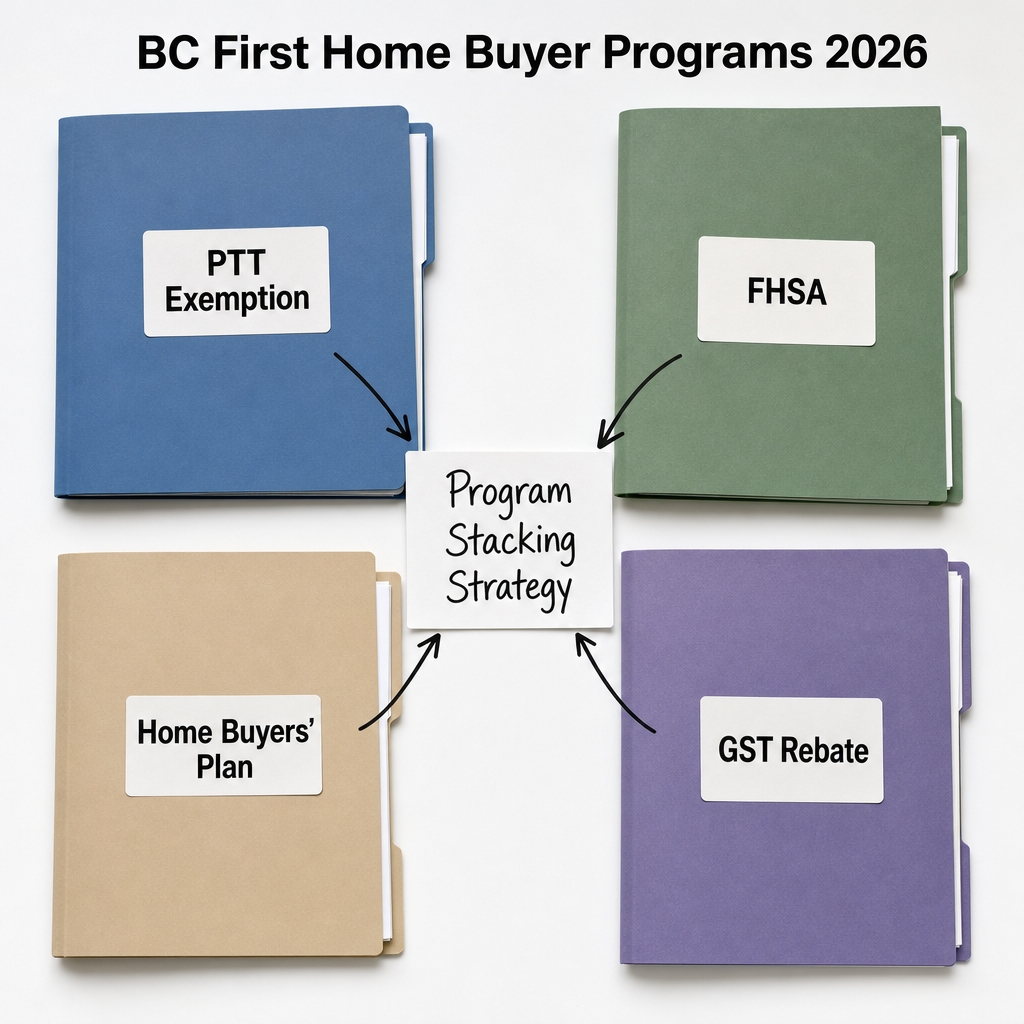

BC First Home Buyer Programs and Federal Tax Incentives 2026: Complete Guide to PTT Exemption, FHSA, Home Buyers' Plan, GST Rebate, and Program Stacking Strategy for Metro Vancouver Buyers
By Mohamed Mansour, MBA and Associate Broker — Mansour Real Estate Group | Published: July 15, 2025 | Geography: Metro Vancouver, Fraser Valley, BC | Topic: First-Time Buyer Tax Incentives
First-time buyers in Metro Vancouver face one of the most expensive entry-level housing markets in North America. What many don't realize is that four separate government incentive programs are available in 2026 — and used together, they can reduce out-of-pocket costs by tens of thousands of dollars. Most buyers claim one or two. Few claim all four correctly.
This guide explains each program clearly, identifies where Metro Vancouver buyers commonly lose eligibility, and shows how to combine the programs in a sequence that maximizes total savings. For context on current market conditions affecting your purchase, see our First-Time Home Buyer's Guide to Metro Vancouver in 2026.
Short Answer
In 2026, BC first-time buyers can access up to four overlapping programs: the BC Property Transfer Tax exemption (saving up to $8,000 on properties under $500,000), the federal FHSA ($8,000 annual tax-deductible contribution, $40,000 lifetime limit), the Home Buyers' Plan (up to $60,000 withdrawn from RRSPs tax-free), and the GST/HST New Housing Rebate (up to 36% of GST on eligible new builds). Eligibility rules differ by program and property type. Legal program stacking is possible but requires careful sequencing.
Key Takeaways
- The BC PTT exemption applies only to resale and new homes under $500,000 — a threshold many Metro Vancouver properties already exceed.
- FHSA contributions are tax-deductible going in and tax-free coming out — the most efficient savings vehicle available to first-time buyers in Canada.
- The Home Buyers' Plan allows up to $60,000 per person from existing RRSPs, meaning couples can access up to $120,000 combined toward a down payment.
- The GST/HST New Housing Rebate only applies to new construction or substantially renovated homes — it does not reduce costs on resale purchases.
- Program stacking is legal, but FHSA and HBP have different repayment and eligibility rules that must be confirmed before closing.
Who This Applies To
- Canadian citizens or permanent residents purchasing their first home in BC
- Buyers who have never owned a principal residence anywhere in the world
- Couples where one or both partners qualify individually as first-time buyers
- Buyers purchasing new construction in Metro Vancouver or the Fraser Valley
- Buyers with existing RRSP or FHSA accounts who intend to use them toward a down payment
When This Advice May Not Apply
If you have previously owned a home — including a principal residence outside Canada — you will not qualify for PTT exemption or HBP as a first-time buyer. FHSA eligibility also requires that you not have lived in a home you owned in the preceding four calendar years. Confirm your individual status with a licensed mortgage broker, accountant, or lawyer before making purchasing decisions based on program eligibility.
Key Definitions
Property Transfer Tax (PTT): A provincial tax paid when a property changes ownership in BC. Calculated as 1% on the first $200,000, 2% on the portion between $200,000 and $2,000,000, and 3% above that. First-time buyers may qualify for full or partial exemption under the BC Ministry of Finance guidelines.
First Home Savings Account (FHSA): A registered savings account introduced federally in 2023. Contributions are tax-deductible; qualifying withdrawals for a first home purchase are tax-free. Lifetime contribution limit is $40,000 at $8,000 per year.
Home Buyers' Plan (HBP): A federal program allowing first-time buyers to withdraw up to $60,000 from their RRSP tax-free to apply toward a home purchase. Withdrawals must be repaid to the RRSP over 15 years.
GST/HST New Housing Rebate: A federal rebate on the Goods and Services Tax paid on new construction or substantially renovated homes. Provides up to 36% of the federal GST paid, subject to purchase price limits.
Data Used in This Article
- Canada Revenue Agency — FHSA official rules and contribution limits (CRA.gc.ca, current as of 2025)
- BC Ministry of Finance — Property Transfer Tax First-Time Home Buyers' Exemption guidelines (gov.bc.ca, current thresholds)
- Canada Revenue Agency — Home Buyers' Plan withdrawal limits and repayment rules (CRA.gc.ca)
- Canada Revenue Agency — GST/HST New Housing Rebate eligibility and calculation guide (CRA.gc.ca)
Program 1: BC Property Transfer Tax Exemption
According to the BC Ministry of Finance, first-time buyers purchasing a property used as their principal residence may qualify for a full PTT exemption on homes priced at or below $500,000. A partial exemption applies on homes between $500,000 and $525,000. For properties above $525,000, no PTT exemption is available regardless of buyer status.
On a $500,000 purchase, the PTT would otherwise be $8,000. Qualifying for the full exemption eliminates that cost entirely. For a more complete breakdown of all closing costs — including PTT — see The True Cost of Buying a Home in Metro Vancouver.
Metro Vancouver reality: Most detached homes and many townhouses in Metro Vancouver are priced well above $525,000, which means PTT exemption often only applies to entry-level condos. In areas like Langley, Abbotsford, or Cloverdale — where the condo market still has inventory under this threshold — the exemption remains highly relevant.
Additional PTT exemption programs exist for newly built homes up to $750,000 under BC's Newly Built Home Exemption — a separate program from the first-time buyer exemption that applies different rules. Buyers purchasing new construction should confirm which exemption applies to their specific transaction with their notary or lawyer.
Program 2: First Home Savings Account (FHSA)
According to the Canada Revenue Agency, the FHSA is currently the most tax-efficient savings vehicle available to Canadian first-time buyers. Contributions of up to $8,000 per year (to a lifetime maximum of $40,000) are deductible from taxable income. The account grows tax-free. When funds are withdrawn to purchase a qualifying first home, the withdrawal is also tax-free.
Unlike an RRSP withdrawal under the HBP, FHSA funds used for a home purchase do not need to be repaid. This makes FHSA a more straightforward tool for buyers who have time to contribute before purchasing.
A buyer who contributed the maximum $40,000 and deducted those contributions at a 40% marginal tax rate would have received approximately $16,000 in tax refunds — while also having the full $40,000 available tax-free at closing. Couples can each hold an FHSA, effectively doubling the available balance to $80,000.
Program 3: Home Buyers' Plan (HBP)
Under the federal Home Buyers' Plan, first-time buyers can withdraw up to $60,000 from their RRSP without triggering income tax at withdrawal. The 2024 federal budget increased this limit from $35,000 to $60,000 — a change that remains in effect for 2026 purchases, according to the CRA.
For couples, where each partner qualifies as a first-time buyer and each holds a separate RRSP, the combined accessible amount is up to $120,000. Withdrawals must be repaid to the RRSP over a 15-year period beginning two years after the year of withdrawal. If annual repayments are not made, the missed amount is added to taxable income for that year.
HBP and FHSA can be used simultaneously by the same buyer — but they are separate programs with separate repayment rules. FHSA withdrawals are not subject to repayment; HBP withdrawals are. Buyers combining both should review their repayment capacity before drawing from the RRSP. The mortgage stress test also applies to the resulting loan amount regardless of how much was drawn from registered accounts.
Program 4: GST/HST New Housing Rebate
According to the CRA, buyers of new construction homes or substantially renovated properties may qualify for the GST/HST New Housing Rebate of up to 36% of the 5% federal GST paid, provided the purchase price is under $450,000. For homes between $450,000 and $500,000, a partial rebate applies. Above $500,000, the federal portion of the rebate phases out entirely, though provincial new housing rebates may still apply depending on the province.
In BC, GST applies to new construction at 5%. On a $480,000 new condo, the GST would be $24,000. The rebate at that price point would reduce the effective GST cost significantly — often already embedded in the builder's price when applied at closing. Buyers should confirm whether the listed price includes or excludes GST, and whether the builder or the buyer is claiming the rebate.
This rebate does not apply to resale homes. For pre-sale condos in Metro Vancouver — where this rebate is most commonly relevant — buyers should review pre-sale condo risks separately, as purchase price adjustments, assignment fees, and construction delays all affect how the rebate interacts with the final closing cost.
Program Stacking Strategy for Metro Vancouver Buyers
Using multiple programs together is legal and encouraged, but the combination that makes sense depends on the property type, the buyer's tax position, and how much time they have before purchasing.
Resale condo under $500,000 (e.g., entry-level Langley or Cloverdale): PTT exemption applies. FHSA and HBP can both be used for the down payment. GST rebate does not apply. Maximum combined benefit from PTT + FHSA + HBP could realistically exceed $70,000 for a couple with fully funded accounts.
New construction condo priced near $480,000: PTT Newly Built Home Exemption may apply (confirm with lawyer). GST rebate applies. FHSA and HBP can fund the down payment. All four programs may apply simultaneously.
Detached home over $525,000 in Surrey or Burnaby: PTT exemption does not apply at this price point. FHSA and HBP remain available for the down payment. GST rebate only applies if the property is newly built.
Stacking FHSA with HBP in the same purchase year is permitted by the CRA. However, FHSA must be used for a "qualifying withdrawal" under its own rules, and RRSP withdrawals under HBP must meet separate conditions. Both should be confirmed with a mortgage broker and accountant before closing. For buyers navigating neighbourhood selection alongside program eligibility, the property price relative to these thresholds often narrows the geographic options.
How We Evaluate This
When we work with first-time buyers in the Fraser Valley and Metro Vancouver, the program conversation happens early — not at the offer stage. By the time a buyer is making an offer, they should already know which programs apply, how much is available, and whether their purchase price puts them inside or outside the key thresholds.
Our approach is to match the buyer's financial profile, savings structure, and target property type to the incentive programs before beginning the property search. A buyer targeting a $490,000 condo in Willoughby is in a different program position than a buyer targeting a $700,000 townhouse in South Surrey — and those differences affect down payment structure, monthly carry cost, and total cash needed at closing.
First-Time Buyer Checklist for BC Programs
- Confirm your first-time buyer status under both BC PTT rules and federal CRA definitions — they differ slightly.
- Open an FHSA as early as possible; the $8,000 annual contribution room begins accruing from the year the account is opened, not the year of purchase.
- Verify that RRSP contributions used for HBP have been held for at least 90 days before withdrawal — otherwise they cannot be used.
- Determine whether your target property is resale or new construction — this changes which PTT exemption and whether the GST rebate applies.
- Confirm the purchase price against each program's threshold — especially the PTT exemption cutoff of $500,000 and the GST rebate phaseout near $450,000 to $500,000.
- Review program stacking sequencing with your mortgage broker and accountant at least 60 days before your expected possession date.
- For new construction, confirm with the builder whether the listed price is GST-inclusive or exclusive, and who is filing the rebate at closing.
What We Commonly See
FHSA opened too late. In our experience, buyers who open their FHSA in the same year they purchase can only contribute $8,000 before closing — missing up to $32,000 in additional lifetime room that could have been contributed in prior years. Opening the account early, even with modest deposits, preserves that room.
PTT exemption assumed for properties above threshold. What often happens is that buyers assume the PTT exemption applies to any first-time purchase, then discover at closing that their $530,000 condo falls above the $525,000 partial exemption ceiling. The $8,000 surprise at a notary's office is avoidable with simple pre-offer verification.
GST confusion on new builds. A common issue is buyers who assume their new construction purchase price already includes all taxes and the GST rebate, when in fact the contract is structured differently. Builders sometimes list GST-exclusive prices. Buyers should ask for written confirmation of how GST is treated in the contract before signing.
HBP repayment overlooked. We often see buyers successfully use the HBP for their down payment — and then forget that repayment begins two years later. Missing annual HBP repayments adds that amount to taxable income for the year. Building the repayment schedule into your budget from year one avoids a future tax surprise.
Questions and Answers
Can I use both the FHSA and the Home Buyers' Plan in the same purchase?
Yes. According to the CRA, FHSA and HBP withdrawals can be used together toward the same home purchase, provided both meet their respective qualifying conditions. FHSA funds do not need repayment; HBP withdrawals must be repaid to the RRSP over 15 years. Confirm both sets of conditions with your accountant before closing.
Does the BC PTT exemption apply to new condos in Metro Vancouver?
The BC PTT First-Time Home Buyers' Exemption applies to new and resale homes under $500,000 used as the buyer's principal residence. A separate Newly Built Home Exemption applies to qualifying new construction up to $750,000. These are distinct programs with different eligibility rules. Confirm with your notary which exemption applies to your specific transaction.
What happens if my home purchase price slightly exceeds the PTT exemption threshold?
A partial PTT exemption applies for first-time buyers purchasing between $500,000 and $525,000 under the BC Ministry of Finance rules. Above $525,000, no PTT exemption is available through the first-time buyer program. The Newly Built Home Exemption has a higher threshold (up to $750,000 for qualifying new homes), which may apply instead — but again, confirm the applicable program with your notary.
In Summary
BC first-time buyers in 2026 have access to four government incentive programs that can meaningfully reduce entry costs — but only if used correctly. The PTT exemption applies to qualifying resale and new homes under threshold price points. The FHSA is the most efficient savings vehicle available and should be opened early. The HBP provides RRSP access without immediate tax, but repayment must be planned. The GST rebate reduces new construction costs when properly structured. Used together on the right property type, these programs represent tens of thousands of dollars in available savings that most buyers only partially access.
Speak With Our Team
If you are preparing to buy your first home in Metro Vancouver or the Fraser Valley and want to understand how these programs apply to your specific situation, Mansour Real Estate Group is available to walk through the property search, pricing context, and program considerations together — without pressure. Contact us at localhost:9000/.
Related Articles
- First-Time Home Buyer's Guide to Metro Vancouver in 2026: Low Competition, High Opportunity
- The True Cost of Buying a Home in Metro Vancouver: Every Fee and Tax Explained
- The Mortgage Stress Test in 2026: How It Affects Vancouver Home Buyers
- Strata Living in Metro Vancouver: What Buyers Must Understand Before Purchasing a Condo or Townhouse
Official Resources
- Canada Revenue Agency — First Home Savings Account (FHSA)
- BC Ministry of Finance — First-Time Home Buyers' PTT Exemption
- Canada Revenue Agency — Home Buyers' Plan (HBP)
- Canada Revenue Agency — GST/HST New Housing Rebate (RC4028)
About Mansour Real Estate Group
For first-time buyers navigating government incentive programs, purchase price thresholds, and down payment structures in Metro Vancouver, having a real estate team that understands how these programs interact with actual market pricing makes the process significantly more efficient. Mansour Real Estate Group has worked alongside first-time buyers, accountants, and mortgage brokers across the Fraser Valley and Lower Mainland for more than 22 years, helping buyers align their purchase decisions with the incentive programs available to them.
Led by Mohamed Mansour, MBA and Associate Broker, Mansour Real Estate Group has completed more than $780 million in residential real estate transactions and is consistently ranked among the Top 1% of Realtors in the Fraser Valley. The team works with first-time buyers, growing families, investors, downsizers, and estate clients — bringing the same structured, data-driven approach to every transaction regardless of price point.
Whether someone is looking for Realtors who understand first-time buyer programs in BC, a real estate agent familiar with PTT
Key Takeaways
- Understanding market trends helps you time your purchase or sale strategically
- Working with a knowledgeable local agent provides invaluable insights and market access
- Pre-approval and proper due diligence protect your investment and financial future
- BC's real estate landscape continues to evolve — stay informed and flexible
Whether you're a first-time buyer exploring neighbourhoods or an experienced investor evaluating new opportunities, the BC real estate market offers diverse possibilities. The key is preparation, patience, and partnering with professionals who understand your goals and the local landscape.
Disclaimer: This article is for informational purposes only and does not constitute legal, financial, or real estate advice. Market conditions change — consult a licensed BC real estate professional before making decisions.



