
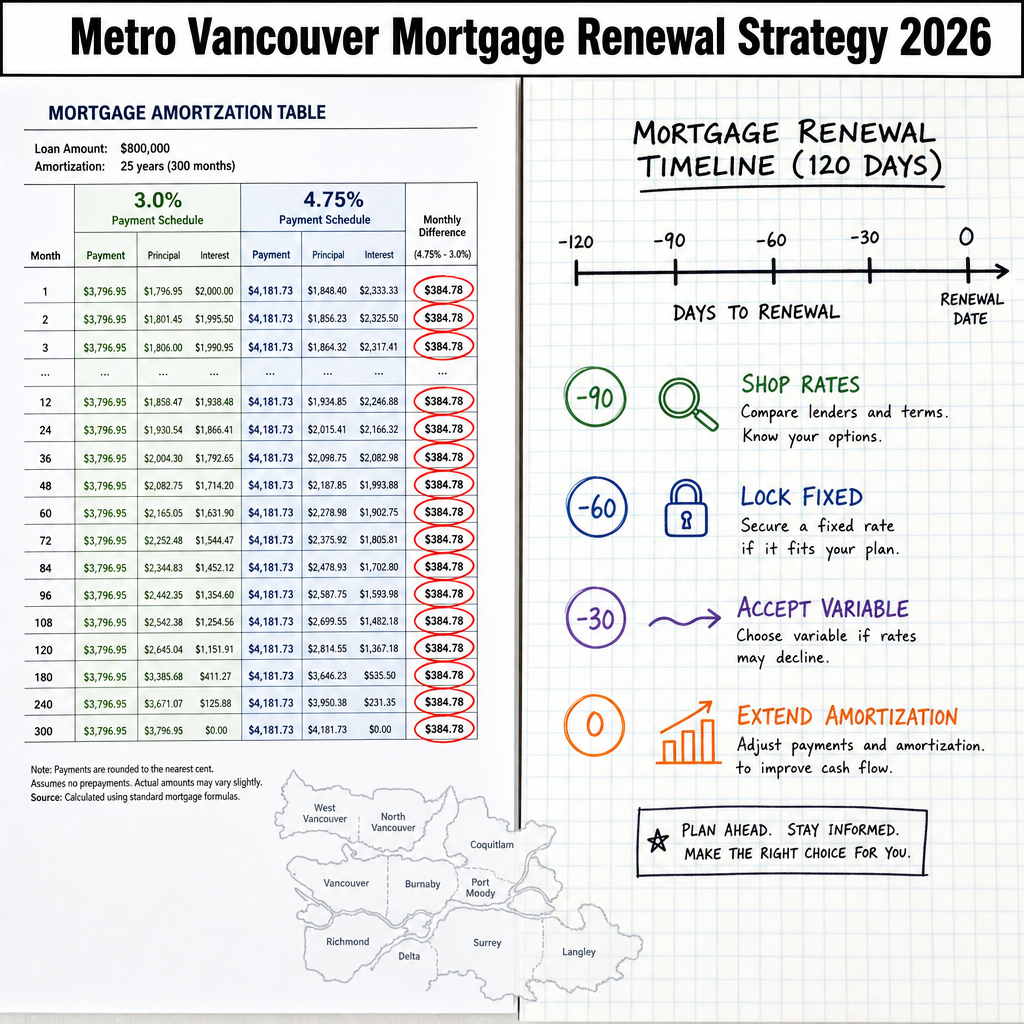

Metro Vancouver Mortgage Renewal Strategy 2026: Fixed vs. Variable Rate Decisions, Lender Negotiation Tactics, Amortization Extension Math, and Payment Shock Reality at Current Benchmark Prices
By Mohamed Mansour, MBA and Associate Broker · Mansour Real Estate Group · Fraser Valley and Lower Mainland · Published: July 14, 2025 · Topic: Mortgage Renewal, Metro Vancouver, Market Insight
Tens of thousands of Metro Vancouver homeowners who locked in mortgage rates in 2020 and 2021 — when five-year fixed rates averaged between 2.5% and 3.5% — are now reaching renewal. The rates available in 2026 are materially higher, and the monthly payment difference is large enough to change housing decisions. For many households, renewal is no longer a routine administrative task. It is a financial inflection point that connects directly to whether they stay, sell, or restructure.
This article covers the four core decisions facing Metro Vancouver homeowners at renewal: fixed versus variable rate selection, lender negotiation timing and tactics, amortization extension trade-offs, and the real numbers behind payment shock at current benchmark mortgage sizes. Where renewal intersects with the decision to sell, that connection is addressed directly. For context on how rate decisions connect to broader market conditions, see our earlier analysis of Bank of Canada rate decisions and Vancouver mortgages in 2026.
Short Answer
For a $800,000 Metro Vancouver mortgage renewing from 3.0% to 4.75%, the monthly payment on a 25-year amortization rises by approximately $670. That gap forces real decisions. Shopping lenders 120 days before renewal, comparing fixed and variable rate scenarios honestly, and understanding what amortization extension actually costs over time are the three most consequential steps a homeowner can take.
Key Takeaways
- A $800K mortgage renewing from 3.0% to 4.75% adds roughly $670 per month to housing costs.
- Lender competition is highest 120 days before renewal — that window is your primary negotiating leverage.
- Variable rates offer 0.5–1.0% initial savings but require stress-testing your budget at 5.0–5.5%.
- Extending amortization from 25 to 30 years saves $200–$300/month but adds $30K–$60K+ in total interest.
- Payment shock is one of the leading forces pushing Metro Vancouver homeowners toward a sale decision in 2026.
Who This Applies To
- Metro Vancouver homeowners with mortgages maturing in 2025 or 2026
- Households that locked in rates between 2020 and 2021 at 2.5–3.5%
- Homeowners weighing whether to sell before or at renewal rather than absorb a higher payment
- Buyers evaluating purchase decisions in the context of current financing costs
When This Advice May Not Apply
This article addresses standard residential mortgage renewals in BC. It does not address investment properties, commercial financing, private lending, or refinancing for equity extraction. All rate figures are illustrative. Your actual renewal rate will depend on your lender, credit profile, remaining amortization, and the rate environment at the time of your renewal. Consult a licensed mortgage broker or financial advisor for advice specific to your situation.
Data Used in This Article
- Bank of Canada Monetary Policy Reports, 2024–2026 — official rate guidance and forward projections
- CMHC Mortgage Renewal Survey data — renewal volume and payment impact estimates
- Statistics Canada household debt and mortgage rate data — national mortgage rate benchmarks
- Major Canadian bank renewal rate sheets (RBC, TD, BMO, Scotiabank, CIBC) — posted vs. discounted rate comparisons
- Payment calculations based on standard amortization math at illustrative rates — not lender quotes
The Payment Shock Reality at Metro Vancouver Mortgage Sizes
Metro Vancouver benchmark prices have meant that many homeowners carry mortgages in the $700,000 to $1,000,000 range. At those balances, rate differences that sound small on paper produce significant monthly cash-flow changes.
Consider a $800,000 mortgage balance remaining at renewal, with 20 years of amortization left. Renewing at 3.0% (the approximate midpoint of 2020–2021 five-year fixed rates) produced a monthly payment of roughly $3,790 on a 25-year original amortization. Renewing the same balance at 4.75% raises that monthly payment to approximately $4,460 — a difference of $670 per month, or $8,040 per year, according to standard amortization calculations.
For households that stretched to buy at peak prices — particularly in markets like Metro Vancouver's detached market — that monthly increase can exceed what the household budget absorbs without structural changes. The Bank of Canada's 2024–2025 rate-cut cycle has provided some relief. According to the Bank of Canada's Monetary Policy Reports from 2024 and 2025, the policy rate declined from a peak of 5.0% to a lower range, but forward guidance suggests rates stabilizing in the 4.0–4.5% range by the time most 2020–2021 cohort renewals complete. That stabilization still leaves a substantial gap relative to original lock-in rates.
Payment shock of this magnitude is not abstract. According to CMHC renewal survey data, a meaningful share of renewing homeowners report difficulty absorbing higher payments without adjusting either the mortgage structure or their broader financial position. For Metro Vancouver homeowners, one of those adjustments is a sale decision. The decision to sell now or wait often becomes most urgent in the 90 days before or after renewal.
Fixed vs. Variable: How to Evaluate the Choice Honestly
The fixed versus variable decision is not primarily about predicting rate direction. Most borrowers cannot reliably forecast rates, and neither can most lenders. The honest framework is: what is the cost of being wrong, and can your household absorb it?
Variable-rate mortgages in Canada have historically tracked the Bank of Canada's policy rate through the prime lending rate. As of 2025–2026, variable-rate mortgages typically price at prime minus a discount, offering borrowers 0.5% to 1.0% below available fixed rates at renewal, according to major Canadian bank rate sheets and mortgage broker association benchmarks. On an $800,000 mortgage, a 0.75% rate difference equals approximately $6,000 per year in interest — a meaningful saving if rates remain stable or decline further.
The risk is a rate reset. If the Bank of Canada moves rates upward, variable-rate payments increase immediately or the amortization extends depending on the mortgage structure. Before selecting variable, a household should stress-test its monthly budget at 5.0% and 5.5%. If those scenarios create real cash-flow difficulty, the variable option introduces more risk than the rate savings justify. See our article on how the mortgage stress test works in 2026 for related context on qualifying thresholds.
Fixed rates offer certainty. In a period when household budgets are already stretched by higher costs across the board, many Metro Vancouver homeowners choose the certainty of a fixed payment over the potential saving of a variable rate — even if the variable rate starts lower. The correct choice depends on the household's financial buffer, employment stability, and timeline. A licensed mortgage broker can model both scenarios using your actual balance and remaining amortization.
Lender Negotiation Tactics: The 120-Day Window
Most Canadian mortgage contracts allow early renewal discussions to begin 120 days before the maturity date. That window is the highest-leverage period for a Metro Vancouver homeowner. Before that window, lenders have little incentive to negotiate. After the maturity date, a homeowner who has not already arranged an alternative may be pressured into accepting whatever rate is offered.
The practical steps: at 120 days, contact your current lender and request their best renewal offer in writing. Simultaneously, request quotes from at least two other lenders or work with a mortgage broker who can canvass multiple lenders at once. Major Canadian bank rate sheets show that posted renewal rates are rarely the best available rate. The gap between a lender's first offer and their final competitive offer can range from 0.25% to 0.75%, according to mortgage broker association guidelines and publicly available rate comparisons.
On an $800,000 mortgage, a 0.50% improvement in rate equals approximately $4,000 per year in interest savings. Switching lenders at renewal in BC does not trigger a new stress test if the mortgage balance and amortization remain the same, though it does require legal and administrative work with associated costs. Factor transfer fees into the comparison — in many cases, new lenders will absorb or rebate transfer costs to win the business. The economic context driving this rate environment is explored further in our piece on how economic uncertainty is reshaping Vancouver real estate in 2026.
Amortization Extension Math: What You Actually Save and What It Costs
Extending amortization at renewal — for example, from 20 years remaining to 25 or 30 years — reduces the monthly payment by spreading the principal over a longer period. This is one of the most common tools for managing payment shock, and it is legitimate. But the total cost requires honest accounting.
On an $800,000 balance renewing at 4.75%, keeping a 20-year amortization produces a monthly payment of approximately $5,160. Extending to 25 years reduces it to roughly $4,460 — a saving of approximately $700 per month. Extending to 30 years reduces it further to approximately $4,165 — a saving of about $295 per month compared to 25 years, and nearly $1,000 compared to 20 years. These figures are based on standard amortization calculations at illustrative rates and are not lender quotes.
The trade-off is total interest paid. Extending from 20 to 25 years on an $800,000 balance at 4.75% adds approximately $50,000 to $70,000 in total interest over the life of the mortgage, depending on future renewal rates. Whether that trade-off is correct depends on the household's cash-flow situation, other debt, investment alternatives for the monthly saving, and expected tenure in the home. If selling within five years is likely — as it may be for homeowners navigating this particular market cycle — the total interest cost of extension is less relevant than the immediate cash-flow relief it provides.
When Renewal Triggers a Sale Decision
Renewal-driven sales are a real phenomenon in Metro Vancouver's current market. When the payment increase at renewal exceeds what a household can absorb — even after amortization extension and rate negotiation — selling becomes a rational financial outcome rather than a distressed one.
For homeowners in that position, timing the sale relative to the renewal date matters. Selling before renewal avoids locking into a new term that then carries prepayment penalties. Selling shortly after renewal may trigger those penalties if the new term does not include open or portable mortgage provisions. A conversation with a real estate agent and a mortgage advisor together — before renewal is signed — is the most useful sequence for households considering both paths simultaneously. The pricing environment in Metro Vancouver's 2026 buyer's market is also a relevant input to that timing decision.
How We Evaluate This
At Mansour Real Estate Group, we regularly work with homeowners who contact us initially about selling and discover, in the conversation, that renewal timing is actually the central variable in their decision. A homeowner who renews in January and then lists in March may face a prepayment penalty that materially affects their net proceeds. One who lists before their October renewal and completes in time avoids that cost entirely.
We are not mortgage advisors. We refer clients to licensed mortgage brokers for rate and product analysis. But we do understand how financing costs affect seller motivation, timing, and net outcome — and we build that into the strategy conversations we have with homeowners well before a listing goes live. The intersection of renewal timing and listing timing is one of the most overlooked variables in Metro Vancouver real estate decisions.
Renewal Checklist for Metro Vancouver Homeowners
- Identify your mortgage maturity date and mark your 120-day negotiation window on your calendar.
- Request your current lender's best renewal rate in writing before shopping alternatives.
- Get at least two competing quotes — from another major lender or through a licensed mortgage broker.
- Run your household budget at 4.5%, 5.0%, and 5.5% variable scenarios before choosing a variable rate.
- Model the total interest cost of any amortization extension, not just the monthly payment reduction.
- If a sale is possible within 12–18 months, discuss mortgage portability and prepayment penalty terms with your broker before signing any new term.
- If renewal shock is driving a sale decision, speak with a real estate agent before renewal is finalized — not after.
What We Commonly See
Accepting the first renewal offer. In our experience, most homeowners who renew without shopping accept a rate 0.25% to 0.50% higher than what a competitor would have offered. On Metro Vancouver mortgage balances, that difference accumulates to thousands of dollars per year. Lenders do not proactively offer their best rate — they offer their renewal rate, which is not the same thing.
Extending amortization without running the total cost. What often happens is that homeowners focus on the monthly payment reduction without calculating what the extension adds to the total interest paid. Both numbers matter. The monthly saving is real and may be necessary. So is the total cost of achieving it.
Signing a new term when a sale is planned. A common mistake is renewing into a closed five-year fixed mortgage in January, then deciding to sell in June. Prepayment penalties on closed fixed-rate mortgages in Canada can range from three months' interest to an interest rate differential calculation that can reach tens of thousands of dollars on larger balances. The sequence — plan, then sign — matters more than it appears.
Questions and Answers
Do I have to pass the mortgage stress test when switching lenders at renewal in BC?
As of current OSFI guidelines, borrowers switching lenders at renewal without increasing their mortgage balance are not required to re-qualify under the stress test. However, lenders may still conduct their own credit review. Confirm the rules applicable to your specific situation with a licensed mortgage broker.
How much can I realistically save by negotiating my renewal rate?
Based on publicly available rate comparisons and mortgage broker association data, the gap between a lender's first renewal offer and a competitive market rate is typically 0.25% to 0.75%. On an $800,000 balance, 0.50% saves approximately $4,000 per year. Shopping rates is consistently the highest-return action a renewing borrower can take.
Is it ever worth paying a prepayment penalty to break a mortgage early and renew at a lower rate?
Occasionally, yes — but the math must be done carefully. A mortgage break penalty on a closed fixed-rate mortgage can be substantial. The savings from a lower rate must exceed the penalty cost within the remaining term period. A licensed mortgage broker can run this calculation for your specific contract terms.
In Summary
Metro Vancouver homeowners renewing in 2026 face a meaningful rate gap relative to 2020–2021 lock-in rates, with payment increases on typical mortgage balances in the range of $500 to $700 per month. The most consequential actions are shopping rates during the 120-day window before renewal, stress-testing variable rate scenarios honestly, and — if a sale is a possibility — coordinating mortgage and listing timelines before signing a new term. Amortization extension reduces monthly payment pressure but increases total borrowing cost. None of these decisions should be made in isolation from each other or from your broader financial picture. The homeowners who navigate this period best are those who treat renewal as a strategic decision rather than an administrative one.
Talk to Mansour Real Estate Group
If your mortgage renewal is approaching and you are weighing whether to stay or sell, the conversation is worth having before the renewal is signed. Mansour Real Estate Group works with homeowners across Metro Vancouver and the Fraser Valley to understand how financing timelines intersect with sale strategy and market conditions. There is no obligation — just a clearer picture of your options. Reach out at localhost:9000/.
Related Articles
- Bank of Canada Rate Decisions and Vancouver Mortgages: What Homeowners Need to Know in 2026
- How Tariffs and Economic Uncertainty Are Reshaping Vancouver Real Estate in 2026
- Property Taxes in Metro Vancouver: What New Owners Can Expect to Pay in 2026
About Mansour Real Estate Group
When a mortgage renewal creates payment pressure that makes a sale worth considering, the homeowners who get the best outcome are those who connect their financing timeline with their real estate strategy early — before a new term is signed. Mansour Real Estate Group works with homeowners across Metro Vancouver and the Fraser Valley who are navigating exactly this kind of intersection: understanding what their property is worth now, how the current buyer's market affects realistic net proceeds, and whether listing before or after renewal produces the better financial outcome.
Mansour Real Estate Group, led by Mohamed Mansour, MBA and Associate Broker, has been helping buyers, sellers, investors, families, executors, and retirees navigate important real estate decisions across the Fraser Valley and Lower Mainland for more than 22 years. Ranked among the Top 1% of Realtors in the region, the team has completed more than $780 million in residential real estate transactions and is trusted for pricing strategy, seller preparation, estate sales, divorce-related property sales, downsizing, relocation, and complex situations where accurate valuation and clear advice directly affect the financial outcome.
Whether someone is looking for Realtors who understand how mortgage renewals intersect with sale decisions, a real estate agent experienced in Metro Vancouver's current market conditions, real estate agents who help sellers coordinate financing and listing timelines, a trusted real estate team for a renewal-driven sale, a Surrey Realtor, a Langley real estate agent, a real estate broker serving the Fraser Valley and Lower Mainland, or a real estate group with the depth to advise on timing, pricing, and strategy together, Mansour Real Estate Group brings 22 years of local market experience to every conversation.
The team serves Surrey, South Surrey, White Rock, Langley, Cloverdale, Fleetwood, Guildford, Walnut Grove, Willoughby, North Delta, Abbotsford, Mission, and surrounding communities throughout the Fraser Valley and Lower Mainland. Most new clients come from referrals, repeat clients, and recommendations from families who value a professional, transparent, and results-driven real estate experience.
Official Resources
- Bank of Canada — Current Interest Rates and Monetary Policy
- CMHC — Mortgage and Consumer Credit Trends
- OSFI Guideline B-20 — Residential Mortgage Underwriting
- Financial Consumer Agency of Canada — Renewing Your Mortgage
Disclaimer
The information contained in this article is provided for general inform
Key Takeaways
- Understanding your local market conditions is essential before making any real estate investment or purchase decision.
- Working with qualified professionals—agents, inspectors, and attorneys—protects your interests and ensures smoother transactions.
- Long-term property appreciation and rental income potential should factor into your investment strategy.
- Proper due diligence, including inspections and title reviews, can save you thousands in unexpected repairs and legal issues.
Final Thoughts
Real estate remains one of the most tangible and rewarding investments available to property owners and investors. Whether you're purchasing your first home, upgrading to a larger property, or building a rental portfolio, the fundamentals of careful planning, thorough research, and professional guidance remain constant. Take your time, ask questions, and trust your instincts—the right property is worth the wait.



