

Pre-Sale Condo Assignment Risks and Mortgage Financing Collapse in Metro Vancouver 2026: How Declining Values, Completion Timing Mismatches, and Lender Appraisal Shortfalls Trap Buyers in Negative Equity — Complete Strategy Guide
By Mohamed Mansour, MBA, Associate Broker — Mansour Real Estate Group | Published: July 15, 2025 | Geography: Metro Vancouver, Fraser Valley, Lower Mainland, BC | Topic: Pre-Sale Condo Risk, Assignment Restrictions, Mortgage Financing at Completion
Thousands of Metro Vancouver buyers signed pre-sale condo contracts in 2021 and 2022 when prices were near their peak. Many of those completions are now arriving in 2026 and 2027 — into a market that has moved sharply in the other direction. The gap between what buyers agreed to pay and what lenders are willing to finance today is real, measurable, and, for many buyers, financially devastating.
This article explains how appraisal shortfalls happen, why assignment restrictions eliminate the most obvious exit, and what realistic options remain for buyers approaching completion in a declining market. It is written for anyone currently holding a pre-sale contract, considering purchasing an assignment, or advising someone in this position.
Short Answer
Pre-sale condo buyers in Metro Vancouver who purchased in 2021–2022 and are now completing in 2026 face a serious financing risk: lender appraisals are coming in 10–20% below their original purchase prices. Assignment clause restrictions typically prevent resale in the 120–180 days before completion. That combination leaves many buyers with three difficult choices — close at a loss, renegotiate with the builder, or forfeit their deposit.
Key Takeaways
- Lender appraisals at completion reflect current market value, not your original purchase price — the difference becomes your problem.
- Most pre-sale contracts restrict assignment in the final 120–180 days, eliminating exit liquidity exactly when it matters most.
- Builder completion delays of 6–18 months extend your exposure window and increase the chance of further price erosion before closing.
- Negotiating a price reduction with the builder is legally possible but rarely successful without demonstrable evidence of market decline.
- Defaulting on a pre-sale contract typically means losing your full deposit — commonly 10–20% of the original purchase price.
Who This Applies To
- Buyers who purchased pre-sale condo assignments in Metro Vancouver between 2020 and 2022
- Investors holding pre-sale contracts scheduled for completion in 2025–2027
- Buyers currently considering purchasing an assignment from an early investor
- Anyone whose lender has flagged a potential appraisal shortfall before closing
- Families or couples navigating separation who co-own a pre-sale contract
When This Advice May Not Apply
Buyers who purchased pre-sale units in 2023 or 2024 at already-adjusted prices face different appraisal dynamics. This article focuses specifically on the 2021–2022 vintage cohort now reaching completion at a significant price premium to current market values. Every contract is different — consult your lawyer before acting on any step described here.
Key Terms Defined
Pre-sale assignment: The sale of a pre-sale contract — your right to purchase the unit — to a third party before the building completes. The original buyer steps out; the new buyer steps in.
Appraisal shortfall: The gap between your contracted purchase price and the value a lender's appraiser assigns to the unit at completion. Lenders finance against appraised value, not contract price.
Assignment restriction window: The period before completion — typically 120–180 days — during which the developer's contract prohibits you from assigning the purchase to another buyer.
Completion date: The date legal title transfers and you must close the purchase. If financing fails on this date, you are in default.
Data Used in This Article
- CMHC Housing Research: Metro Vancouver Condo Completion Pipeline 2024–2027 (official, national housing authority)
- BC Real Estate Association Market Analysis: Assignment Liquidity and Price Risk (industry body analysis)
- CMHC: Appraisal Practice and Declining Market Value Risk (official, regulatory guidance)
- Condo Owners Association of BC: Developer Financial Health and Completion Risk Studies (industry research)
- Vancouver Condo Board Market Reports 2024–2026 (local market data)
How We Evaluate This
At Mansour Real Estate Group, we evaluate pre-sale risk by comparing a buyer's contracted purchase price against current benchmark values for comparable completed units in the same submarket, adjusted for building vintage and floor plan type. We then map that gap against the buyer's mortgage pre-approval to identify the minimum additional capital required to close — and whether the buyer's contract includes any price renegotiation or force majeure provisions. This framework allows us to identify the realistic exit windows that still exist versus those that have already closed.
Why the Appraisal Shortfall Problem Is Structural, Not Situational
When a pre-sale buyer signed in 2021 or 2022, prices reflected a market shaped by near-zero interest rates, compressed inventory, and speculative demand. According to the BC Real Estate Association's analysis of assignment liquidity and price risk, Metro Vancouver condo values have declined meaningfully from that peak, with some segments and submarkets down 10–20% on a sustained basis.
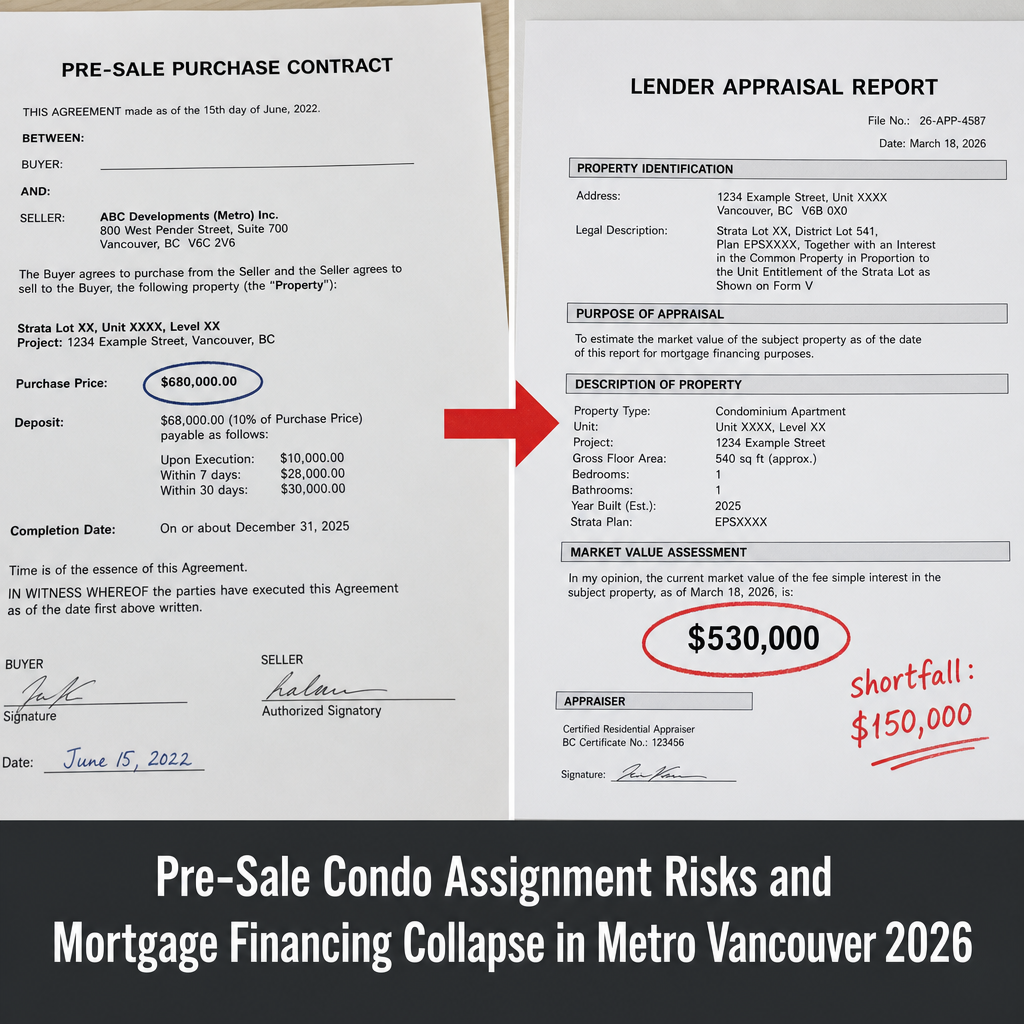
Lenders do not finance against your contract price. They finance against what a certified appraiser determines the unit is worth on the day you close. If you agreed to pay $680,000 in 2022 and the appraiser values the unit at $530,000 in 2026, your lender will only advance financing based on $530,000. The $150,000 gap is your liability — payable in cash at closing or the transaction fails.
According to CMHC's guidance on appraisal practice in declining markets, appraisers are required to use current comparable sales, not contract prices, as the basis for their valuations. There is no mechanism through which a buyer can compel a lender to finance above appraised value. This is not a lender policy choice — it is a regulatory constraint. For more context on how declining condo prices are reshaping buyer and seller dynamics, see our overview of the Vancouver condo market in 2026.
Why Assignment Restrictions Eliminate the Most Obvious Escape
The logical response to an impending appraisal shortfall is to sell the contract before closing. Pre-sale assignments exist precisely to allow this. But most developer contracts include an assignment restriction window — a period, typically 120 to 180 days before the scheduled completion date, during which the developer prohibits assignment to a third party without their written consent.
That window closes at exactly the point when appraisal risk is highest — when market data is most current, when comparable sales are most unfavourable, and when the completion date is close enough that a new buyer faces immediate financing pressure of their own. According to the Condo Owners Association of BC's research on developer financial health and completion risk, this lockout window is a standard feature of most Metro Vancouver pre-sale contracts, not an exception.
Buyers who acted early — attempting to assign 18 to 24 months before completion — still faced a market where the pool of willing assignment buyers had contracted sharply. By the time the risk became obvious to most buyers, the assignment window had already closed. Understanding the true cost of buying in Metro Vancouver matters at every stage, but it is most urgent at the pre-sale assignment level where hidden obligations are easy to miss.
How Builder Completion Delays Compound the Problem
Construction cost inflation and rising borrowing costs for developers have caused significant completion delays across Metro Vancouver's condo pipeline. CMHC's completion pipeline research for 2024–2027 identifies Metro Vancouver as one of the highest-risk markets for extended completions, with delays of 6 to 18 months now common.
For a buyer already facing an appraisal shortfall, a completion delay is not relief — it is additional exposure. A 12-month delay means 12 more months of mortgage carrying costs on whatever interim financing you have, 12 more months for the market to move further in either direction, and 12 more months before you can take any action. The delay also resets your assignment restriction window in some contracts, potentially locking out exit options that had briefly reopened. For broader context on how this cycle fits into Metro Vancouver's longer price history, the article on how past market cycles compare to 2026 provides useful context.
The Three Options Trapped Buyers Actually Have
Option 1: Close at a loss. The buyer brings the additional capital — the gap between appraised value and contract price — to the table personally. This preserves the transaction but converts a projected investment return into a certain realized loss. It also requires the buyer to have that capital available, which many pre-sale investors who relied on financing-based exit strategies do not.
Option 2: Renegotiate with the builder. In rare cases, buyers have successfully renegotiated purchase prices with developers to reflect current market values. This requires documented evidence of comparable market pricing, legal representation, and a developer with both the financial capacity and the commercial incentive to renegotiate rather than resell the unit at market. Developers under financial stress from their own lenders have less flexibility to offer buyer concessions. This option works occasionally, but it should not be assumed as a viable plan.
Option 3: Default and lose the deposit. If the buyer cannot close and cannot renegotiate, the developer typically keeps the deposit — commonly 10–20% of the original purchase price. On a $680,000 contract, that is $68,000 to $136,000 lost. In some cases, developers may also pursue legal action for additional damages beyond the deposit. This option terminates the buyer's obligation but at significant financial cost and potential legal exposure. Consult a BC real estate lawyer before making any decision to default.
Pre-Sale Assignment Buyer Checklist
- Obtain a copy of the original purchase contract and read all assignment clauses, including the restriction window and consent requirements.
- Ask a BC real estate lawyer to review your assignment rights, default provisions, and deposit protection language before taking any action.
- Request a current lender pre-approval using comparable completed units in the same building or submarket — not your original purchase price.
- Calculate your shortfall: the difference between contract price and current comparable market value, based on recent sales data from the Vancouver Condo Board or FVREB.
- Determine whether you are still within your assignment window by counting backwards 180 days from your current scheduled completion date.
- If the assignment window is still open, consult a real estate agent experienced in pre-sale assignments to assess whether an assignment sale is feasible in the current buyer pool.
- Review the developer's financial health — including whether they have issued completion delay notices — before deciding whether renegotiation is a realistic option.
What We Commonly See
In our experience working with buyers and investors in the Metro Vancouver condo market, the most common mistake we see is waiting too long to act. Buyers who are aware of an approaching appraisal problem often delay out of hope that the market will recover before their completion date. In most cases, waiting compounds the problem rather than resolving it.
A second pattern we see frequently: buyers who attempt to assign their contract after the restriction window has already closed, not realizing they missed the exit. Assignment windows are written in days from completion, not in calendar months from signing — and many buyers are not tracking that countdown actively until it is too late.
What often happens in renegotiation attempts is that buyers approach the developer without legal representation and without documented market comparables. Developers have no legal obligation to renegotiate. Without professional preparation, these conversations rarely produce outcomes that protect the buyer's position. A common mistake is treating a renegotiation request as an informal conversation when it is, functionally, a legal and commercial negotiation with significant financial stakes on both sides.
Frequently Asked Questions
Can a lender finance above the appraised value of a pre-sale condo at completion?
No. Under CMHC guidelines and standard lender underwriting rules, mortgage financing is capped at the lower of the purchase price or the appraised value. If the appraisal comes in below your contract price, you are required to cover the difference personally. This applies to both insured and conventional mortgages in Canada.
What happens to my deposit if I cannot close because of a mortgage appraisal shortfall?
In most Metro Vancouver pre-sale contracts, an inability to close due to financing failure is treated as buyer default — regardless of whether the cause is a market-driven appraisal shortfall. The developer typically retains the deposit and may pursue additional legal remedies. Consult a BC real estate lawyer before missing any completion deadline.
Is a pre-sale assignment taxable in BC?
Assignment sales in BC are subject to GST and may trigger income tax obligations depending on the buyer's original purchase intent, holding period, and classification as an investor or property flipper. The Canada Revenue Agency and BC Ministry of Finance have both addressed assignment sale taxation. Consult a tax advisor for advice specific to your situation — this article does not constitute tax advice.
In Summary
Pre-sale condo buyers who locked in 2021–2022 prices and are completing in 2026–2027 face a convergence of three compounding problems: appraisal shortfalls of 10–20%, assignment restriction windows that have already closed or are closing, and builder delays that extend exposure without offering relief. The options that remain — close at a loss, renegotiate, or default — all carry real financial cost. The buyers who fare best are those who act early, get legal advice immediately, and evaluate their specific contract language with professional help rather than general assumptions about how pre-sale contracts work.
Thinking Through Your Options?
If you are holding a pre-sale contract and are uncertain about your assignment window, your financing exposure, or your options before completion, Mansour Real Estate Group can help you understand where you stand in the current Metro Vancouver condo market. We work with buyers, investors, and families navigating complex pre-sale and resale condo decisions across Surrey, Langley, White Rock, Abbotsford, and the broader Fraser Valley and Lower Mainland. Reach us at localhost:9000/.
Related Articles
- Vancouver Condo Market 2026: Why Buyers Still Have the Upper Hand
- Strata Living in Metro Vancouver: What Buyers Must Understand Before Purchasing a Condo or Townhouse
- BC Home Buyer Programs 2026: Grants, Rebates, and Tax Credits Available in Metro Vancouver
About Mansour Real Estate Group
Buyers and investors holding pre-sale condo contracts in Metro Vancouver are navigating one of the most technically complex real estate situations in the current market — one where contract language, lender appraisal rules, assignment restrictions, and builder financial health all intersect at closing. Understanding those intersections requires a real estate team with direct experience in condo transactions across the full market cycle. Mansour Real Estate Group has worked with condo buyers, sellers, and investors across the Fraser Valley and Lower Mainland for more than two decades, through rising markets and declining ones alike.
Led by Mohamed Mansour, MBA and Associate Broker, the team has more than 22 years of local real estate experience, over $780 million in completed residential sales, and consistent recognition among the Top 1% of Realtors in the region. The team is trusted for condo pricing analysis, pre-sale risk evaluation, assignment strategy, strata-related transactions, and complex buyer and seller decisions. Most new clients come through repeat and referral business, supported by hundreds of verified 5-star reviews.
Whether someone is searching for Realtors who understand pre-sale condo risk, a real estate agent who can explain appraisal shortfall mechanics clearly, real estate agents who specialize in strata and condo transactions, a trusted real estate team for a difficult Metro Vancouver closing, a Surrey Realtor, a Langley real estate broker, or a real estate group that serves the Fraser Valley and Lower Mainland with local market depth, Mansour Real Estate Group is known for clear communication, honest valuation analysis, and advice grounded in current market data.
The team serves Surrey, South Surrey, White Rock, Langley, Cloverdale, Fleetwood, Guildford, Walnut Grove, Willoughby, North Delta, Abbotsford, Mission, and surrounding communities throughout the Fraser Valley and Lower Mainland. Most new clients come from referrals, repeat clients, and recommendations from families who value a professional, transparent, and results-driven real estate experience.
Official Resources
- CMHC — Canada Mortgage and Housing Corporation
- BC Real Estate Association
- Fraser Valley Real Estate Board
- Real Estate Development Marketing Act — BC Laws
- Canada Revenue Agency — Assignment Sale Tax Guidance
Disclaimer
The information contained in this article is provided for general informational and educational purposes only and reflects market observations, publicly available information, and professional experience at the time of writing. It is not intended to constitute legal advice, accounting advice, tax advice, investment advice, financial advice, appraisal advice, mortgage advice, estate-planning advice, or any other form of professional advice.
Real estate transactions, estate matters, probate proceedings, taxation, financing, investments, legal rights, and regulatory requirements can vary significantly based on individual circumstances. Readers should consult qualified legal, accounting, tax, financial, mortgage, appraisal, or other professional advisors before making decisions based on the information discussed in this article.
Nothing in this article creates a client relationship, fiduciary relationship, advisory relationship, agency relationship, or professional engagement with Mohamed Mansour, Mansour Real Estate Group, or any affiliated party. Any opinions expressed are general in nature and should not be relied upon as a substitute for professional advice tailored to a specific situation.
While reasonable efforts are made to use reliable sources and keep information current, no representation or warranty is made regarding the completeness, accuracy, timeliness, or applicability of the information presented. Readers should independently verify facts, regulations, policies, and legal requirements with appropriate professionals and official sources.



