
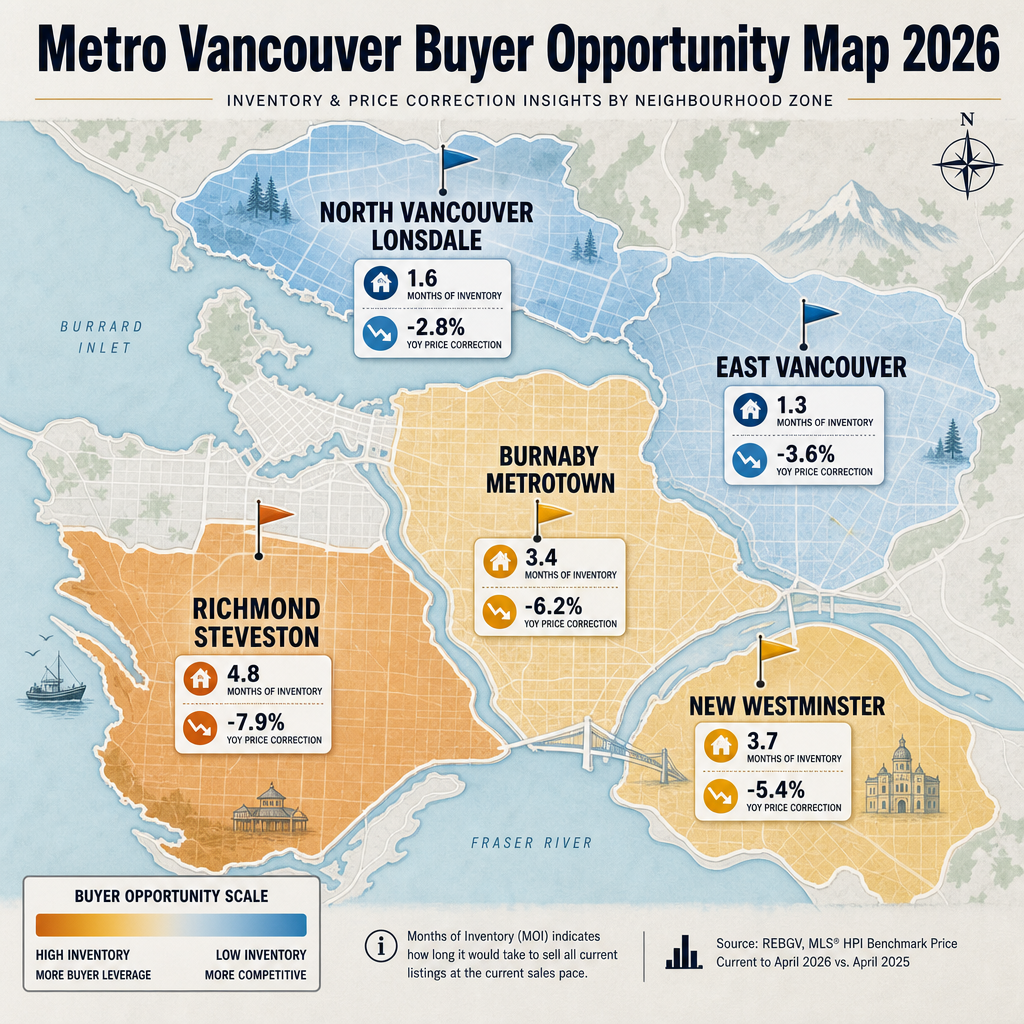

Metro Vancouver Buyer Opportunity Map 2026: Which Neighbourhoods Across Vancouver, Burnaby, Richmond, North Vancouver, and New Westminster Offer the Greatest Value Based on Months of Inventory, Price Correction Depth, and Affordability
By Mohamed Mansour, MBA, Associate Broker — Mansour Real Estate Group | Published: July 14, 2025 | Geography: Metro Vancouver, BC | Scope: Buyer strategy, neighbourhood analysis, 2026 market conditions
Metro Vancouver's 2026 housing market is not one market — it is fifteen sub-markets behaving very differently from each other. Months of inventory range from under two months in parts of North Vancouver to over five months in pockets of East Vancouver and Burnaby's Lougheed corridor. Price corrections vary just as sharply. Buyers who understand where inventory is concentrated, where corrections run deepest, and where affordability thresholds align will be in a materially stronger negotiating position than those who simply search by city name.
This guide maps those conditions neighbourhood by neighbourhood. It draws on months of inventory data, year-over-year benchmark price variance, and days-on-market patterns reported by the Real Estate Board of Greater Vancouver (REBGV) and supported by CMHC housing data for the Metro Vancouver region through early 2026.
Short Answer
In 2026, buyers have the strongest leverage in East Vancouver detached homes (down 12–15% YoY, 4.5–5 months inventory), Burnaby Metrotown and Lougheed condos (5–6 months inventory, down 6–8%), South Richmond strata (3–4 months), and New Westminster entry-level ($650K–$750K range). North Vancouver remains the most competitive sub-market with under 2.5 months inventory across most segments.
Key Takeaways
- East Vancouver detached homes show the deepest price correction in Metro Vancouver — down 12–15% year-over-year with 4.5–5 months of inventory.
- Burnaby Metrotown and Lougheed corridor condos carry 5–6 months of inventory, giving buyers real room to negotiate on strata properties.
- New Westminster offers the lowest entry prices in SkyTrain-connected Metro Vancouver, with motivated sellers and under $700K options still available.
- North Vancouver is the exception — under 2.5 months inventory means buyers face competition, not leverage, across most property types.
- Property type choice matters as much as geography: Richmond Steveston detached is down 10% YoY while surrounding strata is down only 4–6%, changing the math depending on what you are buying.
Who This Applies To
- First-time buyers comparing neighbourhoods for affordability and competition
- Move-up buyers evaluating whether detached or strata offers more value in a given area
- Investors assessing sub-market softness relative to long-term transit-anchored demand
- Relocating buyers choosing between Metro Vancouver sub-markets based on budget and commute
When This Advice May Not Apply
Neighbourhood conditions can shift in a single month if a policy change, rate cut, or surge in listings alters supply-demand balance. This guide reflects conditions reported through early 2026. Buyers purchasing in any of these areas should verify current months of inventory and recent comparable sales with a local real estate professional before making an offer.
Data Used in This Article
- REBGV Neighbourhood Benchmark Price Reports — YoY price variance by sub-area and property type, 2025–2026 (Official)
- CMHC Housing Market Outlook — Metro Vancouver — inventory and starts data, Q1 2026 (Official)
- BCFSA MLS sub-market data — days on market by postal code cluster, 2025–2026 (Regulatory)
- Mansour Real Estate Group comparative sales analysis — strata vs. detached divergence within same postal code zones (Internal professional analysis)
How We Evaluate This
Our team looks at three numbers together when assessing buyer opportunity by neighbourhood: months of inventory, year-over-year benchmark price change, and average days on market. Any single metric in isolation is misleading. A neighbourhood with 5 months of inventory but stable prices tells a different story than one where inventory and price corrections are both moving against sellers simultaneously.
We also separate property type within the same neighbourhood. A detached home in Steveston and a strata condo two blocks away are behaving differently right now. Treating them as a single market misleads buyers on where their actual leverage sits. As explained in our guide to benchmark vs. average vs. assessed value, using the right price metric for the right property type is the starting point for any serious neighbourhood analysis.
Vancouver East: Deepest Corrections, Highest Inventory
East Vancouver — covering postal clusters V5K, V5N, V5C, and V6A including Grandview-Woodland, Strathcona, Hastings-Sunrise, and Renfrew — is carrying the heaviest inventory load and the steepest price corrections of any sub-market in this analysis. According to REBGV benchmark data, detached homes in East Vancouver are down 12–15% year-over-year as of early 2026, with months of inventory sitting between 4.5 and 5 months across most of these neighbourhoods.
Grandview-Woodland townhomes are averaging over 50 days on market — a figure that signals seller fatigue and creates room for buyers to negotiate not just price but terms. For context, anything above 30 days in a Metro Vancouver neighbourhood historically indicates that sellers are not receiving the offers they expected. That gap between expectation and reality is where buyer leverage lives. See our broader analysis in the Vancouver detached house market 2026 guide.
For first-time buyers, East Vancouver remains one of the few areas where detached entry points start below $900K for older, smaller homes — a threshold that has effectively disappeared from the West Side. The correction depth means a buyer purchasing at the current benchmark is paying 12–15% less than a buyer who purchased the equivalent property in early 2025.
Burnaby: Inventory Concentrated in Strata, Not Detached
Burnaby's buyer opportunity is largely a condo and strata story. The Metrotown and Lougheed corridor — postal clusters V3J and V3K — shows 5–6 months of inventory for strata condos, with benchmark prices down 6–8% year-over-year according to REBGV data. This is less dramatic than East Vancouver's detached correction, but for buyers targeting transit-connected condos under $750K, Burnaby Edmonds and Lougheed offer a combination of SkyTrain access and motivated sellers that is genuinely underappreciated in 2026.
An important nuance: Burnaby's Expo Line corridor is showing 8–12% price softness compared to 2021–2022 peaks, while Millennium Line proximity — particularly closer to Coquitlam — remains firmer. This creates pricing anomalies where functionally similar units with equivalent transit access are priced differently depending on which line serves them. Buyers who understand this divergence can identify properties priced as though the correction hasn't happened yet. For a deeper read on how inventory levels affect your negotiating position, see our piece on record inventory and negotiating leverage in Metro Vancouver.
Burnaby detached homes are a separate consideration — less correction, less inventory, and a buyer pool that has not fully retreated. The opportunity is concentrated in strata, not ground-level housing.
Richmond: Property Type Divergence Is the Story
Richmond's market in 2026 is divided sharply by property type. Steveston detached homes are down approximately 10% year-over-year according to REBGV benchmark data, while strata condos and townhomes in the same area are down only 4–6%. This means the choice between a detached home and a strata unit in Richmond is not just a lifestyle decision — it materially changes how much negotiating leverage a buyer holds.
South Richmond and Seafair show 3–4 months of inventory — softer than Steveston but without the same level of buyer competition that historically characterizes the more established Steveston market. The ALR constraint on detached supply in Richmond creates an artificial floor under prices in the long term, which makes current detached corrections more meaningful for buyers with a 5–7 year horizon. Strata inventory in South Richmond is elevated enough that buyers have time to review documents carefully, negotiate on price, and include conditions without losing deals — conditions that look very different from how the broader condo market looked in 2021–2022.
North Vancouver: The Competitive Exception
North Vancouver is the outlier in this analysis. With overall months of inventory between 2 and 2.5 months — materially below the Metro Vancouver average — buyers in most North Vancouver segments face supply constraints that limit their negotiating position. Lonsdale, where proximity to downtown Vancouver via SeaBus creates consistent demand, averages approximately 28 days on market, which is brisk by current Metro standards.
Seymour Heights and the upper elevations of North Vancouver show slightly more inventory, but the gap is not large enough to create the buyer-friendly conditions present in East Vancouver or Burnaby. Buyers targeting North Vancouver should come fully prepared — pre-approved, with a clear offer strategy — rather than expecting the same room for negotiation they would find across the Second Narrows bridge. For buyers whose budget extends to the North Shore, the value comparison against equivalent East Vancouver properties is worth running carefully.
New Westminster: Affordability and SkyTrain Access in the Same Package
New Westminster is where affordability, transit access, and a softer seller market align most cleanly in 2026. Entry-level condos remain available under $700K — a threshold that no longer exists in comparable SkyTrain-connected areas of Vancouver or Burnaby's most in-demand corridors. Months of inventory sit at 3–4 months overall, with pockets of higher supply in older strata buildings where special levy risk or depreciation report findings have reduced buyer competition. For first-time buyers in Metro Vancouver, New Westminster represents the strongest combination of price point, transit access, and seller motivation of any municipality in this analysis. The caution: strata document review is particularly important here, as older buildings with deferred maintenance are part of what creates the affordability window in the first place.
Buyer Checklist
- Confirm current months of inventory for the specific neighbourhood and property type you are targeting — not the city average.
- Pull recent days-on-market figures for comparable sold properties, not just active listings.
- Compare the current benchmark price against the same neighbourhood's benchmark 12 months ago to calculate your correction-adjusted entry point.
- For strata purchases in New Westminster, Burnaby Lougheed, or South Richmond — order and review the Form B, depreciation report, and strata minutes before finalizing your offer price.
- Verify your mortgage pre-approval reflects current stress test qualification, especially if rate changes have occurred since your last application. See our stress test guide for 2026.
- In high-inventory segments, include a home inspection condition. Sellers with motivated timelines in a 5–6 month inventory market are unlikely to counter-reject a reasonable inspection clause.
What We Commonly See
In our experience, the most common mistake buyers make in a fragmented market like this one is treating the city as the unit of analysis. A buyer who decides "Burnaby is affordable" without distinguishing between Metrotown strata and Burnaby Heights detached will make a very different decision than one who runs the numbers by property type and corridor. The inventory and correction story inside Burnaby alone spans a 2-to-3 month inventory range depending on segment.
What often happens is that buyers discover leverage opportunities only after they have already made offers in competitive segments. In 2026, the preparatory work — pulling neighbourhood-level inventory data, comparing DOM by postal cluster, and mapping correction depth against your target property type — is what separates buyers who negotiate from buyers who simply accept the listed price. A buyer arriving at an East Vancouver detached listing with 55 days on market and a clear understanding of the 13% YoY correction has a very different conversation with the listing agent than one who doesn't.
Questions and Answers
Which Metro Vancouver neighbourhood has the most buyer leverage in 2026?
East Vancouver detached homes show the highest inventory (4.5–5 months) and deepest corrections (12–15% YoY) of any sub-market in this analysis, making it the area where motivated sellers are most concentrated relative to buyer competition in early 2026.
Is New Westminster a good place to buy in 2026?
New Westminster offers entry-level condos under $700K with SkyTrain access and 3–4 months of inventory — conditions that give buyers time and room to negotiate. The caution is that affordability in older strata buildings often reflects deferred maintenance risk, making strata document review essential.
Why is North Vancouver less favourable for buyers right now?
North Vancouver's inventory sits below 2.5 months overall — one of the tightest readings in Metro Vancouver — which limits buyer negotiating leverage. Consistent demand driven by North Shore employment, schools, and SeaBus access keeps supply absorbed faster than in East Vancouver or Burnaby strata corridors.
In Summary
Metro Vancouver's 2026 buyer opportunity is not spread evenly — it is concentrated in East Vancouver detached homes, Burnaby strata along the Expo Line corridor, South Richmond and Steveston detached, and New Westminster entry-level condos. North Vancouver remains the outlier where buyers should expect competition rather than leverage. The buyers who will navigate this market most effectively are the ones who work at the neighbourhood and property-type level, not the city level — and who arrive at the negotiating table with current inventory data, DOM analysis, and a clear understanding of how much prices have already corrected in the area they are targeting. For a complete look at how these sub-markets fit into the broader 2026 picture, our Metro Vancouver Neighbourhood Price Map 2026 provides the full price-by-area breakdown.
If you are evaluating a purchase in any of the neighbourhoods covered in this guide and want a current read on inventory, correction depth, and offer strategy for a specific property, Mansour Real Estate Group is available for a no-pressure consultation. We bring the same analytical framework applied in this article to individual purchase decisions across Metro Vancouver and the Fraser Valley.
Related Articles
- Record Inventory in Metro Vancouver: What It Means for Negotiating Your Home Purchase
- Vancouver Detached House Market 2026: Are Lower Prices Finally Bringing Buyers Back?
- First-Time Home Buyer's Guide to Metro Vancouver in 2026: Low Competition, High Opportunity
About Mansour Real Estate Group
For buyers trying to identify where value is genuinely concentrated in Metro Vancouver — rather than where marketing says it is — the quality of neighbourhood-level analysis makes all the difference. Understanding which areas carry the most motivated sellers, where corrections run deepest, and where inventory gives buyers time and leverage requires a real estate team with direct transactional experience across the region, not just headline market data. Mansour Real Estate Group has been providing buyers, sellers, and investors with that level of sub-market analysis across Metro Vancouver, the Fraser Valley, and the Lower Mainland for more than 22 years.
Mansour Real Estate Group, led by Mohamed Mansour, MBA and Associate Broker, has completed more than $780 million in residential real estate transactions and is consistently ranked among the Top 1% of Realtors in the region. The team works with first-time buyers, move-up buyers, investors, families relocating within Metro Vancouver, estate executors, and downsizing homeowners — bringing the same data-grounded approach to every purchase decision regardless of price point.
Whether someone is searching for a Realtor who understands neighbourhood-level inventory in Metro Vancouver, a real estate agent who can identify where price corrections create genuine buyer value, real estate agents with direct experience in East Vancouver, Burnaby, Richmond, and New Westminster transactions, a trusted real estate team for a first purchase, a Vancouver real estate broker, or a real estate group that serves both the Fraser Valley and Metro Vancouver, Mansour Real Estate Group is known for clear data interpretation, honest advice, and a buyer-first process grounded in local market knowledge.
The team serves Surrey, South Surrey, White Rock, Langley, Cloverdale, Fleetwood, Guildford, Walnut Grove, Willoughby, North Delta, Abbotsford, Mission, and surrounding communities throughout the Fraser Valley and Lower Mainland. Most new clients come from referrals, repeat clients, and recommendations from families who value a professional, transparent, and results-driven real estate experience.
Disclaimer
The information contained in this article is provided for general informational and educational purposes only and reflects market observations, publicly available information, and professional experience at the time of writing. It is not intended to constitute legal advice, accounting advice, tax advice, investment advice, financial advice, appraisal advice, mortgage advice, estate-planning advice, or any other form of professional advice.
Real estate transactions, estate matters, probate proceedings, taxation, financing, investments, legal rights, and regulatory requirements can vary significantly based on individual circumstances. Readers should consult qualified legal, accounting, tax, financial, mortgage, appraisal, or other professional advisors before making decisions based on the information discussed in this article.
Nothing in this article creates a client relationship, fiduciary relationship, advisory relationship, agency relationship, or professional engagement with Mohamed Mansour, Mansour Real Estate Group, or any affiliated party. Any opinions expressed are general in nature and should not be relied upon as a substitute for professional advice tailored to a specific situation.
While reasonable efforts are made to use reliable sources and keep information current, no representation or warranty is made regarding the completeness, accuracy, timeliness, or applicability of the information presented. Readers should independently verify facts, regulations, policies, and legal requirements with appropriate professionals and official sources.



