

Vancouver Empty Homes Tax (Vacancy Tax) 2026: Current Rates, Declaration Requirements, Eligible Exemptions, Filing Deadlines, and Penalties for Non-Compliance
By Mohamed Mansour, MBA and Associate Broker · Mansour Real Estate Group · Published May 1, 2026 · City of Vancouver · Metro Vancouver · Fraser Valley
Vancouver's Empty Homes Tax affects every residential property in the City of Vancouver — not just vacant investor units. If you own a property in Vancouver and do not file a declaration by March 31, the City will treat your home as vacant and bill you accordingly. For out-of-town owners and investors, the rules around exemptions, documentation, and the interaction with BC's Speculation and Vacancy Tax create real financial exposure that compounds year over year.
This guide covers the 2026 tax year: current rates, who must declare, which exemptions are available and what evidence supports them, what happens if you miss the deadline, and where the Empty Homes Tax intersects with provincial vacancy taxes. It is written for property owners, not tax specialists — but it will help you ask the right questions before the filing window closes.
Short Answer
Vancouver's Empty Homes Tax is set at 1% of a property's BC assessed value for the 2026 tax year. Every residential property owner in the City of Vancouver must file an annual declaration by March 31. Properties not used as a principal residence and not covered by an eligible exemption are taxed at that 1% rate. Combined with BC's Speculation and Vacancy Tax (2%), total annual exposure can reach 3% of assessed value.
Who This Applies To
- Owners of residential property in the City of Vancouver — detached homes, condos, townhouses, and stratas
- Out-of-province and out-of-country owners who purchased Vancouver property as an investment or secondary residence
- Owners who rent their property and want to confirm their tenancy agreement satisfies exemption criteria
- Owners who inherited a Vancouver property and are unsure whether estate-related timelines trigger vacancy tax exposure
- Buyers evaluating a Vancouver investment property and wanting to understand annual tax obligations before purchasing
When This Advice May Not Apply
This article covers the City of Vancouver's municipal Empty Homes Tax. It does not cover the separate BC Speculation and Vacancy Tax in full detail, Metro Vancouver municipal vacancy programs outside City of Vancouver boundaries, or commercial properties. If your property is outside Vancouver city limits — in Burnaby, Surrey, Langley, or Abbotsford, for example — the Empty Homes Tax does not apply, though the provincial Speculation and Vacancy Tax may still apply depending on the zone. Consult a qualified tax professional for advice specific to your situation.
Key Takeaways
- The 2026 Empty Homes Tax rate is 1% of BC assessed value; combined with the provincial Speculation and Vacancy Tax, total exposure can reach 3% annually.
- Every City of Vancouver residential property owner must declare by March 31, even if they are fully exempt.
- Missing the deadline triggers an automatic vacancy determination — the City does not issue reminders or accept late exemption claims without formal review.
- Eligible exemptions include principal residence, active rental, property listed for sale, and major renovation with permit — but documentation must support each claim.
- Non-compliance penalties reach 50% of unpaid tax plus interest; repeat violations within five years trigger additional audit exposure.
Data Used in This Article
- City of Vancouver Empty Homes Tax Official Portal (vancouver.ca) — official, current tax year
- BC Speculation and Vacancy Tax Guidelines (gov.bc.ca) — provincial, 2026 tax year
- BC Assessment Property Tax Documentation — official provincial assessor
- BC Real Estate Association Tax Guidance, 2026 — industry body, third-party analysis
Key Definitions
Empty Homes Tax (EHT): A municipal tax levied by the City of Vancouver on residential properties not occupied as a principal residence for the full calendar year and not covered by an eligible exemption. Rate: 1% of BC assessed value.
BC Speculation and Vacancy Tax (SVT): A separate provincial tax applying to residential properties across designated BC regions, including Metro Vancouver. Rate: 2% of assessed value for foreign owners and satellite families; 0.5% for Canadian citizens or permanent residents who are BC residents; 2% for non-BC Canadian citizens and permanent residents. Administered separately from the City's EHT.
BC Assessed Value: The value assigned annually by BC Assessment, typically as of July 1 of the prior year. Both the EHT and SVT use this figure as their tax base. For context on how assessed value relates to market value, see Benchmark Price vs. Average Price vs. Assessed Value.
Principal Residence: For EHT purposes, the property must be the owner's primary home, occupied by the owner or a permitted occupant for a minimum period during the year. The City of Vancouver has specific tests for this — proximity of employment, location of family, and other factors. Self-declaration is permitted but can be audited.
How the Empty Homes Tax Rate Works in Practice
The 1% rate applies to the property's BC assessed value — not its sale price or market value. According to BC Assessment, assessed values in Vancouver are typically set as of July 1 of the prior calendar year and mailed to property owners in January. Because assessed values in Vancouver have historically trailed peak market values but can still reach significant numbers, the dollar impact of the Empty Homes Tax is material even on a single residential property.
On a property assessed at $1.2 million, the Empty Homes Tax alone amounts to $12,000 annually. If the same property also triggers the BC Speculation and Vacancy Tax at 2%, the combined annual charge is $36,000. For non-BC-resident Canadian owners, the SVT rate is 2%, meaning this combined exposure is common for out-of-province investors. The full cost of owning a Vancouver property includes these ongoing obligations, not just the purchase price.
The two taxes are administered separately. The City of Vancouver collects the Empty Homes Tax through its own declaration portal. The provincial government administers the Speculation and Vacancy Tax through a separate declaration process, typically with a February deadline. Missing either deadline independently results in automatic vacancy classification under that program.
Declaration Requirements and the March 31 Deadline
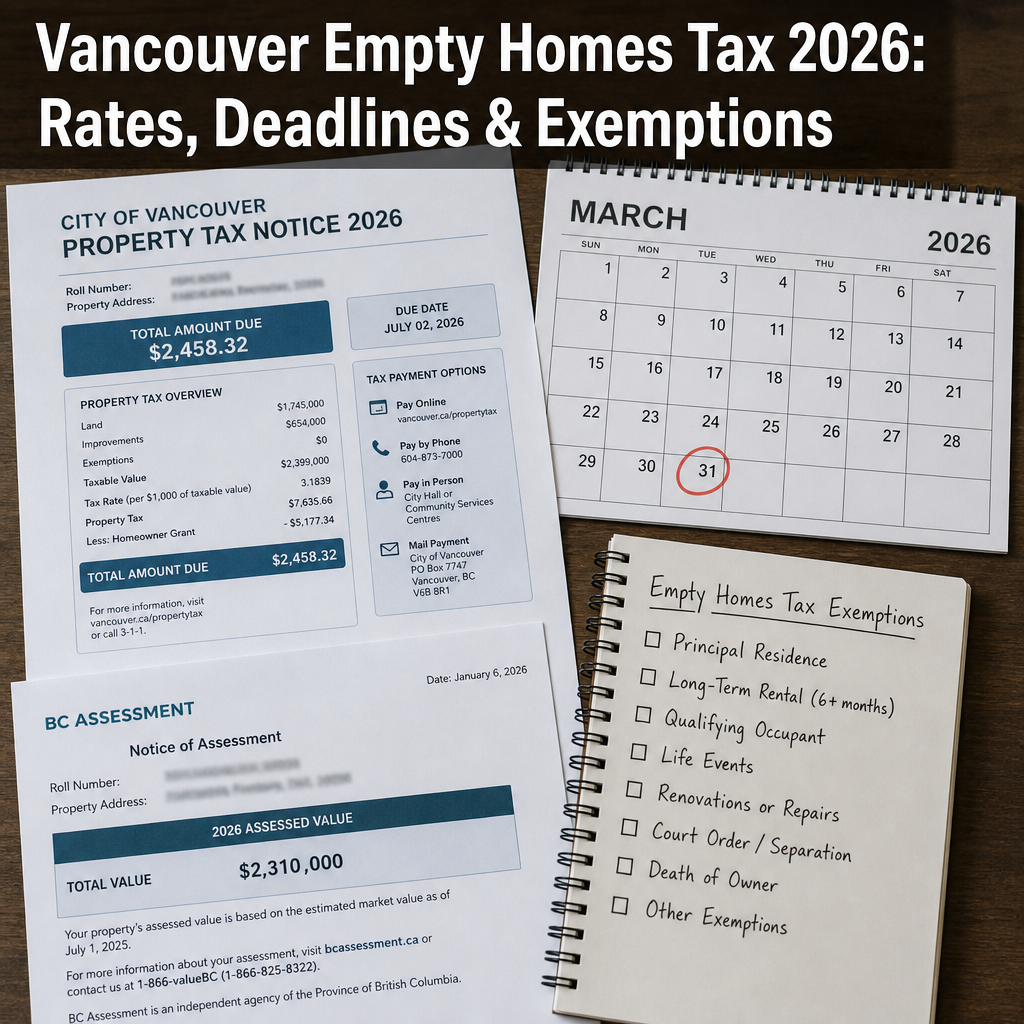
Filing is mandatory for all residential property owners in the City of Vancouver. The declaration covers the prior calendar year. For the 2026 filing cycle, owners are declaring on the 2025 calendar year and must submit through the City of Vancouver's online portal by March 31, 2026. There is no paper alternative under current City of Vancouver procedures. Property owners receive a notification letter in January, but the obligation exists regardless of whether the letter is received.
The declaration asks owners to state whether the property was their principal residence, occupied by a tenant, listed for sale, under renovation, or subject to another exemption. Each response requires supporting documentation if the City requests an audit. Declarations can be submitted early — the portal is typically open from January through March 31.
Out-of-province owners managing the declaration from outside BC face the most common compliance problems: mail forwarding delays, unfamiliarity with the online portal, and uncertainty about which exemption category applies to their situation. According to the City of Vancouver's published administration data, non-compliant properties are automatically classified as vacant after the March 31 deadline with no grace period. The only remedy is a formal complaint or review process after the fact — which takes time and does not guarantee reversal of the tax.
Eligible Exemptions: What Qualifies and What Documentation Is Required
The City of Vancouver recognizes several exemptions from the Empty Homes Tax. Each requires a declaration claim and may require supporting documentation if audited. The main exemption categories, according to the City of Vancouver's official Empty Homes Tax portal, are:
Principal Residence: The property is the owner's primary home. The owner or a permitted occupant — immediate family member — must have lived there for the majority of the year. Documentation supporting this claim can include utility bills, driver's licence address, Canada Revenue Agency correspondence, or other evidence of occupancy.
Active Rental with Tenancy Agreement: The property was rented to a tenant under a tenancy agreement for at least six months of the calendar year, in periods of at least 30 consecutive days. A valid written tenancy agreement is required. Month-to-month verbal arrangements do not satisfy this exemption reliably. Short-term rentals — Airbnb-style arrangements — generally do not qualify unless they meet the minimum period threshold under the City's interpretation. For owners selling or planning to sell a tenanted Vancouver condo, confirming the tenancy agreement satisfies EHT exemption criteria before sale is important.
Property Listed for Sale: The property was actively listed for sale on the MLS system. A confirmed listing record is typically sufficient documentation. This exemption is relevant for owners who moved out in advance of listing. Properties sitting off-market without a formal listing do not qualify.
Major Renovation or Hazardous Condition: A property undergoing significant renovation with valid building permits may qualify. The permits must be active and on record with the City of Vancouver, and the work must be of a scope that prevents occupancy. Minor cosmetic updates do not satisfy this threshold.
Other Recognized Exemptions: The City also recognizes exemptions for properties held in a court order or legal dispute, the death of the owner during the tax year, strata rental restrictions that legally prevent the owner from renting, and properties used for employment purposes by the owner in Vancouver. Each has specific documentation requirements. Consult vancouver.ca or a qualified advisor for current exemption category eligibility.
Penalties for Non-Compliance
Missing the March 31 declaration deadline results in an automatic vacancy determination. The City of Vancouver will calculate the Empty Homes Tax based on the property's assessed value and issue a bill. Failure to pay that bill triggers a 50% penalty surcharge on the unpaid tax, plus interest. For a property assessed at $1.2 million, that sequence produces a $12,000 tax bill, a $6,000 penalty surcharge, and ongoing interest — from a single missed filing.
Second violations within a five-year window escalate exposure further. The City of Vancouver has been increasing audit and enforcement activity since the program's inception. Owners who have been assessed under the Empty Homes Tax and also miss the provincial Speculation and Vacancy Tax declaration face compounding penalties under two separate tax regimes administered by two different levels of government. Owners of strata properties in Metro Vancouver should also be aware that strata rental restrictions — while sometimes an EHT exemption — do not exempt the property from the provincial SVT unless the strata's restriction meets specific BC government criteria.
How We Evaluate This
When working with buyers evaluating Vancouver investment properties, or with out-of-province owners preparing to sell, Mansour Real Estate Group reviews the property's current and prior year EHT and SVT status as part of the overall financial picture. A property with unresolved vacancy tax assessments — or one where the exemption history is uncertain — carries risk that needs to be disclosed and addressed before listing.
We do not provide tax advice and always recommend that investors and out-of-town owners work with a qualified accountant or tax lawyer familiar with both Vancouver's EHT and BC's SVT before making acquisition or disposition decisions. What we provide is the market context: accurate valuations, clear timelines, and a practical understanding of how tax obligations interact with a sale strategy in today's Vancouver real estate market.
Owner Compliance Checklist
- Confirm your Vancouver property's BC Assessment notice has been received and filed — the assessed value is the tax base for both EHT and SVT
- Log in to the City of Vancouver Empty Homes Tax portal at vancouver.ca and complete your annual declaration before March 31
- If claiming a tenancy exemption, confirm your tenancy agreement covers at least six months of the prior calendar year in periods of 30+ consecutive days
- If claiming a renovation exemption, confirm building permits were active with the City of Vancouver during the relevant period
- Complete your separate BC Speculation and Vacancy Tax declaration through the provincial portal at gov.bc.ca — the provincial deadline is typically in February, earlier than the City's March 31 deadline
- Keep all supporting documentation — tenancy agreements, permit records, MLS listing confirmations, utility bills — for a minimum of four years in case of audit
- If you are selling a Vancouver property, confirm all prior year EHT and SVT declarations are complete and no outstanding assessments exist before listing
What We Commonly See
In our experience working with out-of-province buyers and investors across Metro Vancouver, the most common compliance problem is not deliberate avoidance — it is simply not knowing the declaration was required. The City of Vancouver mails a notification letter, but if the owner's address on file is outdated or mail is forwarded slowly, the deadline passes before the owner acts.
A second pattern we see regularly: owners who rent their property believe the rental exemption is automatic. It is not. The tenancy agreement must meet the minimum duration requirements, and the City can and does request documentation during audits. Short-term and informal arrangements are frequently disqualified.
A third situation arises in estate sales. When a property owner dies and the estate takes time to probate, the property may sit unoccupied for months or longer. Executors managing a Vancouver estate property sometimes discover an accumulated EHT liability — compounded by SVT exposure — that affects the net proceeds of the sale. Addressing this proactively, as part of the estate administration process, avoids surprises at conveyancing. Property taxes in Metro Vancouver generally, including how ownership transitions affect tax accounts, are covered in our guide to property taxes for Metro Vancouver owners.
Questions and Answers
If my Vancouver condo is rented on Airbnb, does it qualify for the rental exemption?
Generally no. The City of Vancouver's rental exemption requires tenancy periods of at least 30 consecutive days. Short-term rental arrangements — nightly or weekly bookings — do not satisfy this requirement. Properties used exclusively for short-term rentals without a qualifying long-term tenancy will typically be assessed as vacant under the EHT. Consult the City of Vancouver portal or a tax advisor for your specific situation.
Does the Empty Homes Tax apply to properties outside the City of Vancouver — in Surrey or Langley, for example?
No. The City of Vancouver's Empty Homes Tax is a municipal tax that applies only within Vancouver city limits. Properties in Surrey, Langley, Abbotsford, Burnaby, and other municipalities are not subject to this specific tax. However, BC's Speculation and Vacancy Tax applies across designated areas in Metro Vancouver and beyond, including many Fraser Valley municipalities. That is a separate provincial obligation.
What happens if I filed an exemption claim but the City later audits me and rejects it?
If the City of Vancouver audits your declaration and determines your exemption claim was not supported by adequate documentation, they can reassess the property as vacant and apply the 1% tax retroactively, along with interest. If the original declaration was made in good faith and documentation exists, a formal review process is available. If the claim was inaccurate, the 50% penalty surcharge applies on the resulting unpaid balance. This is why documentation retention matters even for straightforward exemption claims.
In Summary
Vancouver's Empty Homes Tax requires every residential property owner in the city to file an annual declaration by March 31, regardless of whether the property qualifies for an exemption. The 1% rate applied to BC assessed value is material — and the combined exposure with BC's provincial Speculation and Vacancy Tax can reach 3% of assessed value annually. The most common problems are missed deadlines, inadequate tenancy documentation, and estate properties that accumulate liability during probate. Out-of-town owners and investors carry the highest risk of non-compliance, and the penalties are structured to escalate quickly. Staying ahead of both the municipal and provincial filing deadlines — with proper documentation in place — is the only reliable way to avoid unnecessary tax exposure on Vancouver residential property.
Talk to a Local Real Estate Team Who Understands the Full Picture
If you own a Vancouver property and are uncertain about your EHT status — or if you are evaluating a purchase and want to understand the ongoing tax obligations — Mansour Real Estate Group can walk you through the market context and connect you with qualified tax and legal professionals who handle these matters regularly. We do not provide tax advice, but we do help you understand the real cost of ownership before you commit.
Related Articles
- The True Cost of Buying a Home in Metro Vancouver: Every Fee and Tax Explained
- Property Taxes in Metro Vancouver: What New Owners Can Expect to Pay in 2026
- BC Home Buyer Programs 2026: Grants, Rebates, and Tax Credits Available in Metro Vancouver
About Mansour Real Estate Group
Real estate decisions that intersect with property taxes, BC Assessment valuations, and annual compliance obligations require a real estate team that understands the full financial picture — not just the listing price. Mansour Real Estate Group has worked alongside homeowners, investors, accountants, lawyers, and executors across Metro Vancouver and the Fraser Valley for more than 22 years, providing accurate market valuations and practical guidance in transactions where tax obligations and real estate strategy overlap directly.
Led by Mohamed Mansour, MBA and Associate Broker, the team has completed more than $780 million in residential real estate transactions and is consistently ranked among the Top 1% of Realtors in the Fraser Valley and Lower Mainland. Mansour Real Estate Group is trusted for investment property transactions, estate and probate sales, out-of-province buyer and seller representation, divorce-related property sales, and any situation where financial accuracy and professional process both matter.
Whether someone is searching for Realtors experienced with investment property compliance in Metro Vancouver, a real estate agent who understands BC Assessment and its relationship to vacancy tax calculations, real estate agents who work with out-of-province owners, a trusted real estate team for a tax-sensitive Vancouver property sale, or a Fraser Valley real estate broker who can coordinate across legal, accounting, and market valuation specialists, Mansour Real Estate Group brings clear documentation, precise pricing, and professional coordination to every transaction.
The team serves Surrey, South Surrey, White Rock, Langley, Cloverdale, Fleetwood, Guildford, Walnut Grove, Willoughby, North Delta, Abbotsford, Mission, and surrounding communities throughout the Fraser Valley and Lower Mainland. Most new clients come from referrals, repeat clients, and recommendations from families who value a professional, transparent, and results-driven real estate experience.
Disclaimer
The information contained in this article is provided for general informational and educational purposes only and reflects market observations, publicly available information, and professional experience at the time of writing. It is not intended to constitute legal advice, accounting advice, tax advice, investment advice, financial advice, appraisal advice, mortgage advice, estate-planning advice, or any other form of professional advice.
Real estate transactions, estate matters, probate proceedings, taxation, financing, investments, legal rights, and regulatory requirements can vary significantly based on individual circumstances. Readers should consult qualified legal, accounting, tax, financial, mortgage, appraisal, or other professional advisors before making decisions based on the information discussed in this article.
Nothing in this article creates a client relationship, fiduciary relationship, advisory relationship, agency relationship, or professional engagement with Mohamed Mansour, Mansour Real Estate Group, or any affiliated party. Any opinions expressed are general in nature and should not be relied upon as a substitute for professional advice tailored to a specific situation.
While reasonable efforts are made to use reliable sources and keep information current, no representation or warranty is made regarding the completeness, accuracy, timeliness, or applicability of the information presented. Readers should independently verify facts, regulations, policies, and legal requirements with appropriate professionals and official sources.
Official Resources
- City of Vancouver Empty Homes Tax Portal — vancouver.ca
- BC Speculation and Vacancy Tax — gov.bc.ca
- BC Assessment — bcassessment.ca
-
Key Takeaways
- Location remains the most critical factor in real estate investment decisions and long-term property appreciation.
- Working with experienced professionals—agents, inspectors, and lenders—can save thousands of dollars and prevent costly mistakes.
- Understanding your financial situation and setting a realistic budget before house hunting ensures better decision-making.
- Market conditions fluctuate, but properties in desirable areas with strong fundamentals tend to appreciate over time.
Final Thoughts
Buying real estate is one of the most significant financial decisions you'll make in your lifetime. Whether you're a first-time homebuyer or an experienced investor, taking the time to research, plan, and seek professional guidance will serve you well. The real estate market rewards patience, preparation, and informed decision-making.
Remember that real estate is ultimately about finding a property that meets your needs and fits your budget. Trust your instincts, do your due diligence, and don't rush the process. With the right approach, your real estate investment can provide both financial security and a place to call home.



