

Understanding BC Assessment vs. MLS Benchmark Price vs. Actual Sale Price: Why Three Different Numbers Tell Completely Different Stories About Your Home's Value
By Mohamed Mansour, MBA and Associate Broker — Mansour Real Estate Group | Fraser Valley and Lower Mainland | Published: July 15, 2025 | Topic: Market Insight
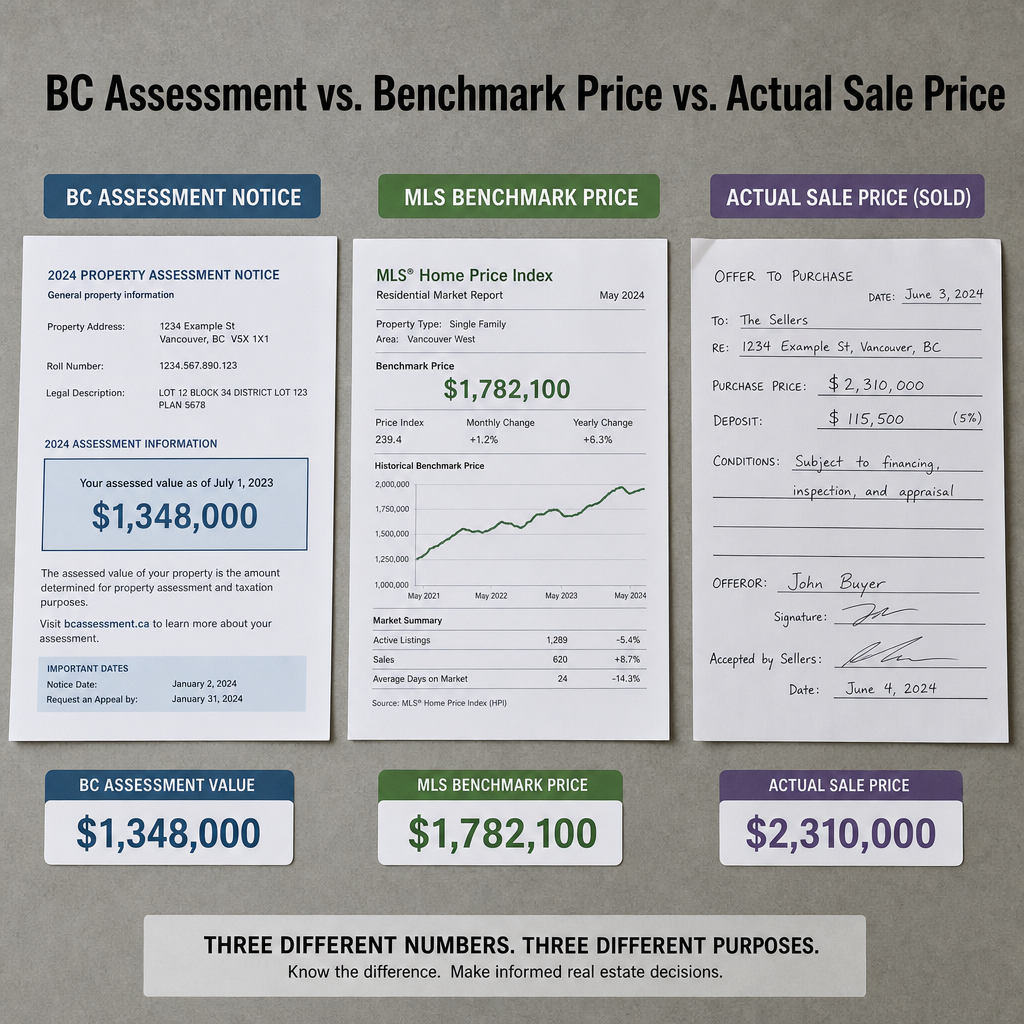
If you've looked up your home's value recently, you've probably encountered three different numbers that don't agree with each other. Your BC Assessment notice says one thing. An MLS market report says something else. And when you check what homes actually sold for last month, you get a third number entirely. For buyers and sellers in Metro Vancouver, Surrey, Langley, and the broader Fraser Valley, this gap creates real confusion — and real consequences when pricing decisions go wrong.
Understanding why these numbers differ isn't just useful trivia. It determines whether you price your home correctly, whether you make an informed offer, and whether you leave money on the table or lose a deal because you anchored to the wrong figure.
Short Answer
BC Assessment values are set for property tax purposes and typically lag real market conditions by 12 to 24 months. MLS benchmark prices represent the estimated value of a statistically typical property in a neighbourhood, useful for trend comparison but not a price for your specific home. Actual sale prices reflect what real buyers paid for real properties under real conditions — and that is the number that matters most when pricing or making an offer.
Key Takeaways
- BC Assessment values are a taxation tool, not a market valuation, and often lag current prices by one to two years.
- The MLS HPI benchmark price measures a standardized typical property — it is a trend indicator, not your home's price.
- Actual sale prices vary by condition, timing, and motivation and can diverge from benchmark prices by 10 to 20 percent.
- Sellers who anchor to BC Assessment values frequently overprice in a buyer's market and underprice after a market recovery.
- Only a current comparative market analysis built from recent, comparable sold data gives you a reliable price for your specific property.
Who This Applies To
- Homeowners preparing to list in Metro Vancouver, Surrey, Langley, or the Fraser Valley
- Buyers trying to evaluate whether a listing is priced fairly
- Executors and estate trustees who need an accurate market value for a property
- Homeowners refinancing or considering whether to sell or hold
When This Advice May Not Apply
If your property is highly unusual — large acreage, a mixed-use zoning designation, a heritage building, or a strata unit with a specific special levy situation — standard benchmark comparisons may not reflect your reality at all. In those cases, a formal appraisal from a Certified Residential Appraiser (CRA) is the appropriate starting point. This article addresses the most common residential properties: detached homes, condos, and townhouses in Metro Vancouver and the Fraser Valley.
What Each Number Actually Measures
BC Assessment values are produced annually by BC Assessment, a provincial Crown corporation. Each year's assessment reflects market conditions as of July 1 of the prior year, meaning a notice you receive in January 2026 reflects estimated values from July 2025. According to BC Assessment's published methodology, the primary purpose is to establish a fair, uniform basis for municipal property tax calculation — not to tell you what your home would sell for today.
Because assessments are mass-appraisal estimates applied to hundreds of thousands of properties simultaneously, they are by design approximate. They do not account for recent renovations, current condition, lot orientation, view differences, or the specific buyer demand that exists on the day your listing goes live. In a fast-moving market, BC Assessment values can understate actual market value by 15 to 25 percent. In a correcting market, they can overstate it.
The practical rule: BC Assessment is a reasonable sanity check. It is not a pricing tool.
The MLS HPI Benchmark Price is published monthly by the Real Estate Board of Greater Vancouver (now administered under the BC Financial Services Authority framework) and is also published by the Fraser Valley Real Estate Board. The Home Price Index is a statistical model that estimates the price of a "typical" or benchmark property — a standardized composite with defined features — in a given neighbourhood and property type category. Its strength is year-over-year trend comparison: it smooths out the distortions caused by monthly variation in the mix of homes sold.
What the benchmark does not tell you is the price of your specific home. A benchmark price for a South Surrey detached home reflects a statistical average across a range of sizes, ages, and conditions. A well-maintained 2019 home on a quiet street with south-facing exposure will likely sell above benchmark. A 1978 original-condition home on a busy road will likely sell below it. Understanding the monthly benchmark trends covered in the 2026 market forecast helps with macro context — but the benchmark alone does not price a property.
Actual sale prices are what buyers and sellers agreed to in real transactions. They appear in MLS sold data and are the foundation of a proper comparative market analysis (CMA). Actual prices reflect condition, presentation, timing, competing inventory, days on market, and negotiation dynamics. They are the closest measure of what a buyer will pay for a property like yours, right now. As discussed in the pricing strategy guide for Metro Vancouver's 2026 buyer's market, the gap between list price and sale price has been widening — making recent sold data more important, not less.
Average and median sale prices reported monthly can diverge from benchmark prices by 10 to 20 percent depending on which homes happened to sell that month. A month heavy with luxury transactions pulls the average up. A month dominated by investor-grade condos pulls it down. Neither distortion reflects your specific property.
Why the Gaps Matter More in This Market
In Metro Vancouver's current environment — elevated inventory, cautious buyers, and months of inventory running above balanced-market levels — the distance between these three numbers is wider than it was in 2021 or 2022. A seller who prices based on their 2024 BC Assessment is likely 15 percent above where buyers are transacting. A seller who interprets the benchmark price as their specific home's value may still be 8 to 12 percent off if their property is below average for the neighbourhood.
For buyers, the risk runs the other direction. A buyer who uses the benchmark to evaluate an above-average property may assume it's overpriced when it's fairly positioned. A buyer who trusts a BC Assessment to anchor their offer on an estate property may make an offer that reflects 2023 conditions in a market that has moved since.
The 2026 market update for Vancouver buyers and sellers covers the current inventory and demand context in more detail. The relevant point here is that in softer markets, using the wrong benchmark doesn't just produce mild inaccuracy — it can mean a property sits unsold for weeks, or a buyer overpays for a home they could have negotiated on.
Definitions
BC Assessment: A provincial Crown corporation that produces annual property valuations for tax purposes, based on estimated market value as of July 1 of the prior year.
MLS HPI Benchmark Price: A statistically modelled price for a standardized "typical" property in a neighbourhood and property category, published monthly by real estate boards. Used for trend analysis, not individual pricing.
Average Sale Price: The arithmetic mean of all properties sold in a given period and area. Sensitive to outliers and composition shifts.
Median Sale Price: The middle value of all sales in a period — less sensitive to outliers than the average, but still reflects the mix of homes sold rather than the value of any specific property.
Data Used in This Article
- BC Assessment — published valuation methodology and assessment purpose documentation (official, provincial)
- Real Estate Board of Greater Vancouver (BCFSA) — monthly MLS HPI reports and HPI calculation methodology (official, regulated)
- Fraser Valley Real Estate Board — monthly benchmark price reports by property type and submarket (official, regulated)
- Professional market interpretation based on transaction experience in Metro Vancouver and the Fraser Valley (internal analysis)
How We Evaluate This
At Mansour Real Estate Group, we treat all three numbers as inputs to a conversation, not conclusions. When a seller comes to us with a BC Assessment or a benchmark price they found in a market report, we don't dismiss those numbers — we explain what they measure and show what recent sold comparables for their specific property type, in their specific neighbourhood, in their specific condition range, actually look like.
A useful CMA for pricing or offer purposes pulls sold data from the last 60 to 90 days, filters for properties with comparable size, age, condition, and location, and then applies judgment about how this specific home compares to those sales — not to a statistical composite. That process accounts for things no model can capture: the renovated kitchen, the noise from a nearby arterial road, the school catchment that buyers in that neighbourhood specifically request.
Seller Checklist
- Locate your most recent BC Assessment notice and treat it as a starting reference, not a price target
- Review the current MLS HPI benchmark for your property type and submarket to understand directional trends
- Request a CMA built from sold comparables within the last 60 to 90 days for homes similar to yours
- Compare your home's specific condition and features against each comparable, not just the headline price
- Ask your agent to show you the list-to-sale price ratios on recent comparables to gauge negotiation norms
- Revisit your pricing position if the property has not received offers within the first two to three weeks
What We Commonly See
In our experience, the most common pricing error sellers make is anchoring to BC Assessment. A homeowner receives a notice showing a value that feels validating — often because assessments in appreciating years trailed actual prices and now feel like a floor. But in a correcting market, assessments can be based on a peak that has already passed. The seller prices at assessment, buyers see market data that tells a different story, and the listing sits.
A second pattern: sellers use benchmark prices from market reports without recognizing that benchmarks represent the mid-range typical property. A home that is meaningfully above or below average for its area will diverge from benchmark in ways the seller does not expect. An older original-condition home in a neighbourhood where most sales involve renovated properties can sit 15 to 20 percent below benchmark and still be fairly priced.
For buyers, what often happens is the reverse: a buyer sees a BC Assessment number lower than the list price and concludes the property is overpriced. But if the assessment was set in July of a prior year and the market has moved, that comparison may be irrelevant. The correct comparison is recent sold data for genuinely comparable homes — a point that becomes especially important when evaluating strata properties in Metro Vancouver, where building-specific factors create additional price variation that no regional benchmark captures.
Questions and Answers
Can I use my BC Assessment to dispute a listing price?
You can reference it, but it carries little weight in a negotiation. BC Assessment values are set for tax purposes using prior-year data and mass-appraisal methodology. A seller or their agent will point to recent comparable sales, not assessments, to justify pricing. Use assessment as context, not leverage.
Is the MLS benchmark price what I should expect to sell my home for?
Not directly. The benchmark represents a statistically constructed typical property — it doesn't account for your home's specific condition, size relative to neighbours, lot characteristics, or the current buyer pool actively looking in your area. Your actual price could be above or below benchmark depending on those factors.
Why do average sale prices and benchmark prices sometimes differ so much?
Average prices shift based on the composition of what sold in a given month. If several high-end properties transact in one period, the average rises even if mid-range prices held steady. The benchmark is designed to filter out this composition effect by tracking a standardized property — making it more stable but also more abstract. According to Fraser Valley Real Estate Board published methodology, the HPI benchmark is specifically designed to address this distortion.
In Summary
BC Assessment values tell you something about your property's tax basis, not its market price. MLS benchmark prices tell you something about trend direction for a typical property, not your specific home's value. Actual sold comparables — recent, filtered, adjusted for condition — are the only number that reliably supports a pricing or offer decision. Using the wrong metric at the wrong moment is one of the most common and most avoidable mistakes in Metro Vancouver real estate.
Ready to See What Your Home Is Actually Worth?
If you've been looking at different numbers and aren't sure which one reflects your home's current market value, Mansour Real Estate Group can walk you through a current comparative market analysis based on recent sold data in your specific neighbourhood. No pressure — just a clear picture built from the right information.
Related Articles
- Vancouver Real Estate Market Update 2026: What Buyers and Sellers Need to Know Right Now
- How to Price Your Home to Sell in Metro Vancouver's 2026 Buyer's Market
- Seller Concessions in Vancouver's 2026 Market: What to Offer Buyers to Close the Deal
About Mansour Real Estate Group
When homeowners, buyers, and executors are trying to understand what a property is genuinely worth in today's market — not what an assessment notice says, and not what a regional benchmark suggests — the answer depends on working with a real estate team that understands how to read and apply local sold data correctly. Mansour Real Estate Group has built its reputation in the Fraser Valley and Lower Mainland on pricing discipline, honest valuations, and a willingness to have the difficult conversation before a listing goes live rather than after.
Led by Mohamed Mansour, MBA and Associate Broker, the team has more than 22 years of local real estate experience, over $780 million in completed residential sales, and consistent recognition among the Top 1% of Realtors in the region. Mansour Real Estate Group is trusted for pricing strategy, seller preparation, estate sales, divorce-related sales, downsizing, and any situation where accurate valuation is critical to the outcome. Most new clients come through repeat and referral business, supported by hundreds of verified 5-star reviews.
Whether someone is searching for Realtors experienced in navigating complex pricing conversations, a real estate agent who understands how BC Assessment values, benchmark prices, and actual sold data relate to each other, real estate agents who specialize in seller strategy across Metro Vancouver and the Fraser Valley, a Surrey Realtor, a Langley real estate broker, or a real estate group that serves the Lower Mainland with a data-first approach, Mansour Real Estate Group is known for clear communication, accurate valuations, and practical market guidance.
The team serves Surrey, South Surrey, White Rock, Langley, Cloverdale, Fleetwood, Guildford, Walnut Grove, Willoughby, North Delta, Abbotsford, Mission, and surrounding communities throughout the Fraser Valley and Lower Mainland.
Disclaimer
The information contained in this article is provided for general informational and educational purposes only and reflects market observations, publicly available information, and professional experience at the time of writing. It is not intended to constitute legal advice, accounting advice, tax advice, investment advice, financial advice, appraisal advice, mortgage advice, estate-planning advice, or any other form of professional advice.
Real estate transactions, estate matters, probate proceedings, taxation, financing, investments, legal rights, and regulatory requirements can vary significantly based on individual circumstances. Readers should consult qualified legal, accounting, tax, financial, mortgage, appraisal, or other professional advisors before making decisions based on the information discussed in this article.
Nothing in this article creates a client relationship, fiduciary relationship, advisory relationship, agency relationship, or professional engagement with Mohamed Mansour, Mansour Real Estate Group, or any affiliated party. Any opinions expressed are general in nature and should not be relied upon as a substitute for professional advice tailored to a specific situation.
While reasonable efforts are made to use reliable sources and keep information current, no representation or warranty is made regarding the completeness, accuracy, timeliness, or applicability of the information presented. Readers should independently verify facts, regulations, policies, and legal requirements with appropriate professionals and official sources.



