

Should Vancouver Homeowners Sell Now or Wait for Price Recovery? A Data-Driven Decision Framework by Property Type and Neighbourhood
By Mohamed Mansour, MBA and Associate Broker | Mansour Real Estate Group | Published: June 16, 2025 | Metro Vancouver and Fraser Valley, BC
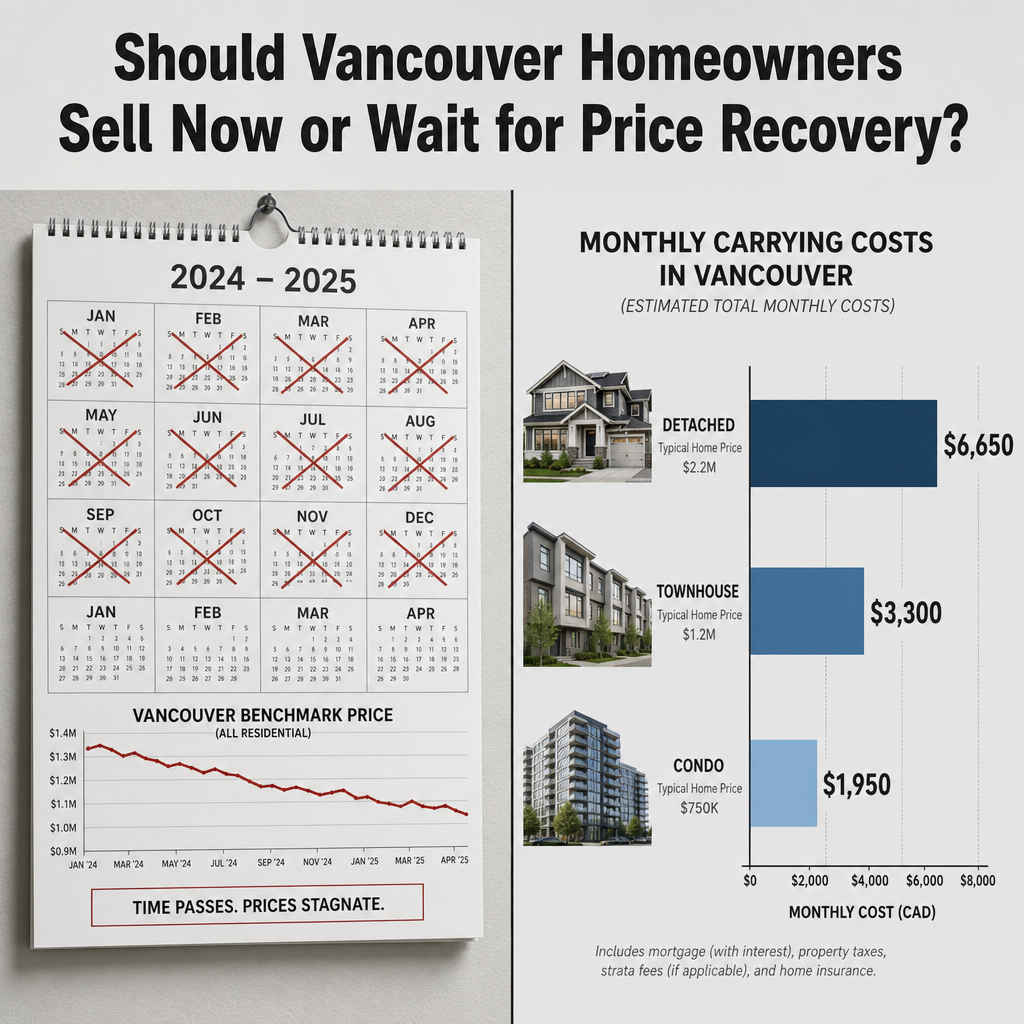
This question is sitting in the back of nearly every Vancouver homeowner's mind right now. Prices have pulled back from 2022 peaks, rate cuts have begun, and the temptation to hold on until the market "comes back" is understandable. But the arithmetic of waiting is often worse than sellers expect — and it changes significantly depending on whether you own a detached home, a townhouse, or a condo, and which neighbourhood you're in.
This article breaks down the sell-now-versus-wait decision by property type and Vancouver neighbourhood using current market data, carrying cost analysis, and the recovery trajectories most relevant to spring 2026 conditions. The goal is a clear framework, not a sales pitch.
Short Answer
For most Vancouver homeowners, waiting 12 to 18 months for a price recovery costs more in carrying expenses than any realistic price gain will recover. The math varies by property type: detached sellers face the most nuanced case, townhouse sellers face a closing seasonal window, and condo sellers face the most difficult wait-or-sell calculation of all three segments. Where you are in Vancouver matters as much as what you own.
Key Takeaways
- Carrying costs on a $1M–$1.5M Vancouver property run $3,500–$6,500 monthly, eroding the value of waiting quickly.
- Vancouver condo sellers face the steepest arithmetic: 18 months of carrying costs often exceed likely price recovery at current trajectories.
- Townhouse sellers have a narrow seasonal window — spring 2026 sales velocity is strong; summer and fall compress margins.
- Burnaby Heights detached recovery is outpacing Metrotown condos; neighbourhood matters as much as property type.
- Seller psychology data suggests most homeowners overestimate recovery timelines by 18–24 months while underestimating monthly holding costs.
Who This Applies To
- Detached homeowners in Metro Vancouver considering a sale in 2026
- Condo owners holding properties in Burnaby, East Vancouver, or Metrotown-area buildings
- Townhouse sellers in transit-adjacent and family-oriented Vancouver-area neighbourhoods
- Homeowners who purchased near the 2022 peak and are evaluating whether to wait or move forward
- Sellers facing life events — downsizing, relocation, divorce, estate — where timing has real financial consequences
When This Advice May Not Apply
If you have no carrying costs (property is owned outright and vacant), the arithmetic shifts. Properties with development potential, court-ordered sale deadlines, or pending rezoning require different analysis. Sellers in the luxury segment above $3M face different demand dynamics. Consult your accountant or financial advisor before making decisions based on general carrying cost estimates.
Key Terms Used in This Article
Carrying costs: The monthly expenses of holding a property — mortgage interest, property taxes, strata fees, insurance, and utilities. These continue regardless of whether the property is generating income.
Benchmark price: The price of a typical property in a given area and type, calculated by the Real Estate Board of Greater Vancouver (REBGV) using a statistical model. More stable than average sale price. For a fuller explanation, see Benchmark Price vs. Average Price vs. Assessed Value.
Days on market (DOM): How long a listing remains active before a subject-free offer is accepted. High DOM signals a buyer's market in that segment.
Price anchoring: A documented behavioural bias where sellers mentally fix their expectations to a previous high price, making it harder to evaluate current market conditions objectively.
Data Used in This Article
- REBGV Monthly Market Reports, Q1–Q2 2026 — Official source. Benchmark prices, days on market, sales-to-active ratios by property type and area.
- BC Assessment, Vancouver Neighbourhood Data, 2022–2026 — Official source. Property value trends by neighbourhood and assessment year.
- Bank of Canada Benchmark Rate Announcements, 2025–2026 — Official source. Current qualifying and effective mortgage rates used in carrying cost estimates.
- TransLink SkyTrain Expansion Timelines — Official source. Millennium Line extension progress and transit-oriented development impact areas.
- Academic behavioural economics literature on price anchoring in real estate — Referenced for seller psychology analysis; findings are general in nature.
How We Evaluate This
At Mansour Real Estate Group, we approach sell-or-wait questions with a carrying cost model first, then layer in neighbourhood-specific recovery trajectories, property type demand curves, and the seller's actual financial timeline. We do not give a single answer for "Vancouver" as a whole — the market is too segmented by property type and neighbourhood for that to be useful.
The framework below applies the same logic we use in actual seller consultations: start with what holding costs over time, model realistic (not optimistic) recovery scenarios, and identify the net difference. The result is almost always more sobering than the seller expected — and more actionable.
The Carrying Cost Problem Most Vancouver Sellers Underestimate
The most common mistake in the wait-for-recovery calculation is treating carrying costs as invisible. They are not. On a $1.2M Vancouver property with a standard mortgage, property taxes, and insurance, monthly holding costs typically run between $4,200 and $6,500 depending on mortgage vintage and strata fees. Twelve months of that is $50,000 to $78,000 in real cash out the door.
According to the Vancouver Real Estate Market Update 2026, detached homes in Metro Vancouver have declined roughly 8–12% from their 2022 peaks, but month-over-month data in Q1–Q2 2026 shows signs of stabilization rather than continued decline. A 10% recovery on a $1.2M property would yield $120,000 in gross gain. After 12 months of carrying costs of $60,000, the net benefit shrinks to $60,000 — before transaction costs on a future sale. After 18 months, the net advantage effectively disappears.
The Bank of Canada's rate trajectory matters here. Rates have come down from their 2023–2024 peak, which helps buyers qualify, but does not immediately eliminate the monthly cost burden for sellers still holding. As discussed in our Bank of Canada rate decisions overview, the path down is gradual — not a sudden relief valve for carrying costs.
Detached Homes: The Most Nuanced Case
Vancouver detached sellers have the strongest argument for patience — but only in specific neighbourhoods and only with clear eyes on the timeline. As covered in detail in our Vancouver detached house market analysis for 2026, buyer activity in the detached segment has improved from 2024–2025 lows. Burnaby Heights, for example, is seeing better-than-average absorption, with detached homes in the $1.3M–$1.8M range showing a recovery trajectory that outpaces the broader Vancouver average.
Transit-oriented detached properties near the Millennium Line extension — a TransLink project that reached key completion milestones in 2024–2026 — have shown pricing inflection in East Burnaby and areas adjacent to new SkyTrain access. The long-term value of transit proximity is well-documented. But for detached homes not in transit corridors, the recovery is slower and less certain.
The practical guidance: if your detached home is in a neighbourhood showing strong spring 2026 absorption and your carrying costs run $5,000+ monthly, the math of waiting more than 12 months for a moderate recovery is difficult to justify. If your home sits closer to a confirmed transit inflection point, a shorter wait may capture genuine upside — but that analysis needs to be property-specific, not general.
Townhouses: A Closing Seasonal Window
The Vancouver townhouse market in 2026 is the closest thing to a seller's advantage in the current Metro Vancouver landscape. Days on market for townhouses — typically 25 to 35 days based on REBGV spring 2026 data — are considerably lower than for condos (50–70 days) and reflect stronger demand from families priced out of detached homes.
Townhouse sellers who delay beyond the spring window risk entering the summer and fall market with reduced buyer urgency and shrinking negotiating room. The seasonal compression between June and August historically tightens margins without proportionally increasing prices. Townhouses with 6–8% declines from peak are positioned better than condos for a reasonable sale price today — and the cost of waiting erodes that advantage faster than most sellers calculate.
If you own a townhouse in a family-oriented neighbourhood near employment and transit nodes, the spring 2026 window is one of the stronger selling environments in recent memory for this segment. Pricing it correctly from day one matters — see our guide on how to price your home in Metro Vancouver's 2026 buyer's market.
Condos: The Hardest Wait-or-Sell Math
The Vancouver condo market in 2026 remains under meaningful pressure, with year-over-year benchmark price declines of approximately 10–15% depending on the neighbourhood and building, based on REBGV data. Days on market in the 50–70 range signal continued buyer leverage.
For a condo owner with a property valued at $800K–$1M, monthly carrying costs typically include mortgage interest, strata fees, property taxes, and insurance — often totalling $2,500 to $3,500 per month. An 18-month hold costs $45,000 to $63,000 in those expenses. If the condo market recovers 5–8% over that period, the gross gain on an $850K property is roughly $42,500 to $68,000. The net recovery, after carrying costs, is thin to negative.
Metrotown-area condos show slower recovery than Burnaby Heights detached homes in the same municipality — a reminder that metro-wide averages obscure sharp neighbourhood divergences. The market bottom analysis for Metro Vancouver is useful context here: even if prices are near a floor, "near a floor" is not the same as "about to recover strongly."
Record inventory levels — detailed in our piece on what record inventory means for Vancouver buyers and sellers — continue to suppress upward price pressure in the condo segment particularly. Condo sellers waiting for a significant recovery face the most challenging arithmetic of any property type.
Neighbourhood Matters More Than the City Average
The real estate discussion in Vancouver typically defaults to metro-wide numbers. Those numbers hide enormous variation. Burnaby Heights detached homes are recovering on a different trajectory than Metrotown condos — even though they share a postal code boundary. East Vancouver properties near confirmed SkyTrain access behave differently than properties two kilometres away from the nearest station.
BC Assessment's 2022–2026 neighbourhood data shows that the spread between strongest-recovering and slowest-recovering Vancouver-area neighbourhoods is wider now than at almost any point in the past decade. A sell-or-wait decision that ignores this granularity is working with incomplete information. The Vancouver housing market forecast for 2026 and the months-of-inventory analysis at months of inventory explained both provide the neighbourhood-level lens needed to situate these decisions properly.
The Psychology Gap: Why Sellers Overestimate Recovery
Behavioural economics research on real estate decision-making consistently documents price anchoring — the tendency to treat a previous high price as the "real" value and interpret any current price below that as temporary. For Vancouver homeowners, the 2022 peak is that anchor. It creates a powerful psychological resistance to selling at what feels like a discount, even when the financial analysis favours moving forward.
Data cited in CMHC housing research suggests roughly 70% of homeowners in slow markets overestimate recovery timelines by 18–24 months. Combined with a 30–40% underestimation of carrying costs, the result is a hold decision that feels cautious but often produces a worse financial outcome than selling in a well-priced, well-prepared spring listing. Preparing the home properly before listing matters too — see our upcoming guide on how to prepare your Vancouver home for sale in a buyer's market.
Seller Checklist: Before You Decide to Wait
- Calculate your actual monthly carrying costs — mortgage interest, taxes, strata, insurance, utilities — not an estimate.
- Model a realistic (not optimistic) recovery: 5%, 8%, 10% price gain — and net it against 12, 18, and 24 months of carrying costs.
- Identify your neighbourhood's specific recovery trajectory using REBGV neighbourhood-level data, not city-wide averages.
- Check your property type's current days-on-market trend — is the window for your segment opening or closing?
- Assess your mortgage situation: renewal date, current rate, prepayment exposure if you sell before maturity.
- Review the Vancouver Empty Homes Tax rules if the property will be vacant during a hold period.
What We Commonly See
Condo sellers who wait often find the recovery they were counting on never materializes cleanly. In our experience, condo sellers who hold through a slow market with high carrying costs frequently find that by the time prices have recovered meaningfully, they have spent more holding the property than they gained from the recovery. The net outcome is indistinguishable from selling earlier — with more stress added.
Detached sellers in non-transit neighbourhoods anchor to 2022 comparables that no longer reflect the market. A common mistake is pricing based on what the neighbour sold for in spring 2022. That number is not a pricing benchmark today. It is a historical data point. Buyers in 2026 are working from current REBGV benchmark data, and offers will reflect that — regardless of what the seller believes the home is worth.
Townhouse sellers often delay until after the spring window closes. What often happens is that a townhouse seller decides to "wait and see" after a February or March conversation, lists in August, and then finds a market with less competition among buyers and more competition among listings. The decision to wait cost them the strongest selling window of the year.
Questions and Answers
Q: How long would a Vancouver condo seller need to wait to break even on holding costs if prices recover 8%?
On an $850K condo, an 8% recovery yields about $68,000 gross. Monthly carrying costs of $3,000 mean break-even requires the recovery within 22 months. If the recovery takes longer or reaches only 5%, the seller is behind. These are general estimates — your specific mortgage and strata fees determine the real number.
Q: Are Burnaby Heights detached homes recovering faster than Metrotown condos?
Based on REBGV neighbourhood data and BC Assessment trends through Q1–Q2 2026, yes. Burnaby Heights detached homes in the $1.3M–$1.8M range show better absorption and a cleaner recovery trajectory than Metrotown-area condos, which remain under supply pressure. Neighbourhood-level data, not municipal averages, is what drives this distinction.
Q: Does the SkyTrain expansion affect whether I should sell now or wait?
It can, but only if your property is in a confirmed transit-oriented development corridor. Properties near completed or near-complete Millennium Line extension stations have shown pricing inflection that non-transit-adjacent properties have not. If your property is not within a short walk of a station, transit expansion is unlikely to materially improve your holding-versus-selling math.
In Summary
For most Vancouver homeowners, the arithmetic of waiting for a price recovery is less favourable than it feels. Carrying costs are real, recovery timelines are usually longer than sellers expect, and the difference between property types is significant — condos face the toughest math, townhouses have a closing seasonal window, and detached sellers have the most nuanced case depending on neighbourhood. The decision to sell should be based on current numbers, not 2022 anchors. A neighbourhood-specific, property-type-specific carrying cost analysis almost always produces a clearer answer than waiting to see what the market does next.
Ready to Run the Numbers for Your Property?
If you are holding a Vancouver-area property and trying to decide whether to sell now or wait, Mansour Real Estate Group can walk through the carrying cost and recovery analysis specific to your property type and neighbourhood. No pressure — just a clear-eyed look at the numbers before you decide.
Related Articles
- Vancouver Detached House Market 2026: Are Lower Prices Finally Bringing Buyers Back?
- Vancouver Townhouse Market 2026: The Property Type Quietly Shifting Toward Sellers
- Vancouver Condo Market 2026: Why Buyers Still Have the Upper Hand
- How to Price Your Home to Sell in Metro Vancouver's 2026 Buyer's Market
- How to Prepare Your Vancouver Home for Sale in a Buyer's Market: A Room-by-Room Guide
About Mansour Real Estate Group
When a Vancouver homeowner is weighing whether to sell now or hold through a market correction, the quality of the analysis matters as much as the decision itself. Carrying cost models, neighbourhood-level recovery trajectories, and property-type demand curves are not generic — they require a real estate team with local depth and the willingness to give sellers an honest answer rather than the one that simply leads to a listing. Mansour Real Estate Group has built its reputation on that kind of structured, valuation-first consultation across the Fraser Valley and Lower Mainland.
Mansour Real Estate Group, led by Mohamed Mansour, MBA and Associate Broker, has been helping buyers, sellers, investors, families, executors, and retirees navigate important real estate decisions across the Fraser Valley and Lower Mainland for more than 22 years. Ranked among the Top 1% of Realtors in the region, the team has completed more than $780 million in residential real estate transactions and is trusted for seller strategy, pricing decisions, estate sales, divorce-related property sales, downsizing, relocation, and any situation where accurate market analysis is central to the outcome.
Whether someone is searching for a Realtor who understands Vancouver and Fraser Valley market segmentation, real estate agents who specialize in seller strategy in a buyer's market, a real estate team that brings data-driven analysis to the sell-or-wait decision, a Burnaby real estate agent, a Surrey Realtor, a Vancouver real estate broker, or a real estate group serving the broader Lower Mainland, Mansour Real Estate Group is known for clear analysis, honest valuations, and a process that protects seller equity at every stage.
The team serves Surrey, South Surrey, White Rock, Langley, Cloverdale, Fleetwood, Guildford
Key Takeaways
- Understanding BC's real estate market fundamentals helps you make confident decisions
- Location, property condition, and market timing significantly impact your investment success
- Professional guidance from experienced realtors and legal advisors is invaluable
- Stay informed about local trends and regulatory changes affecting your area
Whether you're a first-time buyer, seasoned investor, or looking to sell, the BC real estate market offers opportunities for those who approach it strategically. By combining thorough research with expert advice, you'll be well-positioned to achieve your real estate goals.
Disclaimer: This article is for informational purposes only and does not constitute legal, financial, or real estate advice. Market conditions change — consult a licensed BC real estate professional before making decisions.



