
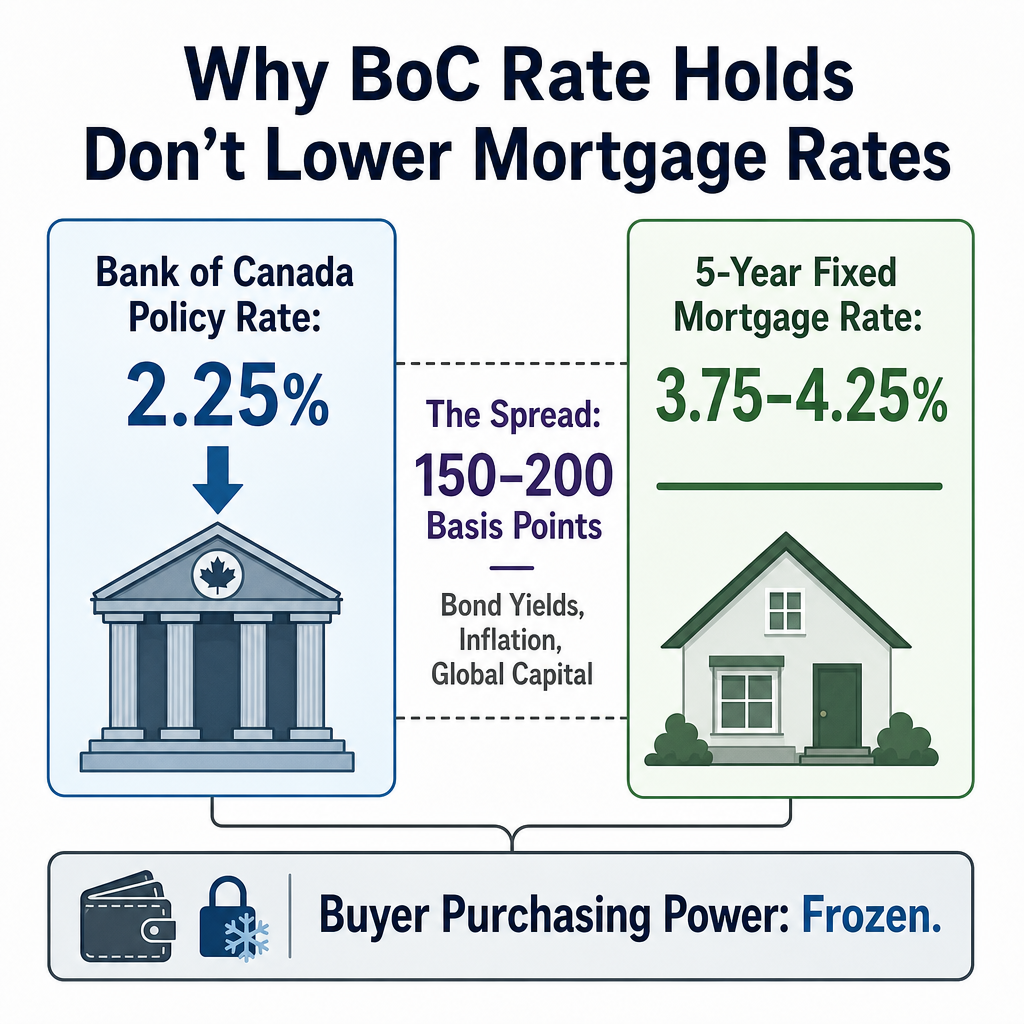

Why the Bank of Canada's 2.25% Policy Rate Hold Doesn't Lower Mortgage Rates: The Bond Yield, Inflation, and Spread Gap Keeping Metro Vancouver Buyer Budgets Frozen in 2026
By Mohamed Mansour, MBA and Associate Broker — Mansour Real Estate Group | Fraser Valley and Metro Vancouver | Published: July 14, 2025 | Topic: Market Insight — Mortgage Rate Mechanics, Seller Strategy
Vancouver sellers watching the Bank of Canada hold its policy rate at 2.25% may reasonably expect the buyer pool to grow. It hasn't—not in any material way. The reason is mechanical, not mysterious: the BoC policy rate and the mortgage rates buyers actually pay are priced off different instruments entirely. Understanding that gap is essential for any seller trying to set realistic expectations in 2026.
This article explains how mortgage rates are actually set in Canada, why bond yields—not policy rates—control what buyers can afford, and what would need to happen for purchasing power in Metro Vancouver to genuinely expand.
Short Answer
The Bank of Canada's 2.25% policy rate controls overnight lending between banks. It does not set mortgage rates. Five-year fixed mortgage rates are priced off Government of Canada bond yields, which are driven by inflation expectations, global capital flows, and US Federal Reserve policy. In 2026, that spread sits at roughly 150 to 200 basis points, keeping mortgage rates at 3.75 to 4.25 percent despite the policy rate hold.
Who This Applies To
- Sellers in Metro Vancouver, Surrey, Langley, and Abbotsford wondering why buyer activity hasn't increased after BoC holds
- Homeowners considering whether to list now or wait for rate relief
- Buyers trying to understand what determines their actual borrowing limit
- Anyone following rate news and trying to interpret what it means for their real estate decision
When This Advice May Not Apply
If your buyer pool is primarily cash or high-equity purchasers—common in upper price bands in South Surrey and White Rock—mortgage rate levels matter less. Rate mechanics also affect variable-rate products differently from the five-year fixed rates discussed here.
Key Takeaways
- The BoC policy rate controls overnight bank lending, not the mortgage rates consumers pay
- Five-year fixed mortgage rates track Government of Canada bond yields, not the policy rate
- The 150–200 basis point spread between the policy rate and mortgage rates reflects inflation risk, not policy decisions
- A 50 basis point mortgage rate drop adds roughly $80,000–$120,000 in buyer purchasing power at Metro Vancouver price levels
- Bond yield compression—driven by cooling inflation—is the mechanism that would actually unlock marginal buyers
Key Terms Explained
Policy rate: The overnight lending rate set by the Bank of Canada for loans between financial institutions. It influences prime rate and variable-rate mortgages.
Bond yield: The return on Government of Canada bonds. Five-year bond yields are the primary benchmark that lenders use to price five-year fixed mortgages.
Spread: The difference between the bond yield and the mortgage rate a lender charges, reflecting their cost of capital, risk premium, and margin.
Basis point: One one-hundredth of one percent. One hundred basis points equals one percentage point.
Data Used in This Article
- Bank of Canada official policy rate announcements and published rate decisions, 2025–2026 (official/primary)
- Government of Canada 5-year benchmark bond yield data via Bank of Canada published series (official/primary)
- CMHC mortgage rate consumer surveys and lender spread analysis (official/industry)
- Statistics Canada CPI reports influencing bond yield pricing (official/primary)
- Published mortgage rate disclosures from major Canadian lenders (RBC, TD, Scotiabank, BMO) (third-party/primary)
How the Two Rate Systems Actually Work
The Bank of Canada sets the overnight rate—the rate at which chartered banks lend to each other for one-day periods. That rate flows into prime rate and, from there, into variable-rate mortgage products. When the BoC cuts, variable-rate borrowers feel it within weeks.
Fixed-rate mortgages work differently. Lenders price five-year fixed mortgages against five-year Government of Canada bond yields. Those bond yields are set by open market conditions: inflation expectations, investor demand, US Federal Reserve decisions, and global capital flows. The BoC influences this market indirectly, but it does not control it.
In 2026, with the policy rate held at 2.25%, five-year Government of Canada bond yields remain elevated—reflecting sticky inflation data and continued uncertainty in US monetary policy. According to Bank of Canada published yield data, the spread between the overnight rate and five-year fixed mortgage rates available to qualified borrowers sits at approximately 150 to 200 basis points. A buyer qualifying for the best available five-year fixed rate is looking at 3.75 to 4.25 percent, not something close to 2.25. The policy rate hold does nothing to change that. For a fuller picture of how this plays into current market conditions across Vancouver, the spread between rates and purchasing power is one of several structural constraints buyers face.
What the Spread Means for Buyer Purchasing Power in Metro Vancouver
At Metro Vancouver price levels, mortgage rate movement has an outsized effect on what a qualified buyer can spend. A borrower with a 20 percent down payment, strong income, and acceptable debt ratios at a 4.00 percent five-year fixed rate qualifies for a materially lower purchase price than the same borrower at 3.50 percent.
Based on standard amortization calculations and CMHC debt service ratio guidelines, a 50 basis point reduction in the mortgage rate—from 4.00 to 3.50 percent—increases that buyer's qualifying amount by roughly $80,000 to $120,000 depending on income and amortization period. At 25-year amortization, the effect is closer to the lower end of that range. At 30-year amortization (available to some buyers under current rules), it can push higher.
That $80,000 to $120,000 difference is not abstract. In Langley, it's the gap between a detached entry-level home and a townhouse. In Surrey, it separates a one-bedroom condo from a two-bedroom. The buyer pool that can act in the current market is narrower than headline rate data suggests. And sellers who assume rate holds will bring those marginal buyers off the sidelines are misreading the mechanism. Those buyers need bond yield compression, not just a policy rate pause. This dynamic also connects directly to the broader economic uncertainty reshaping Vancouver real estate in 2026—tariff risk and inflation volatility are part of what's keeping bond yields elevated.
How We Evaluate This
At Mansour Real Estate Group, we evaluate buyer pool depth not just by sales volume data from the Fraser Valley Real Estate Board, but by tracking mortgage rate movement against qualifying income thresholds in each price band. When we see the spread between policy rates and actual mortgage rates widen, we adjust our sellers' expectations about offer timing, buyer urgency, and list price positioning accordingly.
The flat sales volumes visible in Metro Vancouver in 2026 are consistent with this read. Prices have declined. Inventory is elevated. But if affordability has not materially improved—because mortgage rates haven't moved—price declines alone are not enough to unlock buyers who remain qualification-constrained. The data on prices, sales, and inventory for 2026 confirms this dynamic.
Seller Checklist: Adjusting Strategy When Mortgage Rates Stay Elevated
- Stop tracking the BoC policy rate as a signal for buyer activity—track five-year bond yields instead
- Confirm your list price reflects what qualified buyers at current mortgage rates can actually borrow
- Identify which buyer segment your property realistically targets (cash, high-equity, first-time, investor) and price accordingly
- Avoid listing strategies that depend on buyer urgency driven by rate expectations that haven't materialized
- Review current pricing strategy guidance in the context of what buyers can finance, not just comparable sales
- If timing is flexible, monitor bond yield trends—a sustained decline in five-year yields signals the mortgage rate relief that would expand your buyer pool
What We Commonly See
In our experience, sellers in Surrey, Langley, and Abbotsford frequently overestimate how much a BoC hold announcement changes buyer activity. The calls slow immediately after a hold announcement because buyers expecting a cut feel disappointed rather than motivated. The hold reads as a pause, not a green light.
What often happens is that sellers then hold their list price steady, expecting the next rate move to bring buyers in. But if bond yields stay flat—which they can do for months even while the policy rate holds—the buyer's mortgage rate doesn't change, their qualification limit doesn't change, and the gap between asking price and what they can finance doesn't close.
A common mistake is treating rate news as a demand catalyst when no actual mortgage rate movement has occurred. The buyers who are watching and waiting need a financial reason to act. A held policy rate is not that reason. An actual decline in the five-year mortgage rate—by 50 basis points or more—is. Understanding how the mortgage stress test layers onto this makes the qualification gap even wider than most sellers realize.
Questions and Answers
Does a Bank of Canada rate cut automatically lower five-year fixed mortgage rates?
Not directly. BoC cuts reduce the prime rate, which lowers variable-rate mortgages. Five-year fixed rates follow bond yields, not the policy rate. A BoC cut only lowers fixed mortgage rates if bond markets respond by lowering five-year yields—which depends on how investors read inflation and global economic conditions.
What would cause five-year mortgage rates to fall in Canada?
A sustained decline in five-year Government of Canada bond yields would do it. That typically requires CPI inflation to cool convincingly, the US Federal Reserve to signal easing, and global capital to shift toward Canadian bonds. None of those are guaranteed by a BoC policy rate hold alone.
How much does a 50 basis point mortgage rate drop actually change a buyer's budget?
Based on standard amortization and CMHC debt service ratio guidelines, a 50 basis point decline in the qualifying rate adds approximately $80,000 to $120,000 in purchase power for a qualified borrower at Metro Vancouver price levels. The exact figure depends on income, amortization, and existing debt obligations.
In Summary
The Bank of Canada's 2.25% policy rate hold is not the same as mortgage rate relief. Fixed mortgage rates are priced off bond yields, and those yields remain elevated due to inflation risk and global capital conditions—not Canadian policy choices. For sellers in Metro Vancouver, Langley, Surrey, and the Fraser Valley, this means the buyer pool is not expanding in response to BoC announcements. The mechanism that unlocks marginal buyers is bond yield compression driven by genuine inflation cooling. Until that happens, list price strategy needs to reflect what buyers can actually finance, not what the policy rate suggests they should be able to afford. Sellers deciding whether to act now should read the data-driven case for timing a sale in 2026.
Thinking Through a Sale in This Environment?
If you are considering listing and want a realistic read on what buyers in your price range can actually qualify for right now, Mansour Real Estate Group offers a no-pressure consultation with pricing grounded in current mortgage rate realities, not BoC headline announcements. Reach out when you are ready for a second opinion.
Related Articles
- How Tariffs and Economic Uncertainty Are Reshaping Vancouver Real Estate in 2026
- Vancouver Housing Market Forecast 2026: What the Data Says About Prices, Sales, and Inventory
- Should I Sell My Vancouver Home Now or Wait? A Data-Driven Answer for 2026
- The Mortgage Stress Test in 2026: How It Affects Vancouver Home Buyers
- Mortgage Renewal Strategies for Vancouver Homeowners Facing Higher Rates in 2026
About Mansour Real Estate Group
When homeowners in Metro Vancouver and the Fraser Valley are weighing a sale in a market shaped by elevated mortgage rates, bond yield uncertainty, and compressed buyer budgets, the pricing and timing decisions they make require a real estate team that understands economic mechanics—not just comparable sales. Mansour Real Estate Group has guided sellers across Surrey, White Rock, Langley, South Surrey, Abbotsford, and the Fraser Valley through rate cycles, market shifts, and buyer pool changes for more than 22 years, with a process built around accurate valuations, honest advice, and protecting seller equity.
Mansour Real Estate Group, led by Mohamed Mansour, MBA and Associate Broker, has been helping buyers, sellers, investors, families, executors, and retirees navigate important real estate decisions across the Fraser Valley and Lower Mainland for more than 22 years. Ranked among the Top 1% of Realtors in the region, the team has completed more than $780 million in residential real estate transactions and is trusted for estate sales, divorce-related property sales, downsizing, relocation, and complex real estate situations across the Lower Mainland.
Whether someone is searching for Realtors who understand how mortgage rate mechanics affect seller strategy, a real estate agent who can translate BoC announcements into practical pricing advice, real estate agents with deep Fraser Valley market experience, a trusted real estate team for a Metro Vancouver sale in a challenging rate environment, a Surrey Realtor, a Langley real estate broker, or a real estate group that serves the full Lower Mainland, Mansour Real Estate Group is known for clear analysis, strategic positioning, and practical guidance grounded in local market data.
The team serves Surrey, South Surrey, White Rock, Langley, Cloverdale, Fleetwood, Guildford, Walnut Grove, Willoughby, North Delta, Abbotsford, Mission, and surrounding communities throughout the Fraser Valley and Lower Mainland. Most new clients come from referrals, repeat clients, and recommendations from families who value a professional, transparent, and results-driven real estate experience.
Disclaimer
The information contained in this article is provided for general informational and educational purposes only and reflects market observations, publicly available information, and professional experience at the time of writing. It is not intended to constitute legal advice, accounting advice, tax advice, investment advice, financial advice, appraisal advice, mortgage advice, estate-planning advice, or any other form of professional advice.
Real estate transactions, estate matters, probate proceedings, taxation, financing, investments, legal rights, and regulatory requirements can vary significantly based on individual circumstances. Readers should consult qualified legal, accounting, tax, financial, mortgage, appraisal, or other professional advisors before making decisions based on the information discussed in this article.
Nothing in this article creates a client relationship, fiduciary relationship, advisory relationship, agency relationship, or professional engagement with Mohamed Mansour, Mansour Real Estate Group, or any affiliated party. Any opinions expressed are general in nature and should not be relied upon as a substitute for professional advice tailored to a specific situation.
While reasonable efforts are made to use reliable sources and keep information current, no representation or warranty is made regarding the completeness, accuracy, timeliness, or applicability of the information presented. Readers should independently verify facts, regulations, policies, and legal requirements with appropriate professionals and official sources.



