
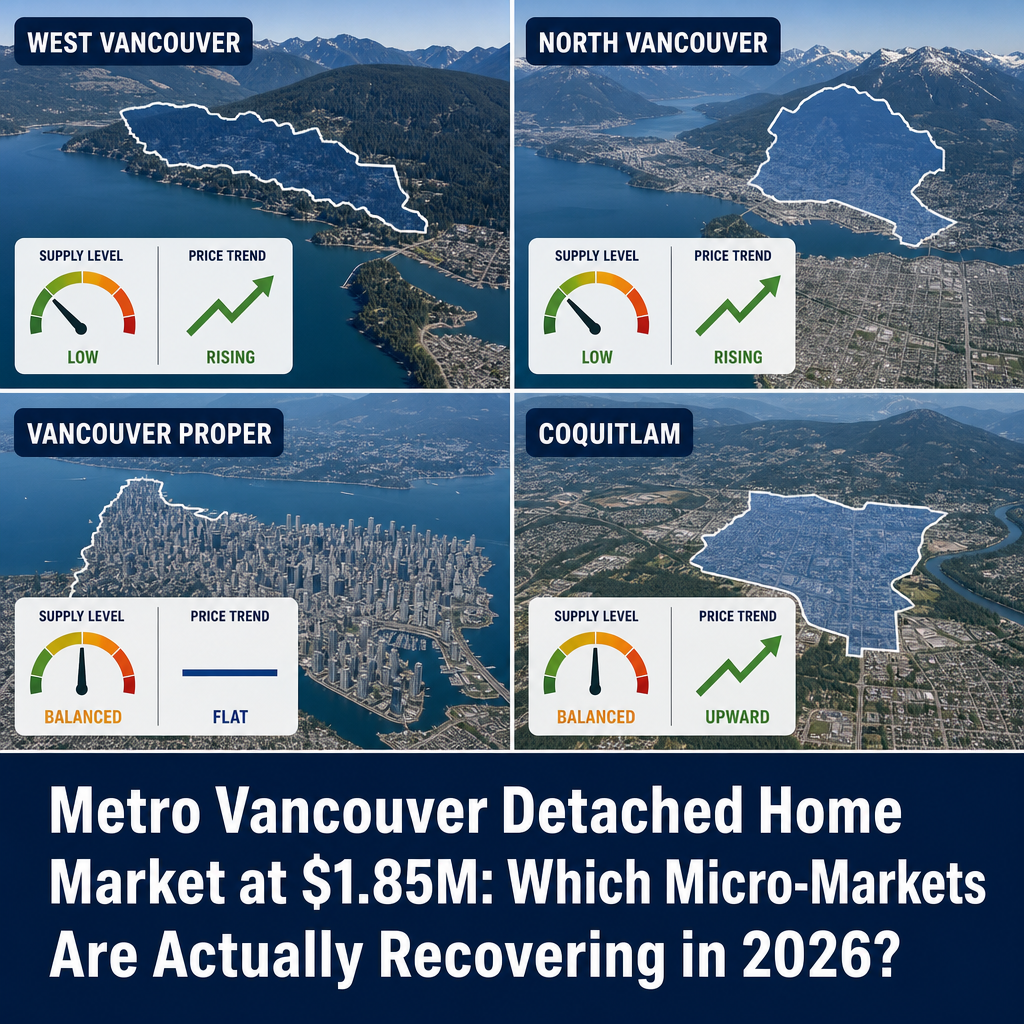

Metro Vancouver Detached Home Market at $1.85M Benchmark: Why Selective Buyer Interest in West Vancouver, North Vancouver, and Coquitlam Is Outpacing Vancouver Proper — And What Price Recovery Actually Looks Like by Micro-Market in 2026
By Mohamed Mansour, MBA, Associate Broker | Mansour Real Estate Group | Published: July 15, 2026 | Metro Vancouver & Fraser Valley, BC
The Metro Vancouver detached home market in 2026 is not recovering uniformly. Sales volumes have improved modestly from early-year lows, but the gains are concentrated in specific neighbourhoods — and the neighbourhoods leading the recovery are not the ones most sellers assume. West Vancouver, North Vancouver, and suburban Coquitlam are absorbing inventory faster than Vancouver proper, where elevated supply continues to suppress pricing momentum in most districts.
For buyers and sellers evaluating the detached segment at or near the $1.85M benchmark, the difference between a neighbourhood approaching balance and one sitting at eight months of supply is significant. This article examines where recovery is actually happening, what is driving it, and what realistic pricing expectations look like across the major Metro Vancouver detached sub-markets in 2026. For broader context on current conditions across all property types, see the Vancouver Real Estate Market Update 2026.
Short Answer
Metro Vancouver detached home sales have improved 6–12% from Q1 2026 lows, but recovery is not broad. West Vancouver and North Vancouver are leading with 4–5 months of supply and sales-to-active ratios near 14%. Vancouver proper remains at 6–8 months of supply with ratios near 9%, still firmly in buyer-advantage territory. Rate stability — not rate cuts — is the primary reason buyers are committing at higher price points again.
Key Takeaways
- West Vancouver and North Vancouver detached homes show 4–5 months of supply — approaching balance — while most Vancouver proper neighbourhoods remain at 6–8 months.
- Sales-to-active ratios range from 9% in Vancouver and Richmond to 14% in West and North Vancouver, confirming a split market across sub-regions.
- Shaughnessy and Point Grey are the strongest performers within Vancouver proper, with selective 2–4% appreciation from early 2026 lows; most other Vancouver districts remain 8–12% below 2021 peak pricing.
- Coquitlam detached homes, particularly Burke Mountain and Westwood Plateau, are outperforming at sub-$1.5M price points due to relative value positioning compared to closer-in markets.
- Carrying costs totalling 2–3% of property value annually are now a primary buyer negotiation point, changing how purchase price decisions are made at this price level.
Who This Applies To
- Buyers evaluating detached homes in Metro Vancouver between $1.4M and $3.5M
- Sellers holding detached properties in West Vancouver, North Vancouver, Vancouver proper, or Coquitlam
- Downsizers from Burnaby, Coquitlam, or the Fraser Valley considering a move into a Vancouver detached property
- Investors and families assessing whether current market conditions represent a reasonable entry point
When This Advice May Not Apply
This analysis reflects market conditions as of mid-2026 and draws on REBGV data, MLS activity trends, and professional observation. Market conditions can shift quickly. Buyers and sellers in specific neighbourhoods should obtain a current comparative market analysis before making pricing decisions. This article does not constitute appraisal advice or a professional valuation.
Key Terms Used in This Article
Benchmark Price: The price of a typical home in a given area and property type, calculated by the Real Estate Board of Greater Vancouver using the MLS Home Price Index. It adjusts for property attributes and is less distorted by extreme sales than average price.
Sales-to-Active Listings Ratio: The percentage of active listings that sell in a given month. Below 12% generally favours buyers; above 20% generally favours sellers. Values between 12–20% suggest balanced market conditions.
Months of Supply: The number of months it would take to sell current inventory at the current sales pace. Under 4 months typically indicates seller conditions; above 6 months indicates buyer conditions. For more detail on how this metric works, see Months of Inventory Explained.
Data Used in This Article
- REBGV Market Snapshot Q1–Q2 2026 — Official board data, sales-to-active ratios and benchmark pricing by sub-market
- BC Assessment Property Values and Benchmark Analysis — Government source, assessed value and regional pricing context
- MLS Historical Sales and Days-on-Market Data by Neighbourhood — Industry data, sub-market absorption and listing trends
- Bank of Canada Rate Guidance and Mortgage Market Analysis — Official source, rate stability context and forward guidance
- Property Tax and Carrying Cost Analysis by Metro Vancouver Municipality — Municipal and professional analysis
- Mansour Real Estate Group Transaction Data and Buyer Observation 2026 — Internal professional observation, non-identifying
Where Recovery Is Actually Happening
According to REBGV data from Q1–Q2 2026, Metro Vancouver detached home sales have improved 6–12% from their early-year lows — but that improvement is not evenly distributed across the region. West Vancouver and North Vancouver are leading the detached segment recovery in 2026, with sales-to-active ratios approaching 14% and months of supply compressed to 4–5 months in several waterfront and hillside sub-markets. That compression is creating selective pricing power that does not exist elsewhere in the region.
West Vancouver waterfront properties in the $2.2M–$3.5M range have stabilized as rate certainty improved buyer confidence and international buyer interest returned to the North Shore. North Vancouver detached homes in the $1.8M–$2.8M range are benefiting from a combination of transit accessibility, lifestyle appeal, and a more constrained supply base relative to demand. These are not boom conditions — but they are meaningfully different from what buyers and sellers are experiencing in Burnaby or East Vancouver, where inventory remains elevated.
The question of whether the broader detached market is approaching a bottom is addressed in more detail in Is Metro Vancouver Real Estate Approaching a Market Bottom in 2026? — the short answer is that it depends heavily on which neighbourhood and price point you are evaluating.
Why Vancouver Proper Is Lagging — and Which Districts Are the Exception
Vancouver proper detached homes remain at 6–8 months of supply in most districts, according to MLS absorption data through mid-2026. That range puts most Vancouver neighbourhoods firmly in buyer-advantage territory. The sales-to-active ratio for Vancouver detached sits near 9%, compared to 14% in West and North Vancouver — a gap that matters when sellers are setting list prices or evaluating offers.
The exceptions within Vancouver proper are meaningful. Shaughnessy and Point Grey are showing selective 2–4% appreciation from early 2026 lows, driven by limited supply, heritage character appeal, and a buyer pool that includes downsizers migrating from Burnaby and Coquitlam rather than first-time purchasers. These buyers are equity-rich, not rate-sensitive, and they are purchasing for lifestyle and property control rather than investment return. That distinction matters for how sellers in those neighbourhoods should position and price.
Most other Vancouver detached districts — East Vancouver, Killarney, Fraserview, Renfrew — remain 8–12% below their 2021 peak prices, according to MLS historical benchmark comparisons. Recovery in those areas is real but slow. Sellers who priced based on 2021 comparables experienced extended days on market and price reductions in Q1 2026. Accurate pricing relative to current conditions, not peak optimism, is what moved properties. For a detailed look at how to set the right price in a buyer's market, see How to Price Your Home to Sell in Metro Vancouver's 2026 Buyer's Market.
How We Evaluate This
At Mansour Real Estate Group, we assess the detached segment by looking at three layers simultaneously: the macro sales-to-active ratio for the sub-market, the current months of supply for the specific street-level neighbourhood, and the buyer profile currently active in that price band. A neighbourhood with a 13% sales-to-active ratio may still have pockets of oversupply if one specific property type — say, older non-renovated ranchers — is accumulating while updated two-storey homes sell promptly.
We also weight buyer intent data from our own transactions. In 2026, the buyers we are working with at the $1.6M–$2.5M detached price point are making decisions based on total carrying cost confidence, not purchase price alone. A buyer who budgets for property tax, maintenance reserves, and insurance alongside their mortgage payment is making a different — and more durable — purchase decision than one who focused purely on rate-driven affordability calculations. That shift in buyer psychology is real, and it affects which properties get offers and which sit. The Vancouver Housing Market Forecast 2026 provides additional context on the data trends shaping buyer and seller behaviour this year.
Carrying Costs: Why the 2–3% Annual Rule Is Now a Negotiation Factor
At an $1.85M purchase price, carrying costs beyond the mortgage have become a primary buyer consideration in 2026. According to municipal property tax analysis for Metro Vancouver, property tax rates for residential detached homes range from approximately 0.3% to 0.4% of assessed value annually depending on municipality — representing $5,550 to $7,400 per year on an $1.85M property. Add maintenance reserves of 1–1.5% annually (a widely accepted planning figure for detached home ownership) and insurance, and total non-mortgage carrying costs reach 2–3% of property value each year. On an $1.85M home, that is $37,000 to $55,500 per year before mortgage payments.
Buyers in 2026 are requesting and reviewing strata documents, building condition disclosures, and deferred maintenance histories more carefully than in prior cycles because they are calculating true ownership economics. For detached homes specifically, buyers are factoring in roof condition, mechanical system age, and drainage history as part of their offer calculus. Sellers whose properties have deferred maintenance are encountering price adjustments that reflect buyers' estimated future maintenance obligations — not just cosmetic condition. For a full breakdown of purchase-related costs at this price level, the upcoming article The True Cost of Buying a Home in Metro Vancouver covers every fee and tax buyers should budget for.
Buyer Checklist: Evaluating a Detached Home in Metro Vancouver's Current Market
- Confirm the current months of supply and sales-to-active ratio for the specific neighbourhood — not the Metro Vancouver average — before setting your offer strategy.
- Calculate total annual carrying costs (property tax + maintenance reserve + insurance) and confirm they fit your budget alongside mortgage payments at stress-test qualifying rates.
- Review days-on-market history for comparable properties in the neighbourhood to understand whether pricing is softening or holding.
- Obtain a building condition assessment or pre-inspection to identify deferred maintenance that may affect your offer price or post-purchase cost.
- Verify BC Assessment value and compare to current list price — in buyer-advantage conditions, list price often exceeds assessed value, but the gap can be a useful negotiation reference.
- Understand whether the seller is equity-motivated (pricing for profit) or timeline-motivated (pricing to transact) — this affects how much room exists in negotiations.
What We Commonly See
Sellers anchored to 2021 peak pricing lose months of market time. In our experience, sellers who list detached homes in East Vancouver or Burnaby using 2021 comparable sales data — without adjusting for current months of supply — routinely experience two to three rounds of price reductions before finding a buyer. The eventual sale price is often lower than what a correctly priced first listing would have achieved.
Buyers underestimate neighbourhood-level variation. What often happens is that a buyer qualifies at $2M, assumes West Vancouver and North Vancouver are interchangeable, and is surprised to find West Vancouver waterfront has already tightened to near-balance conditions while a property three blocks inland has been sitting for 90 days. Micro-market research is not optional at this price point.
Carrying cost surprises derail otherwise committed buyers. A common mistake is for buyers to focus on mortgage payment and overlook that property tax, maintenance, and insurance on a $1.85M detached home can add $3,000–$4,500 per month to true housing costs. When buyers calculate this late in the process, it shifts their price ceiling downward, sometimes enough to change the offer or the property.
Questions and Answers
Is the $1.85M benchmark price for Metro Vancouver detached homes likely to rise in 2026?
The benchmark is stabilizing rather than rising broadly. West Vancouver and North Vancouver are showing selective price recovery, but most Metro Vancouver detached sub-markets remain in buyer-advantage conditions. Broad benchmark appreciation is unlikely without a significant shift in inventory levels, which has not occurred as of mid-2026, according to REBGV data.
What is the sales-to-active ratio for detached homes in Vancouver proper right now?
According to REBGV data through mid-2026, Vancouver detached homes show a sales-to-active ratio near 9%. That range indicates buyer advantage. A ratio above 20% would signal seller conditions. Most Vancouver proper districts are not close to that threshold in 2026.
Why are Coquitlam detached homes performing better than some closer-in markets?
Burke Mountain and Westwood Plateau in Coquitlam offer newer construction, larger lots, and family-oriented neighbourhoods at sub-$1.5M price points that are difficult to replicate in Vancouver proper or North Vancouver at similar price levels. Value-conscious detached buyers, particularly families, have been drawn to these sub-markets as a result, supporting stronger relative absorption.
In Summary
The Metro Vancouver detached home market in 2026 is recovering, but only selectively. West Vancouver and North Vancouver are leading with tighter supply and higher sales-to-active ratios. Vancouver proper remains in buyer-advantage territory across most districts, with Shaughnessy and Point Grey as notable exceptions. Coquitlam's sub-$1.5M detached segment continues to outperform on relative value. The primary driver of renewed buyer commitment is rate stability, not improved affordability — and total carrying cost analysis has replaced pure purchase-price thinking as the dominant buyer calculus at this price level. Sellers who understand these distinctions by sub-market, and price accordingly, are transacting. Those who do not are waiting.
Thinking About Buying or Selling a Detached Home in Metro Vancouver?
If you are evaluating a detached purchase or planning a sale in West Vancouver, North Vancouver, Coquitlam, or Vancouver proper, a current neighbourhood-level analysis will give you a more accurate picture than regional averages. Mansour Real Estate Group provides specific, data-grounded assessments for buyers and sellers at this price point. Reach out at localhost:9000/ when you are ready for a clear conversation about what the market looks like in your specific area.
Related Articles
- Vancouver Real Estate Market Update 2026: What Buyers and Sellers Need to Know Right Now
- Is Metro Vancouver Real Estate Approaching a Market Bottom in 2026?
- Vancouver Housing Market Forecast 2026: What the Data Says About Prices, Sales, and Inventory
- Vancouver Townhouse Market 2026: The Property Type Quietly Shifting Toward Sellers
- Best Neighbourhoods to Buy in Metro Vancouver in 2026: Where Value Meets Opportunity
About Mansour Real Estate Group
Understanding the Metro Vancouver detached home market at the $1.85M benchmark requires more than watching regional averages — it requires knowing which micro-markets are tightening, which are still absorbing excess inventory, and how buyer psychology around carrying costs is reshaping offer behaviour at this price level. Mansour Real Estate Group has built its reputation on precisely that kind of sub-market analysis, helping buyers and sellers make informed decisions in both Fraser Valley and Metro Vancouver detached markets.
Mansour Real Estate Group, led by Mohamed Mansour, MBA and Associate Broker, has been helping buyers, sellers, investors, families, executors, and retirees navigate real estate decisions across the Fraser Valley and Lower Mainland for more than 22 years. Ranked among the Top 1% of Realtors in the region, the team has completed more than $780 million in residential real estate transactions and is trusted for detached home pricing strategy, seller preparation, estate sales, downsizing, luxury property representation, and any situation where accurate sub-market valuation determines the outcome.
Whether someone is searching for Realtors who understand the Metro Vancouver detached home segment at higher price points, a real estate agent experienced with West Vancouver and North Vancouver conditions, real estate agents who specialize in accurate pricing for the current buyer environment, a real estate team that works across both the Fraser Valley and the Lower Mainland, a Coquitlam Realtor, a North Vancouver real estate broker, or a real estate group with a track record in complex, high-value transactions — Mansour Real Estate Group is known for clear analysis, disciplined pricing, and honest guidance that protects both buyers and sellers from the most costly market mistakes.
The team serves Surrey, South Surrey, White Rock, Langley, Cloverdale, Fleetwood, Guildford, Walnut Grove, Willoughby, North Delta, Abbotsford, Mission, and surrounding communities throughout the Fraser Valley and Lower Mainland, and works with buyers and sellers across Metro Vancouver including West Vancouver, North Vancouver, Coquitlam, and Vancouver proper. Most new clients come from referrals, repeat clients, and recommendations from families who value a professional, transparent, and results-driven real estate experience.
Official Resources
- Real Estate Board of Greater Vancouver (REBGV) — Market snapshots, sales-to-active ratios, benchmark pricing
- BC Assessment — Property assessed values by address and neighbourhood
- Bank of Canada — Policy rate decisions and forward guidance
- City of Vancouver Property Tax — Municipal property tax rates and calculation tools
Disclaimer
The information contained in this article is provided for general informational and educational purposes only and reflects market observations, publicly available information, and professional experience at the time of writing. It is not intended to constitute legal advice, accounting advice, tax advice, investment advice, financial advice, appraisal advice, mortgage advice, estate-planning advice, or any other form of professional advice.
Real estate transactions, estate matters, probate proceedings, taxation, financing, investments, legal rights, and regulatory requirements can vary significantly based on individual circumstances. Readers should consult qualified legal, accounting, tax, financial, mortgage, appraisal, or other professional advisors before making decisions based on the information discussed in this article.
Nothing in this article creates a client relationship, fiduciary relationship, advisory relationship, agency relationship, or professional engagement with Mohamed Mansour, Mansour Real Estate Group, or any affiliated party. Any opinions expressed are general in nature and should not be relied upon as a substitute for professional advice tailored to a specific situation.
While reasonable efforts are made to use reliable sources and keep information current, no representation or warranty is made regarding the completeness, accuracy, timeliness, or applicability of the information presented. Readers should Real estate transactions represent some of the most significant financial decisions you'll make in your lifetime. Whether you're buying your first home, selling a family property, or investing in rental income, the principles of due diligence, professional guidance, and market awareness apply universally. The real estate landscape continues to evolve with technology, economic shifts, and changing consumer preferences. Staying informed about these trends and maintaining realistic expectations will position you for success regardless of market conditions. Your journey in real estate should be empowering, not overwhelming. Take the time to educate yourself, ask questions, and trust the expertise of seasoned professionals. The right property—and the right strategy—is waiting for you.Key Takeaways
Final Thoughts



