
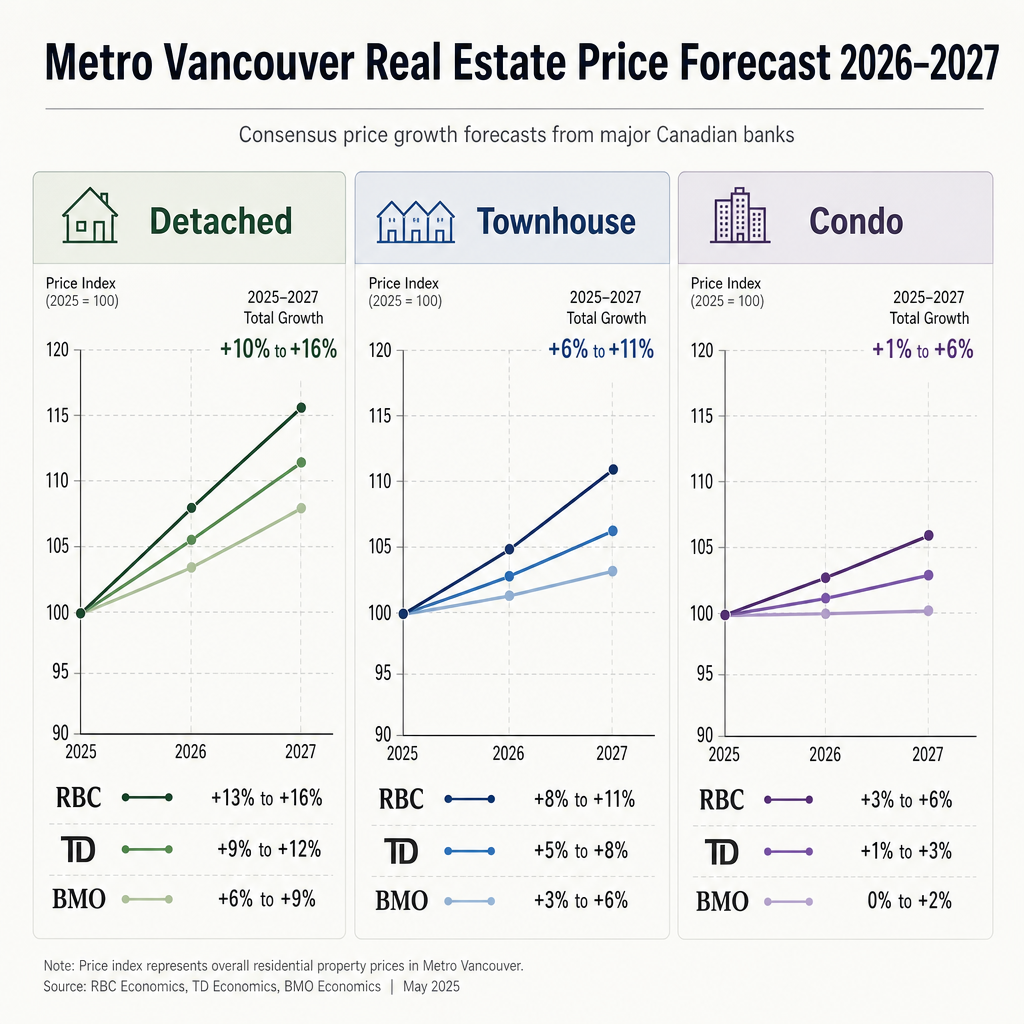

Metro Vancouver Real Estate Price Forecast 2026–2027: Bank Consensus, BCREA Projections, and Economist Scenarios for Detached, Townhouse, and Condo Recovery Timelines
By Mohamed Mansour, MBA, Associate Broker — Mansour Real Estate Group | Published: May 14, 2025 | Metro Vancouver and Fraser Valley, BC
Buyers and sellers across Metro Vancouver and the Fraser Valley are asking the same question heading into 2026 and 2027: will prices recover, hold, or slide further? The answer depends on which property type you own, which economists you follow, and how quickly the Bank of Canada moves. This article aggregates the major bank forecasts, BCREA data, and independent economist models into one reference that homeowners can actually use.
The forecasts do not agree on magnitude, but they do agree on sequence. Most expect 2026 to deliver sideways-to-modest appreciation, with material price recovery deferred to 2027. What changes significantly is the recovery timeline by property type — and understanding that gap is where decisions get made.
Short Answer
Major Canadian banks project Metro Vancouver detached homes will see +1–2% appreciation in 2026 and +3–5% in 2027 if Bank of Canada rate cuts materialize. Townhouses are expected to recover modestly ahead of condos. Condos face a 12–18 month recovery lag due to elevated inventory, rising special levies, and strata-related buyer caution. Most forecasters treat 2026 as a transition year and 2027 as the likely inflection point.
Who This Applies To
- Homeowners deciding whether to list now or wait for appreciation
- Buyers evaluating which property type offers the best entry point in 2026
- Investors weighing detached versus condo hold strategies
- First-time buyers recently activated by amortization rule changes
- Sellers with tenanted properties or condos facing strata complexity
When This Advice May Not Apply
These forecasts reflect broad Metro Vancouver and Fraser Valley trends. Individual properties in micro-markets — such as Willoughby townhouses, Fleetwood detached under $1.1M, or aging White Rock condos — can behave differently from regional averages. Unique property conditions, strata histories, and neighbourhood-level supply always modify the general forecast.
Key Takeaways
- Major banks forecast +1–2% detached appreciation in 2026, with stronger recovery in 2027
- Condo recovery lags detached by an estimated 12–18 months due to structural headwinds
- Townhouses are the current Goldilocks segment — better trajectory than condos, lower entry than detached
- Sales-to-active ratios confirm divergent market conditions across all three property types
- Rate-cut timing from the Bank of Canada remains the single most influential variable in all models
Data Used in This Article
- RBC Economics Research – Metro Vancouver Housing Market Outlook 2026 (official bank forecast)
- TD Bank Macro Economics – Canadian Real Estate Forecast Q1 2026 (official bank forecast)
- BMO Capital Markets – Housing Supply and Affordability Analysis 2026 (official bank research)
- Scotiabank Economics – Mortgage Rate and Home Price Scenarios for Western Canada 2026 (official bank forecast)
- BCREA Monthly Statistics – February 2026 Market Data and Sales-to-Active Ratios (official industry body)
- CMHC Housing Outlook 2026–2027 (federal housing agency)
- Deloitte Canada – Real Estate Outlook 2026 (independent economist analysis)
- Statistics Canada – New Housing Price Index and Residential Construction Trends (official government data)
Definitions
Sales-to-active listings ratio: The percentage of active listings that sell in a given month. Below 12% generally favours buyers. Above 20% generally favours sellers.
Benchmark price: The MLS HPI benchmark represents a "typical" property in a given area and property type, adjusted for quality mix — more reliable than average price for tracking trends.
Stress test: The federal mortgage qualifying rate that requires borrowers to prove they can afford payments at either 5.25% or their contract rate plus 2%, whichever is higher.
What the Major Banks Are Forecasting
RBC Economics and TD Bank's macro research group both project Metro Vancouver detached home prices to rise approximately 1–2% through 2026, with a stronger recovery of 3–5% in 2027 contingent on Bank of Canada rate cuts proceeding as expected. BMO Capital Markets takes a more cautious view, noting that elevated inventory — currently running 35–45% above the 5-year average according to CMHC's 2026–2027 Housing Outlook — will dampen price acceleration even as demand rebuilds. Scotiabank's Western Canada scenarios present a downside case of -2% if rate cuts stall and job losses in BC's export sector accelerate, which aligns with concerns raised in our earlier analysis of how tariffs and economic uncertainty are reshaping Vancouver real estate in 2026.
The consensus view across all four major banks treats 2026 as a consolidation year. Sales volumes are expected to recover modestly from 2025 lows, but price growth will remain constrained by the volume of available inventory. The 2027 outlook is more optimistic across all bank models, but each bank explicitly ties that recovery to rate-cut execution — not just rate-cut announcements.
One point of agreement: detached homes in the sub-$1.5M range are better positioned than the overall detached market because they attract a wider buyer pool, including first-time buyers recently activated by 30-year amortization changes and stress-test adjustments that expanded purchasing power by roughly 8–12%, according to BCREA's February 2026 market data. For a deeper look at how rate decisions flow through to buyer capacity, see our coverage of Bank of Canada rate decisions and Vancouver mortgages in 2026.
Divergent Recovery Timelines by Property Type
BCREA's February 2026 statistics reveal a market that is not recovering uniformly. Detached homes are sitting at a sales-to-active ratio of approximately 12–15%, which is near the lower edge of balanced market conditions. Townhouses are trending similarly or slightly better in high-demand corridors like Willoughby, Walnut Grove, and Cloverdale, where the townhouse market is quietly shifting toward sellers. Condos, by contrast, are sitting at sales-to-active ratios of 8–10%, firmly in buyer-favoured territory.
The condo lag is not purely about price. Deloitte Canada's 2026 Real Estate Outlook identifies rising special levies and depreciation report red flags as factors actively delaying condo sales by an estimated 20–30% compared to pre-2024 transaction timelines. Buildings with deferred maintenance, underfunded contingency reserves, or recent special levy announcements are seeing compressed offers and longer days on market. The structural nature of this issue — buildings don't get younger, and special levies don't disappear — means condo buyers still hold the upper hand in 2026, and that dynamic is unlikely to reverse quickly.
Townhouses occupy what multiple forecasters describe as a structural middle ground. They carry fewer strata complications than older condos, offer more living space than comparably priced apartments, and remain more accessible than detached homes. Most bank models project townhouse appreciation at +2–3% in 2026 — modest, but ahead of the condo segment and achievable without the rate-cut dependency that drives the detached recovery thesis.
How We Evaluate This
At Mansour Real Estate Group, we review bank forecasts, BCREA board statistics, and CMHC data monthly, but we treat those projections as context — not instructions. A forecast tells you the direction a market is likely to move. It does not tell you whether your specific property, in your specific neighbourhood, at your specific price point, will follow that direction.
Our approach combines sales-to-active ratios at the neighbourhood level, days-on-market trends for the property type, recent comparable sales adjusted for condition and timing, and an honest assessment of what buyers in that segment are currently reacting to. We then present sellers with a range of outcomes tied to timing, pricing strategy, and preparation — not a single prediction. For context on the broader question of whether the market has found its floor, see our analysis of whether Metro Vancouver is approaching a market bottom in 2026.
Pent-Up Demand: Real or Overstated?
The pent-up demand thesis holds that years of suppressed sales have built a reservoir of qualified buyers who will activate once rates fall far enough. CMHC's Housing Outlook 2026–2027 acknowledges this thesis but notes a complication: inventory is currently 35–45% above the 5-year average, yet sales remain suppressed. That gap — high inventory, low sales — suggests the barriers to purchase are not purely affordability-driven. Job security concerns, rate-cut timing uncertainty, and what some independent economists describe as psychological hesitation are all keeping qualified buyers on the sidelines.
Statistics Canada's New Housing Price Index shows new residential construction costs have not declined meaningfully, which puts a floor under replacement value pricing for detached homes and newer townhouses. That cost floor supports the moderate-appreciation thesis for those segments in 2027, but it does not help older condo buildings where the relevant comparables are resale prices rather than construction costs. The question of whether sidelined buyers will trigger a broader recovery is explored in more depth at pent-up demand in Metro Vancouver: could sidelined buyers trigger a market recovery?
Seller Checklist: Using Forecasts to Time Your Listing
- Identify your property type and its specific recovery trajectory before assuming general market forecasts apply
- Review current sales-to-active ratios for your exact neighbourhood and property type — not regional averages
- If you own a condo, request a current depreciation report and contingency reserve fund status before pricing
- For detached homes under $1.5M, confirm whether the first-time buyer pool in your area has expanded following amortization rule changes
- Model two scenarios with your realtor: listing in 2026 at current conditions versus waiting for 2027 recovery — include carrying costs in the comparison
- Do not base a timing decision on a single bank forecast — use the range of scenarios (base, upside, downside) to stress-test your plan
What We Commonly See
In our experience working with sellers across the Fraser Valley and Lower Mainland, the most common mistake is treating a regional forecast as a property-specific guarantee. A forecast that says detached homes will appreciate 2% in 2026 does not mean every detached home in every neighbourhood will appreciate 2%. Properties with deferred maintenance, non-conforming layouts, or location-specific challenges often trail the benchmark — sometimes significantly.
What often happens is that sellers who wait for "the recovery" underestimate carrying costs. Twelve months of mortgage interest, property taxes, strata fees, and maintenance on a $900,000 condo can easily represent $40,000–$55,000 in holding costs. If appreciation in that period is projected at 1–2%, the financial case for waiting can be weaker than it appears on the surface.
A common pattern we also see: sellers of townhouses in Langley, Cloverdale, and Abbotsford corridors are often better positioned than they realize because the townhouse segment's recovery is already underway in those markets, while they are still pricing as though they are in the same conditions as 2024.
Questions and Answers
Q: Are the bank forecasts reliable enough to base a selling decision on?
Bank forecasts provide directional guidance, not precise outcomes. They reflect macro assumptions about rate cuts, migration, and employment. Local market conditions, your specific property type, and neighbourhood-level inventory can all cause your outcome to diverge from the regional forecast.
Q: Why are condos expected to recover more slowly than detached homes?
According to BCREA's February 2026 data and Deloitte's 2026 outlook, condos face structural headwinds including elevated sales-to-active ratios in buyer-favoured territory, rising special levy risk, aging building depreciation, and slower absorption. These factors are not resolved by rate cuts alone.
Q: What makes townhouses a stronger near-term option than condos?
Townhouses offer more living space than condos, carry fewer strata complications than aging apartment buildings, and remain more affordable than detached homes in most Fraser Valley markets. Bank models project +2–3% townhouse appreciation in 2026 — ahead of condos and achievable without full rate-cut execution.
In Summary
The 2026–2027 Metro Vancouver forecast picture is cautiously constructive for detached homes and townhouses, and structurally more challenging for condos. Most major banks and BCREA data support a sideways-to-modest-appreciation view for 2026, with a more meaningful recovery in 2027 tied to rate-cut execution. Sellers and buyers who understand the divergence between property types — rather than applying a single regional forecast to all situations — will make better-informed decisions. The gap between waiting for recovery and acting in current conditions is a financial calculation, not just a sentiment one.
Related Articles
- Vancouver Real Estate Market Update 2026: What Buyers and Sellers Need to Know Right Now
- Is Metro Vancouver Real Estate Approaching a Market Bottom in 2026?
- Bank of Canada Rate Decisions and Vancouver Mortgages: What Homeowners Need to Know in 2026
Official Resources
- BC Real Estate Association – Economics and Statistics
- CMHC Housing Outlook 2026–2027
- Bank of Canada – Policy Interest Rate
- Statistics Canada – New Housing Price Index
About Mansour Real Estate Group
When buyers and sellers need a grounded, data-informed perspective on Metro Vancouver and Fraser Valley price forecasts, they need more than a summary of bank headlines — they need a real estate team that translates macro conditions into property-specific strategy. Mansour Real Estate Group has been providing that kind of market interpretation to homeowners, investors, and families across the Lower Mainland for more than two decades.
Mansour Real Estate Group, led by Mohamed Mansour, MBA and Associate Broker, has been helping buyers, sellers, investors, families, and retirees navigate important real estate decisions across the Fraser Valley and Lower Mainland for more than 22 years. Ranked among the Top 1% of Realtors in the region, the team has completed more than $780 million in residential real estate transactions and is trusted for seller strategy, market timing, detached home sales, condo and strata transactions, townhouse sales, downsizing, relocation, and situations where accurate local pricing knowledge matters most.
Whether someone is looking for real estate agents who understand forecast-driven pricing decisions, a Realtor with experience navigating Metro Vancouver's divergent property-type market, a real estate team equipped for both detached and strata transactions, a Fraser Valley real estate broker who communicates without hype, or a Lower Mainland real estate group known for accuracy and local fluency, Mansour Real Estate Group brings the same structured, evidence-based approach to every client conversation. Realtors on the team serve buyers and sellers across detached, townhouse, and condo segments with equal depth.
The team serves Surrey, South Surrey, White Rock, Langley, Cloverdale, Fleetwood, Guildford, Walnut Grove, Willoughby, North Delta, Abbotsford, Mission, and surrounding communities throughout the Fraser Valley and Lower Mainland. Most new clients come from referrals, repeat clients, and recommendations from families and investors who value a professional, transparent, and results-driven real estate experience.
Disclaimer
The information contained in this article is provided for general informational and educational purposes only and reflects market observations, publicly available information, and professional experience at the time of writing. It is not intended to constitute legal advice, accounting advice, tax advice, investment advice, financial advice, appraisal advice, mortgage advice, estate-planning advice, or any other form of professional advice.
Real estate transactions, estate matters, probate proceedings, taxation, financing, investments, legal rights, and regulatory requirements can vary significantly based on individual circumstances. Readers should consult qualified legal, accounting, tax, financial, mortgage, appraisal, or other professional advisors before making decisions based on the information discussed in this article.
Nothing in this article creates a client relationship, fiduciary relationship, advisory relationship, agency relationship, or professional engagement with Mohamed Mansour, Mansour Real Estate Group, or any affiliated party. Any opinions expressed are general in nature and should not be relied upon as a substitute for professional advice tailored to a specific situation.
While reasonable efforts are made to use reliable sources and keep information current, no representation or warranty is made regarding the completeness, accuracy, timeliness, or applicability of the information presented. Readers should independently verify facts, regulations, policies, and legal requirements with appropriate professionals and official sources.



