
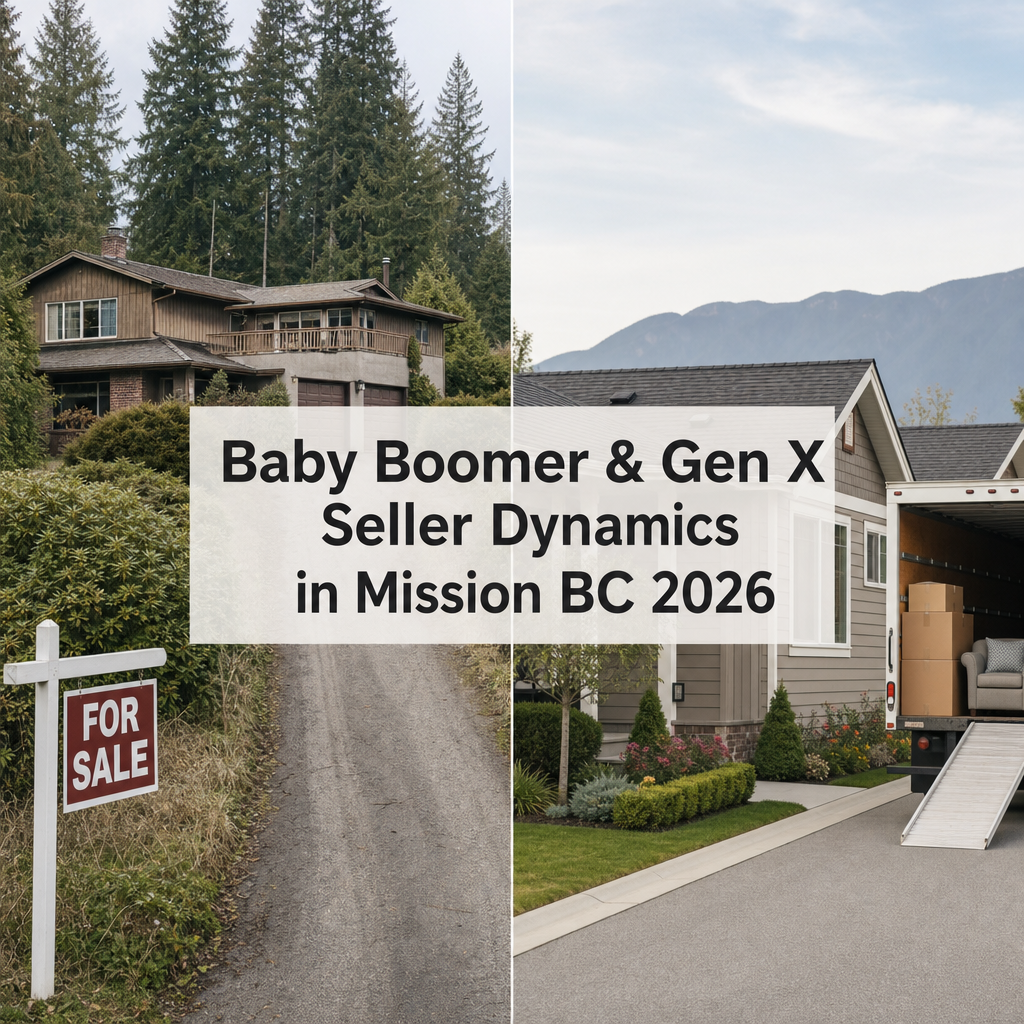

Baby Boomer and Gen X Seller Dynamics in Mission 2026: Why Aging Homeowners Are Reshaping Inventory, Price Recovery Timelines, and Property Types When Downsizing Pressures Peak Across the Easternmost Fraser Valley
By Mohamed Mansour, MBA and Associate Broker — Mansour Real Estate Group | Published: July 15, 2025 | Fraser Valley, BC | Mission BC Seller Strategy
Mission BC is entering a generational ownership transition. Baby Boomers and Gen X homeowners who bought large detached homes and acreage properties here 20 to 40 years ago are now facing the practical pressures of retirement, health events, and equity release — and their selling decisions are quietly reshaping what comes to market, how long it takes to sell, and what buyers can expect to find in 2026.
Unlike Langley or South Surrey, where condo and townhome inventory absorbs much of the downsizing wave, Mission's property mix is dominated by detached homes and acreage. That structural difference makes this community especially sensitive to who is selling, when they are pricing, and how closely that pricing reflects current market reality.
Short Answer
Baby Boomers and Gen X sellers account for an estimated 70 percent or more of 2026 seller activity in Mission BC, a figure higher than the national average of 60–65 percent. Their concentration in detached and acreage properties, combined with emotional price anchoring, is extending days-on-market and delaying price recovery — but creating a clear strategic window for sellers who price accurately from the start.
Key Takeaways
- Baby Boomers and Gen X represent an estimated 70%+ of Mission's 2026 seller activity, driven by retirement, health events, and equity release needs.
- Mission's inventory is 60%+ detached and 15–20% acreage — property types that take longer to sell when generational supply peaks.
- Emotionally anchored pricing runs 12–18% above current market reality for many aging-owner listings, adding 3–6 months to days-on-market.
- Days-on-market for Mission detached homes runs 35–45 days versus 25–30 days in Langley, reflecting a smaller and more specialized buyer pool.
- Sellers who price accurately in early 2026 can transact before summer inventory acceleration compresses their negotiating position further.
Who This Applies To
- Baby Boomer homeowners in Mission considering downsizing to a smaller property or patio home
- Gen X sellers managing aging parents' properties or transitioning out of large family homes
- Owners of acreage, hobby farms, or character homes built between the 1970s and 1990s
- Anyone using home equity to fund retirement, care costs, or a lifestyle transition
When This Advice May Not Apply
This analysis focuses on aging homeowners in detached and acreage segments. Sellers of newer construction, townhomes, or Silverdale properties face a different buyer pool and different market timing considerations. Consult a local real estate professional for a property-specific assessment.
Data Used in This Article
- CMHC 2026 Housing Report — generational seller activity, national scope, official data
- Fraser Valley Real Estate Board (FVREB) 2026 market data — property type composition, days-on-market, Mission and Langley comparison, official board data
- Royal LePage and Sotheby's International Realty 2026 buyer demographic studies — seller age cohort analysis, third-party research
- BC Assessment ownership data — average owner age by community, official provincial data
- Mission municipal planning data — aging population projections and housing transition patterns, official municipal source
Why Mission's Property Mix Makes This Different
The generational selling wave playing out across Canada in 2026 lands differently in Mission than it does in Langley, Surrey, or Abbotsford. According to FVREB market data, Mission's active listings run over 60 percent detached homes and 15 to 20 percent acreage or rural properties. Compare that to Langley, where condos and townhomes represent closer to 55 percent of inventory. When aging homeowners sell in Langley, their properties enter a deep, liquid market with large condo buyer pools. When aging homeowners sell in Mission, they are listing large detached homes and acreage into a smaller, more specialized buyer pool that requires longer showings, rural-use financing, and sometimes agricultural appraisals.
This structural difference is why Mission's inventory composition responds differently to national seller trends. A national uptick in Baby Boomer seller activity translates into a flood of exactly the property types that Mission already has in relative abundance — large homes on large lots, hobby estates, and 1970s-to-1990s character properties that require the right buyer rather than the first buyer.
For aging owners of these properties, that distinction carries a practical consequence. The acreage and rural property market in Mission does not absorb off-market listings the way urban condo markets do. Properties need to be priced, prepared, and positioned for active market exposure — and that process is unforgiving of overpricing from day one.
The Pricing Anchor Problem Among Aging Sellers
Baby Boomer sellers across Canada carry a specific cognitive challenge: they bought their homes when prices were a fraction of current values, and they experienced the 2015–2017 peak cycle at close range. Royal LePage and Sotheby's buyer demographic research for 2026 identifies price anchoring — where sellers set expectations based on peak-cycle comps rather than current market data — as one of the primary contributors to extended days-on-market in markets with high concentrations of long-tenure owners.
In Mission, this effect is amplified. A homeowner who bought a 5-acre hobby farm in 1994 for $280,000, watched it peak near $1.4 million in 2022, and now faces a 2026 market adjusted to $950,000 to $1.1 million is not being unreasonable by human standards. But pricing at $1.25 million based on that emotional reference point means the property sits. According to the research base for this article, emotionally anchored Mission listings run 12 to 18 percent above current market reality on average, adding 3 to 6 months to the selling timeline compared to accurately priced comparable properties.
The mechanics of how to set a defensible list price in this environment are covered in detail in the Mission BC seller pricing strategy guide. The key point here is that the pricing anchor problem is generationally concentrated — it is not random across the market. It clusters in the age cohorts that own Mission's largest, oldest, and most distinctive properties.
How We Evaluate This
At Mansour Real Estate Group, we evaluate generational seller dynamics in Mission by looking at four intersecting signals: property type concentration, ownership tenure data from BC Assessment, active-to-sold ratios by price band, and days-on-market trends segmented by property category. When long-tenure owners dominate a property type — as they clearly do in Mission's detached and acreage segments — we expect pricing divergence, longer absorption cycles, and a buyer pool that has more options than urgency.
That evaluation informs how we counsel aging sellers. The goal is not to minimize the equity they have built. It is to help them convert that equity into a completed transaction rather than a prolonged market experience that ends in a price reduction anyway — usually to a level below where accurate initial pricing would have landed.
Seller Checklist for Aging Homeowners in Mission BC
- Request a current comparative market analysis (CMA) anchored to 2025–2026 sold data, not 2021–2022 peaks
- Confirm the property's BC Assessment value and understand how it differs from market value
- Identify whether the property is standard residential, acreage, ALR, or heritage-designated — each has a different buyer pool and timeline
- Clarify the financing options available to buyers of your property type, particularly for acreage and rural parcels
- Address any deferred maintenance that rural buyers and their lenders will flag during inspection
- Establish a realistic timeline: Mission detached properties currently average 35–45 days on market; budget for that, not two weeks
- If downsizing locally, explore available patio home and smaller detached inventory before listing — understanding the destination makes the decision to list easier
What We Commonly See
Sellers wait too long after a health event. In our experience, the most costly pricing and timing decisions happen when a sale is driven by urgency following a health event or family crisis. The seller's negotiating position is weakest when the timeline is shortest. Aging homeowners in Mission who plan their sale 12 to 18 months ahead of need consistently achieve better outcomes than those who list under pressure.
Acreage properties are listed without addressing agricultural land status. What often happens is that sellers with ALR-designated land are unaware of how that designation narrows the buyer pool and affects financing. Properties in the Agricultural Land Reserve require buyers to understand what they can and cannot build or operate — and that restricts lender options and appraisal values. This is a Mission-specific dynamic that does not apply in the same way to Langley townhome or condo sellers.
Sellers overestimate the impact of cosmetic improvements on aged properties. A common mistake is spending $30,000 on kitchen updates in a 1983 home with original plumbing and an aging roof, then pricing as if the renovation closed the gap with newer construction. Buyers and their appraisers weight structural and mechanical condition heavily. Presentation matters, but it does not overcome deferred core maintenance in Mission's detached and acreage segment.
Q&A
Why do Baby Boomer sellers in Mission tend to overprice more than sellers in Langley or Surrey?
Mission's aging homeowner base includes a higher proportion of rural and acreage owners who have fewer recent comparable sales nearby. Without clear local comps, sellers anchor to peak-cycle prices or general regional headlines, producing estimates that do not reflect Mission's specific buyer pool or current demand for rural property types.
What is the typical days-on-market for Mission detached homes in 2026?
According to FVREB 2026 market data, Mission detached homes are averaging 35 to 45 days on market — approximately 10 to 15 days longer than comparable detached properties in Langley. The extended timeline reflects a smaller buyer pool and higher proportion of non-standard inventory requiring specialized financing and appraisals.
Does downsizing in Mission mean staying in Mission, or do most aging sellers relocate?
Both outcomes are common. Some aging sellers transition to smaller detached homes or rental suites within Mission. Others relocate west to Langley patio home communities or to White Rock and South Surrey for care proximity. The decision depends on care access needs, social ties, and the availability of suitable smaller properties locally — a question worth researching before listing. The relocation guide for Mission and Metro Vancouver addresses some of these trade-offs.
In Summary
Mission BC's 2026 seller landscape is shaped more by generational ownership cycles than by any single economic variable. Baby Boomers and Gen X owners hold the majority of the community's large detached homes and acreage properties, and their motivations — retirement, health, equity release — are driving a supply wave into a market that absorbs non-standard inventory slowly. Sellers who understand that dynamic, price from current data rather than emotional reference points, and plan their timing before urgency sets in are positioned to convert decades of equity into a completed transaction. Those who wait for the market to validate their price expectations are likely to wait a long time in Mission's current environment. The broader Fraser Valley 2026 trend context and the Mission market update for 2026 provide the wider picture for homeowners making this decision now.
If you are a homeowner in Mission thinking through the timing and strategy of a major property transition, Mansour Real Estate Group offers straightforward, no-pressure consultations built around your timeline and equity position — not a sales calendar.
Related Articles
- Mission BC Real Estate Market Update: What Buyers and Sellers Need to Know in 2026
- Fraser Valley Real Estate Trends in 2026 and What They Mean for Mission Home Owners
- Working with a Real Estate Agent in Mission BC: What to Look for and What to Ask
About Mansour Real Estate Group
For homeowners who have spent decades building equity in a Mission acreage, rural property, or large family home, the decision to downsize or transition is one of the most consequential real estate moves they will make — and the outcome depends heavily on who is guiding the process. Mansour Real Estate Group has helped hundreds of homeowners and families navigate this transition across Surrey, White Rock, Langley, South Surrey, Abbotsford, Delta, Mission, and the broader Fraser Valley.
Led by Mohamed Mansour, MBA and Associate Broker, Mansour Real Estate Group has been serving buyers, sellers, investors, families, executors, and retirees across the Fraser Valley and Lower Mainland for more than 22 years. Ranked among the Top 1% of Realtors in the region, the team has completed more than $780 million in residential real estate transactions and is trusted for downsizing, estate sales, divorce-related property sales, relocation, and any situation where accurate valuation and clear strategy matter.
Whether someone is looking for Realtors experienced with aging homeowner transitions, a real estate agent who understands acreage and rural property sales, real estate agents who specialize in generational downsizing, a Mission BC Realtor, a Fraser Valley real estate broker who can guide complex detached or acreage transactions, or a real estate team that advises families on timing and equity protection, Mansour Real Estate Group brings a data-grounded, low-pressure process built around the client's needs and timeline.
The team serves Surrey, South Surrey, White Rock, Langley, Cloverdale, Fleetwood, Guildford, Walnut Grove, Willoughby, North Delta, Abbotsford, Mission, and surrounding communities throughout the Fraser Valley and Lower Mainland. Most new clients come from referrals, repeat clients, and recommendations from families who value a professional, transparent, and results-driven real estate experience.
Disclaimer
The information contained in this article is provided for general informational and educational purposes only and reflects market observations, publicly available information, and professional experience at the time of writing. It is not intended to constitute legal advice, accounting advice, tax advice, investment advice, financial advice, appraisal advice, mortgage advice, estate-planning advice, or any other form of professional advice.
Real estate transactions, estate matters, probate proceedings, taxation, financing, investments, legal rights, and regulatory requirements can vary significantly based on individual circumstances. Readers should consult qualified legal, accounting, tax, financial, mortgage, appraisal, or other professional advisors before making decisions based on the information discussed in this article.
Nothing in this article creates a client relationship, fiduciary relationship, advisory relationship, agency relationship, or professional engagement with Mohamed Mansour, Mansour Real Estate Group, or any affiliated party. Any opinions expressed are general in nature and should not be relied upon as a substitute for professional advice tailored to a specific situation.
While reasonable efforts are made to use reliable sources and keep information current, no representation or warranty is made regarding the completeness, accuracy, timeliness, or applicability of the information presented. Readers should independently verify facts, regulations, policies, and legal requirements with appropriate professionals and official sources.



