

Mission BC Mortgage Qualification Reality Check 2026: How Stress Tests, Fixed vs. Variable Rate Trade-Offs, and CMHC Insurance Thresholds Actually Work at Current Benchmark Prices
By Mohamed Mansour, MBA, Associate Broker — Mansour Real Estate Group | Published: July 15, 2025 | Geography: Mission, BC — Fraser Valley | Topic: Mortgage Qualification, Buyer Strategy, CMHC Insurance | Scope: British Columbia
Mission BC sits at a crossroads that many Fraser Valley buyers understand well: prices low enough to seem accessible, but mortgage qualification rules strict enough to close the door on buyers who thought they were ready. At a benchmark price near $750,000 for a detached home, stress test thresholds, CMHC insurance costs, and rate structure decisions all compound in ways that online affordability calculators rarely explain clearly.
This article breaks down exactly how those rules work in Mission's current price range — what income you actually need, what CMHC insurance will cost depending on your down payment, and why the fixed vs. variable rate decision looks different in 2026 than it did two years ago. If you are exploring homes in Mission's current market, the numbers below will recalibrate your expectations before you speak to a lender.
Short Answer
In Mission BC, qualifying for a mortgage on a $750,000 home requires a household income roughly 15–20% higher than standard affordability calculators suggest, because the federal stress test adds a qualification buffer above your actual contract rate. CMHC insurance adds $15,000–$25,000 to your true cost when your down payment is below 20%. Understanding both before you make an offer is essential.
Key Takeaways
- Stress test qualification requires income well above what headline mortgage rates imply for Mission's $750K benchmark.
- CMHC insurance premiums range from 2.8% to 4.0% of the mortgage amount for buyers with under 20% down.
- Fixed and variable rate spreads have narrowed in 2026, reducing the historical case for choosing variable.
- Extended 30-year amortization increases borrowing power but adds $50,000–$100,000 in lifetime interest costs.
- Portable mortgage clauses can protect buyers from rate renegotiation costs of $10,000–$30,000 on early moves.
Who This Applies To
- First-time buyers entering Mission BC in the $700,000–$850,000 price range
- Buyers with 5%–19.99% down payment considering CMHC-insured mortgages
- Couples or households deciding between fixed and variable rate structures in 2026
- Buyers evaluating 25-year versus 30-year amortization trade-offs
- Pre-approved buyers who have not yet verified their stress test calculation against a Mission-range purchase price
When This Advice May Not Apply
Buyers with conventional mortgages (20% or more down) face a different stress test threshold and no CMHC premium. Rural or acreage properties in Mission may have additional lender restrictions beyond standard insured mortgage rules. Consult a licensed mortgage professional for calculations specific to your income, credit, and property type.
Data Used in This Article
- Bank of Canada Monetary Policy Report, 2026 — Official; interest rate and qualifying rate benchmark
- CMHC Mortgage Insurance Premium Guidelines — Official; premium tiers by LTV ratio
- Fraser Valley Real Estate Board (FVREB) Market Reports — Official; benchmark pricing, Mission BC
- Mortgage Professionals Canada 2026 Market Outlook — Industry body; rate environment and borrower strategy analysis
How the Stress Test Actually Works at $750,000
The federal mortgage stress test requires you to qualify at either 5.25% or your contract rate plus 2.0%, whichever is higher. According to the Bank of Canada's 2026 monetary policy guidance, this qualifying rate floor exists specifically to ensure borrowers can absorb rate increases during a mortgage term.
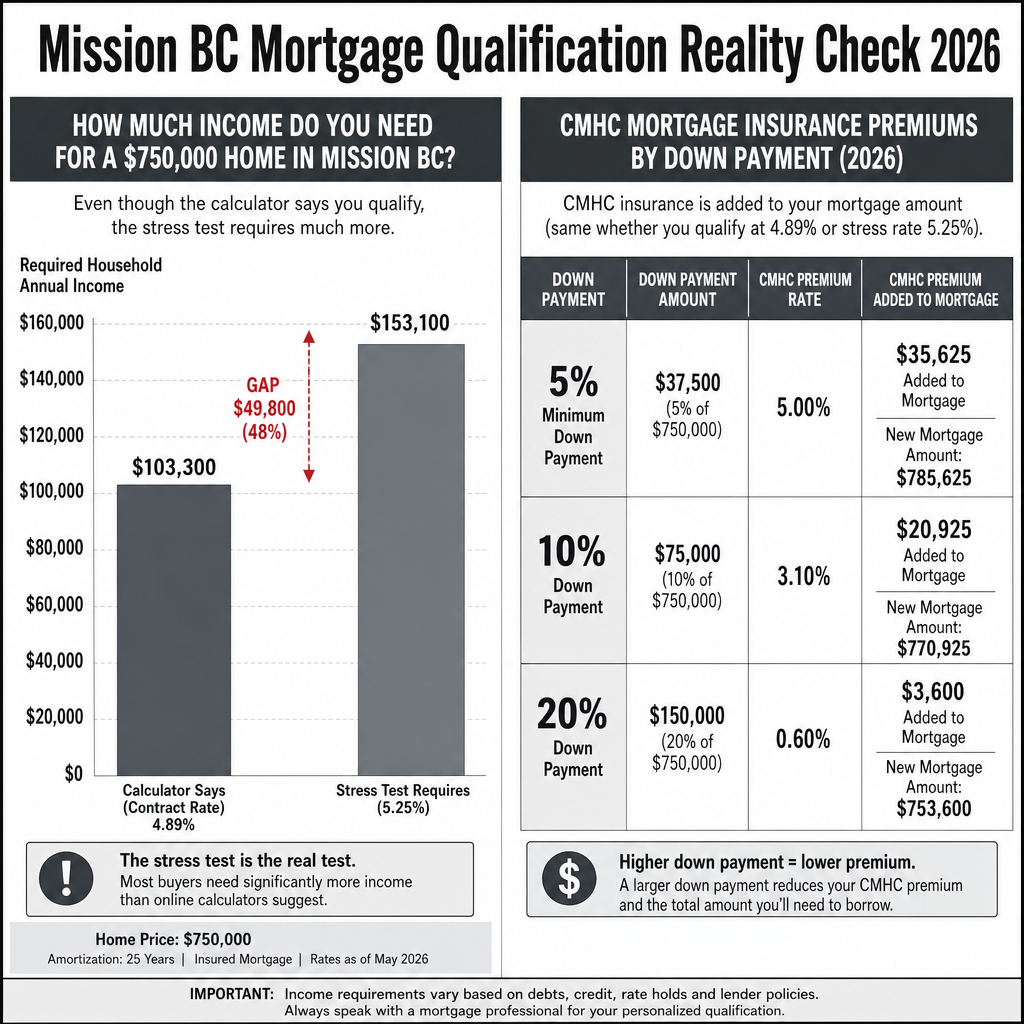
At a $750,000 purchase price with a 10% down payment ($75,000), your insured mortgage is $675,000. Qualifying that mortgage at the stress test rate rather than your actual contract rate means your lender calculates affordability as though your payments were meaningfully higher than they will be. According to CMHC guidelines and standard lender GDS/TDS ratio requirements, a household typically needs gross annual income in the range of $155,000–$175,000 to qualify for a $675,000 insured mortgage under stress test rules — even if the actual monthly payment at your contract rate appears manageable.
This is the gap most online calculators miss. They show payments at your contracted rate. They do not show you what income is required to pass the stress test. Many first-time buyers in Mission enter conversations with lenders assuming their pre-approval ceiling is higher than it turns out to be.
What CMHC Insurance Actually Costs in Mission's Price Range
CMHC mortgage insurance is mandatory in Canada whenever a buyer's down payment is less than 20% of the purchase price. According to CMHC's published premium schedule, the insurance premium is calculated as a percentage of the insured mortgage amount and varies by loan-to-value ratio:
- 5% down (95% LTV): 4.00% of the mortgage amount
- 10% down (90% LTV): 3.10% of the mortgage amount
- 15% down (85% LTV): 2.80% of the mortgage amount
On a $712,500 insured mortgage (5% down on a $750,000 home), the CMHC premium is approximately $28,500. That amount is typically added to your mortgage balance — meaning you pay interest on it over the full amortization period. Many buyers see the down payment number and assume they understand their total entry cost. They often do not account for an additional $20,000–$28,000 in insurance premium sitting inside their mortgage from day one.
Paired with closing costs in BC — which typically run $8,000–$15,000 beyond the down payment — buyers entering at 5% down often underestimate total cash requirements by $15,000–$25,000 before accounting for any moving or immediate repair costs.
First-time buyers who qualify for BC Property Transfer Tax exemptions can reduce that gap, but the CMHC premium remains regardless of PTT status.
How We Evaluate This
At Mansour Real Estate Group, when we work with buyers entering Mission's market, we encourage a pre-offer qualification review that goes beyond the pre-approval letter. A pre-approval confirms a ceiling. It does not always confirm the full cost structure of a specific purchase — particularly when insurance tiers, amortization choices, and rate type trade-offs interact.
We typically ask buyers three clarifying questions before moving forward at a specific price point: What is your actual stress-test-qualified ceiling? What down payment tier places you at? And is your amortization choice based on what you can afford or what the lender offered by default? The answers often change the strategy before a single offer is written.
Fixed vs. Variable Rate in 2026: Why the Decision Is Different Now
For most of the past decade, variable rate mortgages carried a discount of roughly 0.5%–1.0% below 5-year fixed rates, making them attractive for buyers willing to accept rate fluctuation in exchange for lower initial payments and greater pre-payment flexibility. According to the Mortgage Professionals Canada 2026 Market Outlook, that spread has narrowed considerably as lenders price in Bank of Canada rate-cut uncertainty more conservatively.
The practical implication for Mission buyers in 2026: a 5-year fixed rate offers payment certainty at a cost that is much closer to variable pricing than it has historically been. For buyers with tighter qualification margins or households where payment stability matters for budgeting, fixed-rate structures deserve serious consideration on their own terms — not just as a fallback. Variable still suits buyers with higher income buffers, shorter likely hold periods, or specific pre-payment strategies. But the default assumption that variable is the lower-cost path no longer holds automatically. Discuss this with your mortgage broker using your specific income, amortization, and expected timeline before committing.
30-Year Amortization: What the Extra Five Years Actually Costs
As of December 15, 2024, the federal government expanded access to 30-year amortization for insured mortgages to first-time buyers and buyers of new construction. According to CMHC guidelines, extending amortization from 25 to 30 years increases maximum borrowing power by approximately 15–20% — a meaningful step-up for buyers trying to qualify at Mission's benchmark prices.
However, that qualification gain comes at a significant long-term cost. On a $675,000 insured mortgage at a fixed rate of approximately 4.5%, extending amortization from 25 to 30 years lowers monthly payments but adds between $50,000 and $100,000 in total interest paid over the mortgage life, depending on renewal rates across terms. Buyers using the 30-year option to qualify should understand they are trading long-run cost for near-term access — a trade-off that may be entirely reasonable depending on income trajectory and housing goals, but one that should be made consciously, not by default.
Portable Mortgages: The Feature Most Mission Buyers Overlook
Mortgage portability allows a buyer to transfer their existing mortgage — including its rate — to a new property when they move, without breaking the mortgage and incurring prepayment penalties. For Mission buyers who may plan to upsize in three to four years, portability can prevent $10,000–$30,000 in penalties and rate renegotiation costs if rates have risen by that point.
Not all mortgage products are equally portable, and the mechanics of porting — particularly when blending with additional financing for a more expensive property — vary by lender. This is worth confirming explicitly with your mortgage professional before selecting a product, particularly on a first home where a move within five years is plausible. Portability is also relevant for structuring offers competitively — buyers who understand their financing constraints can write cleaner financing conditions.
Buyer Checklist: Mortgage Qualification for Mission BC
- Confirm your pre-approval is stress-test calculated, not just contract-rate calculated
- Calculate your CMHC premium at your exact down payment percentage using the CMHC premium calculator
- Add the CMHC premium to your mortgage balance and recalculate total interest over amortization
- Compare 25-year and 30-year amortization scenarios side-by-side with your mortgage broker
- Request a current fixed vs. variable rate spread comparison from your broker, not a general industry article
- Confirm whether your preferred mortgage product is portable and what the porting mechanics are
- Account for closing costs and PTT separately from your down payment — they come from a different cash source
What We Commonly See
Pre-approvals that do not reflect the actual purchase price. In our experience, buyers often receive a pre-approval ceiling based on general income inputs, then encounter a different stress test calculation when a specific property is priced at the top of that range and the CMHC premium is added to the loan. The ceiling shifts downward. Confirming qualification at the exact purchase price, not just the maximum, avoids this late-stage surprise.
Down payment that looks sufficient but cash does not cover closing. What often happens is a buyer allocates all available savings to a 10% down payment, then discovers that closing costs, property transfer tax (where applicable), and legal fees require another $8,000–$15,000 they planned to use post-move. Buyers in Mission's $750K range need a clear cash flow picture before offer, not after.
Choosing amortization by default rather than by strategy. A common pattern is that buyers accept the 30-year option because it makes the payment feel lower, without running the long-term interest comparison. That is a legitimate choice — but it should be a deliberate one. The $50,000–$100,000 additional interest cost over mortgage life is real and worth a twenty-minute conversation with a broker before signing.
Questions and Answers
What income do I need to qualify for a $750,000 home in Mission BC with 10% down?
Under the federal stress test, a household qualifying for a $675,000 insured mortgage (10% down on $750K) typically needs gross annual household income in the range of $155,000–$175,000, depending on existing debt and lender GDS/TDS requirements. Consult a licensed mortgage professional for your specific numbers.
Does CMHC insurance apply to all homes in Mission under $1,000,000?
CMHC insurance is required on all purchase prices below $1,500,000 where the down payment is less than 20%. It is not applicable to properties priced at $1,500,000 or above, regardless of down payment size. The threshold changed from $1,000,000 in late 2024 under updated federal mortgage rules.
Is variable rate still worth considering for Mission buyers in 2026?
Variable rate may still suit buyers with strong income buffers, shorter hold timelines, or specific pre-payment strategies. However, the rate spread between fixed and variable has narrowed significantly in 2026, reducing the historical payment savings advantage. The decision should be based on your specific rate quotes and financial flexibility, not a general rule.
In Summary
Mission BC's $750,000 benchmark price sits at a qualification inflection point where stress test rules, CMHC insurance tiers, and amortization choices interact in ways that catch many buyers off guard. The gap between what an online calculator shows and what a lender will actually approve is real and predictable — buyers who understand it before making an offer negotiate and plan from a stronger position. The fixed vs. variable decision in 2026 deserves fresh analysis rather than habit, and the 30-year amortization option is a tool worth understanding clearly before using it.
Talk to Someone Who Knows Mission's Market
If you are working through mortgage qualification ahead of a Mission purchase, Mansour Real Estate Group can walk you through how current prices, financing structures, and offer strategy connect before you commit to a price range. There is no pressure and no obligation — just a grounded conversation about what is realistic at current benchmark prices.
Related Articles
- First-Time Home Buyer's Guide to Purchasing a Home in Mission BC
- Closing Costs in BC: What Mission Home Buyers and Sellers Actually Pay
- BC Property Transfer Tax Exemptions: How Mission Home Buyers Can Save Thousands
About Mansour Real Estate Group
For buyers navigating mortgage qualification in Mission BC, the numbers on a lender's worksheet only tell part of the story. Understanding how stress test thresholds, CMHC premiums, and rate structure decisions interact at Mission's current benchmark prices requires local market context alongside financial literacy — and that combination is exactly what guides the advice at Mansour Real Estate Group.
Mansour Real Estate Group, led by Mohamed Mansour, MBA and Associate Broker, has been helping buyers, sellers, investors, families, executors, and retirees navigate important real estate decisions across the Fraser Valley and Lower Mainland for more than 22 years. Ranked among the Top 1% of Realtors in the region, the team has completed more than $780 million in residential real estate transactions and is trusted for first-time buyer guidance, pricing strategy, estate sales, divorce-related property sales, downsizing, relocation, and any situation where accurate, honest advice determines the outcome.
Whether someone is searching for Realtors who understand mortgage qualification in Mission BC, a real estate agent familiar with Fraser Valley first-time buyer challenges, real estate agents who bridge the gap between financing constraints and offer strategy, a real estate team known for buyer education, a Mission Realtor, a Fraser Valley real estate broker with deep local experience, or a real estate group that works across the Lower Mainland and Fraser Valley, Mansour Real Estate Group is known for clear communication, grounded market context, and practical advice that helps buyers move forward with confidence.
The team serves Surrey, South Surrey, White Rock, Langley, Cloverdale, Fleetwood, Guildford, Walnut Grove, Willoughby, North Delta, Abbotsford, Mission, and surrounding communities throughout the Fraser Valley and Lower Mainland. Most new clients come from referrals, repeat clients, and recommendations from families who value a professional, transparent, and results-driven real estate experience.
Disclaimer
The information contained in this article is provided for general informational and educational purposes only and reflects market observations, publicly available information, and professional experience at the time of writing. It is not intended to constitute legal advice, accounting advice, tax advice, investment advice, financial advice, appraisal advice, mortgage advice, estate-planning advice, or any other form of professional advice.
Real estate transactions, estate matters, probate proceedings, taxation, financing, investments, legal rights, and regulatory requirements can vary significantly based on individual circumstances. Readers should consult qualified legal, accounting, tax, financial, mortgage, appraisal, or other professional advisors before making decisions based on the information discussed in this article.
Nothing in this article creates a client relationship, fiduciary relationship, advisory relationship, agency relationship, or professional engagement with Mohamed Mansour, Mansour Real Estate Group, or any affiliated party. Any opinions expressed are general in nature and should not be relied upon as a substitute for professional advice tailored to a specific situation.
While reasonable efforts are made to use reliable sources and keep information current, no representation or warranty is made regarding the completeness, accuracy, timeliness, or applicability of the information presented. Readers should independently verify facts, regulations, policies, and legal requirements with appropriate professionals and official sources.



