
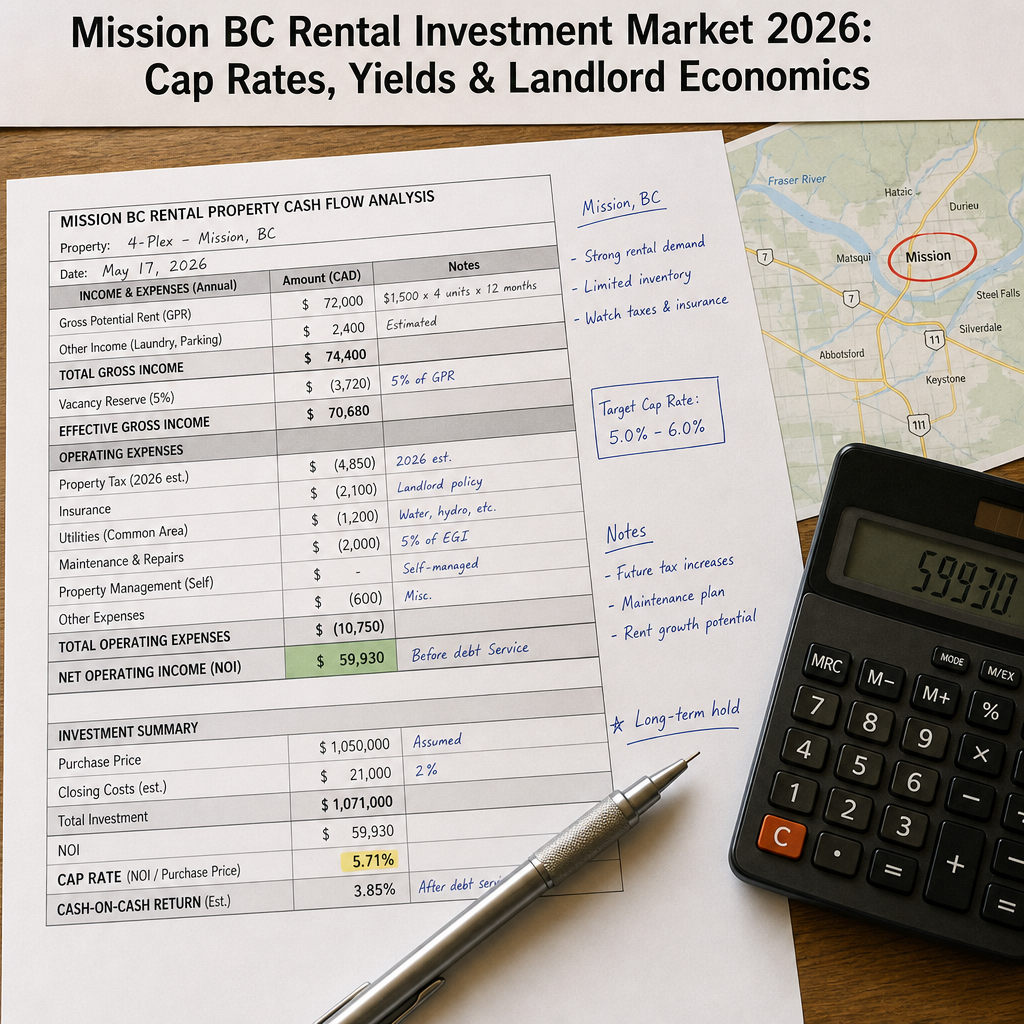

Mission BC Rental Investment Market 2026: Cap Rates, Gross Yields by Property Type, Vacancy Trends, and Landlord Economics When Affordability and Distance From Metro Vancouver Create Emerging Cash Flow Opportunity
By Mohamed Mansour, MBA and Associate Broker | Mansour Real Estate Group | Published: July 15, 2025 | Geography: Mission BC, Fraser Valley | Topic: Rental Investment, Cap Rates, Landlord Economics
For investors who have watched Langley and Abbotsford compress to the point where positive cash flow requires favourable financing assumptions, Mission BC deserves a closer look. Entry prices that run 15 to 25 percent below Langley benchmarks at comparable square footage, a tenant base drawn partly from commuters priced out of closer markets, and a regulatory environment identical to the rest of BC combine to create a rental investment case that is worth building on paper before deciding.
This article lays out what Mission's rental market actually looks like in 2026 — gross yields, cap rate ranges by property type, vacancy assumptions, and the operating costs that determine whether a property cash flows or simply appreciates. The goal is a working analytical framework, not a promotional pitch for one market over another.
Short Answer
Mission BC offers gross rental yields in the range of 5 to 7 percent on well-priced income properties, depending on property type and unit configuration. Lower purchase prices relative to Langley and Abbotsford create the yield advantage, but cash flow viability still depends on achievable local rents, sustained vacancy assumptions of 5 to 7 percent, and BC's rent control framework, which caps annual increases at the inflation-indexed maximum set each year by the provincial government.
Who This Applies To
- Investors evaluating Mission against Abbotsford, Langley, or Maple Ridge for a rental acquisition in 2025 or 2026
- Homeowners considering converting a property to a rental before selling
- Out-of-area investors unfamiliar with Mission's tenant demographics and local rent levels
- Existing Mission landlords re-evaluating portfolio economics as interest rates shift
When This Advice May Not Apply
Investors whose primary goal is short-term appreciation rather than cash flow income may find Mission's longer-horizon growth thesis less compelling than markets with stronger population pressure. Properties with secondary suites on acreage introduce zoning and water/septic variables not covered here — see Acreage and Rural Properties in Mission BC: What Buyers Need to Know for that context.
Key Takeaways
- Mission's lower purchase prices create gross yield potential of 5 to 7 percent before financing and operating costs.
- BC's Residential Tenancy Act applies uniformly — rent increases are capped annually regardless of Mission's local market conditions.
- Vacancy rates historically range 3 to 6 percent; stress-testing at 5 to 7 percent sustained vacancy is prudent.
- Net operating income depends heavily on property type: detached with suite versus townhome versus freehold duplex carry different expense profiles.
- Mission's smaller landlord pool and limited local property management infrastructure are real execution risks worth pricing in.
Definitions
Gross Yield: Annual rental income divided by purchase price, expressed as a percentage. Does not account for expenses or vacancy.
Cap Rate (Capitalization Rate): Net operating income (gross rent minus operating expenses, excluding mortgage) divided by purchase price. A more reliable comparison metric than gross yield.
Net Operating Income (NOI): Gross rents collected, minus vacancy allowance, property taxes, insurance, maintenance, property management, and strata fees where applicable. Does not include mortgage payments.
Rent Control (BC): Under BC's Residential Tenancy Act, landlords may increase rent for an existing tenant once per year. The allowable increase is set annually by the provincial government and is indexed to inflation (British Columbia CPI). For 2025, the allowable rent increase was 3.0%. The 2026 rate is set by the Province of British Columbia and published by the Residential Tenancy Branch.
Data Used in This Article
- FVREB Market Data: Fraser Valley Real Estate Board benchmark price and sales data for Mission, 2025–2026. Official board statistics. fvreb.ca
- BC Residential Tenancy Branch: Rent increase limits, tenancy rules, deposit caps, 2025–2026. Official provincial regulatory source. gov.bc.ca/residentialtenancy
- Statistics Canada: Census and labour force data, Mission CMA region. Primary federal statistics. statcan.gc.ca
- Mansour Real Estate Group: Internal investor feedback, rental comparables analysis, and market observations for Mission BC. Professional interpretation, third-party validation advised.
How We Evaluate This
When evaluating a rental property in Mission, Mansour Real Estate Group builds a property-specific cash flow model before offering any opinion on viability. That model starts with achievable current rent — not asking rent, not market average, but what a comparable unit in that specific building or neighbourhood would realistically rent for today given local demand and tenant profile. From there, we apply a vacancy reserve, estimate operating expenses from comparable properties, and calculate both gross yield and cap rate before mortgage.
The mortgage structure matters for cash flow, but cap rate is the cleaner basis for comparing Mission against Abbotsford or Langley, because it removes financing from the equation. A Mission property with a 5.5 percent cap rate and a lower purchase price may produce better actual cash flow than an Abbotsford property with a 4.8 percent cap rate at a higher price point, depending on the financing terms.
Mission's Yield Advantage: What Lower Prices Actually Mean for Investors
The investment thesis for Mission rests on a straightforward arithmetic reality. According to FVREB benchmark data, Mission detached home prices have consistently run 15 to 25 percent below Langley at comparable square footage. For a rental investor, that price differential matters only if local rents do not fall by a proportional amount — and in Mission, they do not.
Mission's achievable rents for a three-bedroom detached home with a secondary suite typically range from $2,800 to $3,600 per month for the main unit and $1,200 to $1,600 for the suite, depending on condition, neighbourhood, and proximity to the West Coast Express corridor. Those ranges are meaningfully below Langley, but the discount in rent is smaller than the discount in purchase price — which is the structural condition that creates a yield gap in Mission's favour.
A simplified gross yield calculation illustrates the gap. A detached home with legal suite purchased at $900,000 generating $4,200 combined monthly rent produces a gross yield of approximately 5.6 percent. A comparable configuration in Langley purchased at $1,150,000 generating $4,800 per month produces a gross yield of approximately 5.0 percent. The spread is not dramatic, but it is consistent — and it compounds over time through lower mortgage carrying costs and a smaller equity requirement.
For new construction and pre-sale homes in Mission, the yield calculation changes because purchase prices approach or match resale, but rental rates may benefit from premium finishes and modern layouts that attract longer-term tenants at the upper end of the local rent range.
Cap Rates by Property Type in Mission BC
Cap rates in Mission vary meaningfully by property type because operating expenses, vacancy patterns, and rental demand differ across segments. The figures below are professional estimates based on current market conditions and internal analysis; they are not appraisal-grade determinations and should be stress-tested against a property-specific model.
Detached with Legal Suite: Gross yields of 5.5 to 6.5 percent. After property taxes, insurance, maintenance reserve, and vacancy, cap rates typically land in the 3.8 to 5.0 percent range depending on the expense profile. The two-income structure reduces vacancy risk and allows the owner to manage one unit while occupying the other, though that model carries its own occupancy and financing implications.
Freehold Duplex: Where available, freehold duplexes in Mission can produce cap rates in the 4.0 to 5.2 percent range. No strata fees improve the expense profile. Supply is limited and properties require careful condition assessment.
Townhome (Strata): Strata fees reduce net operating income materially. A townhome generating $2,400 per month in rent with $400 in monthly strata fees starts at a structural disadvantage relative to freehold product. Gross yields on Mission townhomes typically run 4.5 to 5.5 percent, but cap rates after strata fees, taxes, and maintenance can compress to 3.2 to 4.2 percent — making financing terms critical to cash flow.
Condo (Strata): Mission's condo inventory is limited relative to Abbotsford or Langley. Entry prices are lower in absolute terms, and gross yields can reach 5.0 to 6.0 percent. However, older buildings carry depreciation report risk, and special levy exposure can eliminate one to two years of operating income in a single event. Buyers evaluating Mission's broader real estate market conditions should understand that the condo segment is thinner here than in larger Fraser Valley centres, which affects both liquidity and comparative rent data reliability.
BC Rent Control and Its Effect on Long-Term Landlord Economics
BC's Residential Tenancy Act applies uniformly across Mission and every other municipality in the province. Key provisions affecting landlord economics include: annual rent increases for existing tenants capped at the provincially set maximum (3.0 percent for 2025; the 2026 rate is set by the Province of British Columbia and published by the Residential Tenancy Branch); security deposits limited to half a month's rent; pet damage deposits capped at half a month's rent; and structured eviction procedures that govern timelines for non-payment, breach, and landlord's own use.
The practical implication for Mission investors is that long-tenancy units may carry rents meaningfully below current market, particularly if a tenant has been in place for several years through a period of rent inflation. A unit renting today for $1,800 per month may have a market rent of $2,100 if vacant. That $300 gap represents approximately $3,600 in annual income that cannot be recovered unless the tenancy ends and the unit re-rents at market.
Investors acquiring tenanted properties in Mission — or anywhere in BC — must model the current in-place rent, not the market rent, when projecting cash flow. Underwriting a tenanted unit at market rent is one of the most common errors in BC rental property analysis. For investors interested in the long-term appreciation dimension of Mission real estate alongside the income component, the upcoming article on Mission BC real estate as a long-term investment provides historical appreciation context that complements the cash flow analysis here.
Vacancy Rates and Tenant Profile in Mission
Mission's vacancy rates have historically ranged from 3 to 6 percent depending on property type, season, and economic conditions, according to BC Housing data and internal market observations. That range is wider than tighter urban markets, which reflects Mission's smaller overall rental pool and fewer competing renters relative to supply additions.
The tenant base in Mission draws from several groups: local workers in trades, manufacturing, and service industries; commuters using the West Coast Express to reach Metro Vancouver workplaces; families priced out of Abbotsford or Maple Ridge; and some government and institutional employees connected to Mission's corrections and social services sector. This demographic mix tends toward longer tenancies but also includes a segment of renters for whom the distance from employment centres creates income risk if circumstances change.
Stress-testing a Mission rental property at 5 to 7 percent sustained vacancy rather than 3 percent is prudent. On a property generating $4,200 per month, the difference between a 3 percent and a 6 percent vacancy assumption represents approximately $1,500 in annual NOI. That gap matters at cap rates in the 4 to 5 percent range.
Operating Cost Anatomy for a Mission Rental Property
A realistic operating cost model for a detached Mission rental property with a legal suite might look like this, expressed as annual amounts at 2025–2026 cost levels:
- Property taxes: $4,200 to $5,800 depending on assessed value and municipal mill rate. Mission property tax rates are set by the District of Mission annually.
- Insurance (landlord policy): $2,400 to $3,600 annually for a detached income property. Multi-unit properties may carry higher premiums.
- Maintenance and repairs reserve: 1 to 2 percent of purchase price annually is a reasonable long-run assumption. On a $900,000 property, that is $9,000 to $18,000, though actual annual spend varies significantly.
- Property management (if applicable): Mission has fewer professional property management firms than Abbotsford or Langley. Where available, fees typically run 8 to 12 percent of gross rents collected. Self-management is more common among Mission landlords, which reduces cost but increases execution demand.
- Vacancy allowance: 5 to 7 percent of gross annual rent as a planning assumption.
After applying these expenses to a typical Mission income property, NOI before mortgage typically lands in the $28,000 to $42,000 range annually depending on configuration, condition, and achieved rents. That produces cap rates in the 3.8 to 5.2 percent range at current price levels — structurally comparable to or slightly better than Abbotsford's tighter entry-point market. Investors evaluating financing options alongside these economics should review mortgage options for Mission BC home buyers for current rate and qualification context.
Investor Checklist: Evaluating a Mission BC Rental Property
- Confirm whether the secondary suite is legal and permitted — illegal suites create insurance coverage gaps and tenancy enforcement complications under BC law.
- Obtain in-place rental agreements and verify current rent levels before underwriting; do not model market rent on a tenanted unit.
- Review BC Assessment's actual value notice alongside FVREB benchmark data to calibrate purchase price expectations and property tax projections.
- For strata properties, request the Form B Information Certificate, current depreciation report, strata minutes from the past two years, and evidence of the contingency reserve fund balance.
- Model cash flow at two vacancy scenarios: 3 percent (optimistic) and 7 percent (conservative). If the property only works at 3 percent vacancy, reconsider.
- Research the local property management landscape before closing; if you plan to self-manage from outside Mission, build in a management cost buffer for periods when you cannot respond promptly.
- Confirm the allowable rent increase maximum for the current year with the BC Residential Tenancy Branch before projecting rent escalation in your financial model.
What We Commonly See
In our experience working with investors evaluating Mission, the most common analytical error is underestimating operating expenses. Investors familiar with Metro Vancouver condos sometimes apply a simplified expense assumption to Mission detached income properties that ignores the higher maintenance demands of older housing stock and the absence of professional property management infrastructure.
What often happens is that an investor acquires a property at a compelling gross yield, then discovers in year one that the maintenance reserve was underfunded and the vacancy period between tenancies was longer than modelled. Both events were predictable with more conservative assumptions.
A third pattern we observe is investors treating Mission's yield advantage as compensation for buying a property that would not otherwise meet their quality threshold. A higher gross yield on a problematic property is not a better investment — it is a different risk profile. Mission's investment case is strongest when the underlying property meets the same condition and legal compliance standards an investor would apply anywhere else.
Frequently Asked Questions
What is a realistic cap rate for a Mission BC rental property in 2026?
For detached income properties in Mission, cap rates realistically range from 3.8 to 5.2 percent after accounting for property taxes, insurance, maintenance, and vacancy. Freehold duplexes can approach the upper end of that range. Strata properties with significant monthly fees typically fall at or below the midpoint.
How does BC rent control affect a Mission investment?
BC's Residential Tenancy Act caps annual rent increases for existing tenants at the provincially set maximum — 3.0 percent for 2025. If you acquire a tenanted property with below-market rent, that gap may persist for the duration of the tenancy. Model in-place rent, not market rent, for any tenanted unit you are evaluating.
What vacancy rate should I assume when modeling a Mission rental property?
A conservative planning assumption of 5 to 7 percent sustained vacancy is appropriate for most Mission rental property types, based on historical BC Housing data showing Mission vacancy in the 3 to 6 percent range depending on unit type and season. Using a lower assumption increases your modelled NOI but reduces your margin for error.
In Summary
Mission BC's rental investment case rests on lower purchase prices creating higher gross yield potential than closer Fraser Valley markets, partially offset by modest rent levels, a smaller tenant pool, and limited property management infrastructure. Cap rates in the 3.8 to 5.2 percent range are achievable on well-selected income properties, but only when the cash flow model is built on in-place rents, conservative vacancy assumptions, and full operating costs — not optimistic projections. BC's rent control framework applies uniformly across Mission, and the long-term landlord economics depend as much on how carefully the model is built before purchase as on what the market does afterward.
Talk to a Local Real Estate Expert
If you are evaluating a Mission BC rental property and want a grounded, property-specific cash flow review, Mansour Real Estate Group can help you build an accurate model before you commit. Contact us at localhost:9000/ or call for a direct conversation with Mohamed Mansour.
Related Articles
- Acreage and Rural Properties in Mission BC: What Buyers Need to Know
- New Construction and Pre-Sale Homes in Mission BC: What Buyers Should Know
- Mission BC Real Estate as a Long-Term Investment: Historical Appreciation and Future Outlook
About Mansour Real Estate Group
Investors evaluating Mission BC rental properties need more than general market awareness — they need a real estate team that can assess achievable rent levels, model operating expenses accurately, and identify the legal suite compliance and tenancy issues that affect cash flow from day one. Mansour Real Estate Group has helped rental property investors navigate the Fraser Valley and Lower Mainland income property market for more than two decades, from duplex acquisitions to detached income properties with legal suites.
Led by Mohamed Mansour, MBA and Associate Broker, the team has been helping buyers, sellers, investors, and families make informed real estate decisions across the Fraser Valley and Lower Mainland for more than 22 years. Ranked among the Top 1% of Realtors in the region, Mansour Real Estate Group has completed more than $780 million in residential real estate transactions and is trusted for investment property analysis, estate sales, relocations, and complex real estate decisions throughout BC's lower mainland.
Whether an investor is searching for a Mission BC Realtor with rental market expertise, a Fraser Valley real estate agent who understands landlord economics and BC tenancy law, a real estate team that works through accurate property-specific cash flow analysis, or a trusted real estate broker for income property acquisitions across Abbotsford, Langley, Mission, and surrounding areas, Mansour Real Estate Group is known for clear analysis, honest valuations, and advice that protects investor capital rather than simply closing transactions.
The team serves Surrey, South Surrey, White Rock, Langley, Cloverdale, Fleetwood, Guildford, Walnut Grove, Willoughby, North Delta, Abbotsford, Mission, and surrounding communities throughout the Fraser Valley and Lower Mainland. Most new clients come from referrals and repeat business, from investors and families who value a professional, transparent, and results-driven real estate experience.
Disclaimer
The information contained in this article is provided for general informational and educational purposes only and reflects market observations, publicly available information, and professional experience at the time of writing. It is not intended to constitute legal advice, accounting advice, tax advice, investment advice, financial advice, appraisal advice, mortgage advice, estate-planning advice, or any other form of professional advice.
Real estate transactions, estate matters, probate proceedings Real estate decisions don't have to be overwhelming. Whether you're a first-time buyer, an experienced investor, or ready to sell, having the right guidance makes all the difference. Connect with a local real estate professional today to discuss your specific situation and explore opportunities tailored to your goals and budget. Your dream property or successful sale is closer than you think. Take the first step today.Key Takeaways
Ready to Make Your Next Move?



