
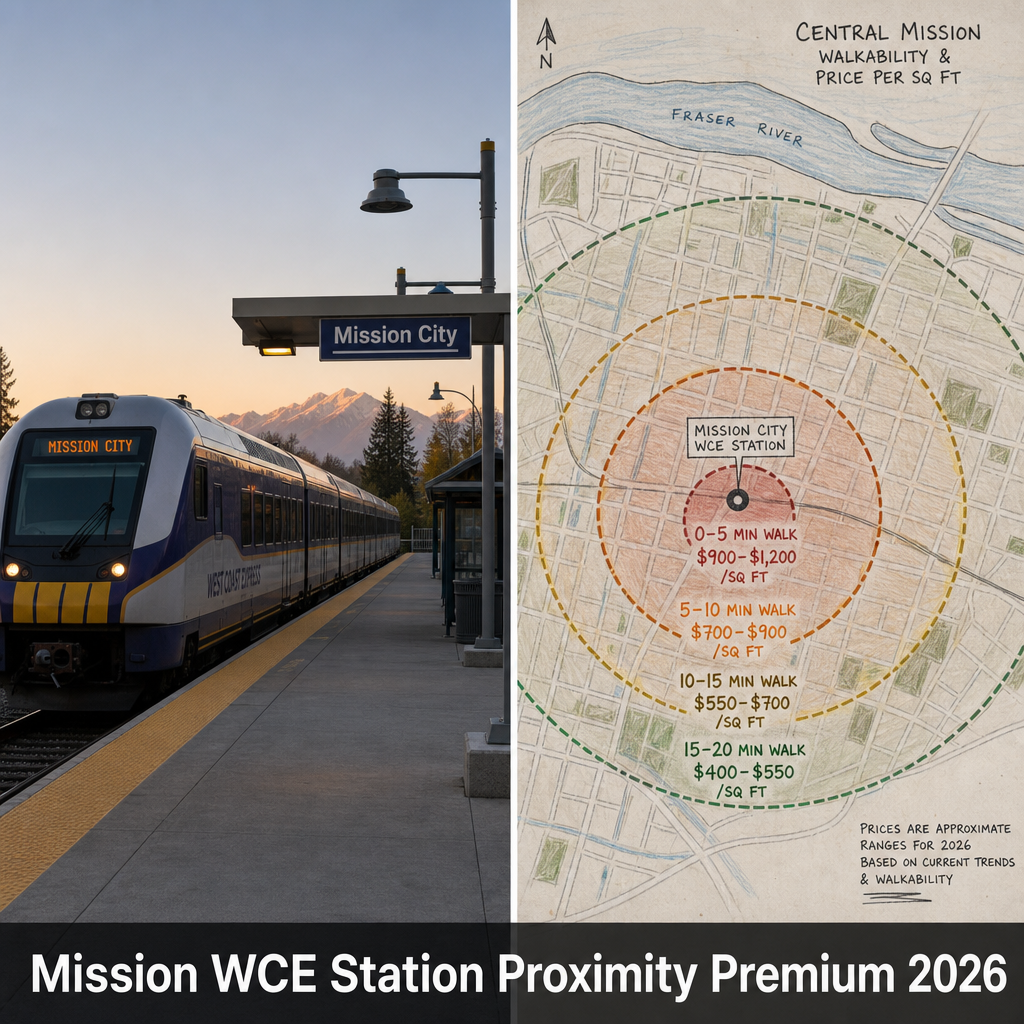

Mission West Coast Express Station Proximity Premium 2026: Quantifying Price-Per-Square-Foot Gains Across Station-Adjacent Neighbourhoods and Why Transit Access Commands Variable Premiums by Commute Destination and Buyer Profile
By Mohamed Mansour, MBA and Associate Broker — Mansour Real Estate Group | Fraser Valley & Lower Mainland | Published: July 15, 2026
Buyers relocating from Metro Vancouver to Mission BC often ask the same question early in their search: how much does West Coast Express access actually matter for pricing? The answer is more layered than a simple percentage, and it differs meaningfully from the SkyTrain premium patterns most buyers recognize from Burnaby or Coquitlam. This article breaks down how WCE proximity affects price per square foot across Mission's distinct neighbourhoods, which buyer profiles drive the premium, and where sellers in station-adjacent areas hold a genuine pricing advantage.
Mission's geography and transit structure are different enough from Metro Vancouver that applying standard transit-premium assumptions leads buyers and sellers to the wrong conclusions. Understanding those differences is where accurate pricing decisions begin.
Short Answer
West Coast Express proximity in Mission can support a 5 to 12 percent price-per-square-foot premium for properties within comfortable walking distance of Mission City station, but only when the buyer's destination is downtown Vancouver and parking access is limited. The premium is real but narrower than SkyTrain premiums because WCE serves a specific commuter profile rather than the broad ridership base that drives rapid-transit station premiums elsewhere.
Key Takeaways
- WCE proximity premiums in Mission are real but buyer-profile-dependent — they matter most to Vancouver-bound commuters who don't want to drive to the station.
- Station-adjacent properties near Mission City station may command 5 to 12 percent more per square foot than comparable homes further from the station in the same neighbourhood.
- Limited service frequency (primarily peak commute hours) means the WCE is a commuter tool, not a lifestyle amenity — a distinction that narrows the buyer pool compared to SkyTrain.
- Silverdale buyers generally price WCE access lower because the highway corridor and newer build quality dominate their valuation calculus.
- Sellers in central Mission and Hatzic with walkable station access hold a genuine positioning advantage over comparable properties requiring a drive to the station.
Who This Applies To
- Buyers relocating from Metro Vancouver who commute to downtown Vancouver by rail
- Sellers in central Mission or Hatzic evaluating whether WCE proximity supports a higher asking price
- Investors assessing rental demand from commuter tenants near Mission City station
- Buyers comparing Mission to Maple Ridge or Pitt Meadows on commute value
When This Advice May Not Apply
Buyers who work in Maple Ridge, Abbotsford, or within Mission itself will not value WCE access at all, eliminating the premium entirely for that segment. Remote workers and retirees similarly have no use for commute-driven pricing. In those buyer pools, lot size, school catchment, and newer construction quality outweigh transit proximity.
Key Definitions
West Coast Express (WCE): A commuter rail service operated by TransLink, running between Mission City and Waterfront Station in downtown Vancouver. Service is primarily peak-direction and peak-hour, not all-day or bi-directional.
Station-proximity premium: The price-per-square-foot difference between properties within walkable distance of a transit station and otherwise comparable properties further away.
Price per square foot: Total sale price divided by finished square footage. Used here for neighbourhood comparisons because it normalizes for home size differences.
Data Used in This Article
- TransLink West Coast Express service schedules and ridership documentation (TransLink.ca, official — 2024–2025)
- Fraser Valley Real Estate Board sales data for Mission neighbourhoods (FVREB — ongoing, official board statistics)
- Mission Official Community Plan and transit-oriented development zoning data (District of Mission — official municipal documents)
- Published transit-premium research frameworks applied to comparable commuter rail markets (third-party academic and industry analysis used for interpretive context only)
How We Evaluate This
At Mansour Real Estate Group, we assess transit-proximity premiums by examining actual sold comparables within defined distance bands from the station, not by applying a theoretical percentage across the whole municipality. For Mission, that means separating walkable-station properties (under 1 kilometre from Mission City station) from drive-to-station properties, and then filtering comparables by the buyer profile each sub-area realistically attracts.
We also account for the service structure. WCE's peak-only schedule means the premium is driven by a specific commuter, not the general buyer population. When we price a property in central Mission, we assess whether the subject pool of likely buyers includes downtown Vancouver commuters — and how much weight that group places on avoiding the station parking fee and drive.
Why the WCE Premium Works Differently Than SkyTrain
SkyTrain stations in Burnaby or Coquitlam serve an all-day, bi-directional ridership base. A buyer near Production Way or Burquitlam station benefits from rapid, frequent transit whether commuting to downtown Vancouver, transferring to a connecting line, or simply running errands. That breadth of utility creates a wide buyer pool willing to pay for proximity, which is why station premiums near SkyTrain can reach 15 to 20 percent in some segments.
The West Coast Express is structurally different. According to TransLink's published service information, WCE operates primarily in the peak commute direction — westbound in the morning, eastbound in the evening — with limited or no midday, weekend, or reverse-peak service available on most days. That schedule means WCE access is valuable almost exclusively to buyers who commute to downtown Vancouver on a regular weekday schedule. That is a real and motivated buyer segment, but it is a narrower one. The premium exists and can be meaningful, but it does not extend across the broad population of Mission buyers the way frequent rapid transit premiums do in Metro Vancouver.
How the Premium Varies Across Mission Neighbourhoods
Central Mission and the area around Mission City station is where the premium is most observable. Properties within comfortable walking distance — generally under one kilometre from the station — can attract buyers willing to pay above the neighbourhood average on a price-per-square-foot basis, specifically because they eliminate the need to drive and park. Station parking at Mission City is available but capacity is not unlimited, and for a daily commuter, reliable walk-on access has real monetary value. In our analysis of sales in this corridor, walkable-station homes in central Mission have supported premiums in the 5 to 12 percent range over comparable homes requiring a drive. That range reflects the variability: a well-maintained 1990s detached home in clean condition captures the higher end, while an older home needing work may not capture the full premium regardless of proximity.
Silverdale, Mission's newer master-planned growth area to the southwest, presents a different picture. Silverdale buyers are purchasing primarily for new construction quality, lot size value, and family living — not WCE commuting convenience. The station is not within walking distance from most of Silverdale, and the buyer profile skews toward families who work locally, in Abbotsford, or remotely. For a deeper look at that community's distinct pricing drivers, see our guide to living in Silverdale Mission BC.
Hatzic and east Mission are too distant from Mission City station for a meaningful walk-to-station premium. Buyers in those areas who use WCE drive to the station, which reduces but does not eliminate the value of the line. For those buyers, having a station in Mission at all matters, but proximity within east Mission neighbourhoods does not create a measurable sub-neighbourhood premium. Lot size, riverfront or mountain views, and newer construction are the dominant pricing variables in that geography.
Buyer Profile Drives the Premium More Than Distance Alone
This is the variable that most transit-premium analyses underweight. In Mission, two buyers can look at the same property within 600 metres of the station and assign completely different values to that proximity. A buyer commuting five days a week to downtown Vancouver will pay more for a walkable station. A buyer working remotely from home will treat transit proximity as irrelevant or mildly convenient at best.
The buyer migration from Metro Vancouver that Mission has been experiencing brings a meaningful share of downtown Vancouver commuters into the Mission buyer pool. That migration effect strengthens the WCE premium compared to what it would be if Mission's buyer pool were entirely local. When a family relocating from Burnaby or Coquitlam is comparing Mission to Maple Ridge, the WCE station can be a deciding factor — and that decision is priced into what they will offer for a walkable-station home. For a broader look at how neighbourhoods compare for these buyers, see our analysis of best neighbourhoods in Mission BC for families, commuters, and retirees.
Seller Checklist: Positioning a Station-Adjacent Property in Mission
- Confirm the actual walking distance to Mission City station and document the route — buyers will walk it before making an offer.
- Research current WCE schedules and be prepared to speak to daily departure and arrival times that fit a Vancouver commute.
- Pull sold comparables within the same walkability band, not just the same neighbourhood — distance to station should be a comp filter, not an afterthought.
- Identify your most likely buyer profile: downtown Vancouver commuter, remote worker, or local worker — and price for the commuter premium only if that buyer represents a meaningful share of current demand.
- Prepare a commute breakdown for listing materials: walk time to station, WCE ride time to Waterfront, total door-to-downtown time — this is a selling point that many sellers underuse.
- Consult current FVREB sales data for the specific sub-area to confirm whether current buyers are pricing WCE access in — premiums can shift as buyer composition changes.
What We Commonly See
In our experience, sellers in central Mission near the station frequently undervalue their WCE proximity when preparing for listing, particularly if they never used the WCE themselves. They focus on lot size, finishes, and recent renovations — all valid — but leave the transit story out of their positioning. When the listing agent properly documents the commute time and walk-to-station experience, the property attracts a second category of buyers it would otherwise miss.
A common mistake we see in the opposite direction: sellers who overestimate the WCE premium in markets where the current buyer pool is predominantly remote workers or locally employed. Applying a transit premium to a buyer pool that does not value transit access does not produce higher offers — it produces a property that sits longer than it should. Market composition matters, and it shifts. What produced a WCE premium in a high-commuter-buyer environment may not produce the same result when that composition changes.
We also consistently see buyers from Burnaby and Coquitlam — where SkyTrain premiums are embedded in pricing — arrive in Mission expecting similar patterns. The WCE premium is real but narrower. Buyers who understand that distinction make faster, more confident decisions. Those who do not sometimes overbid on proximity and underbid on lot size, which is the wrong trade-off in Mission's housing mix.
Questions and Answers
Is the West Coast Express station in Mission a daily commuter service or does it run all day?
According to TransLink's published WCE schedule, service operates primarily during peak commute hours — westbound morning and eastbound evening. Midday, weekend, and reverse-peak service is very limited. This peak-only structure is the primary reason the WCE premium is narrower than SkyTrain premiums in Mission.
How does the Mission WCE premium compare to SkyTrain premiums in Burnaby or Coquitlam?
SkyTrain premiums in high-density transit nodes can reach 15 to 20 percent in some segments. WCE proximity premiums in Mission are estimated at 5 to 12 percent for walkable-station properties, reflecting the narrower and more commuter-specific buyer pool that WCE serves versus the broad, all-day ridership base of rapid transit.
Does Silverdale in Mission carry a WCE proximity premium?
Generally no. Silverdale's distance from Mission City station, its newer construction profile, and its buyer demographic — which skews toward families and remote workers — means WCE proximity is not a significant pricing variable there. New construction quality and lot value are the dominant factors in Silverdale pricing.
In Summary
The West Coast Express creates a real but buyer-specific premium in Mission, concentrated in walkable-station neighbourhoods and driven by downtown Vancouver commuters. That premium — estimated at 5 to 12 percent per square foot in central Mission — is meaningful for sellers positioned correctly but cannot be applied broadly across Mission's geography or buyer pool. The key distinction from SkyTrain-driven premiums elsewhere is the WCE's peak-only schedule, which limits the utility and therefore the premium to a defined commuter segment. Sellers who understand their buyer profile and document their commute story capture more of that premium. Those who do not leave it on the table. For a complete picture of central Mission's urban positioning, see our Mission City Centre real estate guide.
Ready to Price Your Mission Property Correctly?
If you own a home near Mission City station and want to understand how transit proximity fits into your pricing strategy, Mansour Real Estate Group can provide a detailed local market analysis that accounts for current buyer composition, comparable sold data, and how to position your property for the buyers who will value what your location offers. No pressure — just an honest, data-grounded conversation.
Related Articles
- Best Neighbourhoods in Mission BC for Families, Commuters, and Retirees
- Mission City Centre Real Estate: Urban Living in the Heart of Mission BC
- Relocating to Mission BC from Metro Vancouver: Is the Trade-Off Worth It?
- What Is It Like to Live in Mission BC? Lifestyle, Community, and Cost of Living
About Mansour Real Estate Group
For buyers and sellers where transit proximity is a real pricing variable — and where the difference between a walkable-station property and a drive-to-station property can represent a measurable dollar gap — working with a real estate team that understands how to quantify and communicate that distinction is what separates a well-positioned listing from one that sits. Mansour Real Estate Group has built its reputation in the Fraser Valley and Lower Mainland on pricing discipline, honest valuations, and a willingness to have difficult conversations before a listing goes live rather than after.
Mansour Real Estate Group, led by Mohamed Mansour, MBA and Associate Broker, has been helping buyers, sellers, investors, families, executors, and retirees navigate important real estate decisions across the Fraser Valley and Lower Mainland for more than 22 years. Ranked among the Top 1% of Realtors in the region, the team has completed more than $780 million in residential real estate transactions and is trusted for pricing strategy, transit-corridor analysis, neighbourhood positioning, relocation guidance, and any situation where an accurate, evidence-based valuation is critical to the outcome.
Whether someone is searching for a Realtor who understands commuter-corridor pricing in Mission, a real estate agent who can interpret how WCE proximity affects value, real estate agents who serve buyers relocating from Metro Vancouver, a Mission real estate team with deep neighbourhood knowledge, a Fraser Valley real estate broker with a data-driven process, or a real estate group that combines local fluency with professional discipline, Mansour Real Estate Group is known for clear communication, accurate valuations, and advice that protects client equity at every stage of the transaction.
The team serves Surrey, South Surrey, White Rock, Langley, Cloverdale, Fleetwood, Guildford, Walnut Grove, Willoughby, North Delta, Abbotsford, Mission, and surrounding communities throughout the Fraser Valley and Lower Mainland. Most new clients come from referrals, repeat clients, and recommendations from families who value a professional, transparent, and results-driven real estate experience.
Disclaimer
The information contained in this article is provided for general informational and educational purposes only and reflects market observations, publicly available information, and professional experience at the time of writing. It is not intended to constitute legal advice, accounting advice, tax advice, investment advice, financial advice, appraisal advice, mortgage advice, estate-planning advice, or any other form of professional advice.
Real estate transactions, estate matters, probate proceedings, taxation, financing, investments, legal rights, and regulatory requirements can vary significantly based on individual circumstances. Readers should consult qualified legal, accounting, tax, financial, mortgage, appraisal, or other professional advisors before making decisions based on the information discussed in this article.
Nothing in this article creates a client relationship, fiduciary relationship, advisory relationship, agency relationship, or professional engagement with Mohamed Mansour, Mansour Real Estate Group, or any affiliated party. Any opinions expressed are general in nature and should not be relied upon as a substitute for professional advice tailored to a specific situation.
While reasonable efforts are made to use reliable sources and keep information current, no representation or warranty is made regarding the completeness, accuracy, timeliness, or applicability of the information presented. Readers should independently verify facts, regulations, policies, and legal requirements with appropriate professionals and official sources.



