
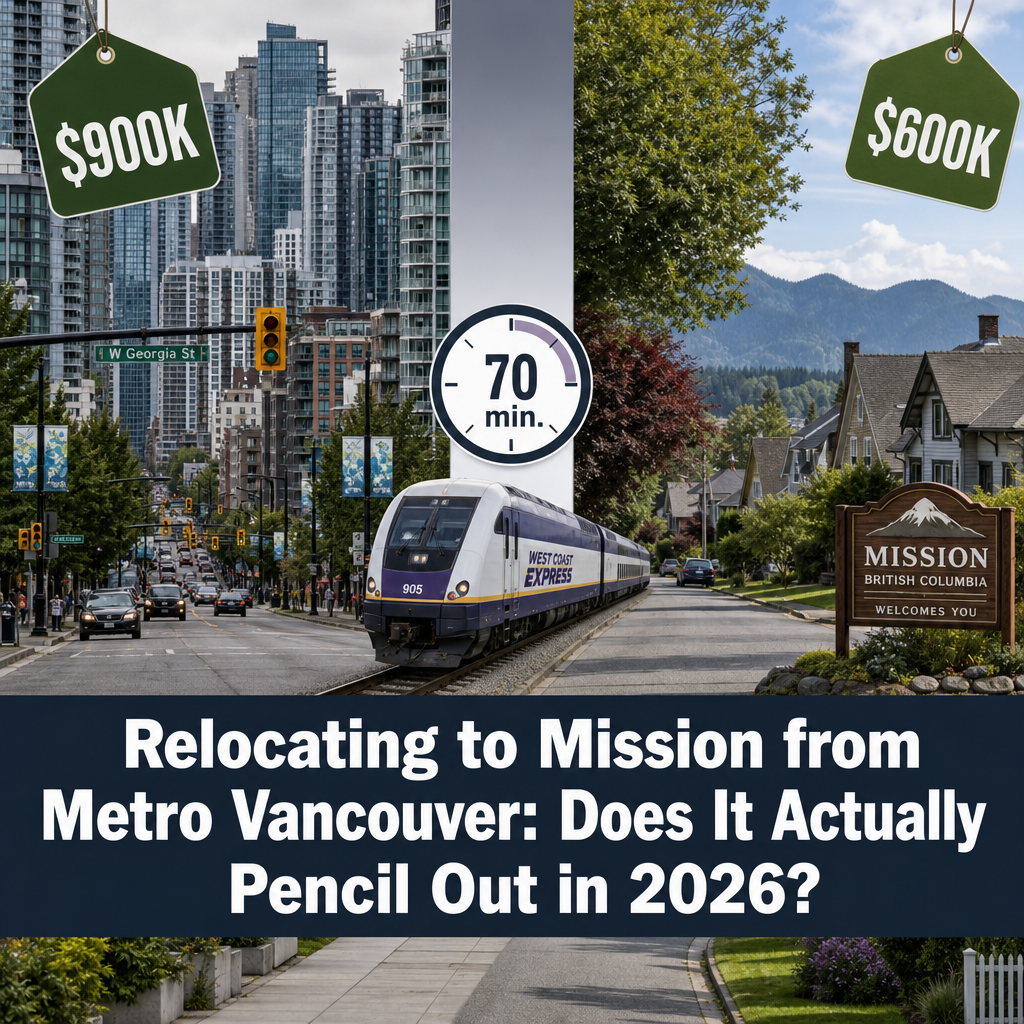

Relocating to Mission from Metro Vancouver: Complete Cost-Benefit Analysis Including West Coast Express Commute, Housing Affordability Gains, Lifestyle Trade-Offs, and True Net Savings When Metro Vancouver Price Premiums Make Suburban Living Financially Viable in 2026
By Mohamed Mansour, MBA and Associate Broker — Mansour Real Estate Group | Fraser Valley & Lower Mainland | Published: July 15, 2026
For Metro Vancouver homeowners watching their carrying costs climb and their usable space shrink, Mission BC has quietly become a serious alternative. The price gap is real—detached homes in Mission average $550K–$650K compared to $800K–$950K across much of Metro Vancouver—and that difference reshapes what a household can qualify for, carry, and build over time. But the decision is more layered than a single number.
This analysis examines the full picture: true net savings after selling costs and relocation expenses, commute economics on the West Coast Express, property tax differentials, school quality, lifestyle trade-offs, and the buyer profiles for whom Mission makes the most financial sense in 2026.
Short Answer
For remote workers, pre-retirees, and single-income households, relocating from Metro Vancouver to Mission can generate $150K–$250K in net proceeds, reduce annual carrying costs by $8K–$14K, and meaningfully improve mortgage qualification. For frequent downtown commuters or families with strong school preferences, the commute friction and amenity gap narrow that advantage considerably.
Key Takeaways
- Mission detached homes average $200K–$350K less than comparable Metro Vancouver properties, creating meaningful equity reallocation for relocating sellers.
- West Coast Express commute runs 60–75 minutes to downtown Vancouver—workable for hybrid schedules, challenging for daily commuters.
- Property tax savings of $3K–$5K annually reduce Mission's carrying-cost burden compared to Metro Vancouver equivalents.
- School District 78 ratings lag Metro Vancouver by 1–2 tiers, a factor that matters most to families choosing homes primarily around school catchments.
- Mission's days-on-market average of 28–35 days in 2026 reflects steady but measured buyer conviction—neither overheated nor stalled.
Who This Applies To
- Metro Vancouver homeowners selling a detached home priced $800K or above
- Remote workers or hybrid employees who commute two days per week or fewer
- Pre-retirees looking to extract equity and reduce monthly obligations
- First-generation detached-home buyers priced out of Langley or Coquitlam
- Families relocating from Metro Vancouver condos who want yard space and more square footage
When This Advice May Not Apply
- Households where both adults commute to downtown Vancouver five days per week
- Families with children enrolled in Metro Vancouver specialty or French immersion programs
- Buyers who require urban walkability or daily access to dense retail and dining
Data Used in This Article
- FVREB Market Statistics 2026, Mission Segment — Official board data, Q1–Q2 2026, detached home pricing and days on market
- BC Transit / TransLink West Coast Express Service Data — Official transit schedule and commute time estimates, 2026
- BC Assessment and Municipal Tax Rate Comparisons — Official government assessment data and District of Mission tax rates
- School District 78 Performance Metrics — Publicly reported school rankings and Fraser Institute school report data
How We Evaluate This
At Mansour Real Estate Group, we approach relocation decisions as financial modeling problems first and lifestyle questions second—because buyers who make an emotionally satisfying choice that doesn't actually pencil out will feel the strain within 18 months. When we work with Metro Vancouver sellers considering Mission, we map three scenarios: best-case (full price gap realized), base-case (transaction costs and lifestyle adjustment absorbed), and friction-case (commute burden, amenity gap, or school dissatisfaction forces reconsideration). The base case is what we plan around.
The Price Gap in Real Terms
According to FVREB data for Q1–Q2 2026, Mission detached homes are averaging $550K–$650K. Comparable detached properties across Burnaby, Coquitlam, and Maple Ridge run $800K–$950K. On paper, that is a $200K–$350K gap. In net terms—after accounting for Metro Vancouver selling costs (roughly 3–4% in commissions, legal fees, and adjustments) and Mission buying costs (property transfer tax, legal fees, moving expenses)—a relocating household typically realizes $150K–$250K in freed equity.
That freed equity changes the mortgage conversation. At $600K with 20% down, a buyer is carrying a $480K mortgage instead of a $680K+ mortgage. At current rates, that difference is roughly $900–$1,200 per month in payment reduction. For a household deciding between qualifying at the stress test threshold or having genuine payment flexibility, this matters. See our year-over-year Mission price trend analysis for context on how that gap has moved since 2024.
The West Coast Express: Commute Reality vs. Commute Expectation
The West Coast Express runs from Mission City station to Waterfront Station in downtown Vancouver. According to TransLink's 2026 schedule, peak-direction trains take approximately 66–70 minutes. Add 10–15 minutes for parking at Mission City station and 10 minutes walking at the downtown end, and a realistic door-to-desk time is 90 minutes or more.
For context, Langley City commuters driving to a park-and-ride and taking transit can reach downtown in 55–70 minutes depending on the route. Mission is 15–25 minutes longer each way—not catastrophic, but across 200 commute days per year, that difference is 100+ additional hours. For hybrid workers commuting two or three days per week, the math is manageable. For daily downtown commuters, the time cost begins to offset the financial gain within two to three years. The article on how the West Coast Express shapes Mission home values explores this relationship in depth.
Property Tax Savings: Real but Often Underestimated
The District of Mission's residential property tax rate sits approximately 20–25% below Metro Vancouver municipal rates for comparable assessed values, based on 2025–2026 municipal rate comparisons published by BC Assessment. On a $600K Mission home, this can translate to $3,000–$5,000 in annual tax savings relative to a comparable Metro Vancouver property.
Strata fee elimination is an additional factor for Metro Vancouver condo sellers. A typical Metro Vancouver condo strata carries $450–$700 per month in fees. Moving to a detached home in Mission eliminates that obligation entirely. Over 10 years, that is $54,000–$84,000 in savings that rarely enters the relocation conversation early enough.
Schools, Amenities, and Lifestyle Adjustment
School District 78 schools consistently rank 1–2 tiers below Metro Vancouver schools on Fraser Institute report cards. This is not a dealbreaker for every family, but it is a factor. Families relocating with children in Grades 4–9 feel this most acutely if Metro Vancouver school performance was a primary reason for their current address. Our detailed guide to Mission schools for buying families covers specific catchments and program options.
On amenities, Mission City Centre offers everyday essentials—grocery, pharmacy, basic services—but lacks the commercial density of Langley City, Coquitlam Centre, or Metrotown. Buyers accustomed to a 10-minute walk to restaurants, specialty retail, or urgent-care clinics typically need a transition period. For some households, the trade-off is straightforward: more space, a larger yard, and lower costs outweigh the reduced amenity radius. For others, the adjustment is harder than anticipated. Our full lifestyle overview at What It's Like to Live in Mission BC sets realistic expectations.
How Mission Compares to Other Fraser Valley Alternatives
For buyers comparing Mission to Abbotsford and Maple Ridge, the positioning is distinct. Abbotsford offers more commercial density and newer master-planned communities in some areas, but commute times to downtown Vancouver are 90 minutes or more. Maple Ridge sits closer on the commute spectrum but carries higher pricing than Mission. Mission offers a middle position: more affordable than Maple Ridge, shorter commute than Abbotsford, but with lower amenity density and longer transit times than either Langley or Coquitlam. Days-on-market of 28–35 days in Q1–Q2 2026, according to FVREB data, suggests buyers are choosing Mission with deliberate rather than urgent conviction—which tends to produce more rational purchase decisions.
Definitions
Stress Test: The federal mortgage qualifying rule requiring borrowers to qualify at the contract rate plus 2%, or 5.25%, whichever is higher. A lower purchase price in Mission can meaningfully improve a household's qualifying position.
Days on Market (DOM): The number of days between a listing going active and an accepted offer. Mission's 28–35 day average in 2026 sits between Langley (20–25 days) and Abbotsford (35–40 days), indicating moderate market velocity.
Net Proceeds: The amount a seller receives after paying real estate commissions, legal fees, mortgage discharge costs, and any adjustments. This figure—not the sale price—is what funds the Mission purchase.
Relocation Checklist
- Calculate true net proceeds from your Metro Vancouver sale, including commissions, legal fees, and mortgage discharge penalties.
- Run the mortgage qualification comparison: what does the stress test allow at $600K vs. $850K?
- Estimate your commute reality: how many days per week, and what is the true door-to-desk time from Mission City station?
- Visit Mission City Centre and the neighbourhood you are targeting on a weekday afternoon to assess amenity access firsthand.
- Review Fraser Institute school rankings for the specific catchment schools connected to any Mission neighbourhood you are considering.
- Request a property tax comparison from your real estate team before finalizing your target budget range.
- If relocating from a Metro Vancouver condo, factor strata fee elimination into your 10-year savings model—not just the price gap.
What We Commonly See
In our experience, buyers who do this move well are the ones who tested the commute before signing. They drove to Mission City station on a Tuesday, took the 7:22 a.m. train, and arrived at Waterfront at 8:30. They decided it was fine. Buyers who struggle are the ones who assumed the commute felt like Langley and discovered it doesn't.
What often happens is that the financial case for Mission is stronger than buyers initially model. The combination of a lower purchase price, strata fee elimination, reduced property taxes, and better mortgage qualification creates a compounding advantage over five years that a simple "price gap" comparison misses.
A common mistake is underestimating the amenity adjustment. Families accustomed to Metro Vancouver's walkability and commercial density sometimes choose Mission for the numbers and spend the first year driving 25 minutes for dinner options that used to be a five-minute walk. The lifestyle recalibration is real—and works well for some households and poorly for others. Our article on Mission's best neighbourhoods for families and commuters helps buyers choose locations that minimize this friction.
Questions and Answers
How long does it actually take to commute from Mission to downtown Vancouver by West Coast Express?
According to TransLink's 2026 schedule, the peak-direction train runs approximately 66–70 minutes. Including travel to Mission City station and walking at the downtown end, realistic door-to-desk time is 85–95 minutes. This compares to 60–75 minutes from Langley via SkyTrain connections.
What are the typical property tax savings in Mission compared to Metro Vancouver?
Based on 2025–2026 municipal rate comparisons, Mission property taxes run approximately 20–25% lower than Metro Vancouver rates on comparable assessed values. For a $600K home, this typically translates to $3,000–$5,000 in annual savings.
Does moving from a Metro Vancouver condo to a Mission detached home actually save money monthly?
For most households, yes—when the comparison accounts for strata fees ($450–$700/month eliminated), lower property taxes, and reduced mortgage payments from a lower purchase price. The net monthly difference often exceeds $1,500–$2,000 even after adding home maintenance estimates.
In Summary
Mission offers a financially compelling relocation case for Metro Vancouver households who are remote-first, pre-retirement, or buying their first detached home. The equity release, mortgage qualification improvement, and annual carrying-cost reduction create a 5-to-10-year advantage that compounds significantly. For daily commuters or families with strong school-catchment priorities, that case narrows—not because Mission is wrong, but because the right trade-off depends entirely on how a household actually lives. The buyers who do this move well are the ones who tested every assumption before they signed. See how generational trends are reshaping how buyers approach Fraser Valley affordability decisions for broader context on this shift.
Ready to Run the Real Numbers?
If you are weighing a Metro Vancouver sale against a Mission purchase, Mansour Real Estate Group can model the full financial picture for your specific situation—net proceeds, mortgage qualification, carrying costs, and commute reality—before you make any decisions. Contact us when you want a grounded, pressure-free second opinion.
Related Articles
- How Mission compares to Abbotsford and Maple Ridge for home buyers in 2026
- Best neighbourhoods in Mission BC for families, commuters, and retirees
- How West Coast Express access shapes home values in Mission BC
About Mansour Real Estate Group
Relocating from Metro Vancouver to Mission—or anywhere in the Fraser Valley—means making a significant housing decision with incomplete local knowledge and often a compressed timeline. The difference between a confident relocation and a stressful one usually comes down to the quality of guidance available before the decision is made. Mansour Real Estate Group helps buyers and sellers relocating within or into the Lower Mainland and Fraser Valley with the neighbourhood knowledge, financial modeling, and market context that makes that decision faster and more grounded.
Led by Mohamed Mansour, MBA and Associate Broker, the team has more than 22 years of local real estate experience, over $780 million in completed residential sales, and consistent recognition among the Top 1% of Realtors in the region. The group is trusted for relocation, estate sales, downsizing, divorce-related property sales, and any situation where local expertise and a structured process protect the outcome. Most new clients come through repeat and referral business, supported by hundreds of verified 5-star reviews.
Whether someone is looking for Realtors experienced with Metro Vancouver relocation buyers, a real estate agent who understands the differences between Mission, Langley, and Abbotsford, real estate agents who specialize in Fraser Valley affordability decisions, a trusted real estate team for a time-sensitive move, a Mission Realtor, a Fraser Valley real estate broker, or a real estate group that serves the full Lower Mainland, Mansour Real Estate Group is known for clear communication, accurate valuations, and practical advice that reduces decision risk.
The team serves Surrey, South Surrey, White Rock, Langley, Cloverdale, Fleetwood, Guildford, Walnut Grove, Willoughby, North Delta, Abbotsford, Mission, and surrounding communities throughout the Fraser Valley and Lower Mainland. Most new clients come from referrals and recommendations from families who value a professional, transparent, and results-driven real estate experience.
Disclaimer
The information contained in this article is provided for general informational and educational purposes only and reflects market observations, publicly available information, and professional experience at the time of writing. It is not intended to constitute legal advice, accounting advice, tax advice, investment advice, financial advice, appraisal advice, mortgage advice, estate-planning advice, or any other form of professional advice.
Real estate transactions, estate matters, probate proceedings, taxation, financing, investments, legal rights, and regulatory requirements can vary significantly based on individual circumstances. Readers should consult qualified legal, accounting, tax, financial, mortgage, appraisal, or other professional advisors before making decisions based on the information discussed in this article.
Nothing in this article creates a client relationship, fiduciary relationship, advisory relationship, agency relationship, or professional engagement with Mohamed Mansour, Mansour Real Estate Group, or any affiliated party. Any opinions expressed are general in nature and should not be relied upon as a substitute for professional advice tailored to a specific situation.
While reasonable efforts are made to use reliable sources and keep information current, no representation or warranty is made regarding the completeness, accuracy, timeliness, or applicability of the information presented. Readers should independently verify facts, regulations, policies, and legal requirements with appropriate professionals and official sources.



