

Mission Real Estate Pricing Strategy 2026: How to Build Your Own Comparative Market Analysis, Interpret Absorption Rates, and Avoid the Overpricing Trap When Buyer Demand Varies Significantly Across Property Types
By Mohamed Mansour, MBA, Associate Broker — Mansour Real Estate Group | Fraser Valley & Lower Mainland | Published: July 15, 2026
Mission sellers face a pricing problem that doesn't show up clearly in provincial averages or neighbourhood headlines. Absorption rates are low, inventory is elevated, and buyer demand varies sharply by property type — sometimes within a few blocks. A detached home on a quiet street in Hatzic can sell in under four weeks while a comparably priced townhome in a mature strata complex sits for 60 days. The difference usually comes down to one thing: how the property was priced at launch.
This guide gives Mission sellers a practical framework for reading comparable sales, interpreting absorption data, and anchoring their initial asking price to current buyer behaviour — not to assessment values, neighbourhood folklore, or what the market looked like in 2021. For a broader overview of where the Mission market stands heading into 2026, see our Mission BC Real Estate Market Update.
Short Answer
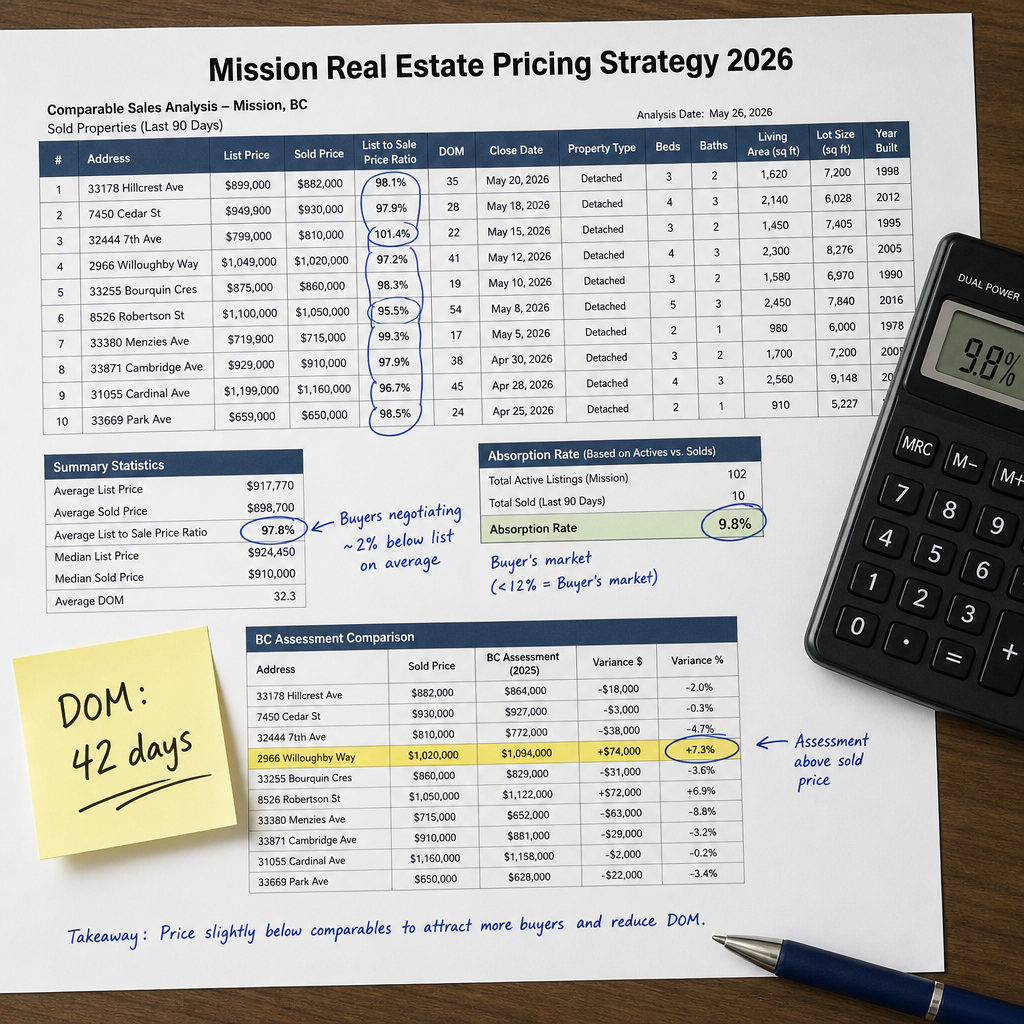
In Mission's current buyer's market, with absorption rates near 9–11% and average days-on-market ranging from 35 to 50-plus days depending on property type, pricing accuracy at launch is the single most important variable a seller controls. Overpricing by even 8–10% typically extends the sales timeline by three to five weeks and forces a price reduction that signals weakness to buyers who were already watching.
Key Takeaways
- Mission's absorption rate of 9–11% confirms a sustained buyer's market where pricing precision outweighs timing.
- BC Assessment values in Mission lag actual market prices by 5–12%, making them unreliable pricing anchors.
- Detached homes sell 20–30% faster than condos and townhomes in comparable Mission price bands.
- List-to-sale ratios average 95–98% for detached but drop to 92–95% for Mission strata properties.
- Sellers who overprice by 10–20% typically face 45–70 day timelines instead of an optimal 25–35 days.
Who This Applies To
- Mission homeowners preparing to list a detached, condo, or townhome property in 2026
- Sellers who have received a BC Assessment notice and are wondering how it relates to their selling price
- Owners who purchased 3–6 years ago and are unsure how current buyer demand has shifted
- Estate sellers or executors managing a Mission property who need a pricing framework grounded in current data
When This Advice May Not Apply
If your property is acreage, rural, or has significant development potential, standard comparable sales methodology requires adjustment. Acreage and rural properties in Mission follow a different buyer pool and pricing logic than residential strata or standard detached homes.
Key Terms Explained
Absorption rate: Monthly sales divided by active listings, expressed as a percentage. Below 12% generally indicates a buyer's market. Mission currently sits at 9–11%, per FVREB market data and Mansour Real Estate Group transaction analysis.
Comparative market analysis (CMA): A pricing estimate built from recently sold comparable properties, adjusted for size, condition, location, and market movement.
List-to-sale-price ratio: The final sale price as a percentage of the original asking price. A ratio of 96% means the home sold for 4% below list.
Days on market (DOM): The number of calendar days from listing date to accepted offer. Extended DOM is often the first signal that initial pricing missed the market.
Data Used in This Article
- Fraser Valley Real Estate Board (FVREB) — Mission sales, inventory, and days-on-market data, 2025–2026 (official monthly statistical reports)
- BC Land Title and Survey Authority — completed transfer records, Mission properties, 2024–2026 (official registry data)
- Canadian Real Estate Association — absorption rate calculation methodology (official CREA guidance)
- BC Assessment Authority — 2026 assessed values, Mission residential properties (official government assessment)
- Mansour Real Estate Group — internal transaction data and days-on-market observations, Mission properties (professional analysis)
How We Evaluate This
When Mansour Real Estate Group prices a Mission property, the starting point is never BC Assessment and never the seller's purchase price. We pull sold comparables from the past 60 to 90 days within the same neighbourhood boundary, filter by property type and finished square footage within 15%, and then apply directional adjustments based on where the market moved between the comparable sale date and today's list date.
We also separate the Mission market by segment before drawing conclusions. Detached home data does not predict condo or townhome absorption. The divergence between detached and strata market conditions in Mission is material and directly affects where a property should be priced on day one.
Why Absorption Rate Matters More Than Headlines in Mission
Regional market headlines often report Fraser Valley data at a level too broad to be useful for individual Mission sellers. According to FVREB monthly statistical reports, Mission's absorption rate in 2025 and into 2026 has consistently tracked between 9% and 11% — well below the 20% threshold that signals a balanced market and far below the 25–30% range that would indicate seller-favourable conditions.
What this means practically: at a 10% absorption rate, roughly one in ten active listings sells in a given month. The listings that sell are not random. They are the ones priced most accurately relative to what active buyers are willing to pay right now. Sellers who price above that range do not simply wait longer — they watch comparable properties sell around them while their own listing accumulates days on market and loses the negotiating credibility that comes with a fresh listing. Mission's elevated inventory levels mean that buyers have alternatives and use them quickly when a property is mispriced.
How to Build a Reliable CMA for a Mission Property
A useful CMA for Mission relies on three filters applied in order. First, restrict comparable sales to the same micro-neighbourhood — not all of Mission, not all of "East Mission" as a single zone. School catchments, proximity to the West Coast Express station, and lot characteristics create pricing micro-climates within Mission that make cross-neighbourhood comparisons unreliable. Neighbourhood-specific dynamics in Mission affect both buyer demand and achievable price, and a CMA that ignores this will drift from reality.
Second, use only sales from the past 60 to 90 days. Sales older than 90 days in the current Mission market reflect a different interest rate environment, a different buyer pool, or both. Using a sale from 2023 or early 2024 as a primary comp will produce a number that neither buyers nor their mortgage lenders will validate.
Third, check list-to-sale ratios within your comparable set. If the three most recent detached sales in your area closed at 96%, 97%, and 95% of their asking prices, that ratio tells you two things: buyers are negotiating, and sellers who priced realistically still achieved near-list results. If your property type is a condo or townhome, expect that ratio to shift lower — current FVREB and Mansour Real Estate Group transaction data show Mission strata properties closing at 92–95% of list, which means your opening price carries more downside risk if it starts too high.
Why BC Assessment Values Mislead Mission Sellers
BC Assessment values are calculated using July 1 of the prior year as the valuation date, based on mass appraisal methodology applied across large property pools. According to BC Assessment's published methodology, individual property assessments are designed to reflect general market levels — not the specific condition, presentation, recent renovation status, or micro-location factors that determine what a buyer will pay in a given week.
In Mission, the gap between assessed value and actual selling price has ranged from 5% to 12% depending on property type and neighbourhood, based on Mansour Real Estate Group's review of BC Land Title transfer data against current assessment rolls. For detached homes in established Mission neighbourhoods, assessed values have trended below market in periods of rising prices and above market in softening periods — the opposite of what sellers need for accurate positioning. Using BC Assessment as your pricing anchor in a buyer's market is particularly risky because the assessment reflects conditions that may no longer exist.
Seller Checklist: Pricing a Mission Property Accurately
- Pull all sold comparables within your specific Mission micro-neighbourhood for the past 60–90 days, filtered by property type.
- Calculate the list-to-sale-price ratio for each comparable sale and identify the range for your segment.
- Check the current absorption rate for your property type specifically — do not use a blended Mission-wide figure.
- Identify the current DOM average for your property type and price band — this is your benchmark for what "normal" looks like.
- Confirm your BC Assessment value and then set it aside — use it only as one rough data point, not a pricing anchor.
- Adjust comparable sale prices for meaningful differences: lot size, finished basement, age of roof or mechanicals, strata fee level if applicable.
- Stress-test your target price: if buyers negotiate to the average list-to-sale ratio for your segment, what do you net? Is that acceptable?
- Before finalizing your list price, confirm whether any active listings in your neighbourhood represent genuine competition — active inventory affects buyer leverage on day one.
What We Commonly See
In our experience working with Mission sellers, the most common pricing error is anchoring to a number that felt right three years ago. A seller who purchased in 2020 or 2021 at a peak price, or who watched a neighbour sell at an exceptional number in 2022, often carries that figure as a mental floor — even when current comps don't support it. What often happens is that the property launches 10–15% above market, attracts no offers in the first two weeks, and then requires a visible price reduction that tells every active buyer the seller is now negotiating from a position of weakness.
A common mistake specific to Mission condos and townhomes is treating them as a single segment. A strata property in a well-maintained building with low fees and a healthy contingency reserve fund sells differently from one with deferred maintenance and a recently approved special levy. Buyers reviewing Form B documents — which disclose strata financial health — will price that risk into their offers whether or not the seller accounts for it in the asking price.
We also frequently see sellers underestimate how much Mission's distance from Metro Vancouver transit affects the buyer pool for certain property types. West Coast Express access meaningfully affects which buyers consider Mission versus closer Fraser Valley communities, and properties that are not near transit-friendly areas of Mission face a narrower buyer pool — which affects both days on market and achievable price.
Questions and Answers
Q: How often do Mission homes actually sell at or above their asking price in 2026?
For detached homes priced accurately within current market range, some sales close at list or marginally above — but this is not the norm. The more common outcome, per FVREB transaction data and Mansour Real Estate Group observations, is a 2–5% negotiated reduction from list for well-priced detached properties, and 5–8% for strata properties.
Q: Should I wait for the spring market to get a better price in Mission?
Seasonal timing matters less in a sustained buyer's market than pricing accuracy. A well-priced Mission property will attract qualified buyers year-round. Waiting for spring adds carrying costs and does not guarantee higher offers if elevated inventory continues to give buyers options across all seasons.
Q: What is a reasonable days-on-market expectation for a well-priced Mission detached home in 2026?
Based on FVREB data and our Mission transaction history, a well-priced detached home in an established Mission neighbourhood typically receives serious buyer interest within 14–21 days and closes an accepted offer within 25–35 days of listing. Properties that exceed 45 days without an accepted offer usually need a pricing review.
In Summary
Mission's 2026 market rewards pricing accuracy more than timing. With absorption rates between 9–11%, elevated inventory across all property types, and a meaningful gap between detached and strata performance, sellers who anchor their price to current sold comparables — not BC Assessment values or dated neighbourhood memory — consistently achieve shorter days-on-market and stronger negotiating positions. The cost of overpricing in Mission is not a smaller sale price. It is a longer, more expensive, more stressful sale process that typically ends at a lower number than a well-priced launch would have produced on day one. Once your price is anchored correctly, how you prepare and present the property becomes the next critical variable.
Thinking About Listing Your Mission Home?
If you want a comparable market analysis built from current Mission sold data — not BC Assessment, not regional averages — Mansour Real Estate Group can provide one. There is no obligation, and the conversation starts with the numbers, not a pitch.
Call or text: 604-765-0376 | Email: [email protected] | localhost:9000/
Related Articles
- Mission BC Real Estate Market Update: What Buyers and Sellers Need to Know in 2026
- Is the Mission BC Housing Market a Buyer's or Seller's Market Right Now?
- How to Prepare Your Mission BC Home for Sale: Staging, Repairs, and Presentation Tips
- The Home Selling Process in Mission BC: A Step-by-Step Timeline for Sellers
- What Do Mission BC Home Sellers Net After Fees and Taxes? A Cost Breakdown
Official Resources
- Fraser Valley Real Estate Board — Monthly Statistics
- BC Land Title and Survey Authority — Property Transfer Records
- BC Assessment Authority — Assessed Values and Methodology
- Canadian Real Estate Association — Absorption Rate Methodology
About Mansour Real Estate Group
When Mission homeowners are preparing to sell, the decisions made before the listing goes live — pricing strategy, comparable analysis, market positioning, and understanding how current buyer demand differs by property type — typically determine the outcome more than anything that happens after. Mansour Real Estate Group has guided sellers across Mission, Abbotsford, Langley, Surrey, and the broader Fraser Valley through those decisions for more than 22 years, with a process built around accurate valuations, honest advice, and protecting seller equity in any market condition.
Led by Mohamed Mansour, MBA and Associate Broker, the team has been helping buyers, sellers, investors, families, and retirees navigate real estate decisions across the Fraser Valley and Lower Mainland for more than 22 years. Ranked among the Top 1% of Realtors in the region, Mansour Real Estate Group has completed more than $780 million in residential real estate transactions and is trusted for seller strategy, estate sales, divorce-related property sales, downsizing, and complex situations where pricing accuracy and clear communication matter most.
Whether someone is looking for a Mission Realtor who understands local absorption rates and micro-neighbourhood pricing, a real estate agent who builds CMAs from current sold data rather than assessments, real estate agents who specialize in seller strategy across the Fraser Valley, a trusted real estate team for a detached home or strata sale, or a Fraser Valley real estate broker with direct local market knowledge — Mansour Real Estate Group is known for methodical analysis, strategic marketing, and practical guidance grounded in what Mission buyers are actually doing right now.
The team serves Mission, Abbotsford, Surrey, South Surrey, White Rock, Langley, Cloverdale, Fleetwood, Guildford, Walnut Grove, Willoughby, and North Delta, and surrounding communities throughout the Fraser Valley and Lower Mainland. Most new clients come from referrals, repeat business, and recommendations from sellers who valued a transparent, results-driven real estate experience.
Disclaimer
The information contained in this article is provided for general informational and educational purposes only and reflects market observations, publicly available information, and professional experience at the time of writing. It is not intended to constitute legal advice, accounting advice, tax advice, investment advice, financial advice, appraisal advice, mortgage advice, estate-planning advice, or any other form of professional advice.
Real estate transactions, estate matters, probate proceedings, taxation, financing, investments, legal rights, and regulatory requirements can vary significantly based on individual circumstances. Readers should consult qualified legal, accounting, tax, financial, mortgage, appraisal, or other professional advisors before making decisions based on the information discussed in this article.
Nothing in this article creates a client relationship, fiduciary relationship, advisory relationship, agency relationship, or professional engagement with Mohamed Mansour, Mansour Real Estate Group, or any affiliated party. Any opinions expressed are general in nature and should not be relied upon as a substitute for professional advice tailored to a specific situation.
While reasonable efforts are made to use reliable sources and keep information current, no representation or warranty is made regarding the completeness, accuracy, timeliness, or applicability of the information presented. Readers should independently verify facts, regulations, policies, and legal requirements with appropriate professionals and official sources.



