
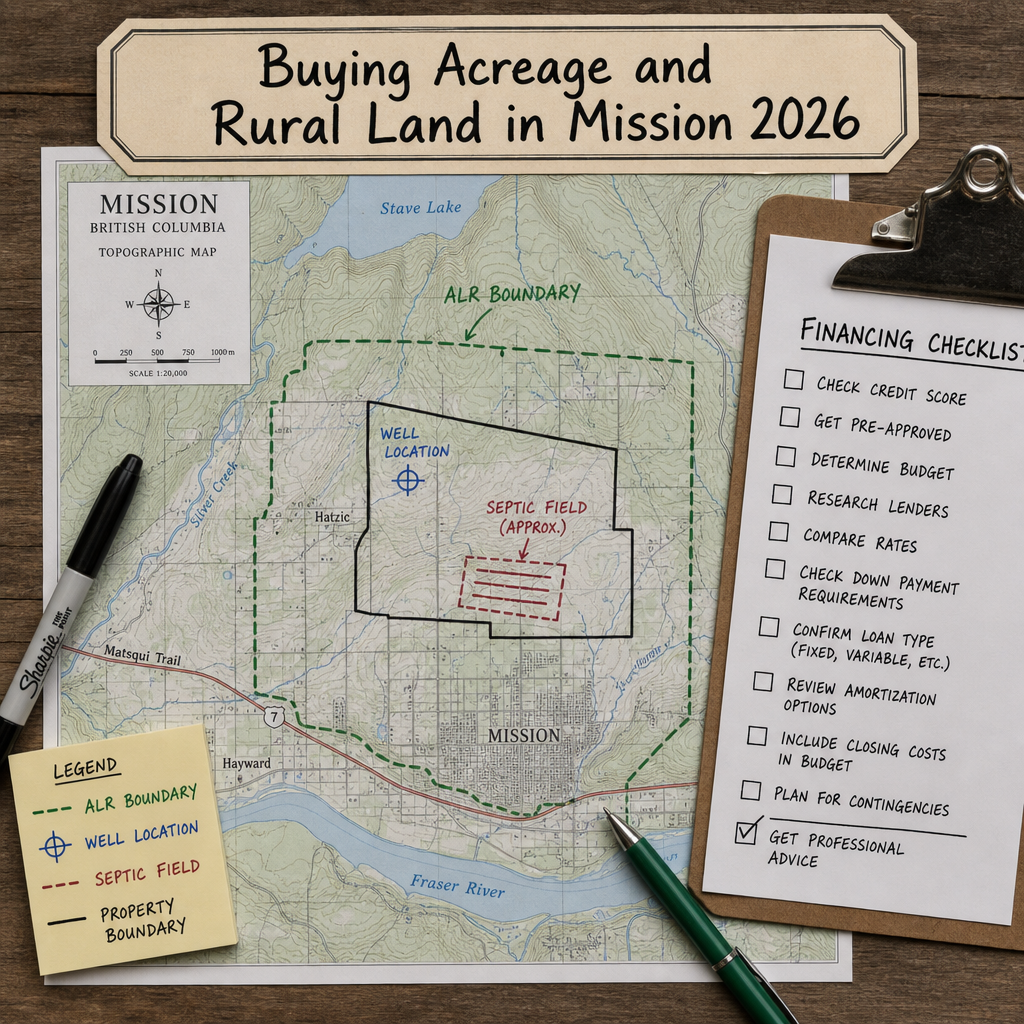

Buying Acreage and Rural Land in Mission 2026: ALR Zoning, Well and Septic Systems, Rural Financing Quirks, and Complete Due Diligence for Non-Urban Properties
By Mohamed Mansour, MBA and Associate Broker | Mansour Real Estate Group | Fraser Valley and Lower Mainland | Published: July 15, 2026
Acreage and rural land in Mission attracts buyers looking for space, privacy, and a different pace of life. But buying a rural property in BC is a fundamentally different process than buying a suburban detached home. The due diligence is more complex, the financing is harder to arrange, and the risks of skipping steps are far more serious.
This guide is written for buyers considering acreage or rural land in Mission — whether they are drawn to hobby farms, recreational retreats, or properties in BC's Agricultural Land Reserve. It covers what to verify, what to watch for, and where rural purchases commonly go wrong. For a broader look at how Mission's overall market is performing, the Mission BC real estate market update for 2026 provides helpful context.
Short Answer
Buying acreage or rural land in Mission requires due diligence that goes well beyond a standard home inspection. ALR zoning restricts land use and limits your lender options. Wells and septic systems need independent testing before subjects are removed. Financing often requires specialized lenders. Buyers should plan for a due diligence period of 30 to 60 days longer than a typical urban purchase.
Key Takeaways
- ALR designation restricts non-farm use on Mission rural land and affects which lenders will finance the purchase.
- Well water must be independently tested for potability and yield — BC guidelines require a minimum flow of 4 litres per minute.
- Septic systems need a professional inspection, pump-out, and percolation test before you remove subjects.
- Many mainstream banks won't lend on ALR land without exemption documentation or proof of agricultural income.
- Rural due diligence timelines extend 30 to 60 days beyond a typical urban close — negotiate this into your offer from the start.
Who This Applies To
- Buyers purchasing 2-acre or larger properties in Mission, including hobby farms, recreational land, and agricultural parcels
- Buyers purchasing land within BC's Agricultural Land Reserve in the Mission corridor
- Buyers transitioning from urban or suburban home ownership who have not owned rural property before
- Investors evaluating Mission acreage for future development, land banking, or farm income
When This Advice May Not Apply
Properties within Mission's urban boundary connected to municipal water and sewer follow standard residential purchase procedures. Small-lot non-ALR properties with municipal services are assessed differently. If a property is outside the ALR and fully serviced, most of the financing and due diligence considerations in this article will not apply. Consult a Realtor familiar with Mission rural inventory to confirm which category your target property falls into.
Key Terms Defined
Agricultural Land Reserve (ALR): A provincial land use zone in BC protecting agricultural land from non-farm development. Administered by the BC Agricultural Land Commission (ALC).
ALR Exemption: An ALC-approved exception allowing non-farm use or subdivision on ALR land in specific circumstances.
Percolation Test: A soil test that measures how quickly water drains, used to determine whether a site can support a septic system.
Appraisal Shortfall: When a lender's appraised value comes in below the agreed purchase price, requiring the buyer to cover the gap in cash.
Data Used in This Article
- BC Agricultural Land Commission — ALR regulations and exemption application process (official, 2026)
- BC Ministry of Health — Well water yield guidelines and potability testing standards (official)
- Mission Official Community Plan — Rural zoning and ALR designations (official, District of Mission)
- Fraser Valley Real Estate Board — Acreage and agricultural property comparable sales data (third-party, 2025–2026)
- Appraisal Institute of Canada — Rural property valuation methodology (industry guidance)
Understanding ALR Zoning in Mission
A significant portion of Mission's rural land sits within BC's Agricultural Land Reserve. ALR designation is not just a zoning label — it is a provincial land use restriction administered by the BC Agricultural Land Commission (ALC) that limits what you can build, how you can subdivide, and how the land can be used.
For buyers, ALR status has three practical consequences. First, you cannot build freely — non-farm residential use on ALR land is restricted. A home may exist on the property, but adding structures, subdividing lots, or using land for commercial purposes unrelated to farming requires ALC approval. Second, lenders treat ALR land differently. Many mainstream banks will not issue a standard residential mortgage on ALR-designated property unless the buyer can demonstrate agricultural use, provide an ALR exemption approval, or meet specific lender criteria. Third, the resale market is narrower. The buyer pool for ALR acreage is smaller than for non-ALR rural land, which affects both liquidity and long-term value.
Before making an offer on any Mission acreage, confirm whether it falls within the ALR. The ALC's public mapping tool and the District of Mission's zoning records both provide this information. If the property is ALR-designated, get clarity on what the current owner has been using it for, whether any ALC applications are in progress, and what your intended use would require.
Mission's rural areas, particularly along the Mission-Chilliwack corridor, include a mix of ALR and non-ALR agricultural land. Recreational properties on undesignated rural lots are easier to finance and use more flexibly — but they come at a price premium that reflects that advantage. For buyers exploring the range of property types available across Mission, the Mission BC property type overview offers useful context on what else is available in the market.
Well Water and Septic Systems: What Buyers Must Verify
Rural properties in Mission are not connected to municipal water or sewer. They depend on private well water systems and on-site septic systems. Both require independent professional assessment before you remove subjects — this is not optional, and it is not something a general home inspector is qualified to certify.
Well water must be tested in two ways. Potability testing confirms that the water is safe to drink, free from bacteria and contaminants. Yield testing confirms that the well produces sufficient volume for household use. BC health authority guidelines reference a minimum yield of 4 litres per minute as a baseline for residential adequacy, though actual requirements depend on household size and intended use. A low-yield well is a significant problem. Drilling a new well in Mission can cost $15,000 to $30,000 or more, and there is no guarantee that a new well will produce better results in the same location. If a well test comes back with low yield or failed potability results, you need to understand your remediation options before committing to the purchase.
Septic systems require a separate inspection from a qualified septic professional, not a home inspector. The inspection should include a pump-out, a physical assessment of tank condition and distribution components, and a review of the drainfield. If the drainfield is aging or improperly sized for the current structure, replacing it can cost $20,000 to $50,000 depending on soil conditions and site access. A percolation test on the soil is necessary to determine whether the existing field is still functioning and whether the land could support a replacement system if needed.
One factor buyers overlook in Mission specifically: rural properties near agricultural operations may have elevated nitrate levels in groundwater from fertilizer runoff. Water quality testing should include a full chemical panel, not just a basic bacterial screen. This is not a reason to avoid rural Mission properties — it is a reason to test thoroughly before committing.
Rural Financing: Why Standard Mortgages Often Don't Apply
Financing rural and acreage properties in Mission is more complicated than financing a suburban detached home. The two main challenges are lender eligibility and appraisal reliability.
Most major banks and credit unions apply residential mortgage criteria that don't fit rural and ALR properties. Common restrictions include lot size limits (many lenders cap standard residential mortgages at 5 to 10 acres), ALR designation exclusions, and requirements for municipal water and sewer connections. Buyers who assume they can finance a 10-acre Mission acreage the same way they would finance a Surrey detached home often discover the restriction only after their pre-approval has been issued — and only after they have an accepted offer in hand.
When mainstream lenders decline, buyers typically turn to credit unions with rural lending programs, agricultural lenders, or private financing. Private rural mortgage rates in BC have ranged from approximately 8 to 12 percent in recent years — materially higher than conventional mortgage rates — and often come with shorter terms and higher fees. This affects purchase affordability and long-term carrying costs in ways buyers need to model before making an offer.
Appraisal accuracy is a separate issue. Rural acreage appraisals rely on comparable rural sales, which are less frequent and less consistent than suburban comparables. When a lender orders an appraisal on a Mission acreage property and the appraiser has limited local rural comparables to work with, the result can diverge significantly from the agreed purchase price. An appraisal shortfall means the lender will only advance funds based on the lower appraised value — and the buyer must cover the gap from their own resources. This risk is much higher on rural properties than on urban ones.
Before writing an offer on Mission acreage, speak with a lender who has confirmed rural and ALR property experience. Ideally, arrange financing pre-qualification specifically for the property type — not just a generic income-based pre-approval — before you begin your search. For buyers comparing Mission's affordability against nearby markets, the Mission vs. Abbotsford and Maple Ridge comparison provides useful pricing context. And for buyers interested in urban Mission properties as an alternative, the Mission City Centre real estate guide covers a very different buying experience.
How We Evaluate This
When Mansour Real Estate Group works with buyers on Mission acreage and rural land, the evaluation process starts with ALR status, zoning designation, and lender eligibility — before anyone tours the property. There is no point in developing an emotional attachment to a 10-acre hobby farm if the financing structure won't work for the buyer's situation.
Once lender eligibility is confirmed, the due diligence phase is structured around the specific risks of the property: well yield and water quality, septic system age and capacity, soil conditions, road access, and any outstanding ALC applications or zoning notes. We build enough subject removal time into the offer from the outset so that each assessment can be completed properly — not rushed to meet an arbitrary deadline.
Rural Buyer Checklist
- Confirm ALR status using the BC Agricultural Land Commission's public mapping tool and District of Mission zoning records before making an offer.
- Speak with a rural-experienced lender and confirm the specific property will qualify before subjects are removed — not just based on your income.
- Hire an independent well driller or hydrogeologist to conduct yield testing and potability testing, including a full chemical panel.
- Engage a certified septic professional (not a general home inspector) for tank inspection, pump-out, and drainfield assessment.
- Commission a soil and drainage assessment if you plan to add structures, expand the drainfield, or use the land agriculturally.
- Verify road access and road maintenance responsibilities — confirm whether the property fronts a public road or requires a right-of-way or private road agreement.
- Research BC Assessment's rural classification for the property and model property tax costs, which differ substantially from residential rates on farm-classified land.
- Build a 30 to 60-day subject removal window into the offer to accommodate all rural-specific due diligence steps.
What We Commonly See
In our experience, the most common mistake Mission acreage buyers make is applying for financing after they have an accepted offer, only to discover that the specific property doesn't qualify under their lender's rural lending criteria. This often forces a rushed pivot to private financing — at significantly higher cost — or a collapsed deal. Confirming lender eligibility for the property type before writing an offer prevents this entirely.
What often happens with well and septic inspections is that buyers accept a seller's verbal assurance that "everything works fine" and skip independent testing to keep the deal moving. In our experience working with buyers on Mission rural properties, septic systems on older rural properties frequently have issues that cost more to remediate than buyers anticipated — issues that a proper inspection would have surfaced before subjects were removed.
A common mistake on rural appraisals is assuming the bank will value the property at the agreed purchase price. On Mission acreage, comparable rural sales are thin. Appraisers working with limited data sometimes arrive at values materially below the contract price. Buyers who haven't reserved enough cash to cover a potential appraisal shortfall can find themselves unable to close. Building a cash buffer for this scenario — or negotiating an appraisal subject into the offer — is standard practice on rural purchases.
Questions and Answers
Can I build a house on ALR land in Mission?
You may be able to build a farm residence on ALR land if it supports an active agricultural operation, but the ALC must approve the use. Non-farm residential construction on ALR land requires ALC approval and is generally not permitted without justification. Confirm the specific rules with the ALC and the District of Mission before assuming any construction is possible.
What does a well yield test actually confirm?
A yield test measures how much water a well can sustainably produce over time. BC health guidelines reference 4 litres per minute as a basic residential minimum. A well producing less than this may not reliably supply a household, particularly during dry summer months. Testing should also assess recovery rate — how quickly the well refills after draw-down.
Why would a mainstream bank decline to finance Mission acreage?
Most major banks apply residential mortgage criteria that include lot size limits, service connection requirements (municipal water and sewer), and restrictions on ALR-designated land. Properties that fall outside those criteria require agricultural lenders, credit unions with rural programs, or private financing — each with different rates, terms, and qualification criteria.
In Summary
Buying acreage or rural land in Mission requires a different approach than buying a suburban home. ALR zoning affects what you can do with the land and who will finance it. Wells and septic systems need professional testing — not seller assurances. Mainstream financing often doesn't apply, and appraisal shortfalls are a real risk. Buyers who build proper due diligence time into their offer, confirm lender eligibility early, and hire the right specialists for water and septic assessments are far better positioned to close successfully and avoid expensive surprises after possession.
Ready to Look at Acreage in Mission?
If you are considering rural land or acreage in Mission and want to understand what the due diligence process will look like for a specific property, Mansour Real Estate Group can walk through the ALR status, financing options, and inspection requirements with you before you make an offer. There is no pressure — just practical, specific guidance on a property type where the details matter a great deal.
Related Articles
- What Types of Homes Are Available in Mission BC: Detached, Townhome, or Condo?
- Best Neighbourhoods in Mission BC for Families, Commuters, and Retirees
- Closing Costs in BC: What Mission Home Buyers and Sellers Actually Pay
About Mansour Real Estate Group
Buying acreage, hobby farms, or rural land in Mission involves layers of complexity that most suburban buyers haven't encountered — ALR designations, well water systems, septic capacity, rural financing restrictions, and due diligence timelines that need to be negotiated into the offer before anyone even tours the property. Mansour Real Estate Group has guided buyers through rural and acreage purchases across Mission, Abbotsford, and the Fraser Valley for more than two decades, bringing a structured, analytical approach to property types where the risks are less visible and the consequences of skipping steps are more costly.
Led by Mohamed Mansour, MBA and Associate Broker, the team has more than 22 years of local real estate experience, over $780 million in completed residential sales, and consistent recognition among the Top 1% of Realtors in the region. Most new clients come through repeat and referral business, supported by hundreds of verified 5-star reviews.
Whether someone is searching for a Mission Realtor who understands rural property due diligence, a real estate agent with experience on ALR-designated land, real estate agents familiar with private well and septic requirements, a real estate team that can navigate rural financing options, or a Fraser Valley real estate broker with acreage transaction experience — Mansour Real Estate Group is known for accurate property assessments, transparent process, and practical guidance that protects buyers from the mistakes that most commonly derail rural purchases.
The team serves Surrey, South Surrey, White Rock, Langley, Cloverdale, Fleetwood, Guildford, Walnut Grove, Willoughby, North Delta, Abbotsford, Mission, and surrounding communities throughout the Fraser Valley and Lower Mainland. Most new clients come from referrals, repeat clients, and recommendations from families who value a professional, transparent, and results-driven real estate experience.
Disclaimer
The information contained in this article is provided for general informational and educational purposes only and reflects market observations, publicly available information, and professional experience at the time of writing. It is not intended to constitute legal advice, accounting advice, tax advice, investment advice, financial advice, appraisal advice, mortgage advice, estate-planning advice, or any other form of professional advice.
Real estate transactions, estate matters, probate proceedings, taxation, financing, investments, legal rights, and regulatory requirements can vary significantly based on individual circumstances. Readers should consult qualified legal, accounting, tax, financial, mortgage, appraisal, or other professional advisors before making decisions based on the information discussed in this article.
Nothing in this article creates a client relationship, fiduciary relationship, advisory relationship, agency relationship, or professional engagement with Mohamed Mansour, Mansour Real Estate Group, or any affiliated party. Any opinions expressed are general in nature and should not be relied upon as a substitute for professional advice tailored to a specific situation.
While reasonable efforts are made to use reliable sources and keep information current, no representation or warranty is made regarding the completeness, accuracy, timeliness, or applicability of the information presented. Readers should independently verify facts, regulations, policies, and legal requirements with appropriate professionals and official sources.



