

How Buyer Subject-Removal Timing and Appraisal Gap Strategy Are Reshaping Fraser Valley Seller Leverage in 2026
By Mohamed Mansour, MBA and Associate Broker | Mansour Real Estate Group | Fraser Valley and Lower Mainland | Published: July 15, 2026
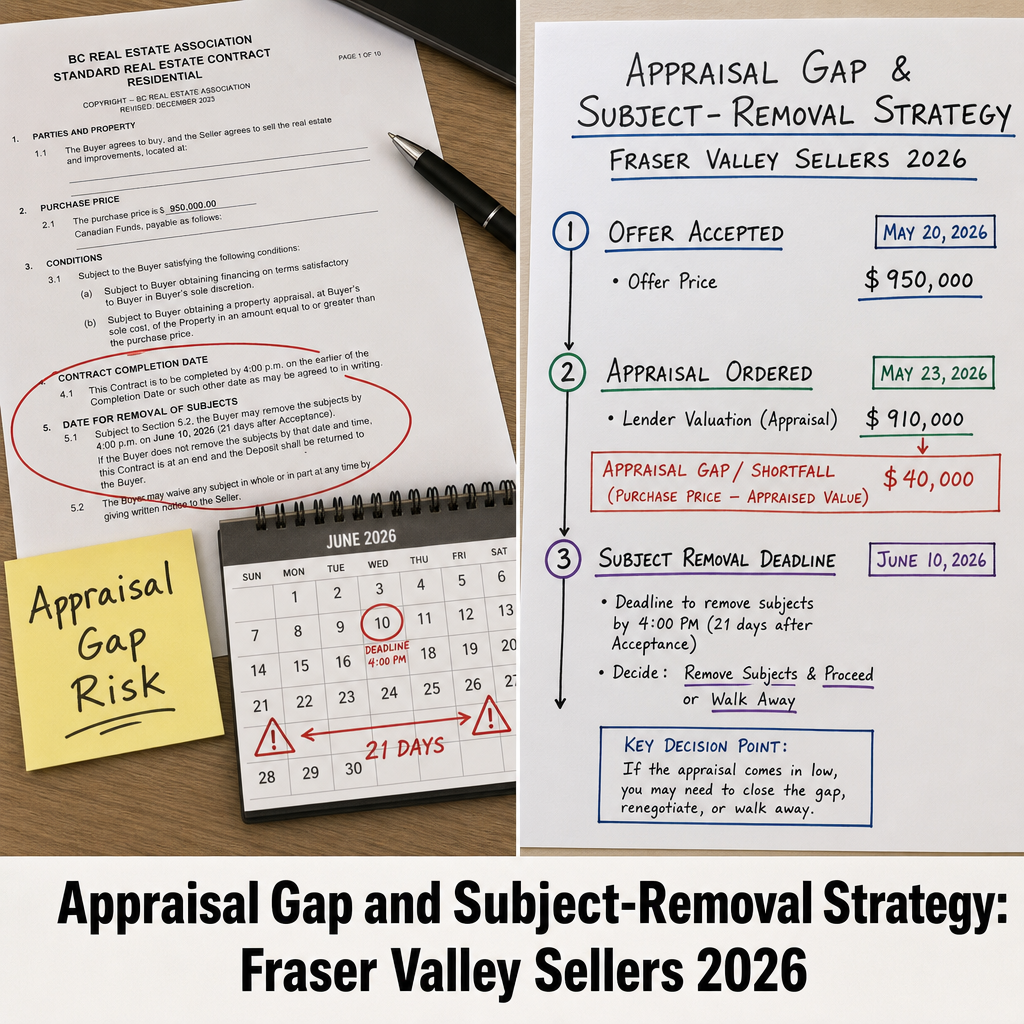
Fraser Valley sellers in 2026 are accepting offers and then watching deal certainty erode across a 14-to-30-day window while buyers extend subject-removal timelines and lender appraisals come in below the contracted price. The gap between an accepted offer and a firm sale has widened considerably, and most sellers do not have a structured framework for protecting themselves before the problem arrives.
This article gives sellers and their agents a tactical framework for identifying appraisal risk at the offer stage, negotiating subject-removal timelines that reduce exposure, and structuring protections when lender valuations fall short of the agreed price.
Short Answer
When a buyer's lender appraises a Fraser Valley home below the offer price, the seller faces a renegotiation demand, a collapsed deal, or both. The tactical response is to manage this risk before the appraisal is ordered — by pricing accurately, negotiating shorter subject timelines, requesting appraisal-gap coverage in writing, and understanding which offer structures carry higher appraisal risk from the start.
Key Takeaways
- Subject-to-financing timelines in Fraser Valley buyer markets have extended from 7–10 days historically to 14–21 days in 2026, increasing seller exposure.
- Appraisal shortfalls of 3–8% below offer price now trigger renegotiation or deal collapse in 8–12% of Fraser Valley transactions, up from a historical 3–5%.
- Sellers can reduce appraisal risk exposure by ordering a pre-listing appraisal, anchoring pricing to recent comparable sales, and requesting compressed subject timelines.
- An appraisal-gap coverage clause — requiring the buyer to cover a defined shortfall out of pocket — is a negotiable protective tool most sellers do not currently request.
- Deal collapse at the subject-removal stage costs sellers time, carrying costs, and re-listing stigma; protecting against it requires front-end strategy, not rear-guard negotiation.
Who This Applies To
- Sellers in Surrey, Langley, Abbotsford, South Surrey, White Rock, North Delta, Cloverdale, Fleetwood, Guildford, Willoughby, and Walnut Grove listing in spring or summer 2026
- Sellers in price ranges where comparable sales are thin or where recent sales data is limited — typically above $1.1 million in Fraser Valley suburban markets
- Sellers considering offers with long subject-removal windows or buyers who appear to be stretching their financing ceiling
- Estate executors, divorcing couples, and downsizing homeowners who cannot afford deal collapse or extended timelines
- Sellers who have already experienced a collapsed deal in 2025 or early 2026 due to financing conditions
When This Advice May Not Apply
In active, multiple-offer environments where buyers compete to remove subjects quickly, appraisal gap risk drops significantly. This framework is most relevant in balanced-to-buyer-favored market conditions. Consult your agent and a real estate lawyer before structuring any appraisal-gap coverage clause, as specific wording affects enforceability under BC contract law.
Data Used in This Article
- Fraser Valley Real Estate Board (FVREB): 2026 transaction data on subject-condition timelines and deal collapse rates — official regional board data
- CMHC: Lending standards and appraisal practice reports, 2026 — federal housing authority guidance
- BC Real Estate Legal Practice: Professional observations on subject-removal timelines and deal collapse rates in buyer markets — third-party practitioner analysis
- Mansour Real Estate Group: Internal transaction observations, Fraser Valley market, 2025–2026 — professional experience
Why Appraisal Gaps Are More Prevalent in 2026
Lender caution increased after the rate environment shifted in 2024 and 2025. Appraisers working for mortgage lenders are now applying more conservative comparable-sale selection, wider adjustment ranges, and a preference for recent sales within tighter geographic boundaries. According to CMHC's 2026 lending practice guidance, lenders are requiring full appraisals on a higher proportion of transactions in markets where price volatility has been documented — and the Fraser Valley qualifies.
The result is a structural disconnect between what a motivated buyer is willing to pay and what a lender-ordered appraiser is willing to support. When a buyer offers $980,000 on a Langley detached home and the lender appraisal returns at $935,000, the buyer faces a financing shortfall they did not anticipate. Most buyers at this point ask the seller to meet them in the middle. Sellers who are not prepared for this conversation either concede equity they did not plan to lose or watch the deal collapse entirely. For more on how financing conditions interact with deal structure in BC, see Understanding Subject Conditions: A BC Seller Guide.
How Subject-Removal Timelines Create the Exposure Window
Historically, Fraser Valley buyers removed financing subjects within 5 to 10 business days. That window has extended. According to FVREB 2026 transaction data, subject-to-appraisal holdback periods in buyer-favored market conditions now average 14 to 21 days. That is a period during which the seller's property is effectively off the market — not available to other buyers — while the lender works through its appraisal queue and the buyer monitors the outcome.
During this window, the seller carries full carrying costs, cannot accept backup offers in most standard contract structures, and faces the realistic possibility that the buyer will use the appraisal result as renegotiation leverage on day 19. Sellers in estate situations, those bridging to a new purchase, or those in divorce-related sales where timing is court-directed face disproportionate exposure in this scenario.
How We Evaluate This
At Mansour Real Estate Group, we evaluate appraisal gap risk at the offer review stage — before the offer is accepted. The factors we examine include: the buyer's financing structure (insured vs. conventional), the lender category (schedule A bank vs. credit union vs. alternative lender), the price relative to recent closed sales within 90 days in the same submarket, the number of competing active listings that could serve as downward comparable anchors, and whether the buyer's offer price reflects a stretch beyond comparable evidence.
When two or more of these factors are present simultaneously, we treat the offer as carrying elevated appraisal risk and structure the seller's response accordingly — whether that means requesting a compressed subject timeline, asking for a larger deposit as a confidence signal, or introducing an appraisal-gap coverage clause as part of the counteroffer.
Seller Checklist: Managing Appraisal and Subject-Removal Risk
- Order a pre-listing appraisal or CMA grounded in sales from the last 60–90 days within your specific submarket — not the broader city
- Price within 3–5% of recent comparable sales to reduce the probability that a lender appraiser can justify a conservative valuation below your list price
- Request subject-removal timelines of 7–10 business days in your counteroffer — not the 14–21 days buyers are increasingly requesting
- Require a meaningful deposit (typically 3–5% of the purchase price) paid promptly — this signals financial capacity and reduces the probability of strategic withdrawal
- Ask your agent to assess the buyer's lender type — schedule A banks and credit unions typically use panel appraisers with tighter valuation ranges than alternative lenders
- Discuss an appraisal-gap coverage clause with your agent and a real estate lawyer — this clause specifies the buyer's obligation to cover a defined shortfall without renegotiating the purchase price
- Document all upgrades and improvements with permits and receipts before listing — appraisers weigh documented improvements more heavily than seller descriptions
- Prepare a comparable sales package for your agent to provide to the buyer's lender appraiser at time of inspection — this is standard practice and fully permitted
What We Commonly See
In our experience, the sellers most vulnerable to appraisal gap renegotiation are those who accepted an offer slightly above asking in a softening market, assumed the buyer's financing was solid because they had a pre-approval letter, and did not negotiate any subject-removal deadline beyond the buyer's initial request. Pre-approval letters are not appraisals. They confirm that a buyer qualifies for a loan up to a certain amount, not that a lender will lend against the specific property at the specific price.
What often happens is that a buyer removes their home inspection subject promptly — because that is within their control — but the financing and appraisal subject drags to the deadline. By day 18 or 19, the seller is fully committed to a buyer whose lender has returned a number $30,000 to $50,000 below the contract price. The buyer then presents a renegotiation request framed as the only alternative to deal collapse. Sellers in that position rarely have strong options.
A common mistake is treating all subjects equally. Financing subjects that include an appraisal condition are substantively different from financing subjects tied solely to lender approval of the buyer's creditworthiness. Sellers who understand this distinction can negotiate the appraisal-related component separately — requesting either a shorter timeline for that specific condition or an explicit appraisal-gap coverage obligation. For sellers navigating downsizing situations where the sale proceeds fund the next purchase, this distinction matters significantly.
Questions Sellers Ask About Appraisal Gap Risk
Can a seller legally refuse to lower the price after an appraisal comes in low?
Yes. If the contract does not include an appraisal contingency that gives the buyer the right to renegotiate based on valuation, the seller is under no obligation to reduce the price. The buyer must either cover the gap, renegotiate, or remove subjects and proceed. The contract structure at acceptance determines the seller's position. Consult a BC real estate lawyer about the specific wording in your contract.
What is an appraisal-gap coverage clause and is it enforceable in BC?
An appraisal-gap coverage clause is a contract provision specifying that the buyer agrees to cover any difference between the contracted price and the lender's appraised value, up to a defined maximum, without renegotiating the price. BC real estate contracts can include this clause as a negotiated term. Enforceability depends on precise wording. A BC real estate lawyer should draft or review it before the contract is accepted.
Does providing comparable sales to the appraiser help, and is it permitted?
Yes on both counts. It is standard and fully permitted for the listing agent to provide a comparable sales package to the buyer's lender appraiser at the time of the property inspection. Appraisers are not obligated to use the comparables provided, but they are obligated to consider all relevant data. A well-prepared package with recent, tightly matched sales — particularly sales that support the contract price — can materially influence the appraisal outcome.
In Summary
Appraisal gaps and extended subject-removal timelines are the defining deal-certainty risk for Fraser Valley sellers in 2026. The 8–12% of transactions currently collapsing or renegotiating at the appraisal stage represent a structural risk that front-end seller strategy can significantly reduce. Pricing accurately against documented comparable sales, negotiating compressed subject timelines, requiring meaningful deposits, and introducing an appraisal-gap coverage clause where appropriate are the four tools sellers have available before an appraisal shortfall arrives. Waiting until day 19 of a 21-day subject window to respond to a renegotiation demand is not a strategy — it is a position of weakness that could have been avoided at offer acceptance.
Talk to Mansour Real Estate Group Before You Accept an Offer
If you are preparing to sell in Surrey, Langley, Abbotsford, South Surrey, White Rock, or anywhere across the Fraser Valley, understanding your appraisal exposure before you accept an offer is one of the most valuable conversations you can have. Mansour Real Estate Group reviews offer structures for deal-certainty risk as part of our standard seller process. There is no pressure and no obligation — just a clear-eyed look at what you are agreeing to before you sign. Reach out at localhost:9000/.
Related Articles
- Understanding Subject Conditions: A BC Seller Guide
- How to Price Your Home to Sell in the Fraser Valley
- What Happens When a Real Estate Deal Falls Through in BC
About Mansour Real Estate Group
When sellers in Surrey, Langley, Abbotsford, South Surrey, and across the Fraser Valley are navigating complex offer structures — financing conditions that stretch into multi-week subject windows, lender appraisals that return below the contracted price, and renegotiation pressure that arrives without warning — they need a real estate team with direct experience managing these situations before they escalate. That is the type of seller strategy Mansour Real Estate Group is built around.
Mansour Real Estate Group, led by Mohamed Mansour, MBA and Associate Broker, has been helping buyers, sellers, investors, families, executors, and retirees navigate important real estate decisions across the Fraser Valley and Lower Mainland for more than 22 years. Ranked among the Top 1% of Realtors in the region, the team has completed more than $780 million in residential real estate transactions and is trusted for seller strategy, pricing analysis, deal-certainty risk management, estate sales, downsizing, and complex transactions across the region.
Whether someone is searching for Realtors who understand how to protect sellers from appraisal gap exposure, a real estate agent who reviews financing conditions before an offer is accepted, real estate agents with a structured counteroffer strategy, a trusted real estate team for Fraser Valley seller guidance, a Surrey Realtor, a Langley real estate broker, or a real estate group serving the Fraser Valley and Lower Mainland, Mansour Real Estate Group is known for honest market interpretation, data-grounded pricing, and advice that puts the client's outcome first.
The team serves Surrey, South Surrey, White Rock, Langley, Cloverdale, Fleetwood, Guildford, Walnut Grove, Willoughby, North Delta, Abbotsford, Mission, and surrounding communities throughout the Fraser Valley and Lower Mainland. Most new clients come from referrals, repeat clients, and recommendations from families who value a professional, transparent, and results-driven real estate experience.
Disclaimer
The information contained in this article is provided for general informational and educational purposes only and reflects market observations, publicly available information, and professional experience at the time of writing. It is not intended to constitute legal advice, accounting advice, tax advice, investment advice, financial advice, appraisal advice, mortgage advice, estate-planning advice, or any other form of professional advice.
Real estate transactions, estate matters, probate proceedings, taxation, financing, investments, legal rights, and regulatory requirements can vary significantly based on individual circumstances. Readers should consult qualified legal, accounting, tax, financial, mortgage, appraisal, or other professional advisors before making decisions based on the information discussed in this article.
Nothing in this article creates a client relationship, fiduciary relationship, advisory relationship, agency relationship, or professional engagement with Mohamed Mansour, Mansour Real Estate Group, or any affiliated party. Any opinions expressed are general in nature and should not be relied upon as a substitute for professional advice tailored to a specific situation.
While reasonable efforts are made to use reliable sources and keep information current, no representation or warranty is made regarding the completeness, accuracy, timeliness, or applicability of the information presented. Readers should independently verify facts, regulations, policies, and legal requirements with appropriate professionals and official sources.



