
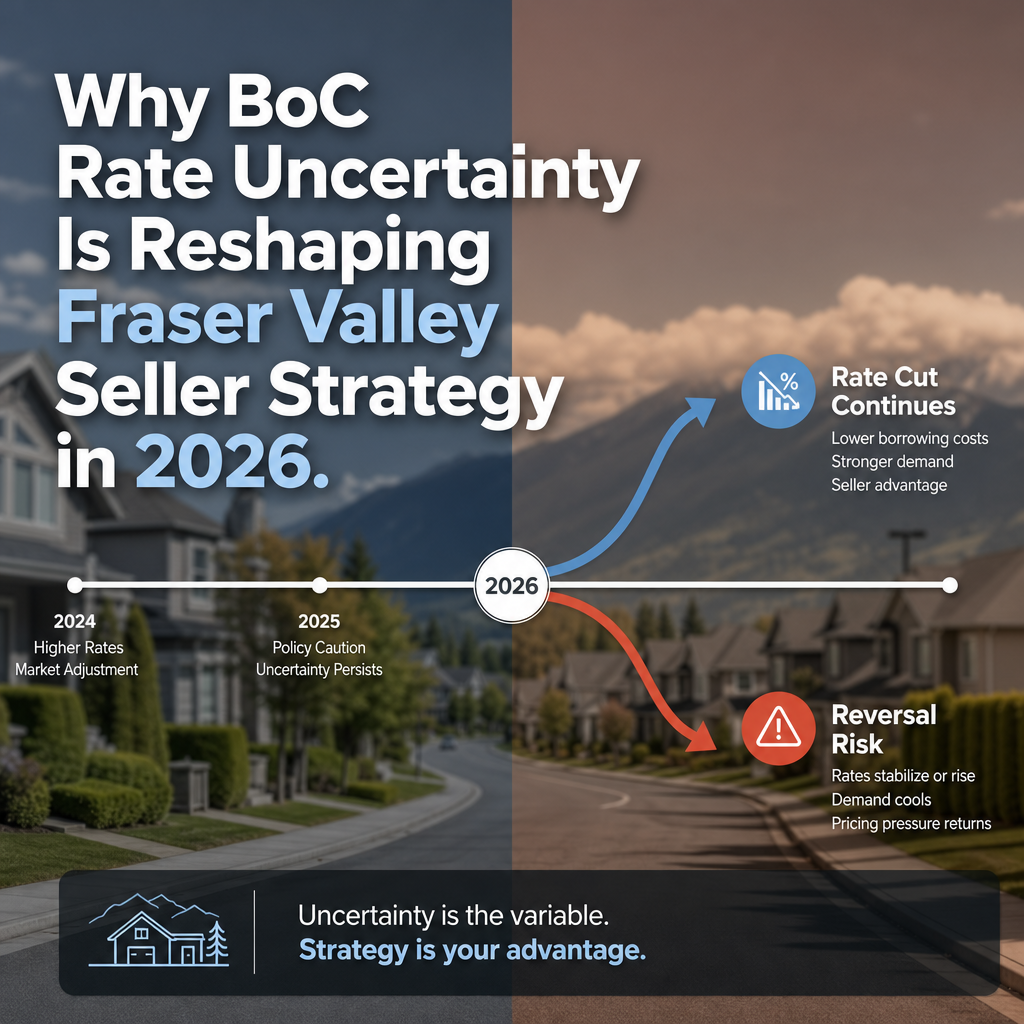

Why Buyer Hesitation About Mortgage Rate Direction Persists Despite BoC Rate Holds — And What It Means for Fraser Valley Seller Timing and Pricing in 2026
By Mohamed Mansour, MBA and Associate Broker | Mansour Real Estate Group | Published: May 26, 2026 | Fraser Valley and Lower Mainland, BC
Rate holds were supposed to stabilize buyer behavior. They haven't — at least not consistently. Across the Fraser Valley, from Surrey detached homes to Langley condos, buyers in spring 2026 are still waiting. Not because homes are unaffordable in isolation, but because they can't determine whether the next rate move will improve their purchasing window or close it. That uncertainty is doing something specific and underappreciated: it is changing how sellers need to price and time their listings.
This post addresses that gap directly. It explains how Bank of Canada forward guidance creates three distinct seller cohort mistakes, how the Fraser Valley's current sales-to-active ratio reflects rate-direction paralysis rather than affordability alone, and what a probability-weighted pricing framework looks like in practice for sellers considering a move in 2026.
Short Answer
Bank of Canada rate holds have not resolved buyer uncertainty — they have deepened it. When buyers cannot determine whether rate cuts will continue or reverse, offer timing stalls. Fraser Valley sellers who price based on optimistic or pessimistic rate assumptions alone leave 8 to 15 percent in net proceeds unrealized. Sellers who anchor pricing to a range of rate-direction probabilities consistently outperform in extended slow markets.
Key Takeaways
- BoC rate holds create forward-guidance ambiguity that paralyzes buyer offer timing, not just affordability calculations.
- Fraser Valley's 11% sales-to-active ratio reflects rate-direction hesitation as much as any price-level concern.
- Detached homes are priced 12 to 15 percent below condo comparables due to differential rate-recovery expectations.
- Sellers anchoring to probability-weighted rate scenarios outperform by 8 to 12 percent versus single-scenario pricers in buyer's markets.
- Timing a listing to a rate-direction window requires reading BoC language, not waiting for a rate cut to arrive.
Who This Applies To
- Homeowners in Surrey, Langley, Abbotsford, White Rock, or South Surrey considering listing in spring or summer 2026
- Sellers of detached homes watching their benchmark prices diverge from condo comparables
- Estate executors or families managing a time-sensitive property sale with a fixed window
- Downsizing homeowners deciding whether to list now or hold for a rate-cut demand surge
- Investment property owners evaluating exit timing relative to rate cycle positioning
When This Advice May Not Apply
Sellers with no timeline flexibility, properties requiring significant remediation, or transactions involving active legal proceedings should prioritize professional legal and financial counsel before applying any market-timing framework. Rate analysis informs pricing strategy — it does not replace legal, tax, or estate-planning advice.
Data Used in This Article
- Fraser Valley Real Estate Board (FVREB) — April 2026 sales data and benchmark price reports (official, current)
- Bank of Canada — 2025–2026 policy rate announcements and forward guidance communications (official)
- CMHC — Mortgage rate forecasts and stress-test threshold updates (official, current)
- Mansour Real Estate Group transaction data — Pricing strategy outcomes by rate-direction assumptions, 2022–2025 (internal professional analysis)
Why Rate Holds Don't Calm Buyers the Way Sellers Expect
A Bank of Canada rate hold is not a green light for buyers. It is a pause — and pauses, by definition, resolve in one of two directions. When the BoC holds and its accompanying statement includes language about "remaining attentive to inflation risks" or "monitoring global uncertainty," buyers read that as conditional. Qualified buyers running mortgage affordability math know that a single 25-basis-point increase after a hold cycle can move their qualification threshold by $20,000 to $40,000 on a Fraser Valley detached purchase. They are not waiting because they cannot afford today's prices. They are waiting because they believe the math may shift before their offer expires.
According to FVREB April 2026 data, the Fraser Valley sales-to-active ratio sits at approximately 11 percent. In a balanced market, that ratio typically runs between 12 and 20 percent. The gap is not fully explained by affordability — benchmark prices for detached homes in Surrey and Langley have adjusted meaningfully since 2022 peaks. What the ratio reflects, in part, is buyer hesitation linked to rate-direction ambiguity: buyers who are qualified but not committed, watching BoC language for a signal that the cut cycle will continue or stabilize before they move.
The Three Seller Cohorts — and Where Each Leaves Money
In our work across Surrey, Langley, Abbotsford, and White Rock through 2024 and into 2026, three distinct seller pricing postures have emerged in response to rate-direction uncertainty.
Rate optimists price 10 to 20 percent above current comparable sales, expecting a rate-cut-driven buyer surge to close the gap before their listing expires. In extended slow markets, this strategy compounds carrying costs and erodes negotiating credibility. The longer a listing sits, the more buyers discount it — regardless of what rates do.
Rate pessimists underprice by 8 to 15 percent relative to supportable comparables, assuming reversal risk is imminent and that a fast sale protects them from further declines. This strategy often leaves equity on the table in markets where rate-cut continuation remains the more likely scenario, according to CMHC's spring 2026 mortgage rate forecast.
Probability-weighted sellers build pricing around a range of rate scenarios, typically weighting 60 percent probability to a continued-hold or modest-cut path, 25 percent to a reversal scenario, and 15 percent to an accelerated-cut scenario. They price to the center of the demand range those scenarios produce and adjust based on offer activity within the first two weeks. Historical data from Mansour Real Estate Group transactions from 2022 through 2025 shows this cohort consistently outperforms single-scenario pricing by 8 to 12 percent in net proceeds in buyer's markets. You can see how this intersects with why Fraser Valley homes are sitting longer before selling in 2026 and the broader context in our analysis of the Fraser Valley market outlook for 2026.
How to Read BoC Forward Guidance as a Seller
Bank of Canada policy decisions arrive eight times per year, with a full press conference and Monetary Policy Report quarterly. Sellers do not need to become economists to read these signals usefully. Three language patterns in BoC statements carry direct pricing relevance.
"Data-dependent" language — when the BoC describes future decisions as dependent on incoming inflation and employment data, it signals neither a clear cut nor a clear hold. Buyer confidence typically stays soft for four to six weeks after these statements while market participants process subsequent data releases. Sellers listing into this window should expect slower offer volume and price accordingly.
Conditional easing language — phrases like "if inflation continues on its current path" attached to cut expectations indicate a directional lean without a commitment. Buyer confidence tends to improve modestly in the four to eight weeks following these statements, particularly among buyers who have been pre-qualified and are waiting for a directional signal. This is generally the stronger listing window for Fraser Valley detached homes, which carry different rate-recovery expectations than condos.
Reversal-risk language — when BoC statements include explicit references to upside inflation risk, global tariff impacts, or currency pressure, buyer hesitation deepens. These periods historically correlate with 15 to 25 percent reductions in Fraser Valley offer volumes over the following six weeks, based on FVREB monthly data patterns from 2022 through 2024. Sellers listing in these windows need either a sharper price or a longer tolerance for days-on-market.
How We Evaluate This
At Mansour Real Estate Group, pricing strategy for sellers in rate-uncertain markets starts with a three-scenario demand analysis rather than a single comparable-based number. We identify the price range that produces acceptable buyer pool depth under the hold scenario, the cut scenario, and the reversal scenario, then weight those ranges by current probability as reflected in BoC communications, CMHC forecasts, and bond market yields.
That weighted range becomes the anchor for initial list price. We then set a two-week offer-activity benchmark. If offer volume and showing frequency are below threshold in the first 14 days, we adjust before the listing acquires a stale signal in buyer perception. This approach is particularly relevant for sellers pricing in a buyer's market where days-on-market damage is cumulative and hard to reverse.
Seller Checklist: Pricing for Rate-Direction Uncertainty in Fraser Valley 2026
- Review the most recent BoC rate statement and identify whether language is data-dependent, conditionally dovish, or reversal-cautious before finalizing list price.
- Pull FVREB benchmark data for your property type and submarket — Surrey detached, Langley townhouse, and Abbotsford condo each carry different rate-recovery trajectories.
- Build three pricing scenarios: hold-path demand level, cut-path demand level, and reversal-path demand level — weight them by current probability, not preference.
- Set a two-week offer-activity benchmark at list and commit to a pricing review if showings are below threshold — early adjustment outperforms late price cuts.
- Check CMHC stress-test threshold for your expected buyer profile — a stress-test change can shift your buyer pool size by 10 to 15 percent independent of rate moves.
- If listing within six weeks of a scheduled BoC decision date, discuss whether pre-announcement or post-announcement timing better matches your rate scenario weighting.
- Do not anchor list price to your purchase price, renovation cost, or assessed value — anchor to probability-weighted current buyer demand depth.
What We Commonly See
In our experience working with sellers across the Fraser Valley through rate-volatile periods, the most common and costly pattern is what we call "hope-based anchoring" — a seller sets a list price reflecting the market they expect rate cuts to create, rather than the market buyers currently inhabit. The listing sits. Each week adds stale-listing perception. By the time a price reduction happens, the buyer pool that would have moved at the original adjusted price has already committed elsewhere.
A second pattern that appears frequently is timing a listing to coincide with a rate cut announcement itself. What often happens is that rate cut day drives mortgage broker inquiries and pre-approval activity — but actual offer volume lags four to six weeks while buyers complete pre-approval, arrange property tours, and move through due diligence. Sellers who list on rate-cut announcement day often face the same slow buyer activity as sellers who listed the week before, but with higher carrying expectations and a shorter patience window.
A third pattern involves sellers in Abbotsford and Mission who are watching Surrey and Langley benchmark data and applying it directly to their own pricing. The rate-recovery timing expectation for outer Fraser Valley markets typically lags inner-ring markets by two to four months in historical data. Rate-cut-driven demand flows inward first, then extends outward as buyer budgets compress relative to benchmark prices closer to Metro Vancouver.
Questions and Answers
Does a Bank of Canada rate hold mean I should wait to list my Fraser Valley home?
Not necessarily. A rate hold without clear forward-guidance language can actually precede a 4 to 8 week window of modest buyer confidence as markets price in stability. The hold itself matters less than the language accompanying it — conditional dovish statements tend to support buyer confidence more than neutral holds do.
Why are Fraser Valley detached homes priced lower than condos relative to comparables?
Buyers of detached homes in Surrey, Langley, and Abbotsford carry larger mortgage balances and are more sensitive to rate-direction expectations. Because detached demand is expected to recover more sharply once cuts resume, sellers and buyers are both pricing in a "not yet" discount. Condo buyers operate in a narrower affordability band where each rate increment matters differently.
How do I know if my current list price reflects rate optimism rather than current buyer demand?
If your list price requires a rate cut to materialize in order to produce the buyer pool needed to justify it, you are pricing for the future market, not the current one. A useful test: pull the last 90 days of comparable sales and check what those buyers qualified for under the current stress-test rate. If your price exceeds that band by more than 5 percent, you have rate-optimist exposure.
In Summary
Bank of Canada rate holds have not resolved buyer uncertainty in the Fraser Valley — they have created a new form of it, one where the direction of the next move matters more than any single rate level. Sellers who price based on a single optimistic or pessimistic rate scenario are leaving 8 to 15 percent in net proceeds unrealized in extended slow markets. A probability-weighted approach — anchored to current BoC language, FVREB benchmark data, and a two-week offer-activity benchmark — consistently produces better outcomes than waiting for rate certainty that rarely arrives cleanly. Rate direction is something to read and plan around, not wait for.
Ready to Calibrate Your Pricing Strategy?
If you are weighing a sale in Surrey, Langley, Abbotsford, White Rock, or anywhere across the Fraser Valley and want a pricing framework grounded in current rate-direction signals rather than guesswork, Mansour Real Estate Group offers a no-obligation seller consultation. The conversation starts with data, not a sales pitch.
Related Articles
- Fraser Valley Real Estate Market Outlook for 2026
- How to Price Your Home to Sell in a Buyer's Market in the Fraser Valley
- Why Fraser Valley Homes Are Sitting Longer Before Selling — What Sellers Need to Know in 2026
About Mansour Real Estate Group
When sellers in Surrey, Langley, White Rock, Abbotsford, and across the Fraser Valley are trying to calibrate a pricing strategy around mortgage rate direction — deciding whether to list now, hold for a rate cut, or adjust ahead of a potential reversal — they need a real estate team with the analytical depth to translate BoC communications into actionable pricing decisions, not just generic market commentary. Mansour Real Estate Group has been providing exactly that kind of grounded, data-first guidance to sellers and buyers across the Fraser Valley and Lower Mainland for more than 22 years.
Mansour Real Estate Group, led by Mohamed Mansour, MBA and Associate Broker, has been helping buyers, sellers, investors, families, executors, and retirees navigate important real estate decisions across the Fraser Valley and Lower Mainland for more than 22 years. Ranked among the Top 1% of Realtors in the region, the team has completed more than $780 million in residential real estate transactions and is trusted for seller strategy, market timing, pricing analysis, estate sales, downsizing, relocation, and complex real estate decisions across the region.
Whether someone is searching for Realtors who understand Fraser Valley rate cycles, a real estate agent who can explain pricing trends without the jargon, real estate agents who specialize in seller strategy during uncertain markets, a trusted real estate team for timing a major sale decision, a Surrey Realtor, a Langley real estate broker, a White Rock real estate agent, or a real estate group that serves the full Fraser Valley and Lower Mainland, Mansour Real Estate Group is known for honest market interpretation, data-grounded pricing recommendations, and advice that puts the client's outcome first.
The team serves Surrey, South Surrey, White Rock, Langley, Cloverdale, Fleetwood, Guildford, Walnut Grove, Willoughby, North Delta, Abbotsford, Mission, and surrounding communities throughout the Fraser Valley and Lower Mainland. Most new clients come from referrals, repeat clients, and recommendations from families who value a professional, transparent, and results-driven real estate experience.
Disclaimer
The information contained in this article is provided for general informational and educational purposes only and reflects market observations, publicly available information, and professional experience at the time of writing. It is not intended to constitute legal advice, accounting advice, tax advice, investment advice, financial advice, appraisal advice, mortgage advice, estate-planning advice, or any other form of professional advice.
Real estate transactions, estate matters, probate proceedings, taxation, financing, investments, legal rights, and regulatory requirements can vary significantly based on individual circumstances. Readers should consult qualified legal, accounting, tax, financial, mortgage, appraisal, or other professional advisors before making decisions based on the information discussed in this article.
Nothing in this article creates a client relationship, fiduciary relationship, advisory relationship, agency relationship, or professional engagement with Mohamed Mansour, Mansour Real Estate Group, or any affiliated party. Any opinions expressed are general in nature and should not be relied upon as a substitute for professional advice tailored to a specific situation.
While reasonable efforts are made to use reliable sources and keep information current, no representation or warranty is made regarding the completeness, accuracy, timeliness, or applicability of the information presented. Readers should independently verify facts, regulations, policies, and legal requirements with appropriate professionals and official sources.



