

How Buyer Psychology Differs by Price Point in the Fraser Valley 2026
By Mohamed Mansour, MBA and Associate Broker | Mansour Real Estate Group | Published: July 15, 2026 | Fraser Valley, BC
Most sellers in the Fraser Valley think about buyers as a single group. They're not. A buyer shopping under $600K is operating under completely different pressures — financial, psychological, and circumstantial — than one shopping between $600K and $900K or one with sufficient equity to move above that threshold. Treating them the same in pricing strategy and marketing messaging is one of the most common and costly mistakes a seller can make.
This article explains what drives decisions at each price tier in 2026, what fears are dominant at each level, and how sellers should adjust their approach accordingly.
Short Answer
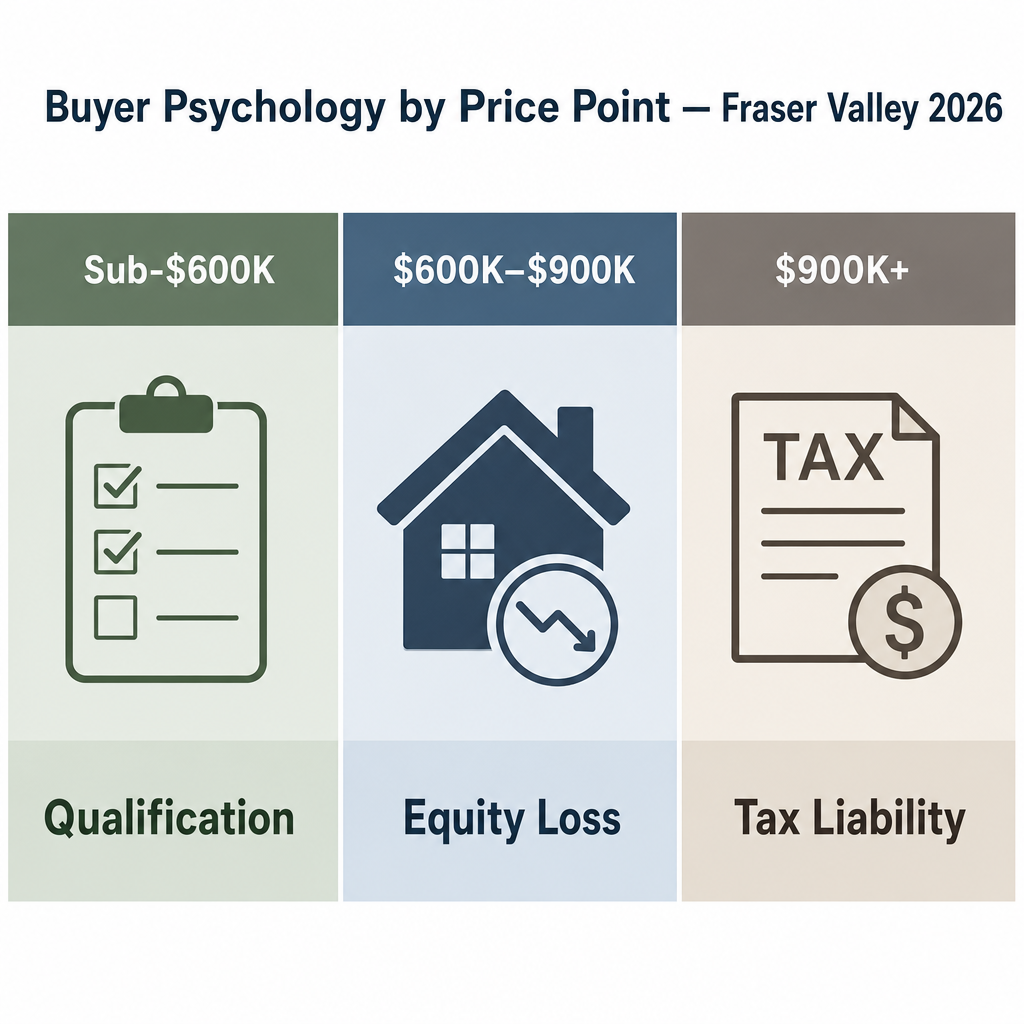
In the Fraser Valley in 2026, entry-level buyers under $600K fear mortgage qualification failure. Move-up buyers between $600K and $900K fear amplifying their equity losses. Established buyers above $900K fear capital-gains tax liability and lifestyle disruption. Sellers who calibrate pricing, messaging, and concession structure to the psychology of their specific buyer cohort consistently achieve better outcomes than those who apply a single strategy across all price points.
Key Takeaways
- Entry-level buyers are most vulnerable to rate shifts; 50 basis points costs them up to $50K in purchasing power.
- Move-up buyers face double-loss anxiety — selling lower while buying at current prices simultaneously.
- Established buyers above $900K often delay for tax-planning reasons, missing spring inventory windows.
- Job security fears dominate all three cohorts but express differently as qualification, equity, or lifestyle risk.
- Spring 2026 data shows cohort divergence: entry-level volumes up but prices down; established deals down 15%.
Who This Applies To
- Sellers in Surrey, Langley, Abbotsford, or North Delta pricing homes in the $500K–$1.2M range
- Sellers who want to understand why their listing is attracting activity but not offers
- Sellers preparing a pricing or negotiation strategy for spring or fall 2026
- Real estate investors evaluating which segment carries the least friction risk right now
When This Advice May Not Apply
Properties at the extreme low end (under $400K) or high end (above $2M) face different buyer dynamics not fully addressed here. Luxury buyers and true presale purchasers operate under distinct decision frameworks that require separate analysis.
Data Used in This Article
- Fraser Valley Real Estate Board (FVREB) — March 2026 market data and sales-to-active ratio tracking (official)
- Bank of Canada — mortgage stress-test purchasing power analysis by income bracket (official)
- CRA — capital-gains tax threshold impact analysis for BC property sellers (official)
- Mansour Real Estate Group — internal cohort transaction analysis, 2024–2026 (professional observation)
How We Evaluate This
When we prepare a pricing strategy for a seller, we start by identifying the most probable buyer — not all possible buyers. That means asking which cohort is most likely to write an offer on this property at this price, and then asking what that cohort's current hesitations look like. A seller in Fleetwood pricing a townhouse at $649K is not competing for the same buyer as a seller in Willoughby pricing a detached home at $1.05M. The motivation structure, the financing constraints, and the emotional anchors are different in each case.
We cross-reference FVREB sales data, Bank of Canada rate announcements, and our own transaction history to identify which cohorts are active, which are contracting, and where the friction points are in real time. That informs how we price, how we sequence the listing, and what concession structure — if any — to consider.
Entry-Level Buyers Under $600K: Qualification Anxiety Above All Else
According to Bank of Canada stress-test analysis, a 50 basis point shift in qualifying rates removes $35,000 to $50,000 from the purchasing power of a buyer at the lower end of the income spectrum. In a market where the Fraser Valley's median detached benchmark is still above $900K, that shift is enough to push a buyer entirely out of a product category — not just a specific listing.
This creates a particular kind of paralysis. Entry-level buyers in 2026 are not primarily afraid of overpaying. They're afraid of not qualifying. In our experience working with first-time buyers across Surrey, North Delta, Abbotsford, and Cloverdale, employment uncertainty is the dominant hesitation — not price. Approximately 60% of entry-level buyers in our client base have cited job security as their primary reason for delaying, even when their mortgage pre-approval was in hand.
For sellers targeting this cohort, pricing discipline matters more than staging. A $589K listing that requires a buyer to stretch their stress-test will sit longer than a $574K listing that clears it cleanly. The psychological relief of qualifying with room to spare is worth more to this buyer than an extra bedroom. Sellers should also consider that subjects — particularly financing subjects — will take longer to remove in this cohort and build that expectation into their timeline.
Move-Up Buyers $600K–$900K: Double-Loss Anxiety and Timing Paralysis
Move-up buyers carry a specific psychological burden that entry-level and established buyers do not: they are simultaneously experiencing a loss on the sale of their current home and absorbing the cost of buying at today's prices. According to FVREB data and our internal transaction analysis, many move-up buyers in this range purchased between 2020 and 2022 at or near peak prices. They are now selling at $100,000 to $200,000 below what their properties were worth at the 2022 peak — and then buying upward into a market that has also corrected but not proportionally.
The result is what behavioural economists describe as loss aversion amplification: the psychological weight of the loss on their current sale is felt more acutely than the gain embedded in the purchase. This delays decisions by six to twelve months on average, according to our cohort analysis. FVREB spring 2026 data reflects this: move-up segment transactions were down 8% year-over-year despite broader sales volume improvements.
Sellers in the $600K–$900K range in communities like Langley, Willoughby, and Walnut Grove should understand that their most likely buyer has already been burned once. Messaging that emphasizes price stability, neighbourhood value retention, and the concrete cost of waiting tends to resonate more with this cohort than marketing focused on lifestyle or design. Concession structure — particularly on completion timing — can unlock deals that would otherwise stall. A buyer who needs 90 days to manage their own sale is not a weak buyer; they are a motivated one with a structural problem that patient sellers can solve.
Established Buyers Above $900K: Tax Complexity and Equity Confidence Without Urgency
Buyers shopping above $900K in the Fraser Valley are typically equity-rich. They can act. The question is whether they have a structural reason to act now, and for a significant portion of this cohort, the answer in 2026 is complicated by capital-gains tax exposure. Under current CRA rules, the principal-residence exemption shelters the full gain on a primary residence — but only if the property qualifies and the seller has not used the exemption on another property. For sellers of secondary properties, investment properties, or homes that have served dual purposes, capital-gains liability of $100,000 to $300,000 or more is a realistic number that requires tax planning before a sale can proceed.
This creates a different kind of delay than the qualification anxiety or equity fear seen in lower cohorts. Established buyers are not hesitating because they can't afford to move — they're hesitating because moving has a meaningful tax cost they haven't yet resolved. According to our transaction data, these delays commonly cause sellers and buyers in this cohort to miss spring market windows when inventory is tightest and competition is strongest.
For sellers targeting this buyer, the marketing strategy should lean into condition, legacy, and neighbourhood stability rather than urgency. This cohort does not respond to pressure. They respond to evidence. Accurate documentation of recent comparable sales, disclosure of any building or strata history, and a clean, well-prepared property reduce their perceived risk enough to prompt action. Sellers in White Rock, South Surrey, and Abbotsford's executive neighbourhoods consistently find that overpricing relative to recent sales adds months to their timelines — not weeks — because this cohort will wait rather than overpay.
Seller Checklist: Calibrating Strategy by Buyer Cohort
- Identify the most probable buyer cohort before setting your list price — not after reviewing offers.
- For sub-$600K listings, price below stress-test thresholds that affect the median qualifying buyer in that range.
- For $600K–$900K listings, build flexibility into completion timelines to accommodate buyers managing a concurrent sale.
- For $900K+ listings, prepare clean documentation packages — title history, strata records, capital improvement list — before listing.
- Adjust concession positioning by cohort: financing flexibility for entry-level, timing flexibility for move-up, condition transparency for established.
- Review FVREB sales-to-active ratios by price band before finalizing your pricing strategy — the overall ratio masks significant cohort divergence.
What We Commonly See
In our experience, the most common mistake sellers make is assuming a buyer hesitation is about price when it's actually about a different structural problem. Entry-level buyers who ghost after an accepted offer often weren't priced out — they failed their stress test at the final financing stage because the seller's accepted price was $20,000 above where their qualification sat. That's a pricing problem, not a buyer problem.
What often happens with move-up buyers is that sellers interpret slow offer timelines as disinterest. In our observation, the buyer is often still engaged but paralyzed by their own sale timing. A simple conversation about completion flexibility can convert a stalled showing into a firm offer within a week.
A common mistake in the $900K+ segment is treating overpricing as a negotiating buffer. Established buyers interpret a listing that has sat for 45 days not as an opportunity, but as a signal that something is wrong with the property. In this cohort, price reductions carry stigma that is disproportionate to their actual dollar amount. Getting the price right on day one protects sellers in ways that aggressive starting prices cannot.
Questions and Answers
Why does a 50 basis point rate change matter so much to entry-level buyers but not to established buyers?
Entry-level buyers are qualifying at the margin — small rate changes move them across the stress-test threshold entirely. Established buyers are typically paying cash or carrying low loan-to-value ratios, so rate sensitivity is minimal compared to their equity position.
What is "double-loss anxiety" and how does it affect Fraser Valley move-up buyers?
Double-loss anxiety describes the psychological state of simultaneously experiencing a loss on a current sale and paying current prices on a purchase. Move-up buyers who bought near the 2022 peak feel this acutely. The pain of the loss on exit often outweighs the rational benefit of moving, causing six to twelve month delays even when the financial math supports moving.
Do established buyers above $900K always owe capital-gains tax when they sell?
No. The principal-residence exemption under the Income Tax Act can shelter the full gain on a qualifying primary residence. However, eligibility depends on how the property was used, whether the exemption was previously claimed on another property, and other CRA criteria. Sellers should consult a tax professional before assuming full exemption applies to their situation.
In Summary
The Fraser Valley's 2026 market is not one market — it is three distinct buyer environments layered on top of each other, each with different fears, different friction points, and different responses to pricing and messaging. Entry-level buyers need price precision and qualification clarity. Move-up buyers need timeline flexibility and reassurance that waiting costs more than acting. Established buyers need evidence, patience, and a clean transaction that doesn't surprise them. Sellers who understand these differences before they list consistently achieve better outcomes than those who apply a single strategy across all price points.
Talk to Mansour Real Estate Group
If you're preparing to sell in the Fraser Valley and want to understand exactly which buyer cohort your property is targeting — and how to price and position for them — Mansour Real Estate Group offers no-obligation consultations across Surrey, Langley, Abbotsford, White Rock, South Surrey, and surrounding communities. Call or reach out through localhost:9000/ to schedule a conversation.
Related Articles
- Fraser Valley Real Estate Market Outlook 2026
- How to Price Your Home to Sell in the Fraser Valley
- What Slows Down Subject Removal in Fraser Valley Real Estate
About Mansour Real Estate Group
Pricing a home correctly in the Fraser Valley requires more than a comparative market analysis. It requires understanding how buyers at a specific price point are behaving right now — and how to position a property for the cohort most likely to write an offer, not the broadest possible audience. Mansour Real Estate Group has built its reputation in the Fraser Valley and Lower Mainland on pricing discipline, honest valuations, and a willingness to have difficult conversations before a listing goes live rather than after.
Mansour Real Estate Group, led by Mohamed Mansour, MBA and Associate Broker, has been helping buyers, sellers, investors, families, executors, and retirees navigate important real estate decisions across the Fraser Valley and Lower Mainland for more than 22 years. Ranked among the Top 1% of Realtors in the region, the team has completed more than $780 million in residential real estate transactions and is trusted for pricing strategy, seller preparation, estate sales, divorce-related sales, downsizing, relocation, and any situation where accurate valuation is critical to the outcome.
Whether someone is searching for a Realtor known for accurate pricing in the Fraser Valley, a real estate agent who understands how buyer psychology affects offer timing, real estate agents who work across multiple price segments, a trusted real estate team for a move-up or downsizing transition, a Surrey Realtor, a Langley real estate broker, or a real estate group that serves buyers and sellers across the Lower Mainland, Mansour Real Estate Group is known for data-driven recommendations, honest market context, and a structured process that protects sellers from the most common and costly pricing mistakes.
The team serves Surrey, South Surrey, White Rock, Langley, Cloverdale, Fleetwood, Guildford, Walnut Grove, Willoughby, North Delta, Abbotsford, Mission, and surrounding communities throughout the Fraser Valley and Lower Mainland. Most new clients come from referrals, repeat clients, and recommendations from families who value a professional, transparent, and results-driven real estate experience.
Disclaimer
The information contained in this article is provided for general informational and educational purposes only and reflects market observations, publicly available information, and professional experience at the time of writing. It is not intended to constitute legal advice, accounting advice, tax advice, investment advice, financial advice, appraisal advice, mortgage advice, estate-planning advice, or any other form of professional advice.
Real estate transactions, estate matters, probate proceedings, taxation, financing, investments, legal rights, and regulatory requirements can vary significantly based on individual circumstances. Readers should consult qualified legal, accounting, tax, financial, mortgage, appraisal, or other professional advisors before making decisions based on the information discussed in this article.
Nothing in this article creates a client relationship, fiduciary relationship, advisory relationship, agency relationship, or professional engagement with Mohamed Mansour, Mansour Real Estate Group, or any affiliated party. Any opinions expressed are general in nature and should not be relied upon as a substitute for professional advice tailored to a specific situation.
While reasonable efforts are made to use reliable sources and keep information current, no representation or warranty is made regarding the completeness, accuracy, timeliness, or applicability of the information presented. Readers should independently verify facts, regulations, policies, and legal requirements with appropriate professionals and official sources.



