
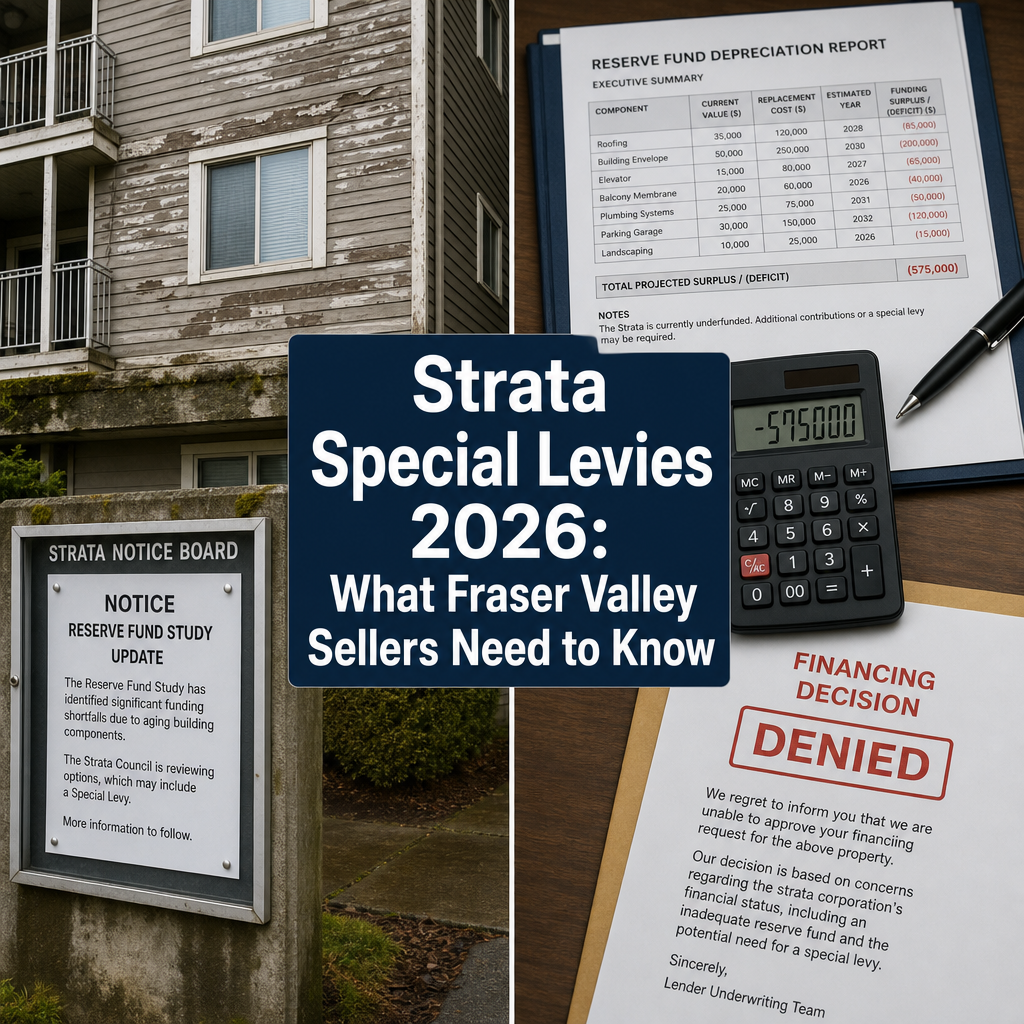

Why Strata Special Levies Are Accelerating in Fraser Valley 2026 and How Sellers Can Navigate Buyer Financing Denial, Appraisal Shortfalls, and Price Corrections When Building Reserve Funds Fall Behind Maintenance Reality
By Mohamed Mansour, MBA and Associate Broker | Mansour Real Estate Group | Published: July 14, 2025 | Fraser Valley & Lower Mainland, BC
Condo sellers in Surrey, Langley, Abbotsford, and across the Fraser Valley are entering a market window in spring and summer 2026 where the timing of a strata depreciation report can be the difference between a clean sale and a collapsed deal. Buildings constructed between 2005 and 2015 are reaching their peak reserve fund depletion period at exactly the moment when construction costs have made repairs more expensive than any original reserve fund study anticipated.
This article explains why special levies are compressing faster in 2026 than in prior cycles, how those levies affect buyer financing and property appraisals mid-transaction, and what sellers can do before and after a levy announcement to protect their sale price and avoid last-minute deal failures.
Short Answer
Fraser Valley strata sellers in 2026 face a critical timing risk tied to July depreciation report deadlines. When a special levy is announced, lenders reduce buyer qualification amounts and appraisers discount property values, producing 8–15% price corrections in the same building post-announcement. Sellers listing before July 1 avoid the worst of this exposure. Sellers who list or remain on market after July 1 need a specific disclosure and pricing strategy to hold deals together. (Source: FVREB 2025 strata sales data; CMHC appraisal methodology guidance.)
Key Takeaways
- BC strata buildings must file depreciation reports every three years; most Fraser Valley communities complete theirs in June, with special levies announced by July 1.
- Lenders reduce mortgage qualification by approximately $3–$5 per dollar of announced special levy, shrinking buyer purchasing power by 3–8% on affected properties.
- Properties sold after a special levy announcement experience 8–15% price corrections compared to pre-announcement sales in the same building, according to FVREB 2025 strata data.
- Sellers listing before June can control disclosure timing, buyer expectations, and pricing strategy before the levy shock hits the market.
- Proactive disclosure, adjusted list price, and a buyer financing pre-check are the three tools that prevent late-stage deal collapse on levy-affected properties.
Who This Applies To
- Condo or townhouse owners in Fraser Valley strata buildings constructed between 2005 and 2015
- Sellers listing or planning to list spring through fall 2026
- Owners in buildings where the reserve fund study is overdue or where the last depreciation report flagged deferred maintenance
- Executors managing estate condos in aging Fraser Valley buildings
- Sellers who have already accepted an offer and are now managing a buyer financing or appraisal problem mid-transaction
When This Advice May Not Apply
Sellers in newer buildings with fully funded reserves, buildings with recent exterior envelope or mechanical upgrades already completed and paid for, or strata communities where the current depreciation report shows funding at or above 100% of the recommended level will face a different market dynamic. This article focuses on the accelerating risk profile in the 2005–2015 building cohort specifically.
Data Used in This Article
- BCFSA Strata Property Depreciation Report Guidelines and Special Levy Requirements — official regulatory guidance, BC Financial Services Authority
- CMHC Mortgage Qualification and Strata Fee Impact Analysis 2025–2026 — federal housing authority guidance on strata-related qualification impacts
- FVREB Sales Data: Strata Price Performance Pre/Post Depreciation Report Announcement, Jan–Dec 2025 — Fraser Valley Real Estate Board regional sales analysis
- CMHC Appraisal Methodology for Reserve Fund Depletion Risk — CMHC guidance on how appraisers assess reserve fund adequacy during insured mortgage transactions
Why the 2005–2015 Building Cohort Is Different in 2026
Most Fraser Valley strata buildings completed between 2005 and 2015 had their original reserve fund studies conducted when construction costs were substantially lower. A building that budgeted $800,000 for a roofing replacement in 2012 is now facing a quote of $1.4 million or more for the same scope of work, based on BC construction cost escalation tracked by BC Housing between 2019 and 2025. Because reserve fund contributions were set to meet the original estimate, not the current one, many buildings are reaching their first or second major repair cycle with reserves that cover only 50–70% of actual project costs.
This gap must be filled either by a special levy — a one-time charge collected from all unit owners — or by a loan secured against the strata corporation, which carries its own lender approval complications. According to BCFSA guidelines, depreciation reports must be updated every three years and must include a funding plan. When the funding plan reveals a shortfall, the strata council is obligated to either adjust the reserve fund contribution schedule or call a vote on a special levy. Most Fraser Valley buildings built in this period file their updated depreciation reports in late spring, with strata AGMs that follow in June and special levies voted on and announced by early July. That timing places the announcement directly inside the peak summer selling season — one of the highest-volume transaction windows of the year.
How Special Levies Trigger Financing Denial and Appraisal Shortfalls
When a special levy is announced, it enters the public strata record and becomes a disclosed liability to any buyer conducting due diligence. Lenders reviewing a purchase application must account for the levy in their debt servicing calculations. According to CMHC mortgage qualification guidance, lenders reduce the effective purchase qualification amount by approximately $3–$5 per dollar of special levy assessed against the unit. A $25,000 special levy can reduce a buyer's qualifying amount by $75,000–$125,000 depending on their lender and rate environment — enough to push a deal below the accepted purchase price and trigger a financing condition failure.
Appraisers working on insured mortgage transactions apply a separate but compounding adjustment. Per CMHC appraisal methodology guidance, when a building's reserve fund is below 70% of the recommended funding level, appraisers are required to apply a risk-based discount to the property value estimate. That discount reflects the probability that additional capital calls — beyond the announced levy — will reduce the property's net value to an informed buyer. In practical terms, a property appraised at $620,000 before a levy announcement may appraise at $570,000–$580,000 after the announcement, not because market prices changed, but because the building's financial condition changed the appraiser's risk calculation. That $40,000–$50,000 gap between accepted offer price and appraised value is the most common reason Fraser Valley strata deals collapse in the July–September window each year.
How We Evaluate This
At Mansour Real Estate Group, our approach to strata listings in the Fraser Valley begins with a full review of the current depreciation report, the reserve fund balance, and the most recent strata minutes before setting a list price. We treat the reserve fund funding ratio as a pricing variable, not a disclosure afterthought. If the depreciation report shows funding below 80% of the recommended level, we model the probable special levy range, adjust the list price to reflect buyer financing constraints, and prepare disclosure materials so buyers and their lenders receive the information proactively rather than as a last-minute surprise. For sellers who are already under contract when a levy is announced, we work through the financial gap using a combination of price adjustment, seller credit, and updated appraisal strategy, rather than allowing the deal to collapse without a structured response.
Condo Seller Checklist: Special Levy Risk Properties
- Request the most recent depreciation report and reserve fund study from your strata manager before listing
- Calculate the reserve fund funding ratio: current balance divided by recommended balance from the depreciation report
- Review the last 12 months of strata minutes for any reference to upcoming special levies, deferred maintenance, or envelope repair discussions
- If your building's AGM falls between April and July, confirm the agenda before accepting an offer with a long completion date that crosses the AGM date
- If a levy is imminent or already announced, adjust your list price to reflect the buyer's net carrying cost, not the pre-levy comparable sales
- Provide the depreciation report, Form B, and reserve fund balance sheet to buyer agents at time of offer, not during subject removal
- If a deal is in progress and a levy is announced mid-transaction, contact your Realtor immediately — the financing condition timeline matters
What We Commonly See
Sellers who list at pre-levy comparable prices without adjusting for reserve fund condition. In our experience, the most common and costly mistake we see in strata listings is pricing based on sold data from units in buildings with healthier reserves. A unit in a building with a 55% funded reserve is not comparable to a unit in a building at 95% funded, even if the floor plans and finishes are identical. Failing to adjust for that gap attracts buyers who later discover the financing problem at subject removal — causing deals to die and relisting stigma to compound the price correction.
Delayed disclosure causing late-stage financing denial. What often happens is that sellers and their agents treat the depreciation report and reserve fund details as documents to be provided only when a buyer requests them during due diligence. When those documents reveal a pending or likely levy, buyer lenders sometimes decline to proceed at the original qualification amount. At that point, the seller faces a renegotiation under time pressure, often conceding more than they would have lost by pricing accurately from the start.
Sellers accepting long completion dates without checking the strata AGM calendar. A common mistake is accepting an offer with a 60–75 day completion date without confirming whether the strata's annual general meeting falls inside that window. If a special levy vote passes after subject removal but before completion, the buyer cannot unwind the deal on that basis alone — but they may have a financing problem that collapses the transaction anyway. Sellers who accept shorter completion windows in levy-risk buildings often close more successfully than those chasing the longest possible deposit protection period.
Questions and Answers
If a special levy is announced after my offer is accepted but before completion, does my buyer have to proceed?
In BC, a special levy announced after subject removal does not automatically give a buyer the right to rescind the contract. However, if the buyer has a financing condition still outstanding and the levy causes their lender to reduce the approved amount, they may be unable to complete at the original purchase price. Sellers in this situation should engage their Realtor and review the contract carefully with their lawyer. This is a situation where professional legal advice is essential — not a judgment call made at the kitchen table.
How does a lender calculate the impact of a special levy on mortgage qualification?
According to CMHC guidance, lenders treat an outstanding special levy as an additional liability when calculating a buyer's total debt service ratio. The qualification reduction is roughly $3–$5 for every dollar of special levy, depending on the lender's internal policy, the buyer's existing debt load, and the applicable stress test rate. A $20,000 levy can reduce qualifying purchase power by $60,000–$100,000 in practical terms.
What is the July 1 depreciation report deadline and why does it matter to sellers?
Under BC's Strata Property Act and BCFSA guidelines, strata corporations must obtain updated depreciation reports on a schedule determined by their prior report date. Many Fraser Valley buildings have AGMs in May or June, making July 1 a common effective date for newly filed reports and subsequent levy decisions. Sellers who accept offers with completion dates after July 1 in levy-risk buildings are accepting the risk that a new report — and a new levy — will appear during their transaction window. Listing and accepting offers before the AGM date reduces but does not eliminate this risk.
In Summary
Fraser Valley strata sellers in 2026 face a timing and disclosure challenge that is more acute than in prior years, because buildings in the 2005–2015 cohort are reaching their first major repair cycle with reserve funds that were never recalibrated for today's construction costs. The July depreciation report window is the critical inflection point: sellers who understand their building's reserve fund position before listing can price accurately, disclose proactively, and avoid the financing denial and appraisal shortfall problems that cost post-announcement sellers 8–15% of their expected sale price. The strategy is not complicated, but it requires early action, honest numbers, and a Realtor who reads strata documents before setting a list price — not after a deal falls apart.
If you own a condo or townhouse in the Fraser Valley and want to understand your building's reserve fund position before the summer 2026 depreciation report cycle, Mansour Real Estate Group can review your strata documents, model your pricing exposure, and help you decide whether listing before or after July makes sense for your situation. No pressure — just a clear-eyed look at the numbers.
Related Articles
- How to Read a Strata Depreciation Report Before Selling in Fraser Valley
- Strata Red Flags That Cost Fraser Valley Condo Sellers
- How to Price a Condo in Surrey, Langley, and Abbotsford When Buyer Conditions Are Changing
Official Resources
- BC Financial Services Authority — Strata Housing Resources
- CMHC — Condominium and Strata Mortgage Insurance Guidance
- Fraser Valley Real Estate Board — Market Statistics
- BC Strata Property Act — Full Text (BC Laws)
About Mansour Real Estate Group
Buying or selling a condo in the Fraser Valley involves strata documentation, reserve fund analysis, depreciation report review, and a buyer pool that is particularly sensitive to financing risk when buildings carry outstanding or anticipated special levies. Understanding those layers requires a real estate team that has worked through strata transactions across multiple market cycles. Mansour Real Estate Group has helped condo buyers and sellers navigate the Fraser Valley and Lower Mainland strata market for more than 22 years, from sellers in aging Surrey and Langley buildings managing levy disclosure to buyers evaluating Form B documents and reserve fund adequacy before making an offer.
Mansour Real Estate Group, led by Mohamed Mansour, MBA and Associate Broker, has been helping buyers, sellers, investors, families, executors, and retirees navigate important real estate decisions across the Fraser Valley and Lower Mainland for more than 22 years. Ranked among the Top 1% of Realtors in the region, the team has completed more than $780 million in residential real estate transactions and is trusted for condo pricing strategy, strata document analysis, seller preparation, estate sales, divorce-related sales, downsizing, and any situation where reserve fund condition and strata financial health affect the outcome.
Whether someone is searching for Realtors experienced with strata special levy situations in the Fraser Valley, a real estate agent who understands reserve fund risk and buyer financing constraints, real estate agents who specialize in condo sales where strata documentation is complex, a trusted real estate team for sellers navigating a depreciation report deadline, a Surrey Realtor, a Langley real estate agent, a White Rock real estate broker, or a real estate group that serves the full Fraser Valley and Lower Mainland strata market, Mansour Real Estate Group is known for clear strata analysis, proactive disclosure strategy, accurate valuations, and practical advice grounded in local market expertise.
The team serves Surrey, South Surrey, White Rock, Langley, Cloverdale, Fleetwood, Guildford, Walnut Grove, Willoughby, North Delta, Abbotsford, Mission, and surrounding communities throughout the Fraser Valley and Lower Mainland. Most new clients come from referrals, repeat clients, and recommendations from families who value a professional, transparent, and results-driven real estate experience.
Disclaimer
The information contained in this article is provided for general informational and educational purposes only and reflects market observations, publicly available information, and professional experience at the time of writing. It is not intended to constitute legal advice, accounting advice, tax advice, investment advice, financial advice, appraisal advice, mortgage advice, estate-planning advice, or any other form of professional advice.
Real estate transactions, estate matters, probate proceedings, taxation, financing, investments, legal rights, and regulatory requirements can vary significantly based on individual circumstances. Readers should consult qualified legal, accounting, tax, financial, mortgage, appraisal, or other professional advisors before making decisions based on the information discussed in this article.
Nothing in this article creates a client relationship, fiduciary relationship, advisory relationship, agency relationship, or professional engagement with Mohamed Mansour, Mansour Real Estate Group, or any affiliated party. Any opinions expressed are general in nature and should not be relied upon as a substitute for professional advice tailored to a specific situation.
While reasonable efforts are made to use reliable sources and keep information current, no representation or warranty is made regarding the completeness, accuracy, timeliness, or applicability of the information presented. Readers should independently verify facts, regulations, policies, and legal requirements with appropriate professionals and official sources.



