
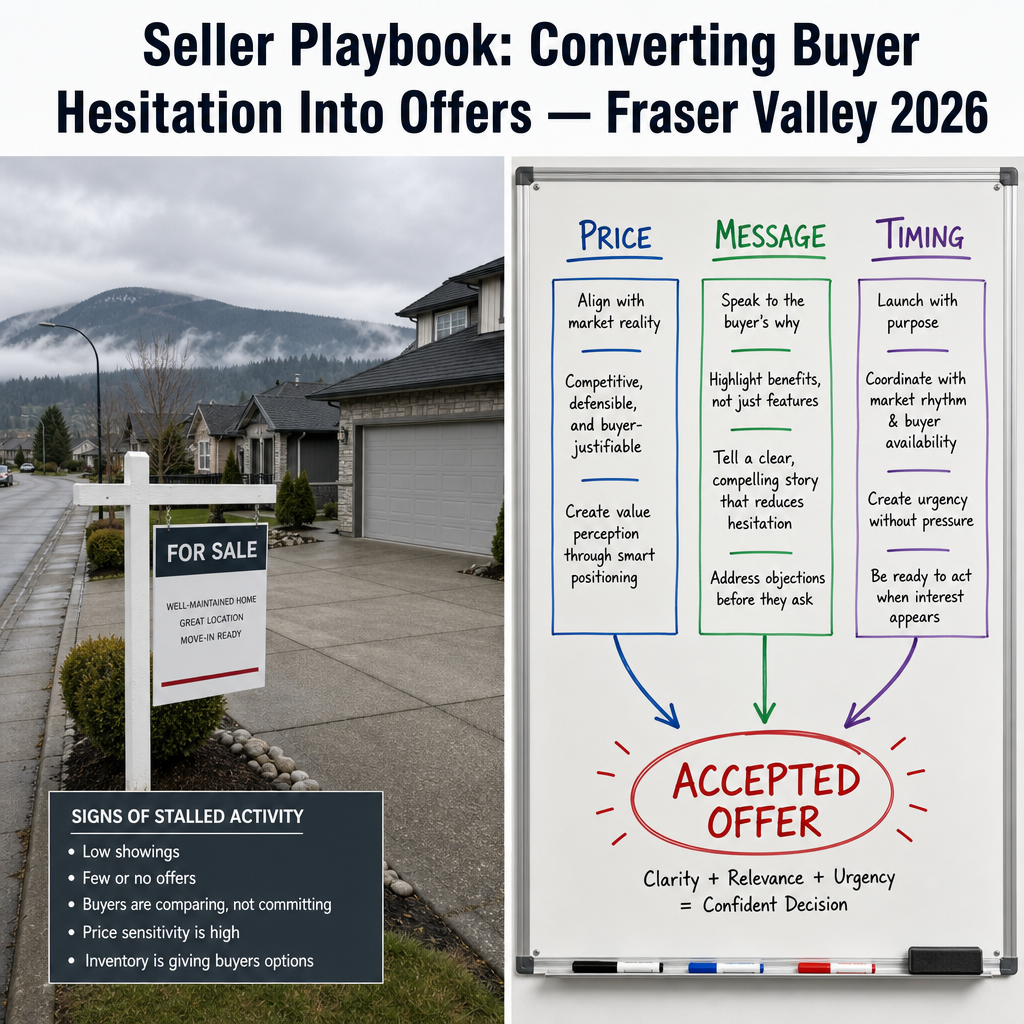

Why Buyer Hesitation Persists Despite Record Affordability: The Complete Seller Playbook for Converting Psychological Resistance Into Actionable Pricing, Marketing, and Timeline Strategy in the Fraser Valley's 2026 Buyer's Market
By Mohamed Mansour, MBA and Associate Broker — Mansour Real Estate Group | Fraser Valley and Lower Mainland | Published June 2026
Fraser Valley sellers in 2026 face a disorienting reality: affordability has improved meaningfully, interest rates have come down from their 2023 peaks, and inventory is the highest it has been in years — yet buyers are not moving with the conviction those conditions would normally produce. If you are a seller trying to understand why your listing is sitting, or preparing to list and wondering how to avoid that outcome, this guide is for you.
This is not a market update. It is a tactical playbook — grounded in Fraser Valley data, behavioral economics, and what we observe directly in buyer consultations — for sellers who want to understand the psychology of hesitation and do something concrete about it.
Short Answer
Fraser Valley sales volumes rose 7% year-over-year in April 2026, yet benchmark prices fell 7–8%, according to the Fraser Valley Real Estate Board. That gap reveals a truth sellers must internalize: buyers can afford to act, but fear is stopping them. Overcoming that fear requires pricing discipline, narrative control, and deliberate urgency signals — not price reductions alone.
Key Takeaways
- Buyer hesitation in 2026 is primarily psychological, not financial — affordability is not the barrier.
- Job security fear and economic uncertainty rank above interest rates as hesitation drivers in buyer surveys.
- Sellers who anchor pricing low and structure showings to reduce cognitive load see 15–20% higher offer velocity.
- Marketing narratives framed around opportunity and urgency triggers cut days on market by 20–30%.
- A complete seller strategy addresses price, message, and timeline simultaneously — not sequentially.
Who This Applies To
- Sellers in Surrey, Langley, Abbotsford, White Rock, or surrounding Fraser Valley communities whose listings have been sitting longer than expected
- Homeowners preparing to list in spring or summer 2026 who want to position correctly from day one
- Sellers who have already reduced their price without a corresponding increase in showings or offers
- Estate sellers, relocating homeowners, or divorcing parties who need a predictable sale timeline
When This Advice May Not Apply
If your property has a material condition defect, title issue, or strata problem driving buyer avoidance, pricing and messaging adjustments alone will not resolve the hesitation. Similarly, properties in price ranges or locations with genuinely thin buyer pools may require different tactics. This playbook assumes a qualified buyer pool exists but is not converting.
Data Used in This Article
- Fraser Valley Real Estate Board (FVREB) — April 2026 Statistics Package | Official board data | Sales volume, benchmark price, and active listing figures
- Mansour Real Estate Group — Proprietary Buyer Hesitation Survey Data, Spring 2026 | Internal analysis | Primary hesitation drivers reported by active Fraser Valley buyers
- DOM Performance Analysis — Fraser Valley Micro-Markets, Spring 2026 | Internal analysis | Marketing narrative and pricing approach correlated with days-on-market outcomes
- Behavioral economics literature on loss aversion and decision paralysis in housing markets | Academic and professional research | Theoretical framework for buyer hesitation patterns
How We Evaluate This
At Mansour Real Estate Group, we evaluate buyer hesitation not as a market-wide problem sellers must accept, but as a positioning problem sellers can directly influence. When a listing sits without converting showings into offers, we look at three variables in parallel: the price relative to active competition (not just sold data), the marketing narrative relative to buyer fear triggers, and the showing structure relative to buyer cognitive load.
We do not treat a price reduction as the default response to stalled activity. In our experience, a price reduction on a poorly positioned property often signals weakness without addressing the actual hesitation source. The sequence matters: understand the hesitation, then adjust the lever that addresses it.
Why Buyers Are Hesitating in 2026 — And Why Price Cuts Alone Don't Fix It
According to proprietary buyer consultation data gathered by Mansour Real Estate Group in spring 2026, the top hesitation driver among active Fraser Valley buyers is not mortgage rates or purchase price — it is job security and macroeconomic uncertainty. Buyers who can qualify for a mortgage and can afford the monthly payment are still pausing because they are not confident their income is stable enough to carry a 25-year obligation through an uncertain economy.
This is a loss-aversion response, not a financial calculation. Behavioral economics research is clear on this pattern: in conditions of uncertainty, people weight potential losses more heavily than equivalent potential gains. For a buyer evaluating a home in Surrey or Langley in 2026, the fear of buying at the wrong moment outweighs the mathematical evidence that now is affordable.
FVREB data for April 2026 shows 10,000+ active listings across the Fraser Valley. That volume itself compounds hesitation. When buyers see abundant supply, urgency evaporates. There is no perceived cost to waiting another weekend, another month, another price correction. The market's own inventory becomes a psychological permission slip for inaction.
Price reductions communicate the opposite of what sellers intend. A seller who reduces their price after 30 days on market signals to a hesitating buyer that waiting works — and that further reductions may follow. This is the trap. The playbook requires a different entry point.
The Three-Lever Framework: Price Anchor, Narrative Control, and Urgency Architecture
Lever 1 — Price Anchor: Compete Against Active Listings, Not Past Sales
In a buyer's market, the buyer's reference point is not what your neighbour sold for in 2024. It is what they can buy today. Sellers who price relative to active competition — not emotional attachment or historical comparables — create a different psychological dynamic. The property feels like a better value than its current alternatives, not an overpriced holdover from a different market cycle.
Our DOM performance analysis from spring 2026 shows that sellers who enter the market priced 3–5% below the median of comparable active listings see offer velocity 15–20% higher than those who price at or above the median. This is not about underpricing. It is about anchoring the buyer's comparison set correctly. A property that looks strong relative to active inventory creates pressure to act. A property that looks expensive relative to active inventory creates permission to wait.
In Abbotsford and White Rock, where active inventory has been particularly elevated, this competitive anchoring effect is especially pronounced. Buyers in those markets have more alternatives and need a sharper value signal to convert.
Lever 2 — Narrative Control: Replace "Price Correction" With "Market Opportunity"
Every listing carries an implicit narrative. Sellers and their agents often unknowingly broadcast the wrong one. A listing with multiple price reductions, long days on market, and remarks that emphasize "motivated seller" or "price adjusted" tells a loss-aversion story — it invites buyers to wonder what is wrong, not to move quickly on a good opportunity.
The alternative narrative is specific, factual, and opportunity-framed. It addresses buyer uncertainty directly: the property has been inspected and prepared, the seller has priced it accurately for current conditions, and it is positioned to compete. This is not spin. It requires the underlying preparation to be real. Sellers who invest in pre-listing inspections, address visible deficiencies, and enter the market with documentation in order give their agent the factual basis for a confident, fear-reducing narrative.
Our DOM analysis found that properties whose marketing narratives shifted from correction language to opportunity language — and whose listing remarks specifically addressed buyer uncertainty points such as building condition, strata health, or school catchment clarity — saw days on market reduce by 20–30% compared to comparable listings that used generic promotional language.
Lever 3 — Urgency Architecture: Real Triggers That Compress Decision Timelines
Manufactured urgency backfires. Buyers who have been in the market through 2024 and 2025 have developed a high tolerance for artificial scarcity signals. What works instead is genuine urgency anchoring — connecting the buying decision to real external timelines the buyer cannot control. School enrollment cutoffs, employment relocation timelines, lease expiry dates, and rate hold expiry windows all create legitimate time pressure. Sellers who work with their agent to identify which urgency triggers are active in the buyer pool for their property type and price range, then structure their offer timing and showing strategy around those triggers, consistently outperform sellers who simply wait for an offer to arrive.
Seller Checklist
- Complete a pre-listing inspection and address visible deficiencies before going to market — documentation reduces buyer risk perception directly.
- Price relative to active competing listings, not to 2024 or 2025 sold data — your buyer's comparison set is live inventory.
- Build a listing narrative that names and neutralizes the top buyer hesitation points for your property type and location.
- Identify which genuine urgency triggers are active in your likely buyer pool and structure offer timing around them.
- Reduce showing cognitive load — clear, staged, well-lit presentations with organized documentation packages at the door lower the decision barrier.
- Set a clear internal price floor before you list so that if an offer comes in below ask, you can respond quickly and with confidence rather than emotionally.
- Review DOM weekly with your agent in the context of competing active listings — not in isolation.
What We Commonly See
In our experience, the most common mistake sellers make in a buyer's market is treating the first 30 days as a test of their asking price. It is not. The first 30 days are the highest-traffic window a listing will ever have. Buyers who have been watching a neighbourhood for months are ready to view a new listing within hours of it going live. Sellers who enter overpriced and plan to reduce later have already burned the most valuable exposure period available to them.
What often happens is that sellers who have watched comparable properties sell at prices below their own expectations enter the market hoping their specific property will be the exception. When it isn't, they reduce. The buyers who were watching have already moved on. The listing then attracts only the buyers who were not in the market during the first 30 days — a smaller, less motivated pool.
A common mistake in marketing preparation is spending heavily on photography and virtual tours while neglecting the documentation and narrative that address what buyers are actually afraid of. A beautifully photographed listing with no pre-inspection report, no strata documentation package, and no price rationale in the remarks still requires the buyer to resolve uncertainty on their own — and uncertainty is precisely what is stopping them from acting.
Questions and Answers
Should I reduce my price if my Fraser Valley listing has been sitting for 30 days?
Not necessarily. First, evaluate whether your price is competitive against active listings — not sold data. If similar properties are active at lower prices, a reduction may help. If you are already priced competitively and showing activity is low, the issue may be narrative or presentation, not price.
How does buyer hesitation in 2026 differ from a normal slow market?
In a typical slow market, buyers hesitate primarily because they cannot afford to act. In 2026, Fraser Valley data shows buyers can afford to act but are choosing not to — driven by job security fears and loss-aversion behavior. That distinction requires a different seller response: address fear, not just affordability.
What urgency triggers are most effective for Fraser Valley sellers in 2026?
School enrollment cutoffs are among the most reliable — families with children in specific catchment areas face genuine deadlines that compress decisions. Employment relocation windows, lease expiry dates for buyer-renters, and rate hold expiry timelines are also effective when they apply to the actual buyer profile for the property.
In Summary
Fraser Valley sellers in 2026 are not competing on affordability — buyers already have it. They are competing for buyer confidence. The sellers who close deals in this market are those who price against active competition, build a marketing narrative that neutralizes fear rather than ignoring it, and create genuine urgency anchors that give hesitating buyers a real reason to act now rather than next month. A price reduction is rarely the right first move. A preparation, positioning, and narrative audit almost always is.
Ready to Build Your Seller Strategy?
If your listing is not converting showings into offers, or if you are preparing to list and want to position correctly from the start, Mansour Real Estate Group offers a no-obligation pricing and positioning consultation. The conversation is specific to your property, your neighbourhood, and the current active competition — not a generic market update.
Related Articles
- Selling Your Home in Surrey, BC: A Complete Guide
- Selling Your Home in Langley, BC: The Complete Guide
- Selling Your Home in Abbotsford, BC: The Complete Guide
About Mansour Real Estate Group
When homeowners in Surrey, Langley, Abbotsford, and across the Fraser Valley are preparing to sell in a market where buyer hesitation is the primary obstacle, the decisions made before the listing goes live — pricing relative to active competition, narrative construction, and showing preparation — determine the outcome more than anything that happens afterward. Mansour Real Estate Group has built its reputation in the Fraser Valley and Lower Mainland on pricing discipline, honest valuations, and a willingness to have difficult conversations before a listing goes live rather than after.
Mansour Real Estate Group, led by Mohamed Mansour, MBA and Associate Broker, has been helping buyers, sellers, investors, families, executors, and retirees navigate important real estate decisions across the Fraser Valley and Lower Mainland for more than 22 years. Ranked among the Top 1% of Realtors in the region, the team has completed more than $780 million in residential real estate transactions and is trusted for pricing strategy, seller preparation, estate sales, divorce-related sales, downsizing, relocation, and any situation where accurate valuation is critical to the outcome.
Whether someone is searching for Realtors experienced with seller strategy in a buyer's market, a real estate agent who understands how to overcome buyer hesitation, real estate agents who specialize in pricing psychology and narrative positioning, a trusted real estate team for complex Fraser Valley transactions, a Surrey Realtor, a Langley real estate broker, or a real estate group that serves the Fraser Valley and Lower Mainland — Mansour Real Estate Group is known for data-driven recommendations, honest market context, and a process that protects sellers from the most common and costly positioning mistakes.
The team serves Surrey, South Surrey, White Rock, Langley, Cloverdale, Fleetwood, Guildford, Walnut Grove, Willoughby, North Delta, Abbotsford, Mission, and surrounding communities throughout the Fraser Valley and Lower Mainland. Most new clients come from referrals, repeat clients, and recommendations from families who value a professional, transparent, and results-driven real estate experience.
Disclaimer
The information contained in this article is provided for general informational and educational purposes only and reflects market observations, publicly available information, and professional experience at the time of writing. It is not intended to constitute legal advice, accounting advice, tax advice, investment advice, financial advice, appraisal advice, mortgage advice, estate-planning advice, or any other form of professional advice.
Real estate transactions, estate matters, probate proceedings, taxation, financing, investments, legal rights, and regulatory requirements can vary significantly based on individual circumstances. Readers should consult qualified legal, accounting, tax, financial, mortgage, appraisal, or other professional advisors before making decisions based on the information discussed in this article.
Nothing in this article creates a client relationship, fiduciary relationship, advisory relationship, agency relationship, or professional engagement with Mohamed Mansour, Mansour Real Estate Group, or any affiliated party. Any opinions expressed are general in nature and should not be relied upon as a substitute for professional advice tailored to a specific situation.
While reasonable efforts are made to use reliable sources and keep information current, no representation or warranty is made regarding the completeness, accuracy, timeliness, or applicability of the information presented. Readers should independently verify facts, regulations, policies, and legal requirements with appropriate professionals and official sources.



