

Why the Townhome Seller's Market Is Compressing in Late Spring 2026 — and What It Means for Your Pricing Strategy Before Summer
By Mohamed Mansour, MBA and Associate Broker, Mansour Real Estate Group | Fraser Valley and Lower Mainland | Published: June 16, 2026 | Market Insight — Attached Housing
This article is for townhome and attached housing owners in the Fraser Valley — particularly in Willoughby, Walnut Grove, and Cloverdale — who are weighing whether to list now or wait until late summer. The sales-to-active ratio advantage that defined the spring market is compressing faster than most sellers realize, and the pricing window is narrower than it looks.
If you have been tracking the attached housing market through early 2026, you may have noticed that townhomes have held a seller's position while detached homes have faced more buyer pressure. That advantage is real — but it is seasonal, and the data suggests it is already softening.
Short Answer
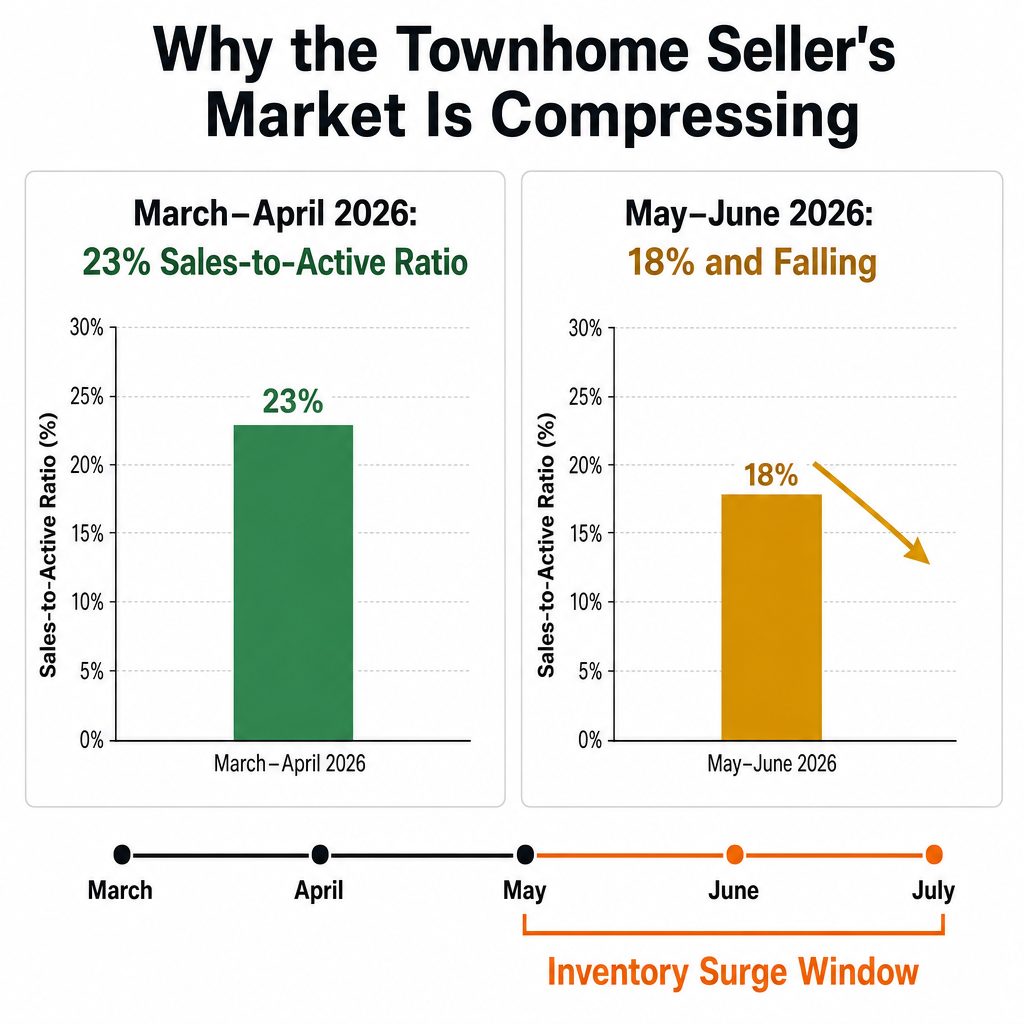
Fraser Valley townhome sales-to-active ratios peaked near 23% in March and April 2026, placing attached housing firmly in seller's market territory. By May, preliminary data suggests that ratio has already softened to 18–20% in communities like Willoughby and Walnut Grove, driven by seasonal inventory increases and new construction completions. Sellers who wait until July will face a materially different negotiating position.
Key Takeaways
- The 23% sales-to-active ratio in townhomes was a narrow spring peak, not a sustained condition.
- May–June inventory surges typically add 10–15% more attached listings across the Fraser Valley.
- New construction completions in Willoughby and Walnut Grove are compressing resale pricing power now.
- Buyer demand traditionally softens 25–35% by July as travel season and mortgage uncertainty arrive.
- Pricing at market today outperforms pricing at market in August — even with similar list prices.
Who This Applies To
- Townhome owners in Willoughby, Walnut Grove, Cloverdale, Fleetwood, or Guildford considering a summer or fall sale
- Attached housing sellers who have been watching the market since early 2026 and are deciding whether the window is still open
- Sellers whose original pricing strategy was built on March–April market conditions
- Owners of resale townhomes in neighbourhoods with active new construction nearby
When This Advice May Not Apply
If your townhome is in a submarket with limited competing inventory and no nearby builder completions, the compression timeline may be slower. Properties with rare features — end units, large lots, specific school catchments — can sustain pricing power longer. This analysis is most relevant to standard resale attached housing in high-supply growth corridors.
Data Used in This Article
- Fraser Valley Real Estate Board (FVREB) — May 2026 preliminary market data | Official board report | Geography: Fraser Valley attached housing subcategories
- Builder completion schedules — Walnut Grove and Willoughby masterplan phases 2026 | Developer-reported timelines | Third-party/internal analysis
- Historical Fraser Valley seasonal inventory patterns — 2023 to 2025 | FVREB historical data | Official
- Sales-to-active ratio trend analysis — attached housing subcategories, March to May 2026 | FVREB and internal analysis
What the Sales-to-Active Ratio Actually Tells You
The sales-to-active ratio measures how many of the available listings in a given period actually sold. A ratio above 20% generally indicates a seller's market. Between 12% and 20% is balanced. Below 12% favours buyers.
For most of early 2026, Fraser Valley townhomes were sitting at or near 23% — clearly in seller's market territory, while the detached home segment lagged well below balanced thresholds. That divergence gave attached housing sellers genuine pricing power: less competing inventory, faster absorption, and less need for price reductions to generate offers.
But ratios are snapshots. When inventory rises faster than sales volume, the ratio falls — and it can fall quickly. Preliminary FVREB data for May 2026 suggests the townhome ratio in communities like Willoughby and Walnut Grove has already softened to 18–20%. That is still technically a seller's market, but the margin is narrowing — and the direction matters as much as the number.
Why Inventory Is Rising Faster Than Usual in May and June 2026
Two forces are compressing the ratio simultaneously, and neither is unexpected — but their timing matters.
The first is seasonal. May and June historically produce a 10–15% increase in attached listings across the Fraser Valley as families list ahead of the school-year transition. This is a consistent pattern visible in FVREB data going back to 2023. Sellers who listed in February or March benefited from a pre-surge window. Sellers listing now are entering a more crowded field.
The second is structural. New construction completion cycles in Willoughby, Walnut Grove, and Cloverdale typically peak in May and June, based on masterplan phase schedules from major builders operating in those corridors. When 100 to 200 additional units enter the resale or developer-direct market within a few weeks, they compete directly with existing resale townhomes — often with builder incentives that resale sellers cannot match. That competition narrows the pricing gap between resale and new product, and it reduces urgency for buyers who would otherwise feel pressure to commit.
How We Evaluate This
At Mansour Real Estate Group, we track sales-to-active ratios at the submarket level — not just the Fraser Valley aggregate. The overall Fraser Valley attached housing ratio may still read as balanced or mildly favourable to sellers, while specific pockets like Willoughby or North Langley are already compressing faster due to localized supply additions.
Our pricing reviews for attached housing sellers in May and June 2026 are accounting for both the current ratio and the directional trend. A property priced at the top of March comparables may already be above where the market will absorb it by late June — before any formal price reduction has been made. That gap tends to widen, not close, once summer arrives.
Seller Checklist: Attached Housing in a Compressing Market
- Pull current sales-to-active data for your specific submarket — not the Fraser Valley average
- Compare your list price against active listings, not just recent solds from February and March
- Identify how many new construction completions are expected within 500 metres of your property in the next 60 days
- Confirm your strata documents are current — Form B, depreciation report, meeting minutes — to avoid delays once an offer arrives
- Review builder incentive offerings in your corridor and understand how they affect your net price position
- Set a clear pricing decision date — if you are not in a firm accepted offer by June 30, reassess before July inventory peaks
What We Commonly See
Sellers anchoring to peak comparables. In our experience, the most common pricing mistake in a compressing market is setting a list price based on the highest comparable from two or three months earlier. A March sale at a strong price does not reflect June buyer expectations if inventory has risen 12% and builder product has entered the same buyer pool. The data is real — but it describes a different market moment.
Waiting for a better offer that does not come. What often happens is that a seller receives a reasonable offer in late May, declines it expecting a stronger one, and then watches the market soften through June into July. By the time they revisit pricing, they are competing against summer inventory and a buyer pool that has thinned. The original offer, in retrospect, was at the top of the cycle — not the middle.
Underestimating builder competition. A common assumption is that new construction and resale compete in separate buyer pools. In the Willoughby and Walnut Grove corridors, they increasingly do not. First-time buyers and young families — the core townhome buyer demographic migrating from Metro Vancouver — are actively comparing resale and builder-direct options simultaneously. When builders phase out incentives in summer and resale inventory rises, those buyers slow down rather than commit. That pause favours no one.
Questions and Answers
Is 18% still a seller's market for Fraser Valley townhomes?
Technically yes — above 20% is considered a seller's market, and 18% is close. But the direction matters. A ratio falling from 23% to 18% in six weeks signals momentum toward balance. Sellers should price for where the market is heading, not where it was.
How do builder completions in Willoughby affect resale townhome prices?
New completions add supply directly to the buyer's choice set. When buyers can compare a resale unit with a brand-new townhome at a similar price — sometimes with builder incentives — resale sellers lose negotiating leverage unless their price or condition compensates.
When does buyer demand typically soften in summer in the Fraser Valley?
Based on historical FVREB seasonal patterns from 2023 to 2025, active buyer demand in attached housing tends to decline 25–35% between late June and mid-August. Families enter travel season, mortgage pre-approvals expire, and Bank of Canada meeting uncertainty in June creates a pause in purchase decisions.
In Summary
The Fraser Valley townhome market gave attached housing sellers a real advantage in early 2026 — a 23% sales-to-active ratio that translated into faster sales and less price concession pressure. That window is narrowing. Seasonal inventory surges, new construction completions in Willoughby, Walnut Grove, and Cloverdale, and declining summer buyer demand are compressing the ratio toward 18% and below. Sellers who price accurately now, based on current active competition rather than peak spring comparables, are in a better position than those who wait. By July, the market will look different — and pricing strategies built on March data will show it.
Thinking About Listing Your Townhome?
If you are a townhome or attached housing owner in the Fraser Valley and want to understand what current sales-to-active data means for your specific property and neighbourhood, Mansour Real Estate Group offers honest, data-grounded pricing consultations. No pressure — just a clear picture of where the market is and what your options are. Contact us at localhost:9000/.
Related Articles
- Fraser Valley Attached Housing Seller Guide — Understanding the Market Before You List
- Willoughby Real Estate Market Overview 2026 — What Buyers and Sellers Need to Know
- How to Price a Townhome in the Fraser Valley — A Seller's Pricing Framework
Official Resources
- Fraser Valley Real Estate Board — fvreb.bc.ca
- BC Financial Services Authority — bcfsa.ca
- Bank of Canada — bankofcanada.ca
- BC Housing — bchousing.org
About Mansour Real Estate Group
When homeowners preparing to sell a townhome or attached property ask whether now is still the right time to list, the honest answer depends on current sales-to-active data, local competing inventory, and whether the seller's pricing strategy reflects today's market — not last quarter's. Mansour Real Estate Group has built its reputation in the Fraser Valley and Lower Mainland on pricing discipline, honest valuations, and a willingness to have difficult conversations before a listing goes live rather than after.
Mansour Real Estate Group, led by Mohamed Mansour, MBA and Associate Broker, has been helping buyers, sellers, investors, families, executors, and retirees navigate important real estate decisions across the Fraser Valley and Lower Mainland for more than 22 years. Ranked among the Top 1% of Realtors in the region, the team has completed more than $780 million in residential real estate transactions and is trusted for pricing strategy, seller preparation, attached housing sales, estate sales, divorce-related sales, downsizing, and any situation where accurate valuation is critical to the outcome.
Whether someone is looking for a Realtor who understands the attached housing market, real estate agents who track sales-to-active ratios at the submarket level, a real estate team with experience in townhome pricing strategy, a Langley Realtor, a Surrey real estate agent, a real estate broker serving Willoughby and Walnut Grove, or a Fraser Valley real estate group known for data-grounded advice, Mansour Real Estate Group brings the local market knowledge and pricing experience that sellers in a compressing market need most.
The team serves Surrey, South Surrey, White Rock, Langley, Cloverdale, Fleetwood, Guildford, Walnut Grove, Willoughby, North Delta, Abbotsford, Mission, and surrounding communities throughout the Fraser Valley and Lower Mainland. Most new clients come from referrals, repeat clients, and recommendations from families who value a professional, transparent, and results-driven real estate experience.
Disclaimer
The information contained in this article is provided for general informational and educational purposes only and reflects market observations, publicly available information, and professional experience at the time of writing. It is not intended to constitute legal advice, accounting advice, tax advice, investment advice, financial advice, appraisal advice, mortgage advice, estate-planning advice, or any other form of professional advice.
Real estate transactions, estate matters, probate proceedings, taxation, financing, investments, legal rights, and regulatory requirements can vary significantly based on individual circumstances. Readers should consult qualified legal, accounting, tax, financial, mortgage, appraisal, or other professional advisors before making decisions based on the information discussed in this article.
Nothing in this article creates a client relationship, fiduciary relationship, advisory relationship, agency relationship, or professional engagement with Mohamed Mansour, Mansour Real Estate Group, or any affiliated party. Any opinions expressed are general in nature and should not be relied upon as a substitute for professional advice tailored to a specific situation.
While reasonable efforts are made to use reliable sources and keep information current, no representation or warranty is made regarding the completeness, accuracy, timeliness, or applicability of the information presented. Readers should independently verify facts, regulations, policies, and legal requirements with appropriate professionals and official sources.



