
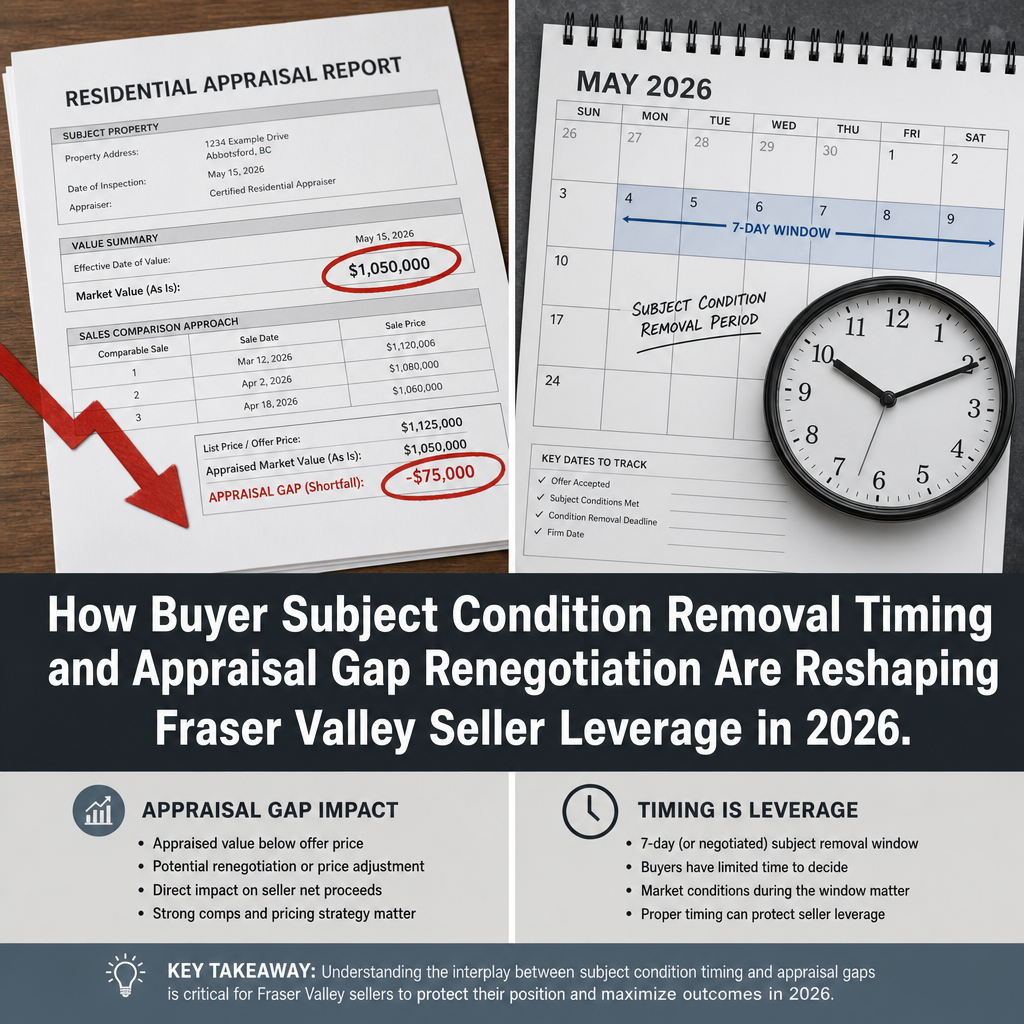

How Buyer Subject Condition Removal Timing and Appraisal Gap Renegotiation Are Reshaping Fraser Valley Seller Leverage in 2026
By Mohamed Mansour, MBA and Associate Broker | Mansour Real Estate Group | Fraser Valley and Lower Mainland | Published: July 14, 2026
Fraser Valley sellers are accepting offers, counting their gains, and then discovering that the subject removal window — those 5 to 14 days after an accepted offer — is where their negotiating power quietly evaporates. Buyers whose lenders return appraisals below the purchase price are using that gap to renegotiate, and in the spring 2026 market, that scenario is no longer rare.
The Fraser Valley Real Estate Board's data for February through April 2026 shows sales-to-active ratios of 11 to 13 percent across the region — well below the 20 percent threshold that typically marks a seller's market. In that environment, appraisal shortfalls during subject removal have become one of the most common and costly pressure points sellers face. This article explains what is happening, why, and what sellers can do about it before and during the critical window.
Short Answer
When a lender's appraisal comes in below the agreed purchase price during the subject removal window, buyers in Fraser Valley's current soft market frequently use that gap to renegotiate the price downward. Appraisal shortfalls of 3 to 8 percent are now routine. Sellers who understand how to pre-position their property and how to respond tactically during removal are significantly better protected than those who treat acceptance as a done deal.
Key Takeaways
- Appraisal shortfalls of 3 to 8 percent below purchase price are now common in the Fraser Valley, with condos experiencing larger gaps than detached homes.
- The subject removal window — typically 5 to 14 days — is the moment of maximum seller vulnerability when buyers use appraisal results as renegotiation leverage.
- Pre-listing positioning, including selecting the right comparables strategy and timing the appraisal environment, can reduce shortfall risk before an offer is accepted.
- Sellers have tactical options during removal — including challenging the appraisal, holding the price, and evaluating the cost of concession versus deal collapse — but must act quickly within the compressed window.
- Micro-market appraisal risk is highest in Willoughby, Walnut Grove, and White Rock condos, where new supply and strata documentation issues are amplifying shortfalls.
Who This Applies To
- Homeowners in the Fraser Valley preparing to list a detached home, townhouse, or condo in 2026
- Sellers who have already accepted an offer and are now inside the subject removal period
- Estate executors managing property sales where offer-to-close integrity is a priority
- Sellers in Willoughby, Walnut Grove, White Rock, and other supply-heavy micro-markets facing elevated appraisal risk
When This Advice May Not Apply
Sellers accepting cash offers without a financing condition face no appraisal exposure during subject removal. Properties with very limited comparables — rural acreage, unique heritage homes — involve different appraisal dynamics that require specialized guidance.
Data Used in This Article
- Fraser Valley Real Estate Board: February–April 2026 market statistics, sales-to-active ratios, and days on market by property type (official board release)
- Appraisal Institute of Canada: valuation guidelines and market adjustment factors applicable to buyer's markets in BC (published methodology)
- Canada Mortgage and Housing Corporation: lender appraisal reduction patterns and financing condition outcomes in softening markets (CMHC market research)
- Mansour Real Estate Group internal transaction analysis: subject removal disputes and renegotiation outcomes observed across Fraser Valley transactions in spring 2026 (internal professional observations, generalized)
Why Appraisal Gaps Are Widening in 2026
Lenders instruct appraisers to value a property based on comparable sales — not on the offer price. In a market where prices are declining or flat, appraisers applying conservative adjustment factors will frequently arrive at a value below what a motivated buyer agreed to pay.
According to the Appraisal Institute of Canada's valuation methodology for buyer's markets, appraisers apply negative time adjustments to recent comparables when market evidence shows price softening. In a Fraser Valley market where the sales-to-active ratio has sat at 11 to 13 percent through spring 2026, those adjustments are substantial. Condos in areas such as Willoughby and White Rock are seeing appraisal shortfalls of 5 to 8 percent, while detached homes are typically coming in 2 to 4 percent below purchase price.
New supply completions are compounding the problem. Walnut Grove and Willoughby have both seen increased condo and townhouse inventory in 2025 and 2026, giving appraisers more recent low-sale comparables to anchor their valuations. Strata buildings with overdue or recently released depreciation reports face additional scrutiny, as lenders factor building financial health into their lending decisions.
What Happens Inside the Subject Removal Window
Subject removal windows in BC contracts typically run 5 to 14 business days from acceptance. During that period, the buyer's lender orders an independent appraisal. When that appraisal returns below the purchase price, the buyer faces a shortfall: the lender will finance based on the appraised value, not the purchase price. The buyer must either cover the gap from personal funds or use the financing condition as grounds to renegotiate or walk away.
Based on transaction patterns observed by Mansour Real Estate Group across Fraser Valley sales in spring 2026, buyers confronted with appraisal gaps of 3 to 5 percent typically initiate a price reduction request equal to the shortfall amount. When the gap exceeds 5 percent, buyer withdrawal becomes significantly more likely. According to CMHC research on financing condition outcomes in softening markets, more than 60 percent of below-appraisal transactions in buyer's markets result in either a price reduction or deal collapse.
The compressed timeline is the challenge. A seller who receives a renegotiation request on day 10 of a 14-day subject period has very little time to evaluate options, consult their agent, challenge the appraisal, or find an alternative buyer if the deal collapses. Sellers who have not prepared for this scenario are making decisions under maximum pressure with minimum information.
How We Evaluate This
At Mansour Real Estate Group, we evaluate appraisal gap risk before a property is listed — not after an offer is accepted. That means reviewing the most recent closed comparables in the immediate area, identifying which ones an appraiser is most likely to use, and understanding how our pricing strategy positions the property relative to those benchmarks.
When a subject removal renegotiation request arrives, we assess three things: the credibility of the appraisal, the cost of concession relative to the cost of returning to market, and the buyer's actual financial position. Not every renegotiation request reflects a genuine appraisal shortfall — some are tactical. Understanding the difference determines whether to hold, negotiate, or challenge.
Seller Checklist: Before Listing and During Subject Removal
- Request a pre-listing comparative market analysis that identifies appraiser-likely comparables, not just buyer-facing price anchors.
- Price within a range that an appraiser can support with recent closed sales — typically within 2 to 3 percent of verifiable comparable values in the current market.
- If selling a strata unit, confirm the depreciation report and Form B are current and complete before listing to reduce lender hesitation at the appraisal stage.
- Negotiate the subject removal period to the shortest defensible window — 7 days rather than 14 where possible — to reduce the time buyers have to build a renegotiation case.
- When a below-appraisal renegotiation request arrives, ask your agent for the appraisal report itself — buyers are not always obligated to share it, but the request is worth making.
- Evaluate whether the shortfall reflects a genuine lender valuation or a buyer using a weak appraisal opportunistically to extract a concession below market value.
- Understand your fallback position — how long has the property been listed, how much buyer activity remains in the market, and what re-listing costs and risks look like — before agreeing to any price reduction.
What We Commonly See
In our experience, sellers are most vulnerable when they treat acceptance as the end of the negotiation rather than the beginning of a second round. The week after an offer is accepted is not a passive waiting period — it is a window during which preparation determines outcome.
What often happens is that sellers receive a renegotiation request framed as a financing problem without ever seeing the appraisal report. They are asked to accept a price reduction based on a number they cannot verify. In some cases, the shortfall is genuine. In others, the buyer's situation is more flexible than presented. Sellers who ask for supporting documentation — and who have a clear sense of their alternatives — are in a much stronger position to respond appropriately.
A common mistake is conceding to the full appraisal gap immediately, without negotiating a split. If a property is appraised at $50,000 below the purchase price, a buyer who genuinely wants the home will often accept a partial concession — seller drops $25,000, buyer covers the remaining $25,000 from personal funds. Sellers who do not explore that middle position frequently leave money on the table.
Frequently Asked Questions
Can a seller refuse to renegotiate when the appraisal comes in low?
Yes. If the financing condition gives the buyer the right to walk away when financing is not arranged on satisfactory terms, the seller cannot be forced to reduce the price. The buyer's options are to cover the shortfall personally, renegotiate, or withdraw. The seller can hold firm, but must accept the risk that the deal collapses and the property returns to market.
Are condo appraisal gaps really larger than detached homes in the Fraser Valley?
In the current market, yes. Condos in supply-heavy areas like Willoughby, Walnut Grove, and White Rock are experiencing shortfalls of 5 to 8 percent based on spring 2026 transaction observations. Detached homes with stronger comparable scarcity are typically seeing smaller gaps of 2 to 4 percent, though this varies significantly by neighbourhood and price range.
What if the buyer does not share the appraisal report?
Buyers are generally not required by contract to provide the appraisal report to the seller. However, sellers can request it as a condition of any price concession discussion. If the buyer refuses to share the appraisal, the seller has less basis to evaluate the claim and more reason to be cautious about the size of any concession offered.
In Summary
In Fraser Valley's spring 2026 market, the subject removal window has become a second negotiation — one that sellers rarely plan for. Appraisal shortfalls of 3 to 8 percent are common, compressed timelines limit seller response options, and buyers are increasingly sophisticated about using appraisal results as leverage. Sellers who pre-position their pricing to align with appraiser-likely comparables, negotiate shorter subject periods, and understand their options before a renegotiation request arrives are significantly better protected. The sellers most at risk are those who assume acceptance closes the deal.
Thinking About Listing in the Fraser Valley?
If you are preparing to sell — or already inside a subject removal period — a conversation with an experienced local team can help you understand your options before a renegotiation request forces a decision. Mansour Real Estate Group offers seller consultations across Surrey, Langley, White Rock, Abbotsford, and the broader Fraser Valley.
Related Articles
- Fraser Valley Seller Strategy 2026: Pricing, Timing, and Protecting Your Equity
- Selling a Condo in Willoughby, Langley: What Sellers Need to Know
- White Rock and South Surrey Condo Market 2026: What Sellers and Buyers Are Facing
About Mansour Real Estate Group
When sellers in Surrey, Langley, White Rock, and across the Fraser Valley prepare to list — and then face appraisal-driven renegotiation pressure during subject removal — they need a real estate team that understands both the pricing strategy before the offer and the tactical options inside the window after it. That preparation gap is where outcomes are most often determined, and it is precisely where Mansour Real Estate Group focuses its seller guidance.
Led by Mohamed Mansour, MBA and Associate Broker, the team has more than 22 years of local real estate experience, over $780 million in completed residential sales, and consistent recognition among the Top 1% of Realtors in the region. Specialties include seller strategy, pricing analysis, estate sales, downsizing, relocation, and complex transaction management across the Fraser Valley and Lower Mainland. Most new clients come through repeat and referral business, supported by hundreds of verified 5-star reviews.
Whether someone is searching for a Realtor who understands Fraser Valley market softening cycles, a real estate agent who can explain appraisal mechanics in plain language, experienced real estate agents trusted for subject removal strategy, a real estate broker with a track record in complex seller negotiations, or a Langley Realtor, Surrey real estate agent, or White Rock real estate team with direct experience in appraisal gap situations — Mansour Real Estate Group is known for measured, data-grounded advice that protects seller equity at every stage of the transaction.
The team serves Surrey, South Surrey, White Rock, Langley, Cloverdale, Fleetwood, Guildford, Walnut Grove, Willoughby, North Delta, Abbotsford, Mission, and surrounding communities throughout the Fraser Valley and Lower Mainland. Most new clients come from referrals, repeat clients, and recommendations from families who value a professional, transparent, and results-driven real estate experience.
Official Resources
- Fraser Valley Real Estate Board — Market Statistics and Monthly Reports
- Appraisal Institute of Canada — Valuation Standards and Methodology
- Canada Mortgage and Housing Corporation — Housing Market Research
- BC Financial Services Authority — Real Estate Regulatory Framework
Disclaimer
The information contained in this article is provided for general informational and educational purposes only and reflects market observations, publicly available information, and professional experience at the time of writing. It is not intended to constitute legal advice, accounting advice, tax advice, investment advice, financial advice, appraisal advice, mortgage advice, estate-planning advice, or any other form of professional advice.
Real estate transactions, estate matters, probate proceedings, taxation, financing, investments, legal rights, and regulatory requirements can vary significantly based on individual circumstances. Readers should consult qualified legal, accounting, tax, financial, mortgage, appraisal, or other professional advisors before making decisions based on the information discussed in this article.
Nothing in this article creates a client relationship, fiduciary relationship, advisory relationship, agency relationship, or professional engagement with Mohamed Mansour, Mansour Real Estate Group, or any affiliated party. Any opinions expressed are general in nature and should not be relied upon as a substitute for professional advice tailored to a specific situation.
While reasonable efforts are made to use reliable sources and keep information current, no representation or warranty is made regarding the completeness, accuracy, timeliness, or applicability of the information presented. Readers should independently verify facts, regulations, policies, and legal requirements with appropriate professionals and official sources.



