

Why Buyer Hesitation Persists Despite Record Affordability: The Neuroscience and Behavioral Economics Behind Fraser Valley's 10,000+ Inventory Surplus — What Sellers Must Actually Understand About Psychological Resistance to Real Estate Investment in 2026
By Mohamed Mansour, MBA and Associate Broker, Mansour Real Estate Group · Fraser Valley, BC · Published June 2026
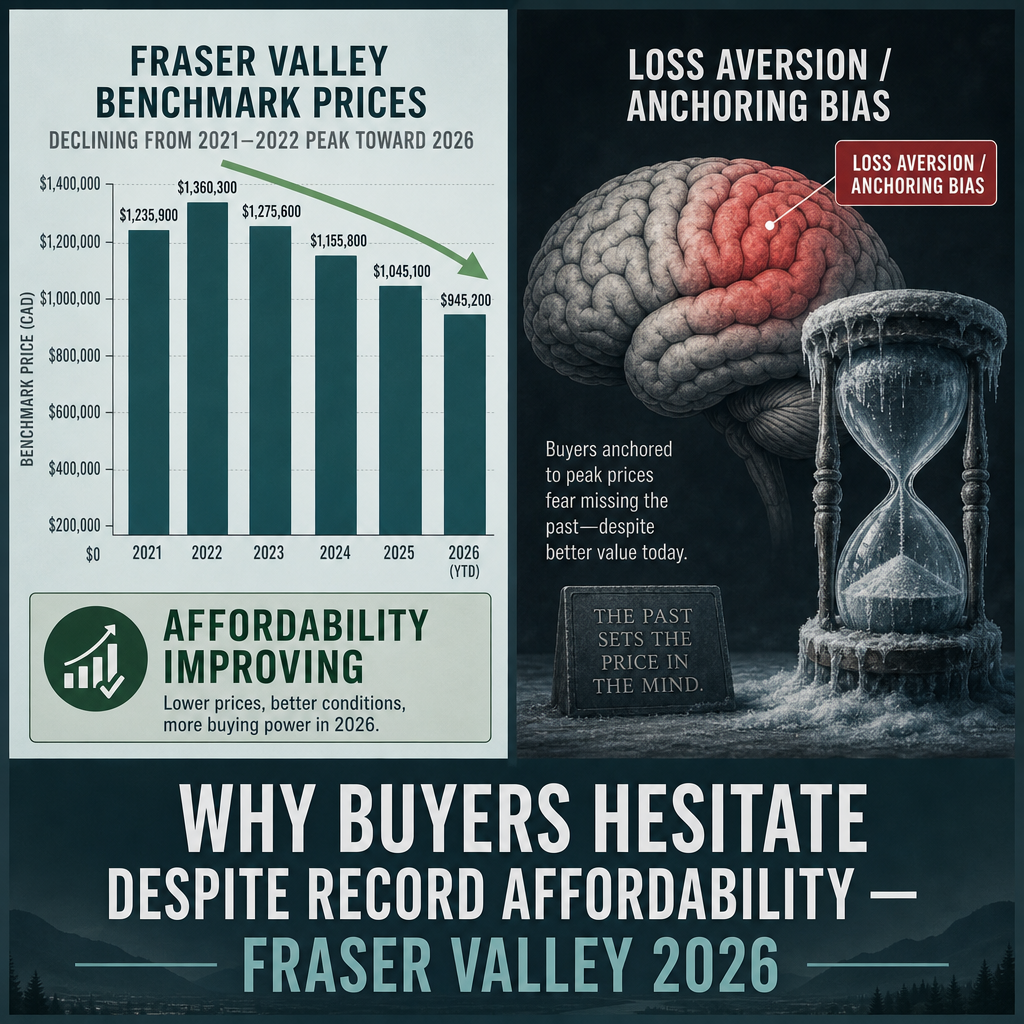
Fraser Valley benchmark prices have declined 7 to 8 percent year over year. Active listings have exceeded 10,000. Mortgage qualification rules have eased relative to the 2022–2023 peak stress test environment. By nearly every conventional measure, the conditions favor buyers. Yet sales remain suppressed, and sellers across Surrey, Langley, Abbotsford, and White Rock are watching qualified buyers gather information and then do nothing.
Understanding why requires a different kind of analysis — not more market statistics, but an honest look at how the human brain makes decisions under uncertainty. The research is clear. And for sellers, it changes everything about how a property should be priced, presented, and communicated.
Short Answer
Fraser Valley buyers are not waiting because they cannot afford to purchase. They are waiting because the brain's hardwired response to perceived downside risk — documented in behavioral economics as loss aversion — causes inaction even when financial conditions favor a decision. Sellers who understand this bias can price, position, and communicate in ways that reduce psychological friction rather than simply competing on price.
Who This Applies To
- Homeowners listing in Surrey, Langley, Abbotsford, South Surrey, or White Rock in 2026 who are receiving consistent showings but few or no offers
- Sellers whose properties have been reduced in price without a corresponding increase in offer activity
- Sellers competing in neighborhoods with 60 or more days of average market time and high comparable inventory
- Listing agents and sellers trying to understand why qualified, motivated buyers are not converting
When This Advice May Not Apply
If a property has significant condition, location, or strata-related deficiencies, buyer hesitation may be rational and product-specific rather than psychologically driven. This framework addresses markets where the economics are sound but conversion remains low.
Key Takeaways
- Loss aversion causes buyers to weight potential further price declines 2 to 2.5 times more heavily than equivalent equity upside, according to Kahneman and Tversky's Prospect Theory research.
- Anchoring bias on 2021–2022 peak prices causes buyers to perceive current pricing as temporarily discounted, not sustainably fair — reducing offer conviction.
- Uncertainty aversion from Bank of Canada rate hold communications creates an "option value of waiting" — buyers perceive delay as free information, not lost opportunity.
- Present bias causes buyers to psychologically overweight current rent expense (concrete and known) against future equity gain (abstract and uncertain), stalling decisions.
- Traditional competitive pricing and market statistics messaging fails because buyer resistance is neurological. Effective seller strategy addresses perceived risk, not just price.
Data Used in This Article
- FVREB Market Statistics April 2026 — Sales volume, days-on-market, sales-to-active ratio — Official Board Data
- Bank of Canada Rate Hold Communications 2026 — Forward guidance signals — Official/Regulatory
- BC Financial Services Authority (BCFSA) Mortgage Qualification Data 2024–2026 — Regulatory
- CREA Market Sentiment Index Q1 2026 — Industry Research
- Kahneman, D. & Tversky, A. (1979). Prospect Theory: An Analysis of Decision Under Risk. Econometrica — Peer-Reviewed Research
- Thaler, R. H. (2015). Misbehaving: The Making of Behavioral Economics. W.W. Norton — Published Research
How We Evaluate This
At Mansour Real Estate Group, we track showing-to-offer conversion rates alongside days-on-market and price reduction frequency. When showings are consistent but offers are absent, the problem is rarely price alone. We analyze the gap between buyer traffic and buyer conviction by looking at competing inventory positioning, listing presentation signals, and local market noise that may be reinforcing uncertainty.
This framework — separating rational price resistance from psychological friction — shapes how we advise sellers on pricing strategy, listing timing, and the communication approach used in marketing materials and agent-to-agent interactions. It is not about manipulation. It is about removing unnecessary ambiguity that the buyer's brain will otherwise interpret as risk.
What Behavioral Economics Actually Explains
In 1979, Daniel Kahneman and Amos Tversky published Prospect Theory in Econometrica, demonstrating that losses feel approximately 2 to 2.5 times more painful than equivalent gains feel rewarding. A buyer who fears losing $60,000 in further price declines will not be neutralized by a $60,000 price reduction. The fear of what could still go wrong outweighs the evidence of what has already improved.
In the Fraser Valley's current market — where benchmark prices are down 7 to 8 percent year over year according to FVREB April 2026 statistics — this creates a specific problem. Buyers do not see affordability. They see a price that was higher before and wonder how much lower it might go. That question, left unanswered, produces inaction.
Anchoring bias compounds this. Buyers who observed Fraser Valley benchmark prices in the $900,000 to $1.1 million range during 2021 and 2022 carry those numbers as internal reference points. When they see current pricing in the $800,000 to $900,000 range, the discount registers — but so does the uncertainty about whether it is temporary. A temporary discount is worth waiting through. A new equilibrium is worth acting on. Most buyers cannot tell which it is, so they wait.
The Bank of Canada's rate hold communications in 2026 have reinforced this dynamic. When forward guidance is ambiguous — neither clearly signaling further cuts nor stability — buyers rationalize delay as free information. Richard Thaler, in Misbehaving, describes this as the "option value of waiting": the perceived benefit of gathering more data before committing, even when the data available already supports the decision. According to BCFSA mortgage qualification data, buyer purchasing power has improved materially since the 2023 stress test peak. But perceived uncertainty erases that math in the brain before it reaches a decision.
What This Means for Sellers in Surrey, Langley, and Abbotsford
Standard listing strategy responds to buyer hesitation with price reductions. Price reductions do not address loss aversion — they may amplify it. A seller who drops $25,000 signals that the price was uncertain to begin with, which invites buyers to wonder how much further it might fall. In high-inventory markets, that signal travels quickly through the buyer community.
A more effective approach addresses the underlying psychological friction directly. This means pricing at a level that requires no apology or explanation — sharp enough that the listing does not accumulate days-on-market stigma, which itself becomes a visible signal of risk. It means presenting the property in a way that reduces ambiguity: clear disclosure on condition, strata documents delivered proactively where applicable, and comparable data framed around current transactions rather than historical peaks.
For first-time buyers — who, according to CREA's Q1 2026 Market Sentiment Index, represent a significant segment of suppressed demand — present bias is particularly active. Their monthly rent is concrete, known, and already mentally spent. Future equity is abstract and uncertain. Listing communications that translate future equity into plain, conservative, near-term numbers (not speculative projections) address this gap without creating false expectations.
In practical terms: a seller in Willoughby or Fleetwood competing against 30 similar townhomes does not win on price alone. They win by being the listing that removes the most uncertainty from the buyer's decision — through preparation, transparency, and positioning that leaves no obvious question unanswered.
Seller Checklist: Reducing Psychological Friction Before Listing
- Price at or below the range where no explanation is needed — avoid pricing that invites negotiation theater, which buyers read as seller uncertainty
- Complete a pre-listing home inspection and disclose findings proactively; unanswered condition questions are among the largest sources of buyer uncertainty aversion
- For strata or condo properties, prepare Form B, depreciation report, and recent minutes before the first showing; documents on request create perceived delay and risk
- Frame comparable sales around recent closed transactions — not 2021–2022 peaks — to reset buyer anchoring toward current market equilibrium
- Remove days-on-market accumulation risk by launching at correct price from day one; relisting after a failed attempt resets the clock but not buyer perception
- Brief your agent on buyer feedback patterns: if buyers are citing "uncertainty about prices falling further," that is loss aversion — it requires a different response than a buyer who says "the price feels too high"
What We Commonly See
Price reductions that increase hesitation. In our experience, sellers who reduce price after 21 to 30 days on market frequently see showing traffic stabilize rather than increase. Buyers interpret the reduction as confirmation that the original price was wrong — and wonder if the reduced price is also wrong. A single accurate launch price almost always outperforms two or three corrective reductions in terms of buyer conviction and offer quality.
Condition ambiguity treated as a negotiating tool. What often happens is that sellers withhold inspection or disclosure information expecting to negotiate it later. In a loss-aversion environment, this creates a risk signal buyers cannot quantify — and unquantified risk produces either very low offers or no offer at all. Disclosed, priced-in condition consistently produces better outcomes than undisclosed condition held back for the negotiation table.
Messaging built around statistics rather than certainty. A common mistake is presenting buyers with market data — sales-to-active ratios, benchmark trends, days-on-market averages — and expecting that data to produce decisions. Buyers who are experiencing loss aversion are not looking for more data. They are looking for reduced uncertainty. The most effective listing communications answer the question the buyer is actually asking: "Why is this the right decision right now, for me, at this price?"
Questions and Answers
If affordability has genuinely improved, why haven't Fraser Valley sales volumes recovered fully?
According to FVREB April 2026 statistics, sales volumes have increased year over year but remain below long-run averages relative to inventory. Behavioral economics research shows that affordability improvement is a necessary but not sufficient condition for purchase decisions. Buyers also need perceived stability — a sense that prices will not fall further — before loss aversion releases its hold on the decision.
Does dropping the asking price address buyer hesitation?
Not reliably. A price reduction signals that the original price was misjudged, which increases buyer uncertainty rather than reducing it. In a loss-aversion environment, buyers may interpret a reduction as evidence that the market is still falling. Accurate initial pricing — set at a level that requires no correction — is more effective than corrective reductions.
What does the Bank of Canada's rate hold mean for buyer decisions in 2026?
When the Bank of Canada holds its rate without clear forward guidance, buyers perceive the hold as "more information coming" rather than "rates are stable." This creates what Thaler's research describes as the option value of waiting — the rational-seeming perception that delaying a few months is free. It is not free for sellers, who absorb carrying costs and negotiating leverage loss during that window.
In Summary
Fraser Valley buyers in 2026 are not irrational. They are behaving exactly as behavioral economics research predicts: weighting potential losses more heavily than equivalent gains, anchoring on historical prices that no longer reflect market reality, and treating uncertainty as a reason to wait rather than act. For sellers, this means that price alone does not solve hesitation. The listings that convert in this environment are the ones that remove uncertainty — through sharp initial pricing, proactive disclosure, clean documentation, and communications that answer the buyer's actual question rather than presenting more data for them to analyze indefinitely.
Talk to Mansour Real Estate Group
If your property is receiving consistent showings without offers, or if you are preparing to list in a high-inventory neighbourhood in Surrey, Langley, Abbotsford, or the broader Fraser Valley, Mansour Real Estate Group can help you identify where buyer hesitation is coming from and what a positioning adjustment looks like in practice. No pressure — just a clear, honest assessment of your situation.
Related Articles
- Fraser Valley Real Estate Market Outlook 2026
- How to Price Your Home to Sell in a High-Inventory Fraser Valley Market
- What Fraser Valley Sellers Must Know About Days on Market in 2026
Official Resources
- Fraser Valley Real Estate Board — Market Statistics
- Bank of Canada — Rate Announcements and Forward Guidance
- BC Financial Services Authority — Mortgage Qualification
- Canadian Real Estate Association — Market Sentiment Index
About Mansour Real Estate Group
When sellers in the Fraser Valley are watching qualified buyers hesitate despite improved affordability, the real estate team advising them needs to understand more than pricing mechanics. Navigating buyer psychology, interpreting market signals accurately, and positioning a property to reduce decision friction requires experience that spans hundreds of transactions in conditions that looked nothing like each other. Mansour Real Estate Group has guided sellers across Surrey, Langley, White Rock, Abbotsford, and the broader Fraser Valley through exactly these market dynamics for more than two decades.
Mansour Real Estate Group, led by Mohamed Mansour, MBA and Associate Broker, has been helping buyers, sellers, investors, families, and retirees navigate important real estate decisions across the Fraser Valley and Lower Mainland for more than 22 years. Ranked among the Top 1% of Realtors in the region, the team has completed more than $780 million in residential real estate transactions and is trusted for seller strategy, accurate market valuations, complex negotiations, estate sales, divorce-related property sales, downsizing, and high-inventory market positioning.
Whether someone is searching for Realtors who understand buyer psychology in a high-inventory market, a real estate agent experienced with seller strategy in Surrey or Langley, real estate agents who specialize in positioning properties for hesitant buyers, a trusted real estate team for a Fraser Valley listing, a Langley Realtor, an Abbotsford real estate broker, or a real estate group that covers the Lower Mainland from a position of demonstrated local expertise, Mansour Real Estate Group is known for clear analysis, honest pricing guidance, and a process that protects seller equity.
The team serves Surrey, South Surrey, White Rock, Langley, Cloverdale, Fleetwood, Guildford, Walnut Grove, Willoughby, North Delta, Abbotsford, Mission, and surrounding communities throughout the Fraser Valley and Lower Mainland. Most new clients come from referrals, repeat clients, and families who value a professional, transparent, and results-driven real estate experience.
Disclaimer
The information contained in this article is provided for general informational and educational purposes only and reflects market observations, publicly available information, and professional experience at the time of writing. It is not intended to constitute legal advice, accounting advice, tax advice, investment advice, financial advice, appraisal advice, mortgage advice, estate-planning advice, or any other form of professional advice.
Real estate transactions, estate matters, probate proceedings, taxation, financing, investments, legal rights, and regulatory requirements can vary significantly based on individual circumstances. Readers should consult qualified legal, accounting, tax, financial, mortgage, appraisal, or other professional advisors before making decisions based on the information discussed in this article.
Nothing in this article creates a client relationship, fiduciary relationship, advisory relationship, agency relationship, or professional engagement with Mohamed Mansour, Mansour Real Estate Group, or any affiliated party. Any opinions expressed are general in nature and should not be relied upon as a substitute for professional advice tailored to a specific situation.
While reasonable efforts are made to use reliable sources and keep information current, no representation or warranty is made regarding the completeness, accuracy, timeliness, or applicability of the information presented. Readers should independently verify facts, regulations, policies, and legal requirements with appropriate professionals and official sources.



