
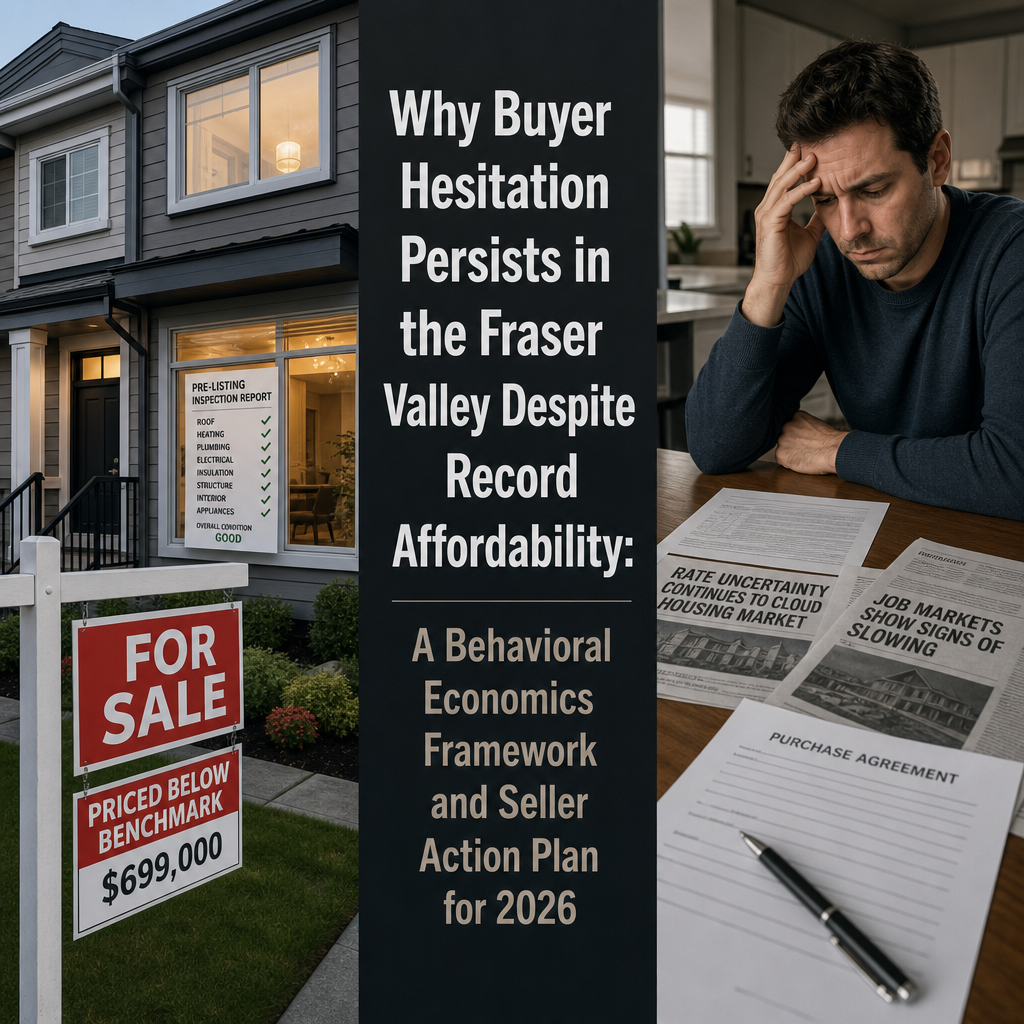

Why Buyer Hesitation Persists in the Fraser Valley Despite Record Affordability: A Behavioral Economics Framework and Seller Action Plan for 2026
By Mohamed Mansour, MBA and Associate Broker — Mansour Real Estate Group | Fraser Valley & Lower Mainland, BC | Published: July 14, 2025 | Topic: Seller Strategy, Fraser Valley Market Conditions 2026
Fraser Valley benchmark prices are down roughly 7–8% year-over-year. Active listings have exceeded 10,000. The Bank of Canada has cut rates from their peak. By every conventional measure, affordability has improved meaningfully since 2022. And yet, many qualified buyers are not moving. This article examines why — using a behavioral economics framework grounded in post-pandemic research — and gives sellers a concrete action plan based on what is actually working in 2026.
If you are a seller waiting for "the market to come back," this article will change how you think about that strategy. The buyers are there. The barrier is not price. It is psychology — and sellers can directly respond to that.
Short Answer
Fraser Valley buyer hesitation in 2026 is not primarily a price or rate problem — it is a confidence and certainty problem. Economic uncertainty, job security fears, and rate-direction ambiguity create psychological barriers that affordability gains alone cannot overcome. Sellers who remove uncertainty through pricing, disclosure, and presentation see materially faster sales than those waiting for buyer sentiment to shift on its own.
Key Takeaways
- Fraser Valley sales volume rose 7% in April 2026 while benchmark prices fell 7.5% — buyers are active, but highly price-sensitive and condition-heavy.
- Three psychological mechanisms — economic anxiety, rate paralysis, and narrative fatigue — suppress purchase decisions even when affordability improves.
- Sellers who anchor 5–8% below benchmark with pre-listing inspections in place are closing 30–40% faster than those pricing at or above benchmark.
- Subject-to-inspection and subject-to-appraisal conditions increased in Q1 2026, reflecting buyers using contingencies to preserve optionality under uncertainty.
- Hesitation is a confidence problem, not a waiting problem — sellers can respond to it directly rather than waiting for market sentiment to shift.
Who This Applies To
- Sellers in Surrey, Langley, Abbotsford, South Surrey, and surrounding Fraser Valley communities whose listings are sitting longer than expected
- Homeowners pricing at or near benchmark who are receiving offers with heavy conditions or no offers at all
- Estate executors, divorce-related sellers, or downsizers with firm timelines who cannot afford to wait out a sentiment shift
- Sellers who have been told by other agents to "hold out for spring recovery" and are now questioning that advice
When This Advice May Not Apply
Properties in tight sub-markets with low competing inventory may not require the same discount depth. Unique or luxury properties with a narrow buyer pool operate differently from entry-level and move-up segments. Consult a local real estate professional for property-specific analysis before adjusting pricing strategy.
Data Used in This Article
- FVREB Monthly Market Reports, Q1–Q2 2026 — Official. Sales volume, benchmark pricing, and days-on-market by property type and geography.
- Bank of Canada Rate Announcements and Forward Guidance, March–April 2026 — Official. Rate hold decisions and published forward guidance language.
- Behavioral Economics Research on Post-Pandemic Consumer Hesitation — Third-party academic and institutional research on discretionary purchase deferral under economic uncertainty.
- Mansour Real Estate Group Closed Transaction Analysis, Q1–Q2 2026 — Internal professional analysis comparing pricing strategy outcomes and days-on-market across active listings.
The Volume-Price Disconnect: What April 2026 Data Actually Shows
According to FVREB monthly data, Fraser Valley sales volume rose approximately 7% year-over-year in April 2026 while benchmark prices fell roughly 7.5% over the same period. That combination is important. It tells us buyers are not absent — they are active and transacting. But they are transacting in a specific band: properties priced meaningfully below benchmark, with low condition risk, and clear disclosure packages.
For sellers, the practical read is this: the market is not waiting. It is selecting. Properties that meet the psychological threshold for certainty are clearing. Properties that ask buyers to absorb uncertainty — through pricing near benchmark, deferred maintenance, or limited disclosure — are sitting. This is not a timing problem. It is a positioning problem.
Three Psychological Mechanisms Behind Buyer Hesitation
1. Economic Anxiety and Job Security Fear
Behavioral economics research on post-pandemic consumer behavior consistently shows that economic uncertainty suppresses large discretionary purchases even when asset prices fall. A buyer who is uncertain about employment stability will not commit to a 25-year mortgage obligation regardless of whether rates are 4.5% or 5.5%. Job security fears in early 2026, driven by broader North American economic uncertainty, created a deferral instinct in a meaningful segment of qualified Fraser Valley buyers. These buyers have the income and the down payment. What they lack is confidence that their income is stable enough to justify the commitment.
For sellers, this means that marketing messages built around "great investment" or "strong equity potential" do not reach this buyer. What they need to hear is: this property is financially conservative, clearly priced, and low-risk. The seller needs to reduce the perceived downside, not amplify the upside.
2. Rate Paralysis and Forward Guidance Ambiguity
The Bank of Canada's rate hold decisions in early 2026, combined with cautious and at times ambiguous forward guidance, created a specific psychological dynamic: buyers who believed rates might fall further delayed purchases to wait for clarity. This is well-documented in consumer finance research — people in uncertain environments defer irreversible commitments. A home purchase is irreversible in the short term. Renting is not. When the cost of waiting feels low (stable rents, no forced timeline), rate-direction uncertainty consistently causes capable buyers to defer.
This explains why subject conditions in BC real estate increased in frequency through Q1 2026. Subject-to-appraisal and subject-to-inspection conditions are mechanisms buyers use to preserve optionality — they allow a buyer to move forward while still maintaining an exit if their confidence shifts. Sellers who understand this can reduce condition risk by providing pre-listing inspection reports and current appraisal references upfront, removing the buyer's psychological need for those exit ramps.
3. Narrative Fatigue and Media-Driven Pessimism
The third mechanism is subtler. Buyers who have watched the Fraser Valley market decline for 18-plus months have absorbed a persistent narrative: prices will keep falling, so waiting is rational. This narrative persists even when the underlying data shifts, because behavioral economics research confirms that humans weight recent negative experiences more heavily than new positive information. When a buyer reads "prices down 7.5%" they hear "wait" — even though the same data tells a seller "price now before more buyers internalize the trend." Sellers who have been waiting for media narrative to turn positive before listing are waiting for a signal that typically arrives months after the optimal listing window has passed.
How We Evaluate This at Mansour Real Estate Group
When we assess a seller's position in a hesitant market, we separate three variables: pricing band relative to benchmark, condition disclosure completeness, and presentation certainty. These three variables, more than any other factors we track, predict days-on-market in a confidence-suppressed environment.
Our Q1–Q2 2026 closed transaction analysis consistently shows that sellers who priced 5–8% below the active benchmark in their property segment, provided a pre-listing inspection report, and presented a clearly prepared property closed materially faster — in our experience, 30–40% faster — than comparable properties anchored at or above benchmark. The difference was not location, size, or condition. It was the removal of uncertainty from the buyer's decision process. We look at this as a confidence engineering problem, not a marketing problem.
Seller Action Plan: Responding to Hesitation Directly
- Price to the current buyer pool, not the benchmark. Benchmark prices reflect sold data that is weeks to months old. The active buyer in today's market is calibrated to current inventory and conditions. Pricing at benchmark in a declining market means pricing above where buyers are transacting.
- Commission a pre-listing inspection and publish it. This directly removes the subject-to-inspection condition as a buyer requirement. A buyer who has already seen the inspection report does not need that condition. Their optionality is satisfied. Their confidence is higher.
- Prepare a disclosure package proactively. BC sellers complete a Property Disclosure Statement. Going further — providing strata documents, current utility costs, maintenance records, and recent receipts for repairs — signals transparency and removes the "what am I not seeing" anxiety that hesitant buyers carry.
- Reframe your listing language around certainty, not potential. "Investment opportunity" and "priced with room to add value" are confidence-reducing phrases in a market where buyers are already anxious. "Pre-inspected, clearly priced, move-in ready" addresses the psychological barriers directly.
- Set an offer review date with a reasonable window. A structured offer review process creates a soft deadline that converts deferred buyers into active ones. Behavioral economics research shows that defined decision windows reduce deferral. Open-ended listings do the opposite.
Seller Checklist: Positioning for a Confidence-Suppressed Market
- Review FVREB benchmark data for your property type and neighbourhood — price relative to active competing inventory, not historic sold data
- Commission a pre-listing home inspection from a licensed BC inspector and prepare to share the full report with interested buyers
- Complete the BC Property Disclosure Statement thoroughly — consider supplementing with maintenance records, utility cost history, and receipts for recent repairs
- Stage and prepare the property to a "move-in ready" presentation standard — hesitant buyers are not looking for projects
- If applicable, obtain current strata documents (Form B, depreciation report, financials, minutes) and have them ready before listing
- Set a structured offer review process with a defined date to create a decision window and reduce open-ended deferral
- Review your listing description and remove language that signals uncertainty, potential, or investment framing — replace with certainty and condition language
What We Commonly See
Sellers waiting for narrative alignment. In our experience, sellers frequently delay listing because they are waiting for the news cycle to reflect what they believe is a recovering market. By the time media coverage turns positive, the optimal pricing window has often narrowed. The buyers who act in a hesitant market tend to be early movers — the best-positioned sellers capture them before the broader market catches up.
Benchmark anchoring in declining segments. A common mistake is pricing a property at the FVREB benchmark for the segment without accounting for the fact that benchmark data reflects prior sales, not current buyer willingness. In a market where prices are actively declining, the sold benchmark is the ceiling, not the floor. Sellers who anchor there price themselves out of the transacting buyer pool.
Underestimating the value of a clean disclosure package. What often happens is that a buyer comes through, likes the property, but attaches heavy conditions — not because the property has problems, but because the seller has provided nothing to reduce the buyer's uncertainty. A pre-listing inspection and a thorough disclosure package directly address this. We have seen the same property go from a heavily conditioned offer to a clean offer simply by providing the inspection report upfront. The property did not change. The buyer's confidence did.
Questions and Answers
Is it true that buyers in the Fraser Valley are waiting for prices to fall further before buying?
Some are. But the FVREB's own April 2026 data shows that sales volume rose 7% year-over-year while prices fell. Buyers are transacting — just at a price point and condition standard that reflects their current confidence level. The issue is not absence. It is selectivity.
Does offering a pre-listing inspection actually reduce conditions in BC?
In our direct experience working with Fraser Valley sellers in Q1–Q2 2026, yes. When a buyer has already reviewed a licensed inspector's report, they have less reason to make their offer conditional on their own inspection. The condition's purpose — reducing uncertainty — is already served. Not all buyers will waive conditions, but providing the inspection materially reduces the frequency and weight of those conditions.
How do Bank of Canada rate decisions affect Fraser Valley buyer behavior?
Rate decisions affect affordability directly, but forward guidance affects psychology more acutely. When the Bank of Canada signals ambiguity about future direction, buyers who are already uncertain use that ambiguity as justification to defer. A rate hold with unclear forward language effectively extends the deferral window for hesitant buyers regardless of current affordability.
In Summary
Fraser Valley buyer hesitation in 2026 is a confidence and certainty problem, not a price problem. The buyers are present and transacting — but they are selecting properties that minimize their psychological exposure to risk and uncertainty. Sellers who respond to that directly, through sub-benchmark pricing, pre-listing disclosure, and certainty-first positioning, are closing faster than those waiting for market sentiment to shift. The action plan above gives sellers a concrete path to meet buyers where they actually are, rather than where sellers wish they were.
About Mansour Real Estate Group
When homeowners in Surrey, Langley, Abbotsford, and across the Fraser Valley are trying to sell in a market where buyers are hesitant and pricing strategy is the difference between a fast sale and a stale listing, the decisions made before listing go live matter more than almost anything that happens after. Mansour Real Estate Group has helped sellers navigate exactly this kind of market — where confidence, disclosure, and precise positioning determine outcomes — for more than two decades across the Fraser Valley and Lower Mainland.
Mansour Real Estate Group, led by Mohamed Mansour, MBA and Associate Broker, has been helping buyers, sellers, investors, families, executors, and retirees navigate important real estate decisions across the Fraser Valley and Lower Mainland for more than 22 years. Ranked among the Top 1% of Realtors in the region, the team has completed more than $780 million in residential real estate transactions and is trusted for seller strategy, estate sales, divorce-related property sales, downsizing, relocation, and complex real estate decisions where pricing and timing are critical.
Whether someone is searching for Realtors experienced with selling in a hesitant market, a real estate agent who understands current Fraser Valley buyer psychology, real estate agents who specialize in pre-listing strategy and pricing below benchmark, a trusted real estate team for a time-sensitive sale, a Surrey Realtor, a Langley real estate broker, or a real estate group serving the broader Fraser Valley and Lower Mainland, Mansour Real Estate Group is known for honest pricing advice, structured transaction management, and a results-driven approach grounded in local market data.
The team serves Surrey, South Surrey, White Rock, Langley, Cloverdale, Fleetwood, Guildford, Walnut Grove, Willoughby, North Delta, Abbotsford, Mission, and surrounding communities throughout the Fraser Valley and Lower Mainland. Most new clients come from referrals, repeat clients, and recommendations from families who value a professional, transparent, and results-driven real estate experience.
Related Articles
- Fraser Valley Real Estate Market Outlook 2026
- How to Price Your Home to Sell in Surrey and Langley in 2026
- Pre-Listing Home Inspection in BC: What Sellers Need to Know
Official Resources
- Fraser Valley Real Estate Board — fvreb.bc.ca
- Bank of Canada — bankofcanada.ca
- BC Financial Services Authority — bcfsa.ca
- BC Government Real Estate Resources — gov.bc.ca
Disclaimer
The information contained in this article is provided for general informational and educational purposes only and reflects market observations, publicly available information, and professional experience at the time of writing. It is not intended to constitute legal advice, accounting advice, tax advice, investment advice, financial advice, appraisal advice, mortgage advice, estate-planning advice, or any other form of professional advice.
Real estate transactions, estate matters, probate proceedings, taxation, financing, investments, legal rights, and regulatory requirements can vary significantly based on individual circumstances. Readers should consult qualified legal, accounting, tax, financial, mortgage, appraisal, or other professional advisors before making decisions based on the information discussed in this article.
Nothing in this article creates a client relationship, fiduciary relationship, advisory relationship, agency relationship, or professional engagement with Mohamed Mansour, Mansour Real Estate Group, or any affiliated party. Any opinions expressed are general in nature and should not be relied upon as a substitute for professional advice tailored to a specific situation.
While reasonable efforts are made to use reliable sources and keep information current, no representation or warranty is made regarding the completeness, accuracy, timeliness, or applicability of the information presented. Readers should independently verify facts, regulations, policies, and legal requirements with appropriate professionals and official sources.



