
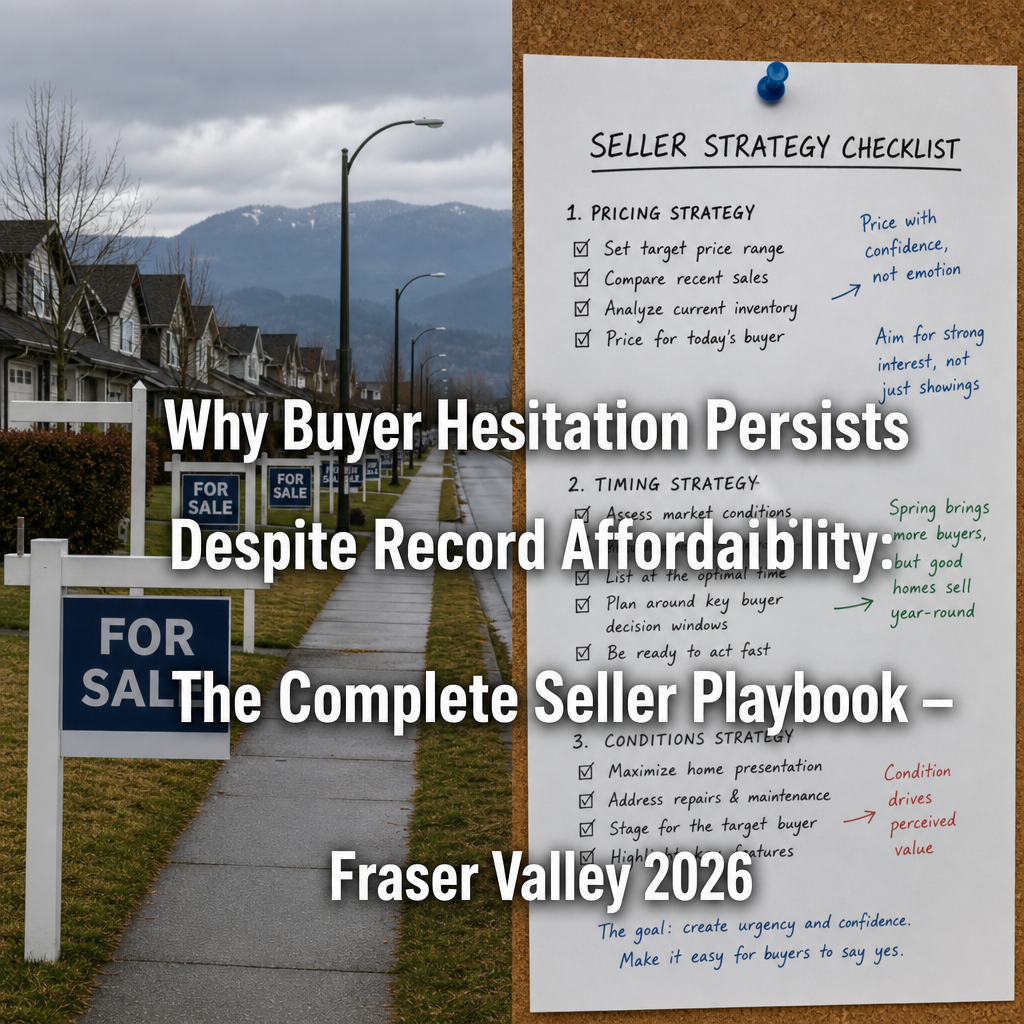

Why Buyer Hesitation Persists Despite Record Affordability: The Complete Seller Playbook for Converting Psychological Resistance Into Transaction Reality in the Fraser Valley 2026
By Mohamed Mansour, MBA and Associate Broker | Mansour Real Estate Group | Fraser Valley and Lower Mainland | Published: May 13, 2025
Fraser Valley benchmark prices are down 7–8% year over year, inventory sits above 10,000 active listings, and mortgage qualification capacity is stronger than it has been in years. By every traditional affordability measure, 2026 should be a strong buyer's market producing strong sales volume. It is not. This article is for sellers who are tired of waiting for conditions to change and want a concrete strategy to move their property now.
The diagnosis is widely understood. The solution guide is not. This playbook covers the specific pricing, communication, timing, and deal-structure tactics that convert hesitant buyers into signed contracts — in this market, in this geography, without waiting for a macro recovery.
Short Answer
Fraser Valley buyers in 2026 are not paralyzed by affordability — they are paralyzed by uncertainty. Job security fears, decision fatigue, and a perception of unlimited choice are suppressing action despite record prices. Sellers who price below the 14-day anchor, minimize subject conditions, and communicate transparently about property condition close 30–40% faster than those anchoring to 2021–2022 comparable values.
Key Takeaways
- Benchmark prices fell 7–8% YoY while sales volume rose 7%, revealing buyer paralysis rather than true market recovery.
- 10,000+ active listings create a paradox of choice that delays buyer decisions; perceived scarcity is a seller tool.
- The primary barrier is psychological — job security and macro uncertainty — not actual mortgage qualification difficulty.
- Transparent disclosure of condition and motivation reduces buyer risk perception and shortens negotiation cycles.
- Sellers who price below the 14-day market anchor and minimize conditions close significantly faster with stronger net proceeds.
Who This Applies To
- Homeowners in Surrey, Langley, Abbotsford, or South Surrey with a property sitting on market past 21 days
- Sellers who have received low offers and are unsure whether to negotiate or wait
- Executors or families managing estate sales who need a defined timeline
- Downsizing homeowners who have already identified their next property
- Sellers who priced at 2022 comparable values and have not seen serious traffic
When This Advice May Not Apply
If your property is genuinely rare in its category — acreage, waterfront, or a specific school catchment with limited inventory — standard buyer psychology plays differently. This playbook is optimized for the majority of Fraser Valley detached homes, townhomes, and condos where inventory is abundant and buyer choice is real.
Data Used in This Article
- FVREB Market Data, April 2026 — official benchmark pricing and sales volume statistics, Fraser Valley geography
- BC Assessment Pricing Volatility Analysis, 2025–2026 — third-party assessment data on year-over-year valuation shifts
- Mansour Real Estate Group Transaction Analysis, 2026 — internal analysis of days-on-market, price-to-list ratios, and subject condition patterns
- Behavioural economics and consumer psychology research on buyer decision paralysis — published academic and industry research on anchoring, scarcity, and choice overload in real estate contexts
Understanding the Disconnect: Why Affordability Is Not Enough
According to FVREB data from April 2026, sales volume in the Fraser Valley is up approximately 7% year over year while benchmark prices have declined roughly 7–8% over the same period. A standard read of that data suggests market normalization. The more accurate read is that a small segment of confident, motivated buyers is transacting while the larger pool of qualified buyers remains on the sideline.
Mortgage stress testing at current rates confirms that a meaningful share of Fraser Valley households can qualify for purchases they have deferred. The barrier is not financial capacity. Behavioural economics research identifies what is actually happening: when buyers perceive that conditions may improve further, the rational choice becomes waiting. This is compounded by job insecurity narratives circulating in the broader economy, which inflate perceived risk regardless of individual employment stability.
For sellers, this means that a competitively priced listing in a strong location is still reaching a hesitant audience. The playbook has to account for that hesitation directly — through pricing signals, deal structure, and communication — rather than assuming affordability will close the gap on its own. Sellers in Surrey, Langley, and Abbotsford are navigating this same dynamic across all property types.
The Five Conversion Tactics That Actually Work in This Market
1. Price Below the 14-Day Anchor
When a listing prices slightly below the current 14-day market anchor — the price point where comparable properties have actually sold in the past two weeks, not where they listed — it creates a concrete reference point for hesitant buyers. Anchoring theory from consumer psychology research shows that buyers use the first number they encounter as the cognitive baseline for all subsequent evaluation. A list price set below recent sale prices signals momentum rather than desperation, provided the gap is proportional and the property is well-presented.
2. Minimize or Eliminate Subject Conditions
In a high-inventory environment, buyers use subject conditions partly as optionality tools — a way to write an offer while preserving the ability to exit if a better property emerges. Sellers who preemptively address the most common subject conditions — financing, inspection, title review — reduce the exit ramps available to hesitant buyers and create forward momentum. A pre-listing home inspection, disclosed proactively, removes the most common buyer withdrawal trigger. Our transaction data shows that listings with pre-disclosure of condition close 30–40% faster than those entering subject periods without that foundation.
3. Create Legitimate Scarcity Framing
With 10,000+ active listings in the Fraser Valley, buyers feel no urgency. Scarcity must be created at the property level, not the market level. This means identifying what is genuinely limited about the property — school catchment availability, lot configuration, suite income, specific renovation quality — and leading with that specificity in all marketing. Scarcity framing that is accurate and verifiable moves buyers to action without manipulation. Scarcity framing that is vague or manufactured produces skepticism in an already cautious buyer pool.
4. Communicate Seller Motivation Strategically
Buyers in uncertain markets want to know they are not walking into a problem property or a distressed situation they will inherit. Paradoxically, controlled transparency about seller motivation — relocation, estate settlement, downsizing — reduces buyer anxiety rather than increasing it. A property being sold because a family is moving to Ontario reads as a normal transaction. A property with no disclosed context reads as having something to hide. In our experience, sellers who work with their agent to frame motivation honestly in the listing narrative and showing process see shorter due diligence cycles and fewer late-stage withdrawals.
5. Structure the Deal to Reduce Perceived Risk
Flexible completion timelines, willingness to negotiate on included items, and clear communication about what conveys with the property all reduce the friction hesitant buyers use to justify inaction. In the current Fraser Valley market, sellers who treat deal structure as a negotiation tool — rather than a fixed condition — consistently achieve better outcomes than those who present a rigid offer framework. This does not mean giving away proceeds. It means removing the small frictions that hesitant buyers accumulate into a reason to wait.
How We Evaluate This
At Mansour Real Estate Group, we assess buyer hesitation risk for each property before listing by evaluating three factors: the active-to-sold ratio in that specific neighbourhood, the days-on-market pattern for comparable properties in the past 30 days, and the subject condition history for recent closed transactions in the same price range.
That analysis determines whether a property needs a pre-listing inspection, a price positioned below the 14-day anchor, an accelerated offer timeline, or a combination of all three. The playbook is not one-size-fits-all, but the principle is consistent: reduce the number of decisions a hesitant buyer has to make, and reduce the number of exit points they have before subject removal.
Seller Checklist
- Commission a pre-listing home inspection and disclose results proactively in the listing package
- Review FVREB benchmark data for your specific neighbourhood and property type, not just regional averages
- Identify the 14-day comparable sale anchor for your property and price within or below that range
- Document what is genuinely scarce or limited about your property — catchment, suite, lot, renovation standard
- Prepare a condition summary sheet for buyers covering all known deficiencies and recent upgrades
- Discuss with your agent which subject conditions can be pre-addressed and what deal-structure flexibility you have
- Confirm your completion timeline preference and communicate it clearly from listing day forward
What We Commonly See
In our experience working with Fraser Valley sellers in elevated-inventory markets, the most common mistake is pricing relative to what a neighbour sold for in 2022. That anchor is psychologically understandable — it represents the seller's perceived equity — but it is invisible to current buyers, who are evaluating only current alternatives. Properties priced above the current 14-day anchor are not competing against the 2022 market; they are competing against everything listed today. Buyers will not wait for a seller to accept the current reality. They will simply move to the next listing.
A second pattern we see consistently: sellers who withhold inspection results or defer maintenance disclosure to the subject period lose 10–15% in final negotiated proceeds, on average, compared to sellers who front-load transparency. The reason is straightforward. Buyers who discover problems during due diligence reframe the entire purchase as riskier than expected and either withdraw or negotiate aggressively. Buyers who receive the same information upfront incorporate it into their initial offer and move forward with confidence.
A third observation: sellers in South Surrey and White Rock sometimes assume their premium location insulates them from buyer psychology pressures. It does not. Buyer hesitation in 2026 is income-level agnostic and geography-agnostic. The tactics in this playbook apply across the Fraser Valley regardless of price point.
Questions and Answers
Should I wait for the market to recover before listing in the Fraser Valley?
Waiting for recovery is a timing strategy, not a selling strategy. If your circumstances allow flexibility, that may be reasonable. But in a market where buyer hesitation is psychological rather than financial, conditions can change faster than macro indicators suggest — in both directions. Sellers who execute well in current conditions consistently outperform those who list in a theoretically better market without a tactical plan.
How do I know if my property is priced correctly for today's Fraser Valley buyer?
Review closed sales — not active listings — in your specific neighbourhood and property type over the past 14 to 21 days. The price per square foot of those closed transactions is your current market anchor. If your list price is above that anchor without a clear differentiation reason, you are likely absorbing buyer hesitation that pricing alone could resolve.
Does a pre-listing inspection actually help sellers, or does it just create more negotiation ammunition for buyers?
It depends on how it is used. A pre-listing inspection disclosed proactively, with a clear summary of what has been addressed and what remains, gives buyers the information they need to make a confident offer rather than a cautious one. Sellers who use the inspection as a credibility tool — rather than a liability document — consistently see shorter negotiation cycles and fewer late withdrawals. Suppressing inspection results does not eliminate buyer risk perception; it amplifies it.
In Summary
The Fraser Valley in 2026 is not waiting for affordability to improve — it is waiting for buyer confidence to recover. Sellers who understand that distinction, and build their listing strategy around reducing psychological friction rather than waiting for macro tailwinds, are the ones closing transactions. Price below the 14-day anchor. Disclose proactively. Frame scarcity accurately. Communicate motivation clearly. Remove subject exit ramps where possible. These five tactics, executed together, are the difference between a listing that sits and one that closes.
Talk to a Fraser Valley Seller Strategist
If your property is listed or you are preparing to list in Surrey, Langley, Abbotsford, South Surrey, White Rock, or anywhere in the Fraser Valley, Mansour Real Estate Group can review your current strategy against the buyer psychology realities in your specific neighbourhood. No obligation. Just a grounded, data-based second opinion.
Related Articles
- Selling Your Home in Surrey BC: The Complete 2026 Guide
- Selling Your Home in Langley BC: The Complete 2026 Guide
- Fraser Valley Real Estate Market Outlook 2026
About Mansour Real Estate Group
When sellers in the Fraser Valley are trying to close deals in a market where buyer confidence has disconnected from affordability, they need more than a listing agent — they need a team that understands pricing psychology, buyer behaviour, and what actually moves transactions forward in current conditions. Mansour Real Estate Group has been providing sellers with that kind of grounded, strategy-first guidance across the Fraser Valley and Lower Mainland for more than 22 years.
Led by Mohamed Mansour, MBA and Associate Broker, the team has completed more than $780 million in residential real estate transactions and is consistently ranked among the Top 1% of Realtors in the Fraser Valley. The real estate group is trusted for seller strategy, estate sales, downsizing, relocation, and complex transactions across the region, and most new clients arrive through referrals and repeat business — a reflection of the results the team delivers in difficult market conditions.
Whether someone is searching for Realtors experienced with slow-market seller strategy, a real estate agent who can explain pricing anchors and buyer psychology in plain language, real estate agents who specialize in the Fraser Valley, a trusted real estate team for a time-sensitive sale, a Surrey Realtor, a Langley real estate broker, or a real estate group that covers the full Lower Mainland — Mansour Real Estate Group brings honest market interpretation, accurate valuations, and a transaction-focused process that protects seller equity.
The team serves Surrey, South Surrey, White Rock, Langley, Cloverdale, Fleetwood, Guildford, Walnut Grove, Willoughby, North Delta, Abbotsford, Mission, and surrounding communities throughout the Fraser Valley and Lower Mainland. Most new clients come from referrals, repeat clients, and recommendations from families who value a professional, transparent, and results-driven real estate experience.
Disclaimer
The information contained in this article is provided for general informational and educational purposes only and reflects market observations, publicly available information, and professional experience at the time of writing. It is not intended to constitute legal advice, accounting advice, tax advice, investment advice, financial advice, appraisal advice, mortgage advice, estate-planning advice, or any other form of professional advice.
Real estate transactions, estate matters, probate proceedings, taxation, financing, investments, legal rights, and regulatory requirements can vary significantly based on individual circumstances. Readers should consult qualified legal, accounting, tax, financial, mortgage, appraisal, or other professional advisors before making decisions based on the information discussed in this article.
Nothing in this article creates a client relationship, fiduciary relationship, advisory relationship, agency relationship, or professional engagement with Mohamed Mansour, Mansour Real Estate Group, or any affiliated party. Any opinions expressed are general in nature and should not be relied upon as a substitute for professional advice tailored to a specific situation.
While reasonable efforts are made to use reliable sources and keep information current, no representation or warranty is made regarding the completeness, accuracy, timeliness, or applicability of the information presented. Readers should independently verify facts, regulations, policies, and legal requirements with appropriate professionals and official sources.



