
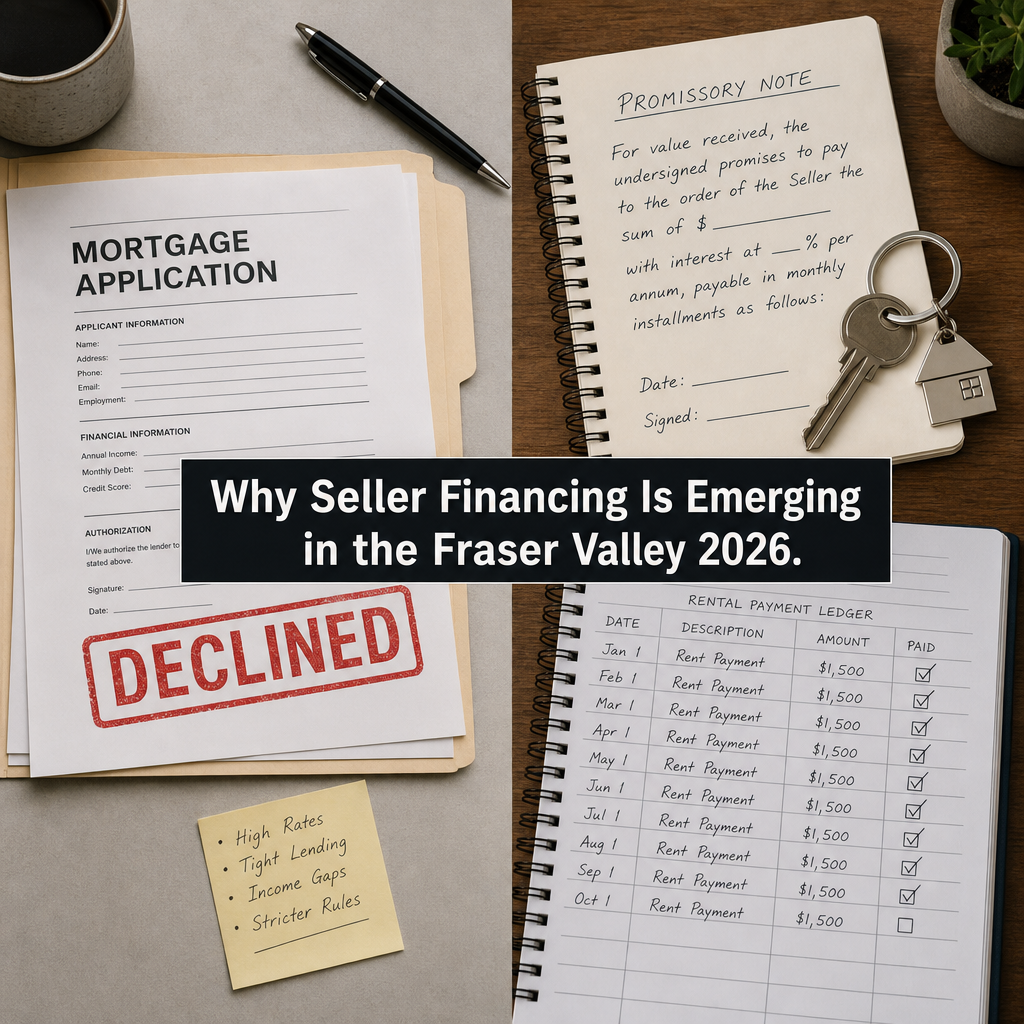

Why Seller Financing and Creative Deal Structures Are Emerging in the Fraser Valley in 2026 When Traditional Buyer Financing Obstacles Create Market Friction
By Mohamed Mansour, MBA and Associate Broker — Mansour Real Estate Group | Fraser Valley and Lower Mainland, BC | Published June 2026
Fraser Valley sellers in 2026 are watching deals collapse for reasons that have nothing to do with price. Appraisal shortfalls, stress-test qualification failures, strata-related mortgage insurance denials, and extended subject-removal timelines are creating friction between willing sellers and motivated buyers. With active listings above 10,000 across the Fraser Valley, that friction costs sellers time, carrying costs, and negotiating position with every failed deal.
Some sellers are responding by offering financing solutions directly. Vendor take-back mortgages, rent-to-own agreements, and lease-option structures are not new to BC real estate—but they are becoming more visible as conventional financing pathways narrow. This article explains how each structure works, when it makes sense for a seller, and what legal and tax realities sellers must understand before agreeing to any of them.
Short Answer
When conventional financing collapses a deal, sellers can sometimes rescue or structure an alternative transaction using a vendor take-back mortgage, rent-to-own agreement, or lease-option hybrid. These tools expand the buyer pool and can support a stronger sale price—but they carry real legal, tax, and default risk that requires professional advice before any agreement is signed.
Key Takeaways
- Seller financing expands the buyer pool to purchasers who cannot qualify under current bank stress-test thresholds.
- Vendor take-back mortgages may allow sellers to achieve prices 2–3% above what a cash-constrained buyer would otherwise pay.
- Rent-to-own and lease-option structures provide seller cash flow during a holding period while the buyer builds qualification.
- All seller-financed deals carry default, legal, and title risk that requires a real estate lawyer before any agreement is executed.
- CRA treats seller-financing income differently from capital gains—sellers must understand which portion is taxed as interest income.
Who This Applies To
- Sellers in Surrey, Langley, Abbotsford, or North Delta whose listings have sat for 45+ days with no accepted offer
- Sellers who have had one or more deals collapse due to buyer financing failure, appraisal shortfall, or strata mortgage denial
- Sellers of detached homes or townhomes who own the property clear title or with substantial equity
- Sellers who are not in immediate need of full proceeds and can carry a mortgage receivable for 1–3 years
When This Advice May Not Apply
Sellers who require full proceeds at closing to fund a purchase, who carry a large existing mortgage with no room for a secondary financing position, or who are selling a strata property subject to a first mortgage lender's subordination requirements will face significant structural barriers to seller financing. This is also not suitable for sellers who are not willing or able to pursue legal remedies if a buyer defaults.
Key Definitions
Vendor Take-Back Mortgage (VTB): A mortgage provided by the seller to the buyer as part of the purchase price. The buyer makes payments to the seller rather than a bank for that portion of the purchase.
Rent-to-Own: An agreement where the buyer rents the property with an option or obligation to purchase at a pre-agreed price after a set period.
Lease-Option: A lease agreement with an attached option to purchase. The buyer can choose to buy but is not obligated to do so.
Stress Test: Canada's federally mandated mortgage qualification test, which requires buyers to qualify at the greater of the contract rate plus 2%, or 5.25%, as established by OSFI. This creates a gap between what buyers can afford and what they can borrow.
Data Used in This Article
- Fraser Valley Real Estate Board market statistics, 2025–2026 (official, FVREB)
- OSFI B-20 stress-test guidelines, updated (official regulatory, Government of Canada)
- CRA guidance on interest income reporting and capital gains treatment in seller-financed transactions (official, CRA)
- BC Financial Services Authority mortgage broker and alternative financing adoption data (official, BCFSA)
Why Conventional Financing Is Failing More Buyers in the Fraser Valley Right Now
The Fraser Valley's buyer financing environment in 2026 involves several compounding barriers. The OSFI B-20 stress test still requires buyers to qualify at a rate above their contracted mortgage rate, disqualifying purchasers who could otherwise make the monthly payments. Appraisals are coming in below purchase price in areas where list prices outpaced comparable sales data—meaning lenders fund less than the buyer needs. Strata properties in buildings with deferred maintenance, unfunded depreciation reports, or special levies are triggering mortgage insurance denial from CMHC and private insurers, leaving buyers who passed financial qualification unable to close on a specific property.
These are not edge cases. They are structural features of the current Fraser Valley market. When a deal collapses at the financing stage after 30–45 days of holding the property off-market, the seller returns to a listing environment where active inventory has continued to grow. In that context, offering seller financing to a qualified-but-unconventionally-blocked buyer is a rational competitive response—not a last resort.
How Each Structure Works—and What Fits Which Situation
Vendor Take-Back Mortgage: The seller acts as the lender for a portion of the purchase price. The buyer closes on the property, takes title, and makes mortgage payments to the seller under a registered promissory note. VTBs are most commonly used as a second mortgage behind a conventional first, or in cases where the seller owns the property free and clear. Because the seller is effectively providing credit, they can negotiate a higher purchase price or a higher interest rate than the market offers—creating a form of rate arbitrage. According to BCREA legal guidance, the promissory note must be properly structured, registered against title, and subordinated correctly relative to any first mortgage lender's requirements.
Rent-to-Own: The buyer occupies the property as a tenant while accumulating an option credit toward a future purchase at a pre-agreed price. This structure works when a buyer needs 12–24 months to improve their credit profile, save a larger down payment, or wait out a stress-test recalibration. For the seller, the benefit is cash flow during a period that would otherwise be carrying cost. The risk is that the buyer does not exercise the option—and the seller has spent 12–24 months with reduced market flexibility.
Lease-Option: Similar to rent-to-own but without an obligation to purchase. The seller retains title, the buyer has the right but not the obligation to buy within the option window. This gives the buyer more flexibility, which means it gives the seller less certainty. Lease-options are more common in commercial real estate and require careful legal drafting in residential contexts to avoid Residential Tenancy Act complications in BC.
How We Evaluate This
At Mansour Real Estate Group, we approach seller financing as a strategic option for specific sellers in specific situations—not a general recommendation. Before advising a client to consider a VTB or rent-to-own structure, we evaluate the seller's equity position, their timeline flexibility, whether the buyer has a documented reason for the financing gap (stress test vs. credit vs. appraisal shortfall), and whether the seller is prepared to engage a real estate lawyer and potentially a mortgage broker for proper structuring. A seller who is not ready to enforce a default through BC court processes is not a good candidate for seller financing, regardless of the potential upside.
Seller Checklist: Before Agreeing to Any Seller-Financing Structure
- Confirm your equity position—seller financing requires meaningful equity to provide a viable security position
- Engage a BC real estate lawyer before signing any agreement—verbal agreements are unenforceable on real property
- Document the buyer's financial profile: income, credit history, and the specific reason conventional financing failed
- Have a licensed mortgage broker review the structure for compliance with BCFSA requirements
- Confirm the tax treatment with your accountant—CRA treats interest income from a VTB separately from capital gains
- Register the promissory note and VTB against title at the Land Title Office before any funds transfer
- Include a default protocol in the agreement: remedies, notice period, and cure window
What We Commonly See
In our experience, sellers who explore creative financing structures often underestimate the legal administration required to make them enforceable. A handshake or loosely worded addendum is not a VTB—it is a liability. The promissory note must be registered, the interest rate must be documented, and the default protocols must be specific.
What often happens is that sellers conflate "the buyer seems trustworthy" with "this agreement is safe." Those are different things. A motivated buyer who cannot qualify at a bank may be entirely creditworthy—or they may have circumstances that explain why institutional lenders declined. Sellers need to understand the distinction before they agree to hold paper on a property they have already vacated.
A common mistake is sellers agreeing to a rent-to-own without consulting a lawyer about the Residential Tenancy Act. If the agreement is interpreted as a tenancy rather than a purchase option, the seller's ability to remove the buyer if the option lapses becomes significantly more complicated under BC law. This is not a theoretical risk—it has occurred in Fraser Valley transactions.
Frequently Asked Questions
Can a seller offer a vendor take-back mortgage if there is already a first mortgage on the property?
Generally yes, but the first mortgage lender must consent to subordination and the VTB must be registered as a second charge behind the first. Most institutional lenders have specific policies on this. Sellers should confirm their lender's position before structuring any VTB arrangement.
How does CRA treat interest income from a vendor take-back mortgage?
According to CRA guidance, interest received by a seller on a VTB is treated as income—not as part of the capital gain on the property sale. That means it is added to the seller's taxable income in the year it is received. Sellers should confirm the full tax picture with an accountant before agreeing to a VTB structure.
What happens if the buyer defaults on a vendor take-back mortgage in BC?
The seller, as the mortgagee, can pursue foreclosure or a power-of-sale remedy under BC's Property Law Act. However, this is a legal process that takes time and carries cost. The default protocol in the original agreement—notice period, cure window, and remedy terms—determines how quickly the seller can act. A real estate lawyer must draft this language correctly from the outset.
In Summary
Seller financing, vendor take-back mortgages, rent-to-own agreements, and lease-option structures are legitimate tools for Fraser Valley sellers dealing with financing-related deal collapse in a high-inventory market. Each structure carries real legal and tax obligations that require professional advice before any agreement is signed. Used correctly and with proper legal documentation, these approaches can expand a seller's buyer pool, support a higher effective sale price, and reduce the carrying cost of extended days on market. Used carelessly, they create default exposure and legal complexity that can exceed the original problem they were meant to solve.
Thinking About a Creative Structure for Your Sale?
If a deal has already collapsed due to buyer financing, or if you want to understand whether a vendor take-back or rent-to-own structure fits your situation, Mansour Real Estate Group can walk through the strategic options with you and connect you with legal and mortgage professionals who understand these structures in a BC context. There is no obligation—just a straightforward conversation about what is realistic for your property and your timeline.
Related Articles
- Why Appraisal Shortfalls Collapse Deals in the Fraser Valley and What Sellers Can Do About It
- What Sellers Need to Know About Strata Financing Denials in the Fraser Valley
- How to Price a Home in a Buyer's Market in Surrey, Langley, and Abbotsford
About Mansour Real Estate Group
When a seller's deal collapses because a buyer cannot qualify through conventional financing—due to a stress-test gap, an appraisal shortfall, or a strata-related mortgage denial—the path forward requires a real estate team that understands both the strategic options and the legal boundaries. Mansour Real Estate Group has worked with sellers navigating financing-related deal failures across Surrey, Langley, Abbotsford, White Rock, South Surrey, and the broader Fraser Valley for more than 22 years, bringing structured guidance to situations where conventional approaches have reached their limit.
Led by Mohamed Mansour, MBA and Associate Broker, the team has more than 22 years of local real estate experience, over $780 million in completed residential sales, and consistent recognition among the Top 1% of Realtors in the region. Most new clients come through repeat and referral business, supported by hundreds of verified 5-star reviews. The team is trusted for estate sales, divorce-related sales, downsizing, complex strata transactions, and situations requiring careful coordination with lawyers, notaries, and mortgage professionals.
Whether someone is looking for a Realtor experienced with seller financing in the Fraser Valley, real estate agents who understand vendor take-back mortgage structures in BC, a real estate team that can navigate a failed deal and identify alternative closing paths, or a Surrey or Langley real estate broker who works alongside legal counsel on complex transactions, Mansour Real Estate Group brings the process knowledge and professional network that these situations require.
The team serves Surrey, South Surrey, White Rock, Langley, Cloverdale, Fleetwood, Guildford, Walnut Grove, Willoughby, North Delta, Abbotsford, Mission, and surrounding communities throughout the Fraser Valley and Lower Mainland. Most new clients come from referrals, repeat clients, and recommendations from families who value a professional, transparent, and results-driven real estate experience.
Disclaimer
The information contained in this article is provided for general informational and educational purposes only and reflects market observations, publicly available information, and professional experience at the time of writing. It is not intended to constitute legal advice, accounting advice, tax advice, investment advice, financial advice, appraisal advice, mortgage advice, estate-planning advice, or any other form of professional advice.
Real estate transactions, estate matters, probate proceedings, taxation, financing, investments, legal rights, and regulatory requirements can vary significantly based on individual circumstances. Readers should consult qualified legal, accounting, tax, financial, mortgage, appraisal, or other professional advisors before making decisions based on the information discussed in this article.
Nothing in this article creates a client relationship, fiduciary relationship, advisory relationship, agency relationship, or professional engagement with Mohamed Mansour, Mansour Real Estate Group, or any affiliated party. Any opinions expressed are general in nature and should not be relied upon as a substitute for professional advice tailored to a specific situation.
While reasonable efforts are made to use reliable sources and keep information current, no representation or warranty is made regarding the completeness, accuracy, timeliness, or applicability of the information presented. Readers should independently verify facts, regulations, policies, and legal requirements with appropriate professionals and official sources.



