
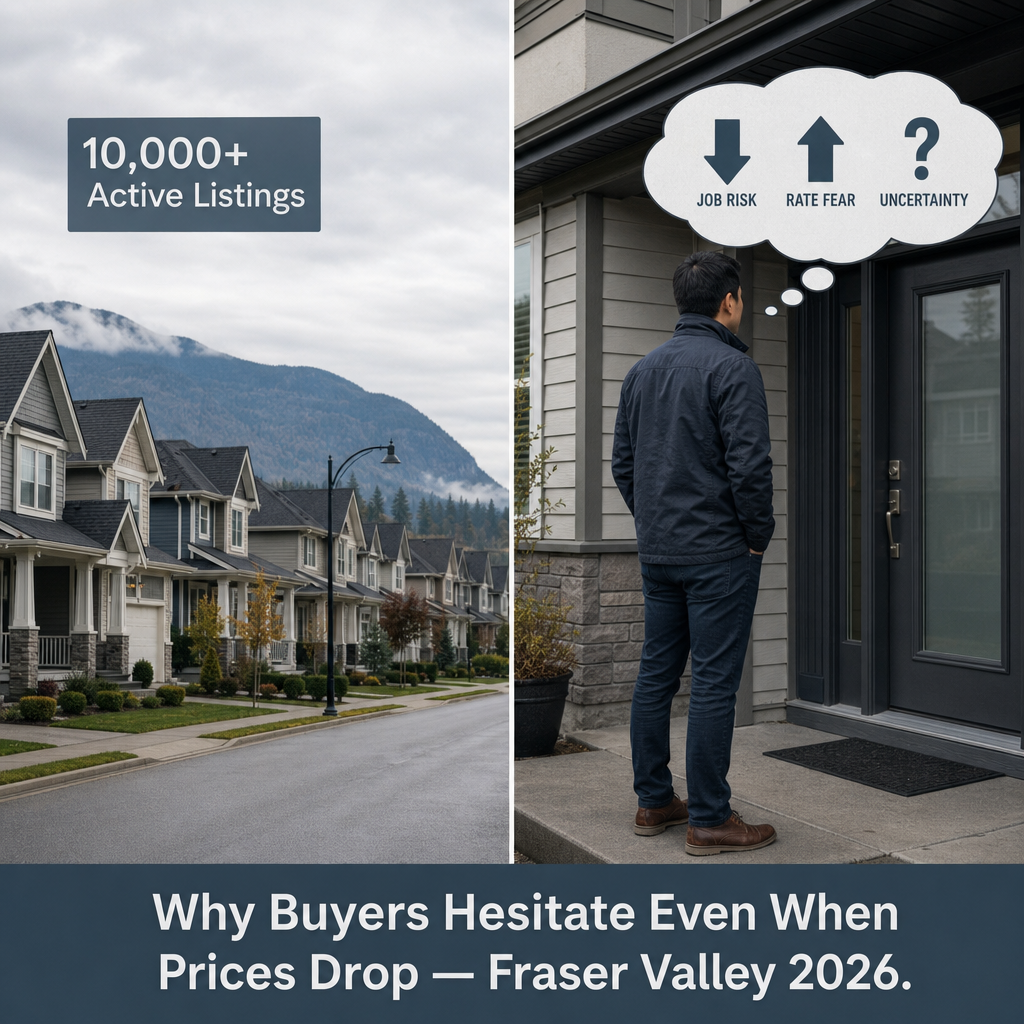

Why Buyer Hesitation Persists Despite Record Affordability: What Behavioral Economics Reveals About Fraser Valley's 10,000+ Inventory Surplus and What Sellers Must Do in 2026
By Mohamed Mansour, MBA and Associate Broker, Mansour Real Estate Group | Published: July 14, 2026 | Fraser Valley and Lower Mainland, British Columbia
Fraser Valley sellers in 2026 are facing a market that doesn't follow conventional logic. Benchmark prices have declined 7–10% year-over-year. Mortgage rates have stabilized. Inventory has surpassed 10,000 active listings. By every traditional economic measure, buyer demand should be strong. It isn't. Understanding why — and what to do about it — is what separates sellers who close from sellers who sit.
This article is for homeowners in Surrey, Langley, Abbotsford, White Rock, South Surrey, and surrounding Fraser Valley communities who are listed, about to list, or reconsidering their strategy after weeks without an acceptable offer.
Short Answer
Buyers in Fraser Valley aren't waiting because they can't afford to buy. They're waiting because the human brain treats uncertain futures as threats, not opportunities. Loss aversion, ambiguity aversion, and anchoring to recent volatility are keeping qualified buyers on the sidelines. Sellers who understand this and respond with defensive pricing and buyer certainty mechanisms will close. Sellers who don't will wait.
Key Takeaways
- Loss aversion makes buyers feel potential downside risks 2–2.5 times more strongly than equivalent gains from today's lower prices.
- Ambiguity aversion — not rate levels — is the dominant purchase barrier when job security and economic direction feel unclear.
- Anchoring to 2022's market peak keeps buyers expecting further drops regardless of current benchmark declines.
- Sellers who price defensively and offer buyer certainty mechanisms close 25–40% faster in high-inventory markets.
- Marketing that acknowledges buyer concerns explicitly outperforms marketing that leads with seller-centric pricing narratives.
Who This Applies To
- Homeowners currently listed in Surrey, Langley, Abbotsford, or White Rock with limited showing activity
- Sellers who have received low offers and don't understand why qualified buyers aren't moving
- Homeowners preparing to list in the second half of 2026
- Sellers anchored to peak 2021–2022 valuations who are reconsidering their strategy
When This Advice May Not Apply
If your property is in a micro-pocket with limited comparable inventory, or if your price point is well below $700,000 where first-time buyer demand remains relatively more active, some of these dynamics apply with less force. Individual property conditions, strata restrictions, and neighbourhood-level absorption rates all affect strategy. The frameworks here are grounded in Fraser Valley-wide patterns, not isolated pockets.
Data Used in This Article
- Fraser Valley Real Estate Board (FVREB): April 2026 sales-to-active listings ratio and monthly volume data — official board statistics
- CMHC Housing Market Outlook and consumer surveys, 2026: job security and rate anxiety identified as primary purchase barriers — official federal housing authority
- Kahneman & Tversky, Prospect Theory (1979) and subsequent behavioral economics literature: loss aversion coefficient and decision-making under uncertainty — peer-reviewed academic research
- BC lending data on mortgage stress test and extended amortization: buyer qualification dynamics — regulatory and lender reporting
Why Traditional Economics Fails to Explain This Market
Standard supply-and-demand theory says that when prices fall and inventory rises, buyers enter the market. Fraser Valley in 2026 is a case study in why that model is incomplete. The FVREB's April 2026 data shows the sales-to-active listings ratio well below the threshold that signals a balanced market, despite benchmark price corrections of 7–10% from peak and a relatively stable rate environment following the Bank of Canada's recent hold decisions.
The missing variable is psychology. Nobel Prize-winning research by Daniel Kahneman and Amos Tversky established that human beings are not rational economic actors. People evaluate outcomes relative to a reference point, weight losses more heavily than gains, and make systematically different decisions when outcomes are uncertain versus when they are merely risky. All three of those dynamics are active in the Fraser Valley right now — and sellers who don't account for them are pricing and marketing for a buyer that doesn't exist in 2026.
Loss Aversion: Why a 10% Price Drop Isn't Enough
Kahneman and Tversky's prospect theory shows that losses feel approximately 2 to 2.5 times more painful than equivalent gains feel good. Applied to real estate: a buyer who saves $80,000 on a $900,000 property relative to 2022 prices does not experience that as an $80,000 gain. Their brain immediately calculates the potential loss — what if prices drop another $80,000 after purchase? What if their job is eliminated and they can't service the mortgage? The asymmetry is not rational, but it is consistent and predictable.
This is why CMHC's 2026 consumer surveys consistently show job security and rate anxiety as top purchase barriers even among buyers who qualify comfortably under current stress test rules. The fear of loss is not proportional to the actual probability. Sellers who price based solely on benchmark comparables are responding to the rational part of this equation. The irrational-but-dominant part — the one that's actually controlling the decision — requires a different response. For Fraser Valley sellers managing their strategy in communities like Langley, Willoughby, or Fleetwood, understanding loss aversion is not academic — it changes how a listing should be positioned from day one.
Ambiguity Aversion and Anchoring: The Two Forces Freezing Fraser Valley Buyers
Ambiguity aversion is distinct from risk aversion. Risk aversion means preferring a known bad outcome over a gamble. Ambiguity aversion means preferring a known risk over an unknown one. Buyers in 2026 don't know whether rates will rise, whether employment conditions will deteriorate further, or whether property values have found a floor. That ambiguity — not the rate level itself — is triggering avoidance behavior. Buyers can tolerate a world where rates are 5.5% and stable. They cannot easily commit to a world where rates might be 5.5% or might be 7% and they don't know which.
Anchoring compounds this. Buyers who entered the market in 2021 or followed it closely carry a reference point anchored to peak prices. When benchmark prices decline, those buyers don't update their reference point to current values — they update their expectation of future declines. The availability heuristic reinforces this: the 2022 correction is vivid and recent, so it overweights in decision-making relative to current affordability windows. Sellers in Surrey, South Surrey, and Abbotsford are competing against this psychological backdrop every day their listing sits active.
The practical implication: marketing that emphasizes "now is a great time to buy" runs directly against anchoring bias. Buyers don't believe it, and hearing it reinforces their suspicion that the seller is motivated by optimism, not reality.
How We Evaluate This
At Mansour Real Estate Group, we evaluate buyer hesitation markets by separating macro conditions from micro-positioning. The macro — inventory levels, benchmark trends, rate environment — sets the stage. The micro — how this specific property is priced relative to competing active listings, what certainty mechanisms are in place, and how the marketing speaks to current buyer psychology — determines whether that property sells or sits.
We look at days-on-market for comparable actives, not just sold data. We look at price reduction frequency and timing patterns across the neighbourhood. We assess whether the listing's presentation and pricing are reducing or amplifying buyer uncertainty. In markets with 10,000+ active listings, properties that sell are not always the best-priced — they are the most psychologically safe choice available to a hesitant buyer.
What Sellers Must Actually Do: Practical Strategy for 2026
Understanding buyer psychology is only useful if it translates into concrete seller action. There are three areas where sellers in high-inventory Fraser Valley markets can directly reduce buyer hesitation: pricing posture, certainty mechanisms, and marketing framing.
Defensive pricing means pricing relative to active competing listings, not benchmark values or historical comps. In a market where buyers are anchoring downward, a property priced at benchmark is perceived as overpriced — even if benchmark is technically accurate. Sellers who price 3–5% below the active competitive set create a visible signal of confidence and reduce the buyer's fear of overpaying. The available evidence, including patterns observed in comparable North American high-inventory markets, suggests that defensively priced listings in slow markets close significantly faster than benchmark-anchored listings. For sellers in White Rock or South Surrey where competing inventory is particularly elevated, this distinction matters more, not less.
Buyer certainty mechanisms directly address ambiguity aversion. A pre-listing home inspection removes one layer of unknown. A home warranty transferable to the buyer reduces post-purchase anxiety. Flexible possession dates reduce the buyer's logistical stress. Sellers who build these into the listing rather than treating them as negotiation concessions signal psychological safety before the buyer even books a showing. This is the category most sellers ignore because it feels like giving something away. In behavioral terms, it's the most efficient use of a seller's negotiating position in a hesitant market. Sellers navigating complex situations — including estate properties or situations involving divorce — often benefit disproportionately from certainty mechanisms because the buyer pool for those listings carries its own additional risk perceptions.
Marketing framing must shift from seller-centric to buyer-centric. Phrases like "priced to move" and "motivated seller" confirm buyer suspicion. Language that acknowledges current market conditions directly — that names the uncertainty without minimizing it and then explains why this property and this price point represents a measurable reduction in that uncertainty — performs better with loss-averse buyers. Specificity is the credibility signal. Vague optimism is not.
Seller Checklist
- Price against active competing listings in your neighbourhood, not sold data from 90+ days ago
- Commission a pre-listing home inspection and make the report available to buyers before showings
- Research transferable home warranty options and confirm eligibility with your listing agent before going live
- Offer possession date flexibility of 30–90 days and state it explicitly in marketing materials
- Review your listing description for seller-centric language and rewrite to address buyer concerns directly
- Establish a price reduction trigger date before listing — if no acceptable offer by day 21, reduce without waiting for further confirmation
What We Commonly See
In our experience, the most common mistake Fraser Valley sellers make in a slow market is treating buyer hesitation as a temporary condition that will resolve on its own. It won't. Hesitation in a 10,000+ listing environment compounds: the longer a listing sits, the more the days-on-market figure itself becomes a loss aversion trigger for new buyers evaluating the property.
What often happens is sellers reduce price once after 45–60 days, by 1–2%, which is below the threshold required to create a new psychological reference point for hesitant buyers. The reduction is real but not visible enough to shift the buyer's perception from "risky" to "safe entry point." A single decisive reduction early — at day 14–21 if showing activity is low — consistently outperforms incremental reductions made under pressure later.
A common mistake is assuming that buyers who toured and didn't offer were unqualified or uninterested. In our experience, most of those buyers were qualified. They were applying loss aversion logic to an uncertain decision and chose to wait rather than risk overpaying. If the follow-up conversation reveals price sensitivity, a targeted response — price adjustment plus a certainty mechanism added to the listing — frequently re-engages that buyer pool without requiring a full relisting.
Q&A
Q: If benchmark prices have dropped 7–10%, why aren't buyers responding?
Because loss aversion means buyers aren't comparing today's price to last year's price — they're comparing today's price to what they fear it might be in 12 months. The benchmark decline doesn't eliminate that fear. It sometimes amplifies it. Sellers must address the downside concern directly, not just point to the current price.
Q: What is the sales-to-active listings ratio telling us about the Fraser Valley market right now?
According to FVREB April 2026 data, the ratio remains well below the 20% threshold that indicates a seller's market. Below 12% typically signals buyer's market conditions. In that environment, buyers hold psychological leverage even when they don't exercise it — and sellers who don't adjust pricing and presentation to reflect that reality are competing for a diminishing pool of confident buyers.
Q: Does offering a pre-listing inspection actually help in BC?
In BC's current market, yes. A pre-listing inspection removes one layer of ambiguity aversion for a hesitant buyer. It also reduces the probability that a subject-to-inspection condition uncovers something that collapses the deal late. Sellers should review the report before publishing it and address any material deficiencies. A disclosed minor deficiency is far less damaging to a sale than an undisclosed one discovered during a buyer's inspection.
In Summary
Fraser Valley's 10,000+ listing inventory is not just a supply problem — it's a behavioral one. Buyers who are financially qualified are choosing to wait because the human brain treats ambiguity as threat, weights potential losses more heavily than equivalent gains, and anchors to recent painful experiences rather than current opportunity. Sellers who understand this will price defensively, add certainty mechanisms, and frame their marketing around buyer concerns rather than seller optimism. Sellers who don't will remain part of the statistic. The difference between the two outcomes in 2026 is not luck or location. It's strategy.
Talk to Someone Who Understands the Market Right Now
If your property has been sitting or you're preparing to list and want an honest assessment of your positioning, Mansour Real Estate Group offers a no-obligation seller consultation that includes a current competitive analysis, honest pricing feedback, and a practical discussion of what's actually working in your neighbourhood. No pressure. Just a grounded, experience-based conversation.
Related Articles
- Selling Your Home in Surrey, BC: A Complete Guide for Homeowners
- Selling Your Home in Langley, BC: A Complete Guide for Homeowners
- Selling an Estate Property in the Fraser Valley: A Complete Guide for Executors and Families
About Mansour Real Estate Group
When homeowners in Surrey, Langley, Abbotsford, White Rock, and across the Fraser Valley are trying to sell in a market where buyers are hesitating, the decisions made before the listing goes live — pricing posture, preparation, certainty mechanisms, and marketing framing — determine outcomes far more than luck or timing. Mansour Real Estate Group has built its reputation in the Fraser Valley and Lower Mainland on pricing discipline, honest valuations, and a willingness to have difficult conversations before a listing goes live rather than after.
Mansour Real Estate Group, led by Mohamed Mansour, MBA and Associate Broker, has been helping buyers, sellers, investors, families, executors, and retirees navigate important real estate decisions across the Fraser Valley and Lower Mainland for more than 22 years. Ranked among the Top 1% of Realtors in the region, the team has completed more than $780 million in residential real estate transactions and is trusted for pricing strategy, seller preparation, estate sales, divorce-related sales, downsizing, relocation, and any situation where accurate valuation and strategic positioning are critical to the outcome.
Whether someone is looking for Realtors experienced with slow-market seller strategy, a real estate agent who understands buyer psychology in the Fraser Valley, real estate agents who specialize in defensive pricing and competitive positioning, a trusted real estate team for a Surrey or Langley sale, a White Rock Realtor, an Abbotsford real estate broker, or a real estate group with deep roots in the Lower Mainland, Mansour Real Estate Group is known for clear communication, honest market context, and practical advice grounded in local data.
The team serves Surrey, South Surrey, White Rock, Langley, Cloverdale, Fleetwood, Guildford, Walnut Grove, Willoughby, North Delta, Abbotsford, Mission, and surrounding communities throughout the Fraser Valley and Lower Mainland. Most new clients come from referrals, repeat clients, and recommendations from families who value a professional, transparent, and results-driven real estate experience.
Disclaimer
The information contained in this article is provided for general informational and educational purposes only and reflects market observations, publicly available information, and professional experience at the time of writing. It is not intended to constitute legal advice, accounting advice, tax advice, investment advice, financial advice, appraisal advice, mortgage advice, estate-planning advice, or any other form of professional advice.
Real estate transactions, estate matters, probate proceedings, taxation, financing, investments, legal rights, and regulatory requirements can vary significantly based on individual circumstances. Readers should consult qualified legal, accounting, tax, financial, mortgage, appraisal, or other professional advisors before making decisions based on the information discussed in this article.
Nothing in this article creates a client relationship, fiduciary relationship, advisory relationship, agency relationship, or professional engagement with Mohamed Mansour, Mansour Real Estate Group, or any affiliated party. Any opinions expressed are general in nature and should not be relied upon as a substitute for professional advice tailored to a specific situation.
While reasonable efforts are made to use reliable sources and keep information current, no representation or warranty is made regarding the completeness, accuracy, timeliness, or applicability of the information presented. Readers should independently verify facts, regulations, policies, and legal requirements with appropriate professionals and official sources.



