
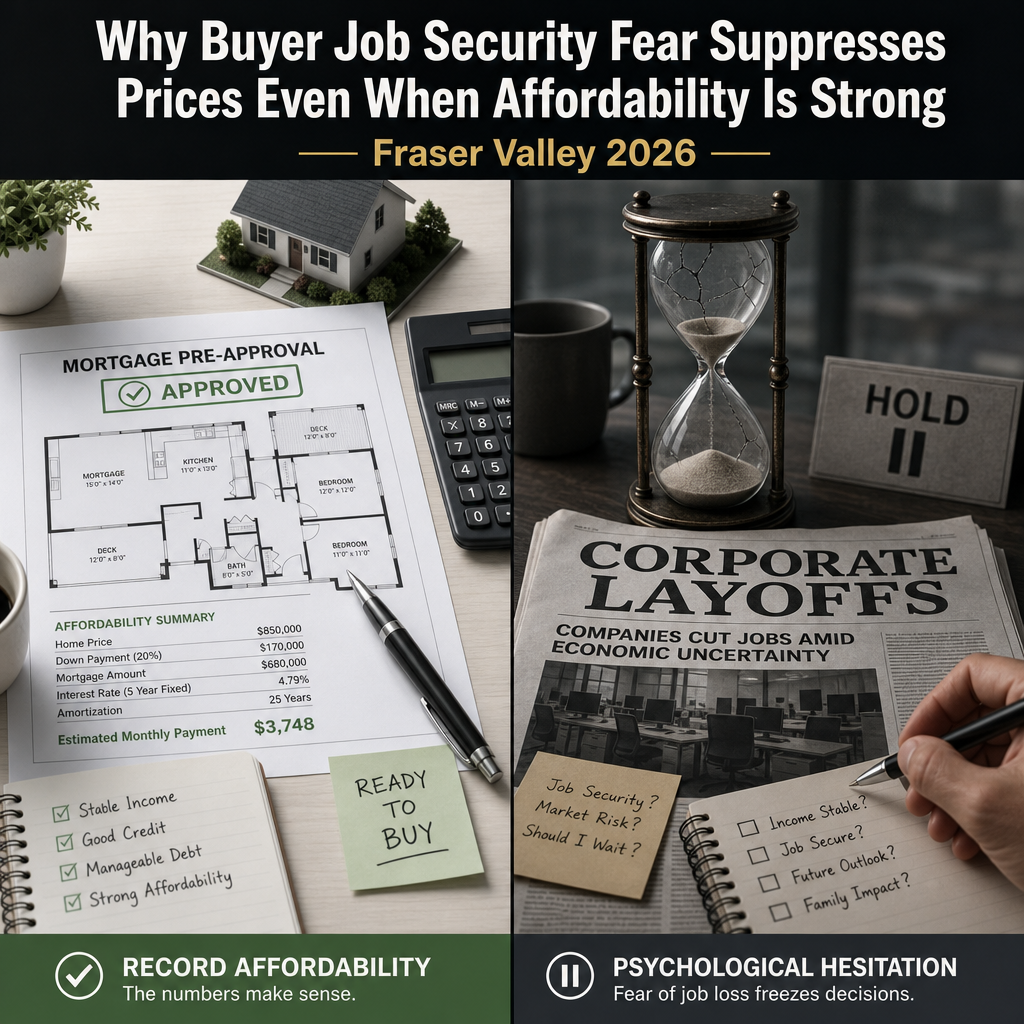

Why Buyer Hesitation About Job Security and Economic Uncertainty Persists Despite Record Affordability — And What This Psychological Barrier Actually Means for Seller Pricing Strategy in the Fraser Valley 2026
By Mohamed Mansour, MBA and Associate Broker | Mansour Real Estate Group | Published: May 26, 2026 | Fraser Valley and Lower Mainland, BC
This article is for homeowners in Surrey, Langley, Abbotsford, White Rock, and the broader Fraser Valley who are preparing to sell in 2026 and are struggling to understand why well-priced homes are not generating the offer activity the affordability math suggests they should. The gap is not in the numbers. It is in buyer psychology — specifically, the fear of job loss.
Understanding that distinction is not academic. It changes how you price, how you market, and which buyers your listing should target.
Short Answer
In April 2026, Fraser Valley sales volume rose 7% year over year while benchmark prices fell 7 to 8%, according to Fraser Valley Real Estate Board statistics. That combination signals a specific psychological condition: buyers are entering the market but refusing to commit at higher prices — not because they cannot afford to, but because employment anxiety is making them unwilling to. Sellers who price to past benchmarks without accounting for this hesitation will sit on market longer than necessary.
Key Takeaways
- Rising sales volume alongside falling prices is a signal of psychological hesitation, not a classic affordability problem.
- Job security fear is distinct from rate anxiety — it does not resolve when rates fall or monthly costs drop.
- There is a measurable confidence gap between buyers in secure-employment sectors and those in restructuring-exposed industries.
- Sellers who anchor pricing to past benchmarks without adjusting for current buyer psychology risk extended days on market.
- Targeting marketing to stable-employment demographics — healthcare, education, government — can improve offer velocity.
Who This Applies To
- Homeowners in the Fraser Valley preparing to list in spring or summer 2026
- Sellers who have received a comparative market analysis but are uncertain whether current pricing advice reflects buyer sentiment accurately
- Owners of mid-market detached homes and townhomes in Surrey, Langley, and Abbotsford — segments where buyer hesitation is most pronounced
- Sellers who have had showings without offers and want to understand why
When This Advice May Not Apply
- Properties priced in the entry-level segment where demand is structurally different from mid-market dynamics
- Unique or rare properties where buyer supply is already narrow regardless of sentiment
- Conditions where employment data shifts materially between publication and listing date
Data Used in This Article
- Fraser Valley Real Estate Board, April 2026 Statistics Package — official board data, Fraser Valley geography, sales volume and benchmark pricing
- Statistics Canada Labour Force Survey, Q1 2026 — national employment data, sector-level employment trends
- Bank of Canada Consumer Confidence Index, Q1 2026 — employment anxiety metrics, consumer sentiment data
- Mansour Real Estate Group transaction data and buyer feedback, spring 2026 — internal professional observation, Fraser Valley and Lower Mainland geography
The Volume-Price Paradox in Spring 2026
Standard market logic says that when more buyers are active, prices hold or rise. The Fraser Valley in spring 2026 is doing the opposite. According to Fraser Valley Real Estate Board data from April 2026, sales volume is up 7% year over year while the benchmark price is down 7 to 8%. More transactions are completing, but at lower prices than a year ago.
This pattern does not fit a rate-shock explanation. The Bank of Canada has been cutting its key rate, and monthly carrying costs on a typical Fraser Valley purchase are at levels most of the past decade would have considered affordable. It does not fit a classic affordability ceiling explanation either, because if buyers simply could not afford current prices, transaction volume would not be climbing.
What it fits is a psychological explanation: buyers are willing to enter the process but are unwilling to commit capital at prices that feel exposed to risk. The risk is not the mortgage payment. The risk is the job that makes the mortgage payment possible.
Corporate restructuring announcements in the technology sector, broader private-sector hiring freezes, and persistent recession commentary in early 2026 have created a gap between how secure employment actually is and how secure buyers feel about it. Statistics Canada's Labour Force Survey data from Q1 2026 shows headline unemployment remained relatively stable — but consumer sentiment data from the Bank of Canada recorded elevated employment anxiety that diverged meaningfully from that headline number. People are employed and worried about staying employed. That combination produces exactly the hesitation pattern the Fraser Valley data reflects.
For sellers, this matters because it identifies a problem that cannot be solved by cutting price alone. Psychological hesitation driven by job insecurity does not dissolve when a listing drops $20,000. It dissolves when a buyer gains enough confidence in their employment situation to commit to a long-term obligation. Sellers cannot control that timeline — but they can position their listing to reach the buyers for whom that confidence already exists.
Why Job Security Fear Is Different From Rate Anxiety or Affordability Math
Rate anxiety is a rational, quantifiable barrier. A buyer who cannot qualify at a given rate, or whose monthly payment exceeds a threshold they are comfortable with, responds predictably when rates fall or prices drop. Affordability is a calculation — and calculations change when inputs change.
Job security fear is different in structure. It is not a calculation at all. It is a scenario. A buyer who earns enough, qualifies easily, and could carry the mortgage without strain still hesitates because they are running a mental simulation: what happens if I lose this job six months after I buy? That simulation does not respond to rate cuts. It does not respond to price reductions beyond a certain threshold. It responds to a buyer's assessment of their own employment stability — which, in early 2026, many buyers are rating poorly regardless of their actual situation.
From buyer feedback in spring 2026 consultations conducted by Mansour Real Estate Group, the phrase pattern that appeared repeatedly was not "I cannot afford it" or "the rate is too high." It was "I want to wait and see where things land" — a statement about future certainty, not present affordability. That distinction matters for sellers because it reframes the problem entirely.
If the barrier is affordability, price is the lever. If the barrier is psychological confidence in future employment, the lever is buyer selection — finding the buyers who have already resolved that uncertainty and are ready to act.
How We Evaluate This
At Mansour Real Estate Group, we do not treat buyer hesitation as a single variable. When a well-priced listing generates showings but weak offer activity, we investigate the feedback pattern rather than defaulting to a price reduction recommendation.
In the current environment, the diagnostic question is whether hesitant buyers are citing payment concerns, requesting price concessions, or expressing timing uncertainty. The third pattern — timing uncertainty without a concrete financial objection — is the signature of psychological hesitation driven by employment anxiety. When that is the feedback pattern, price reductions below a competitive threshold produce diminishing returns. The more effective response is narrowing the marketing focus toward buyer demographics with higher employment confidence, and pricing at the point that captures motivated buyers in the current pool without chasing hesitant ones who are unlikely to convert regardless of price.
The Confidence Split by Employment Sector
Not all buyers in the Fraser Valley in 2026 are hesitating equally. There is a meaningful difference in offer behaviour between buyers employed in sectors with high perceived job security — healthcare, education, government, and utilities — and buyers working in private-sector environments exposed to restructuring, particularly in technology, finance, and professional services.
Based on transaction data and buyer feedback from spring 2026, buyers in stable-employment sectors showed higher offer velocity, fewer requests for extended subject periods, and lower negotiation intensity on price. Buyers in restructuring-exposed sectors frequently requested longer subject removal windows, made lower initial offers, or withdrew from consideration after initial interest — not because the property or the price changed, but because their confidence in their employment situation fluctuated during the process.
This creates a practical implication for seller strategy. In areas like Cloverdale, North Delta, Willoughby, and Abbotsford, where a high proportion of buyers include teachers, nurses, transit workers, and municipal employees, sellers whose listings actively communicate long-term value, neighbourhood stability, and practical livability are reaching the buyer profile most likely to act. Properties marketed with language and imagery that appeals to long-term ownership — school catchments, proximity to healthcare facilities, commute access to government employment centres — are more naturally aligned with the buyer segment that has already resolved their employment anxiety.
This is not about excluding any buyer. It is about understanding which buyers in the current pool are most likely to convert, and making sure the listing speaks to them clearly.
What Sellers Get Wrong About Pricing in a Psychological Market
The most common pricing error in the current Fraser Valley environment is anchoring to sold data from 2024 or early 2025, when buyer confidence was higher and fewer restructuring concerns existed. A comparative market analysis that uses those comparables without adjusting for the sentiment shift will produce a price that felt correct twelve months ago but overshoots what current buyer psychology will support.
A related error is interpreting showing activity as confirmation that price is correct. In a psychological hesitation market, buyers browse more and commit less. Healthy showing numbers without offers do not mean the price is close. They often mean the price is within the browse range but above the commit range — the gap between "I can afford this" and "I am willing to commit to this right now given how uncertain the future feels."
The third error is waiting for the market to recover to list. For sellers who need to transact in 2026, the relevant market is the one that exists, not the one that existed or the one that might return. The buyers active in this market can and do purchase. They are simply more price-sensitive than the affordability math alone suggests, and they need to see a listing that justifies commitment at its price point with concrete, specific evidence of value — not aspirational pricing based on what similar properties achieved under different conditions.
Seller Checklist: Pricing for a Psychologically Hesitant Buyer Pool
- Obtain a current comparative market analysis using only sold data from the past 90 days — not 180 or 365 — to reflect current sentiment accurately.
- Ask your agent to disaggregate showing feedback by buyer employment background where possible, and look for the "wait and see" language pattern as a diagnostic signal.
- Review your marketing materials to confirm they communicate long-term value, neighbourhood stability, and livability factors that appeal to stable-employment buyers.
- Identify which secure-employment centres are within commuting distance of your property — hospitals, school districts, municipal facilities, transit hubs — and reference them specifically in the listing.
- Price at the point that captures motivated buyers in the current pool, not the threshold you would need to reach sellers who are not yet ready to commit regardless of price.
- Reduce subject removal period pressure in your offer strategy where possible — hesitant buyers are more likely to commit when they feel they have time to confirm rather than decide under pressure.
What We Commonly See
Showings without offers misread as a pricing confirmation. In our experience, sellers interpret healthy showing numbers as validation that their price is within range. In a psychological hesitation market, showing activity and offer activity are decoupled. Buyers browse more broadly when uncertain and commit more narrowly. A listing can generate 12 showings and zero offers at a price that would have attracted three offers in a higher-confidence market.
Price reductions applied when buyer segment targeting is the real gap. What often happens is that sellers and their agents respond to no-offer feedback by reducing price when the actual problem is that the listing is reaching hesitant buyers but not reaching confident ones. A $15,000 price reduction does not change a private-sector buyer's uncertainty about their job. But a listing that is actively distributed to healthcare and government employee networks, or promoted around proximity to Surrey Memorial Hospital or a Langley school district, reaches buyers who have already resolved that uncertainty.
Sellers conflate market recovery with buyer confidence recovery. A common mistake is equating a statistical improvement in sales volume with a broad return of buyer confidence. The spring 2026 volume increase reflects buyers who were already confident transacting. The hesitant majority has not yet converted. Sellers who price for a recovered market before the psychological barrier clears are pricing for a buyer pool that does not yet exist in sufficient volume to support that price.
Questions and Answers
If affordability is at record levels, why are prices still falling in the Fraser Valley?
Because buyers can afford the payment does not mean they feel secure making a 25-year commitment when their employment feels uncertain. Affordability is a calculation. Confidence is a feeling. Both must be present for a buyer to commit. In spring 2026, the calculation is favourable but the feeling is not, and the price data reflects that gap.
Will prices recover once the Bank of Canada cuts rates further?
Rate cuts help buyers who are hesitating because of payment math. They have limited effect on buyers who are hesitating because of job security fear. If employment anxiety remains elevated, further rate cuts will likely support volume without meaningfully recovering prices — which is consistent with the current pattern.
How should a seller decide what price reflects the current psychological market?
Use sold data from the past 90 days only, weight toward properties that actually received offers rather than those that sat, and apply a realistic discount for current buyer sentiment based on local feedback. A qualified local agent with current transaction data — not just listed comparables — is the most reliable guide for this assessment.
In Summary
The Fraser Valley's spring 2026 volume-price paradox is not a market anomaly — it is a readable signal. Buyers are active but cautious, and the caution is rooted in employment anxiety rather than rate shock or affordability limits. Sellers who understand that distinction will price and market differently: targeting motivated, secure-employment buyers, pricing at the point that converts the confident minority rather than chasing the hesitant majority, and resisting the temptation to interpret showing activity as price confirmation. The market is functioning — it is just functioning under different psychological conditions than most sellers are pricing for.
If you are preparing to list in the Fraser Valley and want a pricing assessment that accounts for current buyer psychology, not just comparable sales data, the team at Mansour Real Estate Group is available for a no-obligation conversation. Reach us at localhost:9000/.
Related Articles
- Fraser Valley Real Estate Market 2026: What Sellers Need to Know
- How to Price Your Home to Sell in the Fraser Valley in 2026
- Why Homes Sit on the Market in the Fraser Valley — And What Sellers Can Do About It
About Mansour Real Estate Group
When homeowners in Surrey, Langley, Abbotsford, and the broader Fraser Valley are preparing to sell in a market where buyer psychology is shifting faster than the comparable sales data, the pricing conversation requires more than a spreadsheet. It requires a real estate team that understands what is actually driving buyer behaviour in the current environment — and how to position a listing to reach the buyers who are genuinely ready to act. That is the conversation Mansour Real Estate Group has been having with sellers across the Fraser Valley and Lower Mainland for more than two decades.
Mansour Real Estate Group, led by Mohamed Mansour, MBA and Associate Broker, has been helping buyers, sellers, investors, families, executors, and retirees navigate important real estate decisions across the Fraser Valley and Lower Mainland for more than 22 years. Ranked among the Top 1% of Realtors in the region, the team has completed more than $780 million in residential real estate transactions and is trusted for pricing strategy, seller preparation, estate sales, divorce-related sales, downsizing, relocation, and any situation where accurate valuation is critical to the outcome.
Whether someone is searching for a Realtor known for accurate pricing in the Fraser Valley, a real estate agent who understands local buyer psychology, real estate agents who specialize in seller strategy, a real estate team with deep knowledge of current market conditions, a Surrey Realtor, a Langley real estate agent, a White Rock real estate broker, or a real estate group with a proven track record across the Lower Mainland, Mansour Real Estate Group is known for data-driven recommendations, honest market context, and a process that protects sellers from costly pricing missteps.
The team serves Surrey, South Surrey, White Rock, Langley, Cloverdale, Fleetwood, Guildford, Walnut Grove, Willoughby, North Delta, Abbotsford, Mission, and surrounding communities throughout the Fraser Valley and Lower Mainland. Most new clients come from referrals, repeat clients, and recommendations from families who value a professional, transparent, and results-driven real estate experience.
Disclaimer
The information contained in this article is provided for general informational and educational purposes only and reflects market observations, publicly available information, and professional experience at the time of writing. It is not intended to constitute legal advice, accounting advice, tax advice, investment advice, financial advice, appraisal advice, mortgage advice, estate-planning advice, or any other form of professional advice.
Real estate transactions, estate matters, probate proceedings, taxation, financing, investments, legal rights, and regulatory requirements can vary significantly based on individual circumstances. Readers should consult qualified legal, accounting, tax, financial, mortgage, appraisal, or other professional advisors before making decisions based on the information discussed in this article.
Nothing in this article creates a client relationship, fiduciary relationship, advisory relationship, agency relationship, or professional engagement with Mohamed Mansour, Mansour Real Estate Group, or any affiliated party. Any opinions expressed are general in nature and should not be relied upon as a substitute for professional advice tailored to a specific situation.
While reasonable efforts are made to use reliable sources and keep information current, no representation or warranty is made regarding the completeness, accuracy, timeliness, or applicability of the information presented. Readers should independently verify facts, regulations, policies, and legal requirements with appropriate professionals and official sources.



