
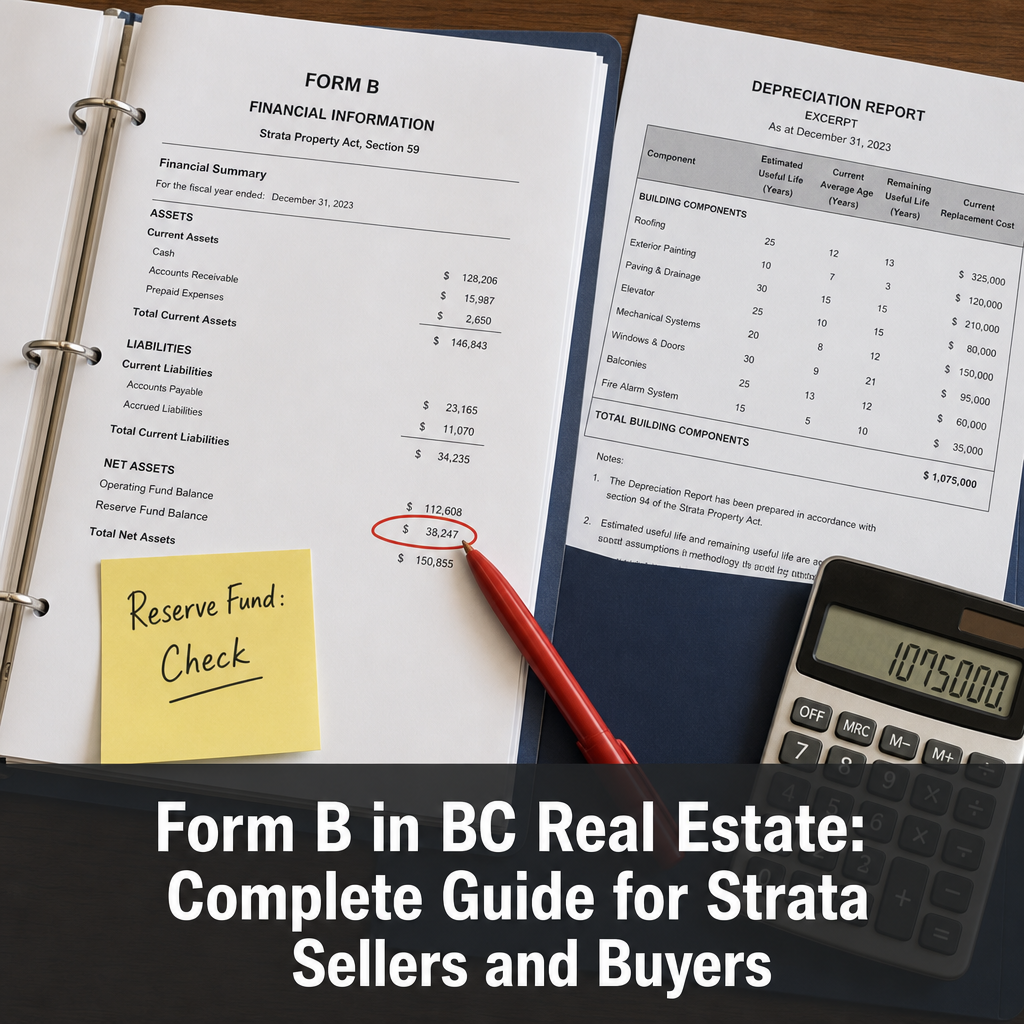

Form B Disclosure in BC Real Estate: Complete Guide to the Information Certificate, Reserve Fund Adequacy, Special Levy Risk, and What Strata Sellers and Buyers Actually Need to Know
By Mohamed Mansour, MBA and Associate Broker | Mansour Real Estate Group | Published: July 14, 2025 | Fraser Valley and Lower Mainland, BC
If you are selling a strata property in the Fraser Valley — a condo in Surrey, a townhome in Langley or Willoughby, a unit in Abbotsford or Cloverdale — Form B is one of the most consequential documents in your transaction. Most sellers know it exists. Far fewer understand what it actually discloses, how buyers and lenders read it, and why specific entries inside it can trigger financing denial, appraisal reductions, or price renegotiation before subjects are removed.
This guide explains Form B from the ground up: what it contains, how it affects buyer decisions, what lenders look for, and what strata sellers in the Fraser Valley should understand before they list.
Short Answer
Form B (Information Certificate) is a mandatory document under BC's Strata Property Act that discloses a strata corporation's financial health, reserve fund balance, special levies, and bylaw restrictions to buyers before purchase. It must be provided within three days of offer acceptance. Its contents directly affect buyer financing approvals, lender conditions, and appraisal outcomes — particularly in Fraser Valley markets where strata inventory is elevated and buyers and their lenders have more time to scrutinize strata documents carefully.
Who This Applies To
- Owners selling a condo, townhome, or strata lot in BC
- Buyers reviewing strata documents during a subject-removal period
- Sellers in buildings with older systems, thin reserve funds, or recent strata disputes
- Investors selling strata units with rental restrictions or bylaw complications
- Executors or estate representatives selling a strata property on behalf of a deceased owner
When This Advice May Not Apply
This guide focuses on standard residential strata sales in BC. Bare land strata, leasehold strata, and complex commercial-residential mixed-use situations may involve additional disclosures. Consult your real estate agent and a strata lawyer for situations involving strata wind-up, significant litigation, or unique governance structures.
Key Takeaways
- Form B must be delivered within three days of offer acceptance under the Strata Property Act; delay can give buyers exit rights.
- Reserve fund balances below 30% funded trigger lender conditions and appraisal reductions in many Fraser Valley strata transactions.
- Special levy announcements within six months of a sale can reduce buyer financing approvals by 15–25% according to current lender policy reviews.
- Bylaw restrictions on rentals, pets, and unit use directly reduce the buyer pool and affect resale value at the time of listing.
- Sellers who review their building's Form B before listing can price accurately, avoid surprise renegotiations, and close faster.
Data Used in This Article
- BC Strata Property Act, Sections 96–103 — legislation — official provincial source
- Real Estate Council of BC (RECBC) — Form B disclosure standards — official regulatory source
- CMHC Strata Lending Guidelines, 2026 — lender policy — official CMHC publication
- Fraser Valley Real Estate Board (FVREB) — strata transaction and sales-to-active data, 2024–2026 — official board reports
- RBC and TD Bank strata lending policy updates, 2025–2026 — lender policy documentation
What Is Form B?
Form B is the Information Certificate required under Sections 96 through 103 of BC's Strata Property Act. The strata corporation issues it, not the seller. It is a factual snapshot of the strata's financial position, governance status, and legal obligations at the time of sale.
Form B typically includes the current reserve fund balance, the most recent financial statements, the depreciation report (or a statement explaining why one is absent), any outstanding special levies, monthly strata fees for the unit, confirmed bylaws and rules, any ongoing legal proceedings involving the strata, and any amounts the owner owes to the strata corporation. When buyers in Langley, Surrey, or Abbotsford receive a Form B and accompanying strata documents, this package is what they and their lenders review before committing to the purchase. For a broader look at how strata documentation affects condo transactions across the region, see our guide to selling a condo in the Fraser Valley.
Timeline: When Form B Must Be Delivered
Under the Strata Property Act, the strata corporation must provide Form B within eight days of a written request. In a live transaction, the accepted practice is that the seller's agent requests Form B immediately upon offer acceptance, with a target delivery of three days to keep the subject-removal timeline intact. If Form B is not delivered within five days of the offer's acceptance, BC's regulations give buyers the right to rescind the contract — a risk no seller wants to carry when a deal is already in motion.
Strata councils in some older buildings in Cloverdale, North Delta, and parts of Abbotsford can be slow to respond to certificate requests, particularly when the property manager is handling multiple concurrent requests. Sellers who request Form B before listing — rather than waiting for an offer — avoid this delay entirely and can answer buyer questions from day one. This proactive step also signals building transparency, which matters in a buyer's market where financing conditions are strictly scrutinized.
Reserve Fund Adequacy: What the Numbers Mean
The reserve fund is the strata corporation's savings account for major repairs — roofs, parkades, elevators, plumbing, heating systems, and building envelopes. A well-funded reserve reduces the need for special levies and signals that the strata has been managed responsibly over time.
Industry guidance, including CMHC's strata lending framework, treats a reserve fund funded below 30% of its recommended balance as a risk flag. Lenders — including RBC and TD Bank, based on their 2025–2026 strata lending policy updates — may apply additional conditions, request updated depreciation reports, or reduce the mortgage amount they are willing to advance on a unit in a severely underfunded building. When the reserve fund sits below 20% of recommended balance, appraisers working in the Fraser Valley have applied value adjustments of 5–15% in transactions where the depreciation report signals near-term major repairs. For sellers, this means the unit may appraise below the accepted offer price — triggering either a price renegotiation or a collapsed deal. Our article on depreciation reports in BC strata sales explains how appraisers read those findings in detail.
Special Levies: Timing, Disclosure, and Financing Impact
A special levy is a one-time charge assessed against all strata owners to fund a major repair or capital project the reserve fund cannot cover. Form B discloses any approved or pending special levies at the time of the certificate's issuance.
The financing complication is significant. If a special levy has been announced within six months of a sale, lenders now routinely request documentation on the owner's financial capacity to cover that obligation. Based on current lending policy reviews from major Canadian banks, special levy exposure can reduce buyer financing approval by 15–25% and extend closing timelines by two to four weeks as lenders complete their strata financial review. For sellers in Willoughby townhome complexes or Guildford condo buildings where major envelope or mechanical work is upcoming, this timeline extension and potential price reduction is not hypothetical — it is a documented pattern in 2025–2026 Fraser Valley strata closings.
Sellers who are aware of an upcoming special levy before listing have a choice: price the unit to reflect that obligation, disclose it transparently and negotiate a clean deal, or time the listing relative to the levy approval date. Each path has trade-offs. What does not work is leaving a buyer to discover a pending levy through Form B mid-transaction — that scenario almost always produces a renegotiation or subject removal. This dynamic is particularly relevant for sellers of townhomes in Langley and similar Fraser Valley markets where strata aging and deferred maintenance are increasingly common.
Bylaw Restrictions That Affect Your Sale
Form B includes the strata's bylaws and rules. For sellers, the most commercially significant bylaws involve rental restrictions, pet policies, age restrictions, and limitations on unit alterations. A building that prohibits rentals or limits rentals to a percentage of total units immediately removes investor buyers from the pool. A strict no-pets bylaw eliminates a substantial portion of owner-occupier buyers in many Fraser Valley communities. These restrictions are real — and they are visible to every buyer who reads the Form B package.
Since BC's legislative changes in 2022 removed the ability of stratas to prohibit rentals outright for most properties, older buildings that voted to retain restrictions under grandfather provisions, or buildings with remaining age-based restrictions under Section 123 of the Strata Property Act, may still carry bylaw limitations that affect marketability. Sellers should confirm their building's current bylaw status before pricing — restrictions that reduce the buyer pool should be factored into the list price, not treated as a surprise after offers come in.
Definitions
Form B (Information Certificate): The mandatory disclosure document issued by a BC strata corporation that summarizes the strata's financial position, reserve fund, special levies, bylaws, and legal proceedings at the time of sale.
Reserve Fund: The strata's savings account for long-term capital repairs and replacements, funded by monthly contributions from all owners.
Depreciation Report: A mandatory third-party engineering assessment of the strata's physical components, repair timelines, and recommended reserve fund contributions over a 30-year horizon.
Special Levy: A one-time assessment charged to strata owners to fund a capital repair that the reserve fund cannot fully cover.
Subject Removal: The point in a BC real estate transaction when a buyer formally removes their conditions (subjects), making the contract unconditional and binding.
How We Evaluate This
When Mansour Real Estate Group prepares a strata property for market in Surrey, Langley, Abbotsford, or elsewhere in the Fraser Valley, our pre-listing process includes a review of the building's Form B package before setting the list price. We look at the reserve fund balance relative to the depreciation report's recommended funding level, any outstanding or pending special levies, and bylaw restrictions that would narrow the buyer pool. We use that review to set a realistic price — one that reflects the building's financial health honestly — and to prepare the seller for questions that buyers and their lenders will raise.
In a buyer's market, where Fraser Valley strata sales-to-active ratios in the townhome segment are running between 15% and 23% (according to FVREB transaction data, 2025–2026), Form B red flags do not quietly disappear. They surface during subject-removal periods and they produce one of three outcomes: a renegotiated price, a collapsed deal, or an extended closing timeline. Pre-listing Form B review is the most reliable way to avoid all three.
Strata Seller Checklist
- Request Form B from your strata corporation or property manager before listing — do not wait for an offer.
- Review the reserve fund balance against the depreciation report's recommended funding level.
- Confirm whether any special levies have been approved, announced, or are anticipated in the next 12 months.
- Read the bylaws for rental restrictions, pet policies, age restrictions, and alteration approvals.
- Check whether the strata has a current depreciation report — buildings without one are a lender flag.
- Confirm your outstanding strata fees and any amounts owed to the strata corporation; these appear on Form B and are visible to buyers.
- Ask your real estate agent to walk through Form B findings with you before pricing the unit.
- Factor bylaw restrictions and reserve fund status into your list price — buyers and their lenders will.
What We Commonly See
In our experience working with strata sellers across the Fraser Valley, the most common problem is not that Form B contains bad news — it is that sellers are surprised by it mid-transaction when the buyer has already read it.
What often happens in older Cloverdale and Guildford condo buildings is that a seller prices confidently based on comparable sales, accepts an offer, and then receives a Form B that shows a reserve fund at 18% of recommended balance with a depreciation report flagging roof replacement within two years. The buyer's lender conditions on a new appraisal. The appraisal comes in $25,000 to $40,000 below the offer price. The deal either renegotiates downward or falls apart. This sequence is avoidable — but only if the seller has read their own Form B before listing.
A common mistake among sellers of units in buildings with rental restrictions is assuming those restrictions do not matter if they are selling to an owner-occupier. They do matter — because every investor who would otherwise compete for the unit is already out of the market, and owner-occupier buyers know it, which affects how aggressively they negotiate.
Questions and Answers
Q: Can a seller refuse to provide Form B to a buyer?
No. Under BC's Strata Property Act, the strata corporation is legally obligated to issue Form B upon request. A seller cannot withhold it, and a transaction cannot legally close without it. Failure to deliver within the required window can give buyers the right to rescind the contract.
Q: What happens if the strata does not have a current depreciation report?
Form B must disclose whether a depreciation report exists. Buildings without a current report — particularly those exempt by owner vote under older BC regulations — are treated as higher risk by lenders. CMHC and major banks may apply stricter lending conditions or decline to insure mortgages on units in buildings without current reports. This is an increasingly significant issue in some older Fraser Valley strata buildings.
Q: Does a pending special levy have to be disclosed even if the strata has not formally approved it?
Form B discloses approved special levies. However, sellers in BC also have a general duty of disclosure for material latent defects. If you are aware that a special general meeting to approve a levy has been called, that information is material and should be disclosed. Consult your real estate agent and a real estate lawyer regarding your specific obligations.
Q: Can the reserve fund balance on Form B change between offer and completion?
Yes. Form B is a snapshot of the strata's financial position on the date the certificate is issued. Monthly contributions continue, and major disbursements may occur between Form B issuance and the completion date. For long completion timelines, buyers may request an updated Form B before final closing. This is particularly relevant in Abbotsford and Langley strata buildings undergoing active repair work.
Q: Do bylaw restrictions on Form B affect what a buyer can do with the unit after purchase?
Yes, directly. Bylaw restrictions disclosed in Form B are legally binding on the buyer once they take ownership. A buyer who ignores a no-rental bylaw and attempts to rent the unit anyway is in violation of strata rules and subject to fines and enforcement proceedings. Buyers should read all bylaws in the Form B package before removing subjects — and sellers should expect that buyers and their agents will.
In Summary
Form B is not a formality — it is a financial and legal disclosure that buyers, lenders, and appraisers use to make consequential decisions. For strata sellers in the Fraser Valley, understanding what is inside Form B before listing is the single most reliable way to price accurately, avoid mid-transaction renegotiations, and close with confidence. Reserve fund adequacy, special levy timing, and bylaw restrictions are the three areas that most directly affect financing outcomes in the current market. Reviewing your building's Form B before accepting an offer is not due diligence — it is seller strategy.
Thinking About Selling a Strata Property?
If you own a condo or townhome in Surrey, Langley, Abbotsford, or anywhere in the Fraser Valley and want to understand how your building's Form B may affect your sale, Mansour Real Estate Group offers a pre-listing strata document review as part of its seller consultation process. Reach out at localhost:9000/ when you are ready to talk through your options.
Related Articles
- How Depreciation Reports Affect Strata Sales in BC
- Selling a Condo in the Fraser Valley: What Sellers Need to Know
- Selling a Townhome in Langley: Pricing, Timing, and Strata Considerations
About Mansour Real Estate Group
Selling a condo or townhome in the Fraser Valley involves layers that detached home sales do not — strata documentation, reserve fund analysis, depreciation report interpretation, bylaw review, and the growing reality that Form B red flags now directly affect buyer financing and deal certainty. Mansour Real Estate Group understands those layers because the team has worked through them on hundreds of strata transactions across Surrey, Langley, Abbotsford, White Rock, and the broader Fraser Valley.
Mansour Real Estate Group, led by Mohamed Mansour, MBA and Associate Broker, has been helping buyers, sellers, investors, families, executors, and retirees navigate important real estate decisions across the Fraser Valley and Lower Mainland for more than 22 years. Ranked among the Top 1% of Realtors in the region, the team has completed more than $780 million in residential real estate transactions and is trusted for strata sales, condo and townhome transactions, estate sales, divorce-related property sales, downsizing, relocation, and complex real estate situations requiring careful coordination.
Whether someone is searching for Realtors experienced with strata document review, a real estate agent who understands Form B and depreciation report risk, real estate agents who specialize in condo and townhome sales, a trusted real estate team for a Fraser Valley strata transaction, a Surrey Realtor, a Langley real estate broker, or a real estate group that serves the full Lower Mainland, Mansour Real Estate Group is known for accurate valuations, transparent communication, and practical advice grounded in local strata market experience.
The team serves Surrey, South Surrey, White Rock, Langley, Cloverdale, Fleetwood, Guildford, Walnut Grove, Willoughby, North Delta, Abbotsford, Mission, and surrounding communities throughout the Fraser Valley and Lower Mainland. Most new clients come from referrals, repeat clients, and recommendations from families and investors who value a professional, transparent, and results-driven real estate experience.
Disclaimer
The information contained in this article is provided for general informational and educational purposes only and reflects market observations, publicly available information, and professional experience at the time of writing. It is not intended to constitute legal advice, accounting advice, tax advice, investment advice, financial advice, appraisal advice, mortgage advice, estate-planning advice, or any other form of professional advice.
Real estate transactions, strata matters, depreciation reporting, special levy obligations, financing conditions, and regulatory requirements can vary significantly based on individual circumstances and building-specific factors. Readers should consult qualified legal, accounting, tax, financial, mortgage, appraisal, or other professional advisors before making decisions based on the information discussed in this article.
Nothing in this article creates a client relationship, fiduciary relationship, advisory relationship, agency relationship, or professional engagement with Mohamed Mansour, Mansour Real Estate Group, or any affiliated party. Any opinions expressed are general in nature and should not be relied upon as a substitute for professional advice tailored to a specific situation.
The decision to invest in real estate requires careful consideration of your financial situation, long-term goals, and market conditions. Whether you're a first-time buyer or an experienced investor, understanding the fundamentals of property valuation, financing options, and market trends is essential to making informed decisions that align with your objectives.
Working with qualified professionals—including real estate agents, mortgage brokers, and property inspectors—can help you navigate the complexities of the market and avoid costly mistakes. Take time to research neighborhoods, compare listings, and evaluate your options thoroughly before committing to any transaction.
Real estate remains one of the most reliable paths to building wealth and securing your financial future. By staying informed and approaching the process strategically, you can find properties that not only meet your needs but also provide lasting value for years to come.



