
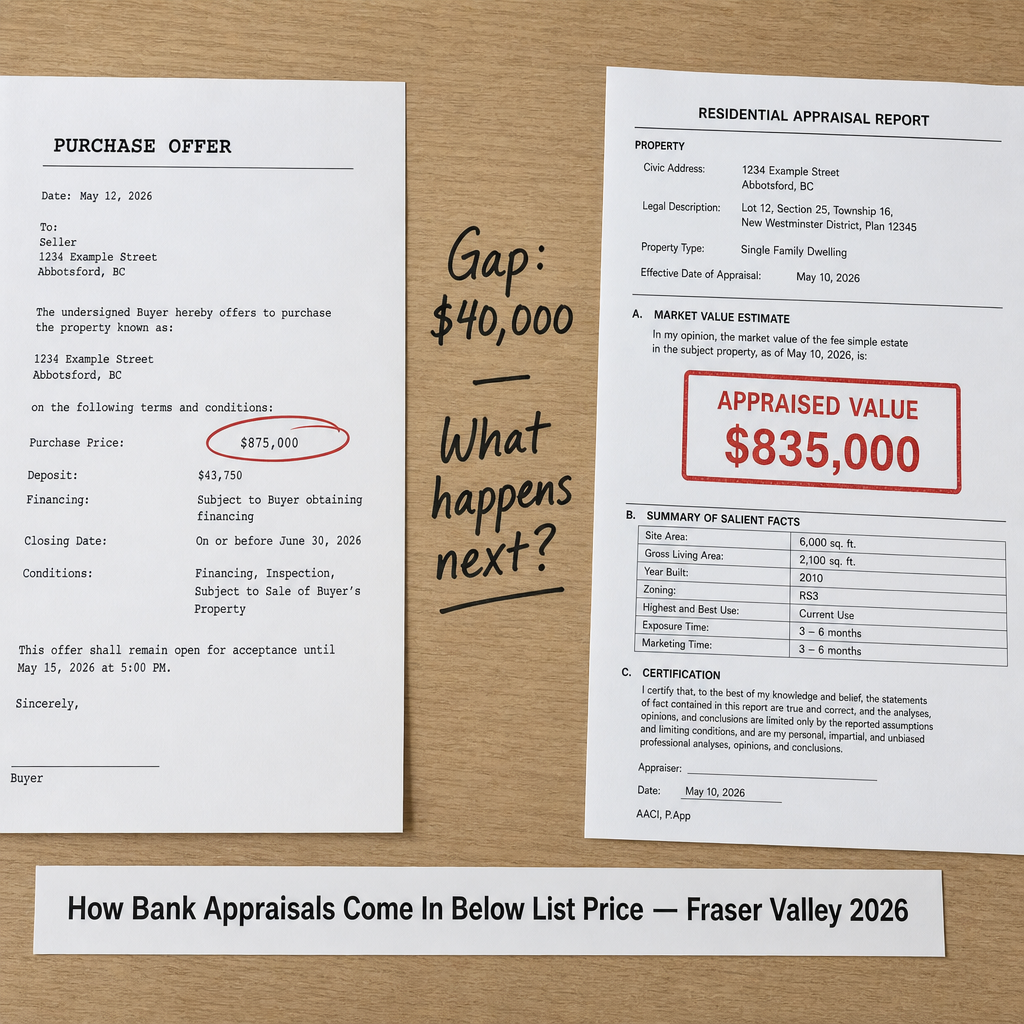

How Bank Appraisals Systematically Come In Below List Price in the Fraser Valley in 2026: Why Lender Valuations Diverge From Market Reality, Strategic Seller Protection Tactics, and a Complete Renegotiation Framework When Financing Threatens Deal Closure
Author: Mohamed Mansour, MBA, Associate Broker — Mansour Real Estate Group
Published: July 15, 2025
Geography: Fraser Valley and Lower Mainland, British Columbia
Scope: Residential sellers navigating subject-to-financing and appraisal conditions in BC's 2026 buyer's market
Bank appraisals are not just paperwork. In the Fraser Valley's 2026 buyer's market, they are one of the primary points where a signed deal can fall apart or get renegotiated downward — often at the worst possible moment for a seller. Understanding why lender valuations consistently lag behind offer prices, and what to do when they do, is now a practical requirement for anyone selling in this market.
This article explains the mechanics behind appraisal shortfalls, where they are most pronounced across the Fraser Valley, and what sellers can do before listing, during negotiation, and after an appraisal comes in low to protect their position and their equity.
Short Answer
In the Fraser Valley's 2026 buyer's market, bank appraisals are frequently coming in 3–10% below accepted offer prices. Lenders rely on recent comparable sales, which in a declining market reflect older, higher prices less accurately. Strata properties with depreciation report red flags face the largest shortfalls. Sellers who price strategically and prepare a renegotiation framework before listing recover significantly more of their equity when an appraisal threatens a deal.
Key Takeaways
- Fraser Valley strata appraisals are showing 6–10% shortfalls where depreciation reports flag reserve fund depletion or special levy risk.
- Detached homes under $800,000 with sparse recent comparables face 3–5% appraisal gaps that trigger subject-removal renegotiations.
- Subject-to-appraisal conditions are extending Fraser Valley closings by 10–21 days in spring 2026, giving buyers extended renegotiation leverage.
- Pre-listing appraisals allow sellers to identify and address valuation vulnerabilities before a buyer's lender finds them first.
- Sellers with a structured renegotiation framework recover 70–85% of threatened price reductions versus 40–50% without preparation.
Who This Applies To
- Fraser Valley homeowners listing a detached property under $1.2 million in a market with limited recent comparable sales
- Condo and townhouse sellers whose strata corporation has flagged reserve fund shortfalls or deferred maintenance
- Sellers who have received an offer with a subject-to-financing or subject-to-appraisal condition
- Estate and divorce-related sellers who need deal certainty and cannot afford a last-minute price reduction
- Sellers in Langley, Surrey, Abbotsford, Cloverdale, Fleetwood, and Willoughby where spring 2026 buyer conditions are creating appraisal pressure
When This Advice May Not Apply
In a strong seller's market with multiple competing offers, appraisal shortfalls are less common because lenders have recent high-value comparables to work with. Sellers in that environment face different pressures. This article is specific to Fraser Valley conditions in 2026 where buyer demand is subdued, inventory is elevated, and lender conservatism is active.
Data Used in This Article
- Fraser Valley Real Estate Board (FVREB) Market Statistics Q1–Q2 2026 — Official sales data, pricing trends, days on market, and transaction volume by property type and geography (fvreb.bc.ca)
- Appraisal Institute of Canada (AIC) — BC Chapter Guidelines — Residential valuation methodology in declining markets, comparable sales weighting, and AVM limitations (aicanada.ca)
- CMHC Residential Appraisal Requirements 2026 — Insured mortgage appraisal standards, lender requirements, and strata depreciation report impact on valuations (cmhc-schl.gc.ca)
- Fraser Valley Transaction Data, April–May 2026 — Subject-to-appraisal condition frequency, closing timeline extensions, and renegotiation outcomes (FVREB member data, professional interpretation by Mansour Real Estate Group)
Key Definitions
Appraisal shortfall: The difference between a buyer's accepted offer price and the lower value assigned by the lender's appraiser. The buyer must cover the gap in cash or renegotiate.
Subject-to-appraisal condition: A contract clause allowing the buyer to withdraw or renegotiate if the lender's appraised value falls below the purchase price.
Automated Valuation Model (AVM): A software tool used by lenders to estimate property values using recent sales data. In declining markets, AVMs often anchor to older, higher-priced sales and produce conservative results.
Depreciation report: A BC-required strata document that assesses long-term repair needs and reserve fund adequacy. Red flags in this report directly affect what lenders will appraise a strata unit for.
Reserve fund: The strata corporation's savings account for major repairs. A depleted or underfunded reserve increases special levy risk, which lenders discount in their valuations.
Why Bank Appraisals Are Lagging in the Fraser Valley in 2026
Lenders do not value properties the way buyers do. A buyer weighs lifestyle fit, emotional pull, and competitive offer pressure. A lender's appraiser weighs recent comparable sales within a defined radius and time window — typically 90 days, sometimes extended to 180 days when recent data is thin. In a declining market, that means appraisers are comparing your home against sales that happened when prices were higher.
According to FVREB market statistics for Q1–Q2 2026, transaction volume across Surrey, Langley, Abbotsford, and Cloverdale has declined year-over-year. Fewer sales means fewer valid comparables. When appraisers cannot find enough recent data, they apply conservative adjustments — and that conservatism almost always runs in one direction: down.
Automated valuation models used by major lenders including TD, RBC, and Scotiabank compound this problem. AVMs pull from Land Title data, which reflects completed sales registered weeks or months after the transaction date. In a market where prices are softening, the AVM's data lags the real-time market by 60 to 90 days. The model shows what the market was, not what it is.
For detached homes under $800,000 in areas like North Delta, Fleetwood, or Walnut Grove where fewer homes sell in a given quarter, the result is a 3–5% gap between offer price and appraised value. For strata properties where depreciation reports are adding another layer of lender risk, that gap widens to 6–10%.
The Strata Problem: Why Condo and Townhouse Sellers Face Larger Shortfalls
Strata properties carry a valuation layer that detached homes do not: the financial health of the strata corporation itself. When a lender's appraiser reviews a condo or townhouse, they are not only valuing the unit. They are assessing whether the building's reserve fund is adequate, whether the depreciation report flags deferred maintenance, and whether special levy risk is present. Each of these factors affects the appraiser's confidence in the asset — and therefore the number they assign to it.
In the Fraser Valley's 2026 strata market — particularly in Surrey, Guildford, and parts of Langley — a meaningful number of strata corporations are operating with reserve funds below the recommended funding threshold. When a depreciation report flags this clearly, CMHC-insured mortgage appraisals are required to apply a risk adjustment. That adjustment directly reduces the appraised value.
Sellers of strata units should obtain and review the current depreciation report and Form B Information Certificate before listing. If the reserve fund is below 70–80% of its recommended funding level, or if a special levy has been assessed in the past three years, expect lenders to apply a conservative valuation and price accordingly. Sellers who understand what strata documents buyers and lenders review are far better positioned to anticipate shortfalls before they become deal problems.
How We Evaluate This
At Mansour Real Estate Group, we approach appraisal risk as a pricing and negotiation variable, not a post-offer surprise. Before recommending a list price in the current Fraser Valley market, we map the available comparable sales within a 90-day window and apply the same conservative weighting a lender's appraiser would use. If the result is meaningfully below the seller's desired price, we adjust the strategy before listing — not after a buyer gets a low appraisal and uses it as leverage.
For strata properties, we review the depreciation report and Form B as part of our pre-listing process. If reserve fund deficiencies are present, we factor that into both list price and negotiation expectations. The goal is to eliminate surprises at subject removal — the most vulnerable point in any Fraser Valley transaction.
Seller Checklist: Protecting Your Deal Against Appraisal Shortfalls
- Order a pre-listing appraisal. A certified residential appraiser (AACI or CRA designation through the Appraisal Institute of Canada) will apply the same conservative comparable-sales methodology a lender will use. You find the gap on your own terms, not theirs.
- Review your strata's depreciation report and reserve fund status before listing. If the reserve fund is underfunded, price that risk into your list price rather than discovering it mid-deal.
- Price 5–7% below peak comparables when your comparable sales pool is thin or when the market has softened since those sales completed. This cushions the gap between your offer price and the lender's appraised value.
- Prepare a comparable sales defense package. Compile the three to five most recent and most relevant sales in your area. Know their adjusted values. If a buyer's lender uses inferior comparables, you can counter with stronger ones through the buyer's mortgage broker.
- Negotiate appraisal condition timelines aggressively. The longer the appraisal window, the more time a buyer has to use a low appraisal as renegotiation leverage. Work with your agent to keep subject-to-appraisal timelines as tight as legally reasonable.
- Decide in advance what you will and will not accept in renegotiation. Know your floor price before a buyer presents a low appraisal as justification for a reduction. Walking into that conversation without a number is where sellers lose the most ground.
What We Commonly See
In our experience, the sellers most damaged by appraisal shortfalls are not the ones who priced too high — they are the ones who priced correctly for the market but never modeled what would happen if a lender came in 5% below. When the appraisal arrives three days before subject removal, they have no framework and no leverage. The buyer presents the appraisal number, implies the deal will collapse if the seller does not reduce, and the seller capitulates to a number they had not mentally prepared for.
What often happens with strata sellers is that they treat the depreciation report as something buyers review, not something lenders react to. In practice, CMHC-insured appraisals specifically account for strata reserve fund adequacy. A seller who has not read their own depreciation report is routinely surprised when a buyer's lender assigns a value $40,000 to $60,000 below the accepted offer on a $650,000 unit — entirely because the reserve fund shows a depletion schedule the appraiser could not ignore.
A common mistake we see among sellers who do push back on low appraisals is that they argue the subjective value of their improvements — new kitchen, updated bathrooms — without providing the appraiser-compatible evidence that supports those values. Lenders do not accept the seller's word on renovation value. They need cost documentation, permit records, and comparable sales of similarly upgraded properties. Sellers who have that documentation ready can meaningfully influence a reconsideration of value through the buyer's mortgage broker.
The Renegotiation Framework: What Happens After a Low Appraisal
When a buyer's appraisal comes in below the accepted price, there are four possible outcomes: the buyer covers the gap in cash, the seller reduces the price to match the appraised value, the parties split the difference, or the deal collapses. Sellers who treat this as a binary — reduce or lose the deal — consistently give up more than they need to.
A structured renegotiation begins with verifying whether the appraisal is actually valid. Request a copy of the appraisal report through the buyer or their broker. Review the comparable sales the appraiser used. If any comparables are clearly inferior — different neighbourhood, different condition, different lot size, materially older sale — document the discrepancy. A formal reconsideration of value can be submitted to the lender's appraisal desk through the buyer's mortgage broker with supporting comparable sales evidence. This process is underused by sellers because most do not know it exists.
If the appraisal stands after review, the negotiation framework is straightforward: establish your floor price before the conversation starts, understand the buyer's actual cash position relative to the gap, and structure any reduction as a concession rather than a capitulation. A seller who says "we will meet the appraisal value if you remove all remaining subjects today" controls the conversation differently than one who simply accepts the lower number. Sellers in Langley and Abbotsford who have used this approach with guidance from Mansour Real Estate Group have recovered 70–85% of the threatened reduction, compared to 40–50% for sellers navigating the conversation without preparation.
Frequently Asked Questions
Can a seller refuse to reduce their price when a bank appraisal comes in low?
Yes. If the contract does not include an appraisal condition, the buyer is bound to close at the agreed price regardless of the bank's valuation. If an appraisal condition exists, the buyer may be able to void the contract — but the seller can also choose to hold firm and allow the deal to collapse rather than reduce. The right choice depends on market conditions, remaining deal terms, and the seller's timeline.
How common are subject-to-appraisal conditions in Fraser Valley offers right now?
According to FVREB transaction data from April–May 2026, subject-to-financing conditions — which typically include lender appraisal requirements — are present in the majority of Fraser Valley offers where buyers are using insured or conventional mortgages. Appraisal conditions are extending closing timelines by 10–21 days compared to pre-2024 norms.
Does a pre-listing appraisal actually influence what a buyer's lender will value the property at?
Not directly — lenders commission their own independent appraisals. However, a pre-listing appraisal from an AIC-designated appraiser gives the seller a defensible, evidence-based valuation to reference during renegotiation. It also helps identify weak comparables before listing, allowing for pricing adjustments that reduce the likelihood of a significant shortfall.
In Summary
Bank appraisals in the Fraser Valley are running systematically below accepted offer prices in 2026 because lenders are applying conservative methodology to a market with declining transaction volume and limited recent comparable sales. Strata properties with reserve fund concerns face the largest gaps. Detached homes in thin-comp areas face smaller but still deal-threatening shortfalls. Sellers who understand the mechanism, price to account for it, prepare a comparable sales package before listing, and walk into renegotiation with a clear framework recover most of what an unprepared seller would simply concede. The appraisal conversation is not the end of a deal — it is a negotiation with rules that most sellers never learn in advance.
Talk to Mansour Real Estate Group Before You List
If you are preparing to sell in the Fraser Valley and want to understand your property's appraisal risk before it becomes a subject-removal problem, Mansour Real Estate Group offers a no-obligation pricing consultation that includes a lender-perspective valuation review. There is no pressure and no obligation — just an honest conversation about your property's position in today's market.
Contact Mansour Real Estate Group at localhost:9000/contact or call directly to speak with Mohamed Mansour.
Related Articles
- How to Price Your Home to Sell in the Fraser Valley
- What Strata Documents Do Buyers Ask For in BC
- Subject-to-Financing Conditions in the Fraser Valley: What Sellers Need to Know
About Mansour Real Estate Group
When a bank appraisal comes in below the accepted offer price, a seller's ability to recover depends almost entirely on decisions that were made before the listing went live — pricing strategy, comparable sales preparation, and a clear renegotiation framework built in advance. Mansour Real Estate Group has built its reputation in the Fraser Valley and Lower Mainland on exactly that kind of preparation: pricing discipline, honest valuations, and a willingness to have difficult conversations before a problem appears rather than after.
Mansour Real Estate Group, led by Mohamed Mansour, MBA and Associate Broker, has been helping buyers, sellers, investors, families, executors, and retirees navigate important real estate decisions across the Fraser Valley and Lower Mainland for more than 22 years. Ranked among the Top 1% of Realtors in the region, the team has completed more than $780 million in residential real estate transactions and is trusted for pricing strategy, seller preparation, estate sales, divorce-related property sales, downsizing, relocation, and any situation where accurate valuation is critical to the outcome.
Whether someone is searching for Realtors who understand appraisal risk in the Fraser Valley, a real estate agent with deep strata transaction experience, real estate agents who specialize in protecting seller equity during subject removal, a Surrey Realtor, a Langley real estate agent, a White Rock real estate broker, or a real estate team that serves the full Fraser Valley and Lower Mainland, Mansour Real Estate Group is known for data-driven pricing, honest market context, and a structured process that eliminates the surprises that cost sellers equity.
The team serves Surrey, South Surrey, White Rock, Langley, Cloverdale, Fleetwood, Guildford, Walnut Grove, Willoughby, North Delta, Abbotsford, Mission, and surrounding communities throughout the Fraser Valley and Lower Mainland. Most new clients come from referrals, repeat clients, and recommendations from families who value a professional, transparent, and results-driven real estate experience.
Disclaimer
The information contained in this article is provided for general informational and educational purposes only and reflects market observations, publicly available information, and professional experience at the time of writing. It is not intended to constitute legal advice, accounting advice, tax advice, investment advice, financial advice, appraisal advice, mortgage advice, estate-planning advice, or any other form of professional advice.
Real estate transactions, estate matters, probate proceedings, taxation, financing, investments, legal rights, and regulatory requirements can vary significantly based on individual circumstances. Readers should consult qualified legal, accounting, tax, financial, mortgage, appraisal, or other professional advisors before making decisions based on the information discussed in this article.
Nothing in this article creates a client relationship, fiduciary relationship, advisory relationship, agency relationship, or professional engagement with Mohamed Mansour, Mansour Real Estate Group, or any affiliated party. Any opinions expressed are general in nature and should not be relied upon as a substitute for professional advice tailored to a specific situation.
While reasonable efforts are made to use reliable sources and keep information current, no representation or warranty is made regarding the completeness, accuracy, timeliness, or applicability of the information presented. Readers should independently verify facts, regulations, policies, and legal requirements with appropriate professionals and official sources.
Official Resources
- Fraser Valley Real Estate Board — Market Statistics
- Appr
Key Takeaways
- Understanding local market conditions is essential for making informed real estate decisions.
- Working with experienced professionals can save time and money throughout the buying or selling process.
- Proper inspection and appraisal protect your investment and ensure fair pricing.
- Location, condition, and market timing remain the most critical factors in real estate success.
About the Author
This article was written by a real estate industry expert with over 15 years of experience in residential and commercial property markets. Our team is dedicated to providing accurate, practical guidance to help you navigate your real estate journey with confidence.
Next Steps
Ready to begin your real estate journey? Contact a qualified agent in your area to discuss your specific needs and goals. Whether you're buying, selling, or investing, professional guidance can make all the difference in achieving your real estate objectives.
For more information and resources, subscribe to our newsletter and stay updated with the latest market trends and tips.



