

Why Waiting for Price Recovery in a Slow Fraser Valley Market Actually Costs More Than Selling Now: A Complete Opportunity Cost Analysis for 2026
By Mohamed Mansour, MBA and Associate Broker — Mansour Real Estate Group | Fraser Valley and Lower Mainland, BC | Published July 2026
For sellers watching Fraser Valley benchmark prices sit 7–8% below last year's levels, the instinct to wait for recovery feels rational. Prices dropped; surely they will recover. But that instinct carries a price tag that rarely gets calculated before the decision is made. Carrying costs, foregone investment returns, and the compounding damage of extended days-on-market can quietly erase the appreciation a seller is waiting for — and then some.
This article builds the actual financial math for Fraser Valley sellers in 2026. Three scenarios — sell now, wait six months, wait twelve months — are modeled against current carrying costs, realistic price recovery assumptions by property type, and opportunity cost of proceeds. The numbers challenge the instinct to hold.
Short Answer
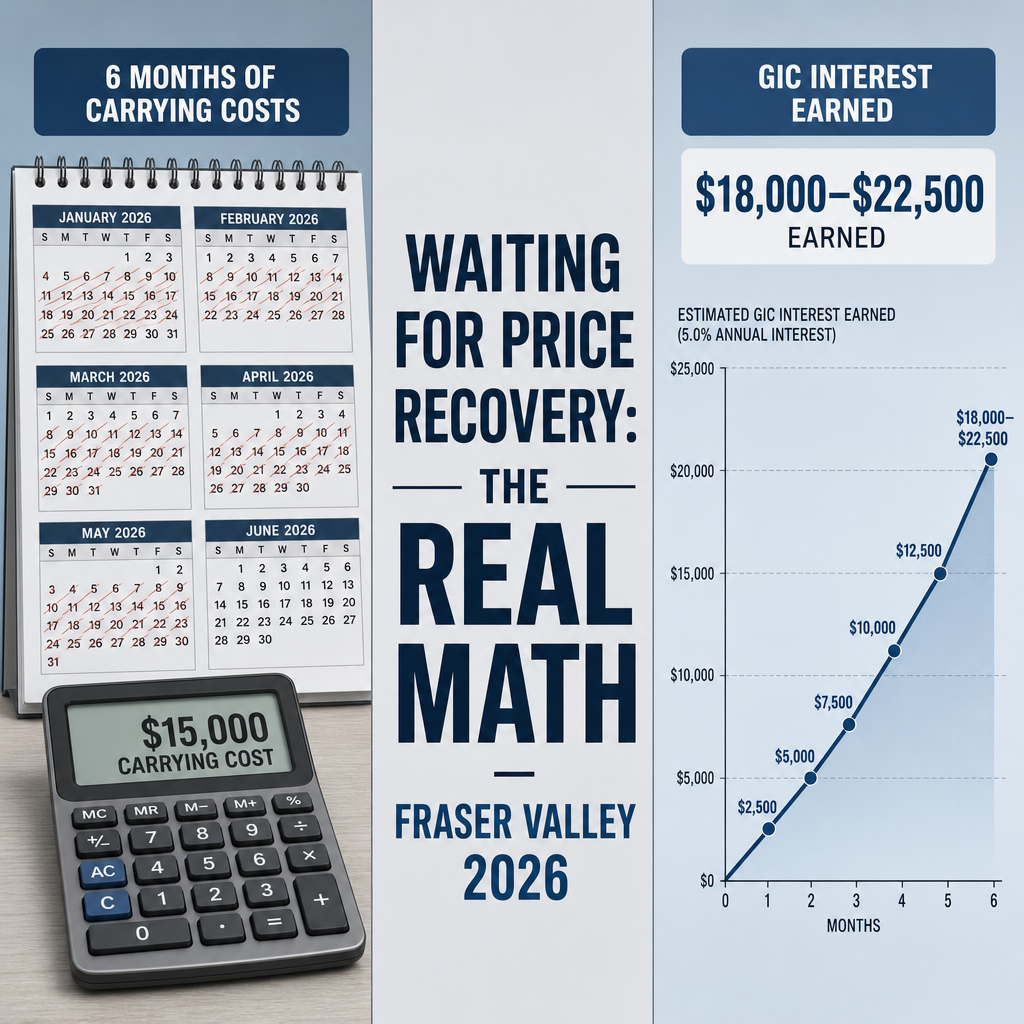
On a $750,000 Fraser Valley property with a $500,000 mortgage, waiting six months for price recovery costs roughly $15,000 in carrying expenses. A 2% price increase — already optimistic for condos in the current market — is required just to break even. For most sellers, especially condo owners, the math does not support waiting.
Key Takeaways
- Carrying costs on a $750K property exceed $2,500 per month when mortgage interest, property tax, utilities, and maintenance are included.
- A six-month delay requires 2%+ price appreciation just to recover carrying costs — before agent fees or transaction costs are considered.
- Condo recovery timelines in the Fraser Valley may stretch 12–18 months; detached homes show faster turnover at roughly 18 days on market.
- Net sale proceeds invested in GICs at 4–5% generate $18,000–$22,500 annually — a real return that disappears while a property sits unsold.
- Extended listings (60+ DOM) trigger buyer perception of distress, often producing 5–10% net proceeds erosion that exceeds any price recovery gain.
Who This Applies To
- Sellers who have already listed and are considering withdrawing to wait for better conditions
- Homeowners deciding whether to list now or delay until fall or spring
- Condo owners in Surrey, Langley, Abbotsford, or Cloverdale carrying a property they no longer occupy
- Estate executors managing a vacant property and weighing a sale timeline against carrying costs
- Sellers who purchased a replacement property and are now carrying two mortgages
When This Advice May Not Apply
If a property is mortgage-free, a seller's carrying cost calculation changes materially. If a seller occupies the home and has no urgency, the financial comparison is different. If a property type or neighbourhood shows consistent absorption and rising benchmark prices supported by current FVREB data, holding may be defensible. These scenarios require a separate analysis.
Data Used in This Article
- FVREB Market Statistics — April and May 2026: Benchmark prices by property type, sales-to-active ratios, days-on-market averages. Official data release.
- BCREA Market Intelligence Reports — April and May 2026: Provincial sales volume and price trend analysis. Official third-party industry source.
- Bank of Canada Policy Rate History and Mortgage Rate Context — 2025–2026: Used to anchor mortgage interest carrying cost assumptions.
- CMHC Housing Market Assessment — 2026: Property type recovery projections and affordability analysis.
- GIC Rate Comparisons — Canadian Financial Institutions, May 2026: Current 1-year GIC rate range of 4–5% used for opportunity cost modeling.
How We Evaluate This
When a seller considers waiting for price recovery, Mansour Real Estate Group works through the same financial framework used in this article: monthly carrying cost, realistic price recovery timeline by property type, and opportunity cost of the net proceeds sitting in the property rather than working elsewhere. We do not approach this as a philosophical debate about market direction. We model the numbers.
The analysis is always property-type specific. The carrying cost and days-on-market reality for a condo in Guildford is different from a detached home in Willoughby. The price recovery timeline differs. The buyer pool differs. The decision must reflect those differences — not a general market optimism that may apply to one segment but not another.
The Carrying Cost Reality
Consider a $750,000 Fraser Valley property with a $500,000 outstanding mortgage at 5.5% — a reasonable assumption for a seller who purchased or refinanced in the 2022–2023 period. Monthly mortgage interest on that balance runs approximately $2,292. Property tax on a $750,000 home in Surrey or Langley typically falls between $350 and $450 per month when annualized. Utilities — heat, hydro, water — add $200 to $250 monthly. A minimal maintenance reserve of $200 per month is conservative for a home of that value.
That totals roughly $3,050 to $3,200 per month, or between $36,000 and $38,400 annually, just to hold the property. Over six months, the carrying burden reaches $15,000 to $16,000 before any transaction costs are considered.
For a seller to break even on a six-month hold, the property would need to appreciate by at least 2% — from $750,000 to $765,000 — net of selling costs. According to BCREA and FVREB data from April and May 2026, benchmark prices in the Fraser Valley are down 7–8% year-over-year, with sales volumes up but inventory still elevated above 10,000 active listings. A 2% recovery in six months, while possible for well-located detached homes, is not a reliable assumption across all property types.
Three Scenarios: Sell Now vs. Six Months vs. Twelve Months
Scenario A — Sell now at $750,000. Net proceeds after a standard commission structure and closing costs approximate $450,000 assuming a $300,000 mortgage payoff and typical transaction costs. Those proceeds placed in a 1-year GIC at 4.5% generate approximately $20,250 over twelve months. The seller has closed, moved forward, and their capital is working.
Scenario B — Wait six months, sell at $765,000 (assumes 2% recovery). Carrying costs over six months: $15,000–$16,000. Gross gain from price recovery: $15,000. Net gain: approximately zero, before any change in transaction costs, agent fees on the higher price, or the foregone GIC return on proceeds that were tied up. The seller waited six months for the same net outcome.
Scenario C — Wait twelve months, sell at $780,000 (assumes 4% recovery). Carrying costs over twelve months: $36,000–$38,400. Gross gain from price recovery: $30,000. Net outcome: a loss of $6,000 to $8,400, plus foregone investment returns on proceeds of $20,250, plus the psychological and listing-perception costs of an extended market presence. This scenario assumes consistent 4% appreciation over twelve months — an optimistic projection for condos in the Fraser Valley's current environment, as CMHC's 2026 assessment projects condo recovery timelines of 12–18 months in some segments.
For detached homes in higher-demand Fraser Valley areas like Willoughby or South Surrey, days-on-market of around 18 days suggests a more active buyer pool. For condos — particularly older strata buildings in Guildford, Abbotsford, or Cloverdale — days-on-market exceeds 50, meaning a delayed seller faces a longer exposure period and a buyer pool that negotiates harder as DOM climbs.
Seller Checklist
- Calculate your exact monthly carrying cost: mortgage interest + property tax + utilities + maintenance reserve.
- Request a current comparative market analysis from your agent specifically for your property type and neighbourhood — not a general Fraser Valley number.
- Identify the realistic price recovery timeline for your segment using current FVREB benchmark data, not year-over-year comparisons.
- Model the break-even appreciation required to cover six months of carrying costs before committing to a delay.
- Compare net proceeds against current GIC or high-interest savings rates to quantify the opportunity cost of waiting.
- If already listed, review your days-on-market number relative to segment averages — if you're approaching 45+ DOM, perception risk is already building.
What We Commonly See
In our experience, the most common and costly mistake is a seller anchoring their list price to what a neighbour sold for in 2022 or early 2023. When the property doesn't sell at that price, the instinct is to withdraw and wait rather than reduce. What actually happens is the carrying clock keeps running while the market perception of the property worsens.
What often happens after 60+ days on market is that buyers begin asking what is wrong with the property. A price reduction at that point signals distress rather than strategy. Sellers who reduce by 5% after 90 DOM often receive offers 3–5% below the reduced price — effectively selling for 8–10% less than an accurate day-one price would have achieved, while also absorbing three months of carrying costs.
A common mistake for condo sellers specifically is assuming the detached market's recovery signals apply to them. The Fraser Valley condo market and detached market are behaving differently in 2026. FVREB data shows detached homes moving faster than condos by a significant margin. A condo seller waiting for detached-market signals to time their re-entry is likely using the wrong benchmark.
Frequently Asked Questions
What is the break-even appreciation needed to justify waiting six months to sell in the Fraser Valley?
On a $750,000 property with a $500,000 mortgage at 5.5%, carrying costs run approximately $15,000 over six months. The property must appreciate by at least 2% — to $765,000 — before any transaction costs are applied, just to break even on the delay.
How does days-on-market affect a seller's net proceeds in a slow market?
In the Fraser Valley's 2026 market, buyers treat elevated days-on-market as a negotiating signal. Properties exceeding 60 DOM typically receive offers below asking, and sellers who have already reduced the price face compounded perception problems. The net effect frequently exceeds what a timely, accurately priced sale would have cost.
Is the condo market in the Fraser Valley recovering at the same pace as detached homes?
No. FVREB data and CMHC's 2026 housing market assessment indicate different recovery trajectories. Detached homes in the Fraser Valley average around 18 days on market, while condos exceed 50 days. CMHC projects condo recovery timelines of 12–18 months in some Fraser Valley segments, making the hold-and-wait strategy significantly more costly for condo owners than for detached sellers.
In Summary
The math of waiting for price recovery in the Fraser Valley's 2026 market rarely favors the seller. Carrying costs on a mortgaged property eliminate the gains from moderate price recovery, and the timeline for meaningful appreciation — particularly for condos — extends well beyond the point where waiting makes financial sense. Sellers who price accurately and sell in current conditions preserve equity more reliably than those who hold for a recovery that carrying costs have already eroded. The decision deserves a precise, property-specific calculation — not a general market sentiment.
Talk to Mansour Real Estate Group Before You Decide to Wait
If you're weighing whether to list now or hold, Mansour Real Estate Group can model the specific carrying cost and break-even analysis for your property — by address, mortgage balance, and current market conditions. That conversation costs nothing and typically clarifies the decision faster than any general market commentary can. Reach out when you're ready to look at the numbers.
Related Articles
- Fraser Valley Real Estate Market 2026: What Sellers and Buyers Need to Know Now
- How to Price Your Home in a Buyer's Market: Fraser Valley Seller Strategy
- Selling a Condo in the Fraser Valley in 2026: What the Strata Market Requires Now
Official Resources
- Fraser Valley Real Estate Board — Monthly Market Statistics
- BC Real Estate Association — Market Intelligence Reports
- CMHC — Housing Market Assessment
- Bank of Canada — Interest Rate Data
About Mansour Real Estate Group
When homeowners in Surrey, Langley, Abbotsford, or White Rock are deciding whether to sell now or hold for a better market, the answer depends almost entirely on the specific financial math of their property — not on general optimism about where prices might go. Mansour Real Estate Group has built its reputation in the Fraser Valley and Lower Mainland on pricing discipline, honest valuations, and a willingness to work through the numbers with sellers before a listing decision is made, not after the holding costs have already accumulated.
Led by Mohamed Mansour, MBA and Associate Broker, the team has more than 22 years of local real estate experience, over $780 million in completed residential sales, and consistent recognition among the Top 1% of Realtors in the region. The Real Estate Group is trusted for pricing strategy, seller preparation, estate sales, divorce-related sales, downsizing, relocation, and any situation where accurate valuation is critical to protecting equity. Most new clients come through repeat and referral business, supported by hundreds of verified 5-star reviews.
Whether someone is looking for a Realtor who understands the carrying cost math of waiting in a slow market, a real estate agent who can model the break-even analysis for their specific property, real estate agents who specialize in seller strategy across the Fraser Valley, a real estate team that prioritizes honest financial context over optimistic market narratives, a Surrey Realtor, a Langley real estate agent, a White Rock real estate broker, or a Fraser Valley real estate group with two decades of local market experience, Mansour Real Estate Group provides the kind of analysis that makes the decision clearer.
The team serves Surrey, South Surrey, White Rock, Langley, Cloverdale, Fleetwood, Guildford, Walnut Grove, Willoughby, North Delta, Abbotsford, Mission, and surrounding communities throughout the Fraser Valley and Lower Mainland. Most new clients arrive through referrals from families and individuals who found the process transparent, the advice practical, and the outcome worth recommending to others.
Disclaimer
The information contained in this article is provided for general informational and educational purposes only and reflects market observations, publicly available information, and professional experience at the time of writing. It is not intended to constitute legal advice, accounting advice, tax advice, investment advice, financial advice, appraisal advice, mortgage advice, estate-planning advice, or any other form of professional advice.
Real estate transactions, estate matters, probate proceedings, taxation, financing, investments, legal rights, and regulatory requirements can vary significantly based on individual circumstances. Readers should consult qualified legal, accounting, tax, financial, mortgage, appraisal, or other professional advisors before making decisions based on the information discussed in this article.
Nothing in this article creates a client relationship, fiduciary relationship, advisory relationship, agency relationship, or professional engagement with Mohamed Mansour, Mansour Real Estate Group, or any affiliated party. Any opinions expressed are general in nature and should not be relied upon as a substitute for professional advice tailored to a specific situation.
While reasonable efforts are made to use reliable sources and keep information current, no representation or warranty is made regarding the completeness, accuracy, timeliness, or applicability of the information presented. Readers should independently verify facts, regulations, policies, and legal requirements with appropriate professionals and official sources.



