

Fraser Valley Seller's Complete Home Inspection Strategy 2026: How to Read Reports, Identify Deal-Killing Defects vs. Cosmetic Issues, Strategically Disclose Findings, and Defend Your Price When Buyer Inspections Trigger Renegotiation
By Mohamed Mansour, MBA and Associate Broker | Mansour Real Estate Group | Fraser Valley and Lower Mainland, BC | Published: July 15, 2025 | Topic: Seller Strategy
For sellers in Surrey, Langley, Abbotsford, White Rock, and across the Fraser Valley, home inspections have become one of the highest-leverage moments in a transaction. Buyers use inspection reports to renegotiate price, extend timelines, or walk away entirely. Sellers who understand how to manage this process before a buyer ever books an inspector are in a fundamentally stronger position than those who react after the fact.
This guide covers every phase: conducting a pre-listing inspection, reading the report with strategic clarity, understanding your legal disclosure obligations under BC law, distinguishing material defects from cosmetic issues, and defending your price when a buyer's inspector tries to use findings as leverage.
Short Answer
Fraser Valley sellers who conduct a pre-listing inspection, disclose material defects proactively, and price around known issues consistently close faster and with fewer post-offer surprises than sellers who wait for buyer inspections to surface problems. BC law requires disclosure of known material defects regardless of strategy. Understanding which findings are legally significant and which are cosmetic determines how much negotiating leverage buyers can actually apply.
Key Takeaways
- BC sellers must disclose all known material defects; failing to do so creates post-closing litigation risk that does not end at completion.
- A typical buyer inspection lists 40 to 80 items; only 5 to 15 percent are material defects that affect financing, safety, or resale value.
- Structural, roof, electrical, and mechanical defects can trigger appraisal shortfalls and financing denial independent of the agreed purchase price.
- Pre-listing inspections allow sellers to price defensively before buyer leverage emerges, not after an accepted offer is on the table.
- Cosmetic defects — paint, flooring, landscaping, minor fixtures — are buyer responsibility and should not result in price reductions when disclosed honestly.
Who This Applies To
- Sellers in Surrey, Langley, Abbotsford, White Rock, South Surrey, North Delta, Cloverdale, Fleetwood, Guildford, Walnut Grove, and Willoughby preparing to list in 2026.
- Sellers of older homes (pre-1990 construction) where deferred maintenance or aging systems are likely.
- Estate and executor sellers managing a property they have not personally occupied or recently maintained.
- Sellers who have received an accepted offer and are now facing a buyer inspection contingency.
- Sellers who have already had a pre-listing inspection and are unsure how to use the findings strategically.
When This Advice May Not Apply
If the property is sold on an as-is, where-is basis — common in estate sales and some court-ordered sales — different disclosure and pricing conventions apply. Sellers in those situations should work closely with their real estate agent and a BC real estate lawyer to ensure the listing terms are documented correctly. This guide reflects standard resale transactions across the Fraser Valley.
Data Used in This Article
- BC Law Society — Mandatory Disclosure Requirements in Real Estate Transactions: Official legal guidance. Disclosure obligations under BC common law and real estate licensing rules.
- Canadian Standards Association — Home Inspection Standards and Defect Classification: National standard. Defines material defect categories and inspection scope.
- Fraser Valley Real Estate Board — Market Data 2026: Official FVREB reporting. Days-on-market variance by inspection contingency type.
- Lender Appraisal Guidelines — Common Defect Triggers: Industry guidance. Defect categories that trigger financing denial or appraisal shortfalls.
- Fraser Valley Real Estate Legal Practice — Post-Closing Litigation Trends: Legal practice data. Non-disclosure liability patterns in BC real estate.
What BC Law Requires Sellers to Disclose
BC sellers are legally required to disclose all known material latent defects — meaning defects that are not visible through a reasonable inspection and that affect the property's habitability, safety, or value. This obligation exists regardless of whether a buyer conducts their own inspection, and it survives completion. A seller who knowingly conceals a material defect can face post-closing litigation even after keys have been handed over.
The BC Real Estate Council's Property Disclosure Statement (PDS) formalizes this requirement. Sellers complete this document before listing, answering specific questions about known defects, past water damage, structural issues, and building permits. Inaccurate or incomplete answers create legal exposure. According to the BC Law Society's guidance on mandatory disclosure in real estate transactions, sellers have a positive duty to disclose what they know — they cannot claim ignorance of a defect they actively chose not to investigate once a concern was raised.
Cosmetic issues — scratched floors, aging paint, worn carpets — do not require formal disclosure in the same way, though being transparent about visible condition generally reduces friction during buyer inspections. The legal line sits between a known structural or safety issue and ordinary wear that a buyer should reasonably observe on a showing.
Material Defects vs. Cosmetic Issues: How to Read the Distinction
When a buyer's inspection report comes back listing 60 items, sellers often panic at the volume. The more useful question is: how many of those 60 items are material defects, and how many are observations a buyer should have expected to find in any resale home of this age?
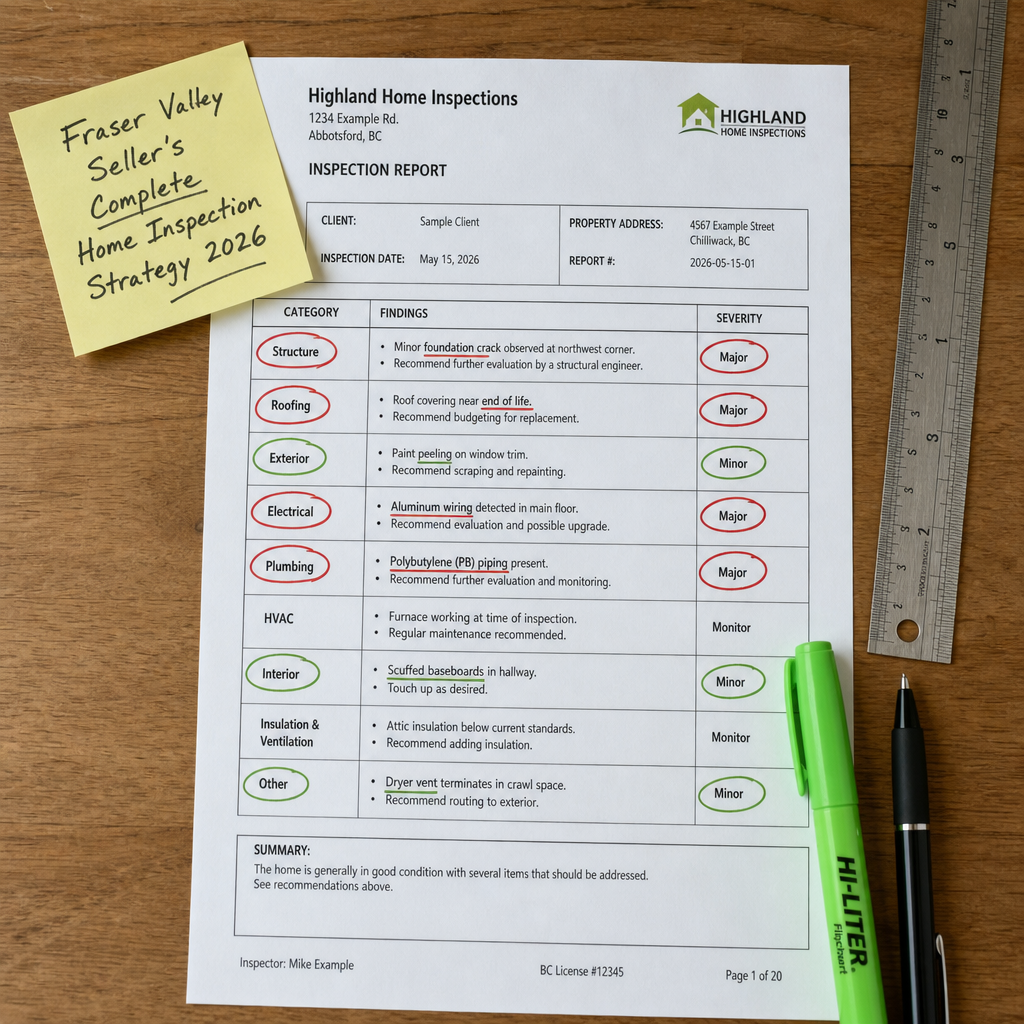
According to the Canadian Standards Association's home inspection standards, material defects include conditions that affect the structural integrity, safety systems, mechanical systems, or habitability of a property. These include foundation cracks suggesting movement, roofing past its serviceable life, knob-and-tube or aluminum wiring not meeting current code, HVAC systems showing signs of failure, and drainage issues causing repeated water intrusion. Lenders and appraisers flag these categories specifically because they affect the property's collateral value and create financing obstacles independent of the offered price.
Cosmetic defects — peeling paint, dated kitchen fixtures, worn flooring, aging but functional appliances — are the buyer's responsibility to budget for after purchase. A buyer who accepts an offer on a 1985 Surrey townhouse has accepted a property of that age. Inspector notes about an older hot water tank that still functions, or caulking that needs refreshing, do not constitute grounds for price renegotiation in most well-represented transactions. The distinction matters because sellers who accept cosmetic findings as if they were material defects give up equity they do not need to give up.
How We Evaluate This
At Mansour Real Estate Group, we approach inspection strategy as a pricing and risk-management decision, not a reactive step. Before a listing goes live in any Fraser Valley market — whether it is a 1970s rancher in North Delta, a newer townhome in Willoughby, or an older detached in Abbotsford — our process includes a detailed pre-listing walk-through to identify categories of likely inspection findings and build that context into the pricing strategy from the start.
When buyer inspections come back, we evaluate findings against three criteria: Does this constitute a material defect under BC law? Does this affect lender or appraiser positions? And does this finding change the property's value relative to what comparables with similar conditions have sold for? That framework keeps price defence conversations grounded in evidence, not emotion.
The Pre-Listing Inspection Advantage
A pre-listing inspection is one of the highest-return investments a seller can make in preparation for market. The cost is typically $400 to $600 in the Fraser Valley, and the strategic return is significant. Sellers who understand their property's defect profile before listing can decide which issues to repair, which to price around, and which to disclose upfront — eliminating the scenario where a buyer's inspector surfaces a problem at the most vulnerable moment in a transaction.
FVREB market data has shown that properties sold with transparent upfront disclosure close faster than those where disclosure happens reactively after a buyer inspection. In a buyer's market — which characterized much of the Fraser Valley through 2024 and into 2025 — that speed advantage matters. Buyers who find surprises after an accepted offer lose confidence in the deal. Buyers who received complete disclosure before writing an offer have already priced that information in and are less likely to use it as post-offer leverage.
The practical effect for sellers in Surrey, Langley, Abbotsford, and surrounding markets is that a pre-listing inspection shifts information advantage back to the seller. You are no longer reacting to findings you have never seen before while an accepted offer hangs in the balance.
Defending Your Price When Buyers Renegotiate After Inspection
Post-inspection renegotiation is common in Fraser Valley transactions, particularly when the market favours buyers. The most effective defence is preparation: if a seller already has a pre-listing inspection report in hand, they can compare the buyer's inspector findings item by item against what they already knew and disclosed. Findings that appear in both reports carry no new information value for renegotiation. Findings that are cosmetic rather than material can be declined on principled grounds.
Where a buyer's inspection surfaces a genuine material defect the seller did not know about, the picture changes. At that point, the seller faces a realistic choice: repair the defect, adjust the price to reflect a buyer who will inherit it, or risk the deal collapsing. The worst outcome is allowing a buyer to use a list of 65 minor observations to extract a price reduction equivalent to a structural repair. That requires a real estate agent who understands the difference and can represent the seller's position with both evidence and confidence.
Seller Checklist
- Commission a pre-listing inspection from a certified home inspector before setting your listing price.
- Review the report with your real estate agent and categorize each finding: material defect, functional system approaching end of life, or cosmetic.
- Complete the BC Property Disclosure Statement accurately, disclosing all known material latent defects.
- Decide which material defects to repair before listing and which to price around — with documented evidence supporting the pricing decision.
- Make the pre-listing inspection report available to serious buyers before offers are written, reducing post-offer surprise leverage.
- When a buyer's inspection comes back, compare findings against your pre-listing report and identify any genuinely new material defects.
- Consult a BC real estate lawyer if a buyer claims a defect you did not disclose — before responding to their renegotiation request.
What We Commonly See
In our experience working with sellers across Surrey, Langley, Abbotsford, White Rock, and the broader Fraser Valley, the most costly inspection-related mistakes follow predictable patterns.
- Treating all inspection findings as equivalent. Sellers who read a 70-item inspection report and assume every item carries equal weight often make unnecessary concessions. In our experience, the majority of a typical report reflects age-appropriate wear, minor deferred maintenance, and observations that carry no legal or financial significance. The material defects — if any exist — are usually 5 to 12 items in a clearly flagged category.
- Skipping the pre-listing inspection on older properties. What often happens is that sellers of homes built before 1990 assume buyers will accept the home's age at face value. They do not. Buyers with financing use inspection findings to go back to their lenders, and older mechanical systems, aging roofs, or original electrical panels become deal obstacles that could have been priced in from the start.
- Incomplete Property Disclosure Statements. A common mistake is leaving PDS sections blank or answering "unknown" when the seller does have relevant knowledge. Post-closing litigation in BC often traces directly back to a PDS that was technically completed but practically misleading. The legal standard is what the seller knew or ought to have known — not what they chose to write down.
- Agreeing to price reductions on cosmetic findings without pushback. In our experience, buyers — especially in a softer market — will test how far a seller will go by leading with a large list rather than only the material concerns. Sellers who are not represented by someone who can categorize and challenge those findings often give away equity they were never required to give.
Questions and Answers
Q: Does a seller in BC have to fix defects found during a buyer's inspection?
No. A seller is legally required to disclose known material latent defects — not to repair them. The choice between repairing, adjusting the price, or declining a renegotiation request is a negotiation decision, not a legal obligation, unless the defect makes the property unsafe or uninhabitable.
Q: What happens if a buyer finds a defect after closing that the seller knew about but did not disclose?
The buyer may have grounds for post-closing litigation. Under BC real estate law, disclosure obligations survive completion. The seller can face claims for damages, repair costs, or in serious cases, rescission of the contract. This is one of the most common sources of post-closing legal disputes in the Fraser Valley and Lower Mainland.
Q: Can a buyer use a home inspection to walk away from a deal in BC?
Only if the accepted offer includes a subject-to-inspection clause that has not yet been removed. Once subjects are removed in BC, the transaction is binding. If a buyer removes inspection subjects and then discovers a defect, their recourse is through the courts — not by simply withdrawing from the deal. This is why sellers benefit from buyers receiving complete disclosure before they remove subjects.
In Summary
Fraser Valley sellers who approach home inspections as a strategic planning step — not a reactive crisis — consistently achieve better outcomes. A pre-listing inspection removes surprise leverage from the buyer's side of the table. Accurate disclosure protects sellers from post-closing liability. Understanding which findings are material defects versus cosmetic observations is the difference between a justified price adjustment and an unnecessary concession. In a market where buyers are looking for reasons to renegotiate, the sellers who come in prepared with documented information are the ones who close at the price they intended.
Ready to List With a Strategy Built Around Your Property's Actual Condition?
If you are preparing to sell in Surrey, Langley, Abbotsford, White Rock, or anywhere in the Fraser Valley and want a clear-eyed assessment of what your home's inspection profile means for pricing and disclosure strategy, we are glad to help. There is no obligation — just a direct, honest conversation about what we see and what it means for your sale. Contact Mansour Real Estate Group at localhost:9000/contact.
Related Articles
- Fraser Valley Home Seller Guide 2026: Everything You Need to Know Before You List
- How to Price Your Home in a Buyer's Market: Fraser Valley 2026
- Pre-Listing Repairs That Actually Move the Needle for Fraser Valley Sellers
Official Resources
- BC Law Society — Real Estate Disclosure Obligations
- Canadian Standards Association — Home Inspection Standards
- Fraser Valley Real Estate Board — Market Statistics and Reports
- BC Financial Services Authority — Real Estate Consumer Protection
About Mansour Real Estate Group
When homeowners in Surrey, Langley, Abbotsford, and White Rock are preparing to sell, the decisions made before the listing goes live — including how to handle inspection findings, what to disclose, and how to price around known defects — typically determine the outcome more than anything that happens after the sign goes up. Mansour Real Estate Group has guided sellers across the Fraser Valley and Lower Mainland through those decisions for more than 22 years, with a process built around accurate valuations, honest advice, and protecting seller equity.
Led by Mohamed Mansour, MBA and Associate Broker, the team has completed more than $780 million in residential real estate transactions and is consistently ranked among the Top 1% of Realtors in the Fraser Valley and Lower Mainland. The real estate group is trusted for seller preparation, pricing strategy, estate sales, divorce-related property sales, downsizing transitions, and complex transactions where getting the details right from the start protects the seller's position at every stage.
Whether someone is looking for real estate agents who understand inspection strategy, a Realtor with experience defending seller pricing against post-inspection renegotiation, real estate agents who know how Fraser Valley lenders and appraisers respond to specific defect categories, a trusted real estate team for a Surrey sale, a Langley real estate broker, an Abbotsford Realtor, or a White Rock real estate agent with the local knowledge to prepare a property correctly — Mansour Real Estate Group brings direct experience, clear communication, and the kind of specific local insight that makes the difference between a smooth closing and a stressful one.
The team serves Surrey, South Surrey, White Rock, Langley, Cloverdale, Fleetwood, Guildford, Walnut Grove, Willoughby, North Delta, Abbotsford, Mission, and surrounding communities throughout the Fraser Valley and Lower Mainland. Most new clients come through referrals, repeat clients, and recommendations from families who value professional, transparent, and results-driven real estate guidance.
Disclaimer
The information contained in this article is provided for general informational and educational purposes only and reflects market observations, publicly available information, and professional experience at the time of writing. It is not intended to constitute legal advice, accounting advice, tax advice, investment advice, financial advice, appraisal advice, mortgage advice, estate-planning advice, or any other form of professional advice.
Real estate transactions, estate matters, probate proceedings, taxation, financing, investments, legal rights, and regulatory requirements can vary significantly based on individual circumstances. Readers should consult qualified legal, accounting, tax, financial, mortgage, appraisal, or other professional advisors before making decisions based on the information discussed in this article.
Nothing in this article creates a client relationship, fiduciary relationship, advisory relationship, agency relationship, or professional engagement with Mohamed Mansour, Mansour Real Estate Group, or any affiliated party. Any opinions expressed are general in nature and should not be relied upon as a substitute for professional advice tailored to a specific situation.
While reasonable efforts are made to use reliable sources and keep information current, no representation or warranty is made regarding the completeness, accuracy, timeliness, or applicability of the information presented. Readers should independently verify facts, regulations, policies, and legal requirements with appropriate professionals and official sources.



