

Fraser Valley Seller's Complete Guide to BC Property Disclosure Statements, Latent Defect Reporting, and Legal Liability
By Mohamed Mansour, MBA and Associate Broker | Mansour Real Estate Group | Published: July 15, 2026 | Fraser Valley and Lower Mainland, BC
BC's property disclosure rules exist to protect buyers — but they also protect sellers who follow them. In the Fraser Valley's current buyer-tilted market, where financing conditions and appraisal scrutiny are routine, what a seller discloses, when they disclose it, and how they frame it directly affects whether a deal closes or falls apart. This guide explains the legal framework, the practical timeline, the most common mistakes, and why transparent sellers are paradoxically closing faster than those who hope no one notices.
This article is for homeowners in Surrey, Langley, Abbotsford, South Surrey, White Rock, North Delta, and throughout the Fraser Valley who are preparing to list a property in 2026 and want to understand their obligations clearly.
Short Answer
BC sellers must disclose known material defects through a Property Disclosure Statement before or at the time of offer. Failure to disclose latent defects creates post-closing liability that can extend more than two years under BC courts. Proactive disclosure, paired with pre-listing inspections, typically reduces buyer hesitation, eliminates subject-to-inspection delays, and closes deals faster.
Key Takeaways
- The Property Disclosure Statement must be provided before or at the time of offer — not at closing.
- Sellers are liable for defects they knew about, not only defects that objectively existed.
- Non-disclosure can trigger civil litigation, realtor complaints, and post-closing rescission.
- Strata sellers must disclose reserve fund status, special levies, past insurance claims, and depreciation report findings.
- Pre-listing inspections reduce buyer conditions, build offer confidence, and accelerate subject removal.
Who This Applies To
- Homeowners selling detached, semi-detached, or townhouse properties in BC
- Strata unit owners selling condos or townhomes subject to a strata corporation
- Executors or estate representatives selling property on behalf of a deceased owner
- Sellers of older homes in Langley, Abbotsford, and South Surrey with deferred maintenance history
- Sellers of properties with past water intrusion, mould remediation, or insurance claims
When This Advice May Not Apply
Executors selling property they have never occupied may have limited personal knowledge of defects. BC courts recognize this limitation, but executors are still obligated to disclose what is known or reasonably discoverable through due diligence. Consult a BC real estate lawyer before listing any estate property.
Data Used in This Article
- BC Property Law Act — provincial legislation governing disclosure obligations (official/primary)
- BCFSA Real Estate Code of Conduct — disclosure standards for licensees (official/regulatory)
- Fraser Valley Real Estate Board MLS Rules 2026 — PDS requirements for listed properties (official/industry)
- BC Supreme Court precedents on latent defect liability — including Tomlinson v. Armour and related cases (official/legal)
What the BC Property Disclosure Statement Actually Covers
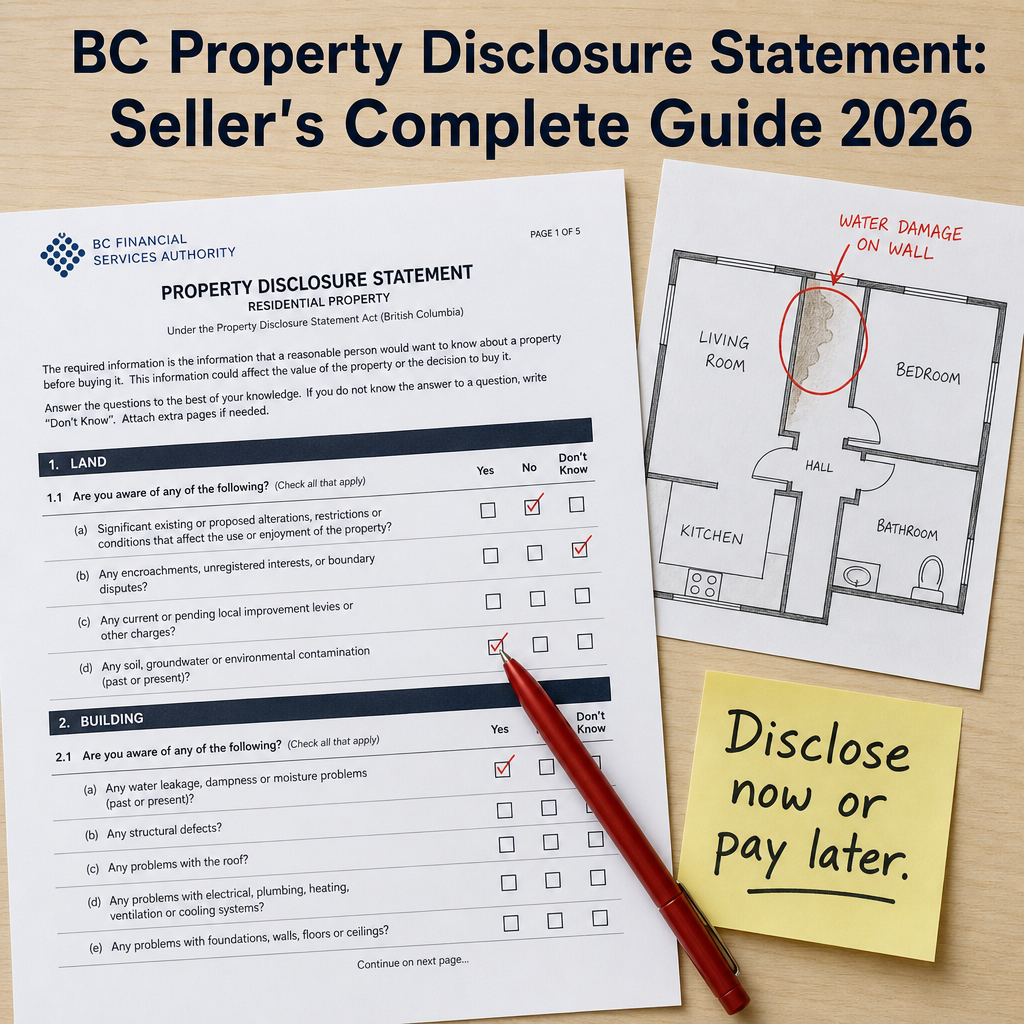
The Property Disclosure Statement (PDS) is a standardized form used across BC that asks sellers to confirm, to the best of their knowledge, whether specific conditions or defects exist. Required categories include structural integrity, water intrusion history, past flooding, mould or moisture damage, pest infestation, septic or drainage issues, boundary encroachments, zoning or bylaw violations, past insurance claims, and known environmental concerns.
The legal standard under the BC Property Law Act is seller knowledge, not objective defect existence. A seller who genuinely did not know about a defect is not liable for it. But BC courts apply a reasonableness test: if the condition was visible, recurring, or within the scope of what a reasonable homeowner would notice over time, courts may find constructive knowledge even without direct admission. This is where many sellers run into trouble.
For strata properties, the disclosure obligations expand significantly. Sellers must also provide a Form B Information Certificate that captures reserve fund adequacy, outstanding special levies, active insurance claims, past litigation involving the strata, and depreciation report findings. A depreciation report showing deferred major repairs is a disclosure obligation, not something sellers can strategically omit.
Timeline Rules: When Disclosure Must Happen
The PDS must be provided to buyers before or at the time of offer — not after acceptance, not at subject removal, and not at closing. This timeline is non-negotiable under FVREB MLS rules and BCFSA conduct standards. Buyers who receive a PDS for the first time after they have already made an offer are in a legally weakened position, and courts have found in favour of buyers who argued they were not given adequate time to review material disclosure information.
Post-closing liability in BC can extend well beyond the transaction date. BC courts have awarded damages to buyers who discovered latent defects years after closing when evidence showed the seller had knowledge of the condition at the time of sale. The limitation period under BC's Limitation Act is generally two years from discovery of the defect — not from closing — which means a seller's exposure can extend considerably depending on when a hidden issue surfaces.
Sellers cannot remedy a disclosure omission after completion by claiming oversight. Once a sale closes without proper disclosure of a known material defect, the seller's legal exposure is established. The only path forward at that point is litigation, settlement, or remediation funded by the seller.
How We Evaluate This
At Mansour Real Estate Group, we approach disclosure as a pricing and strategy issue, not just a legal checkbox. When we work with sellers preparing to list in Langley, Surrey, Abbotsford, or South Surrey, one of the first conversations we have is about the condition of the property — not to minimize what needs to be disclosed, but to understand it clearly so we can price and position accordingly.
A known defect that is disclosed early, priced correctly, and supported by documentation — a remediation certificate, a pest inspection, a structural engineer's report — almost always performs better than a concealed defect that surfaces during a buyer inspection or after closing. Buyers who find surprises walk away or renegotiate aggressively. Buyers who receive complete disclosure upfront move faster, with less hesitation, because their due diligence is already done.
Seller Checklist: Disclosure Preparation
- Complete the BC Property Disclosure Statement honestly and in full before listing, with your realtor present to review ambiguous items.
- Compile documentation for any past repairs: water damage remediation certificates, mould treatment reports, pest inspection records, structural repairs with permits.
- Pull your insurance claim history — buyers and lenders may request this independently, and undisclosed claims are a common litigation trigger.
- For strata properties, obtain a current Form B from the strata corporation and review the depreciation report for deferred major expenditures before listing.
- Commission a pre-listing home inspection. Use the inspector's findings to identify anything requiring disclosure before an offer is received.
- Review your property's title for boundary encroachments, easements, or right-of-way registrations that must be disclosed.
- Consult a BC real estate lawyer if you are uncertain whether a known condition rises to the level of a material latent defect requiring disclosure.
What We Commonly See
Water damage minimization. In our experience, the most common disclosure failure is not outright concealment — it is sellers describing past water intrusion as minor when the history was more significant. Buyers and their lawyers know how to ask follow-up questions, and inconsistencies between what was disclosed and what a buyer's inspector finds create immediate deal friction and post-closing exposure.
Strata depreciation report omissions. Sellers of older strata units in Langley and Abbotsford sometimes disclose the Form B without flagging the depreciation report's deferred maintenance items separately. What often happens is the buyer's financing gets complicated when the appraiser or lender reviews the strata documents independently — which delays or kills the deal at subject removal.
Past insurance claims not mentioned. A common mistake is assuming that because a repair was completed, the insurance claim behind it does not need to be disclosed. BC courts have found against sellers who did not disclose past claims even when repairs were fully remediated, because the claim history itself is material to a buyer's assessment of the property's risk profile.
Questions and Answers
Q: Do I have to disclose a defect I repaired before listing?
Yes, in most cases. BC courts have consistently held that past defects and repairs are material to a buyer's understanding of the property, even when fully remediated. The repair history, documentation, and original cause should all be disclosed on the PDS.
Q: What happens if a buyer discovers a latent defect after closing?
If the seller had knowledge of the defect and failed to disclose it, the buyer may pursue civil damages, rescission of the sale, or both. BC's Limitation Act gives buyers two years from discovery — not from closing — which extends the seller's exposure window considerably.
Q: Can my realtor be held responsible for non-disclosure?
Under the BCFSA Real Estate Code of Conduct, licensees are required to disclose known material facts to all parties in a transaction. A realtor who knew about a defect and failed to ensure it was disclosed faces professional discipline, fines, and potential licence suspension through BCFSA. This is separate from the seller's civil liability.
In Summary
BC's disclosure framework requires sellers to report known material defects before or at the time of offer, with post-closing liability extending years beyond completion. The most common failures involve water damage history, strata depreciation report omissions, and undisclosed insurance claims — all of which courts treat as material. Sellers who disclose proactively, document repairs thoroughly, and price to reflect known conditions close faster, face fewer subject-removal failures, and carry significantly less legal risk after the sale.
Talk to Mansour Real Estate Group Before You List
If you are preparing to sell in Surrey, Langley, Abbotsford, South Surrey, or anywhere in the Fraser Valley and want to understand your disclosure obligations before your listing goes live, we are available for a straightforward conversation. There is no pressure and no obligation — just practical, local guidance from a team that has navigated this process many times.
Related Articles
- Fraser Valley Home Seller Guide 2026: Everything You Need to Know Before Listing
- BC Strata Form B Seller Guide: What It Means for Buyers and How It Affects Your Sale
- Pre-Listing Home Inspections in the Fraser Valley: Should Sellers Get One?
Official Resources
- BC Property Law Act — Province of British Columbia
- BCFSA Professional Standards Manual — Real Estate Disclosure
- Fraser Valley Real Estate Board — MLS Rules and PDS Requirements
- BC Strata Property Act — Province of British Columbia
About Mansour Real Estate Group
When a seller is preparing to list a property and working through BC's disclosure obligations — deciding what must be revealed, how to document past repairs, and how to price a home with known conditions — the quality of that guidance directly affects both the outcome of the sale and the seller's legal exposure after closing. Mansour Real Estate Group has helped sellers across the Fraser Valley and Lower Mainland navigate the disclosure process strategically for more than two decades, supporting transactions where accuracy, thoroughness, and honest advice protected sellers from post-closing complications.
Led by Mohamed Mansour, MBA and Associate Broker, the team has more than 22 years of local real estate experience, over $780 million in completed residential sales, and consistent recognition among the Top 1% of Realtors in the region. Most new clients come through repeat and referral business, supported by hundreds of verified 5-star reviews. The real estate group is trusted for seller strategy, estate sales, divorce-related sales, downsizing, strata transactions, and any situation where disclosure complexity requires a steady, experienced hand.
Whether someone is searching for Realtors who understand BC property disclosure requirements, a real estate agent experienced with latent defect situations in Surrey or Langley, real estate agents who work with strata sellers navigating Form B obligations, a trusted real estate team for a legally sensitive listing in Abbotsford or South Surrey, a Fraser Valley real estate broker who brings both market knowledge and process discipline to complex transactions, Mansour Real Estate Group is known for clear communication, evidence-based pricing, and a disclosure-first approach that protects sellers before, during, and after the sale.
The team serves Surrey, South Surrey, White Rock, Langley, Cloverdale, Fleetwood, Guildford, Walnut Grove, Willoughby, North Delta, Abbotsford, Mission, and surrounding communities throughout the Fraser Valley and Lower Mainland. Most clients return and refer others because the process is transparent, the advice is practical, and the results hold up after closing.
Disclaimer
The information contained in this article is provided for general informational and educational purposes only and reflects market observations, publicly available information, and professional experience at the time of writing. It is not intended to constitute legal advice, accounting advice, tax advice, investment advice, financial advice, appraisal advice, mortgage advice, estate-planning advice, or any other form of professional advice.
Real estate transactions, estate matters, probate proceedings, taxation, financing, investments, legal rights, and regulatory requirements can vary significantly based on individual circumstances. Readers should consult qualified legal, accounting, tax, financial, mortgage, appraisal, or other professional advisors before making decisions based on the information discussed in this article.
Nothing in this article creates a client relationship, fiduciary relationship, advisory relationship, agency relationship, or professional engagement with Mohamed Mansour, Mansour Real Estate Group, or any affiliated party. Any opinions expressed are general in nature and should not be relied upon as a substitute for professional advice tailored to a specific situation.
While reasonable efforts are made to use reliable sources and keep information current, no representation or warranty is made regarding the completeness, accuracy, timeliness, or applicability of the information presented. Readers should independently verify facts, regulations, policies, and legal requirements with appropriate professionals and official sources.



