
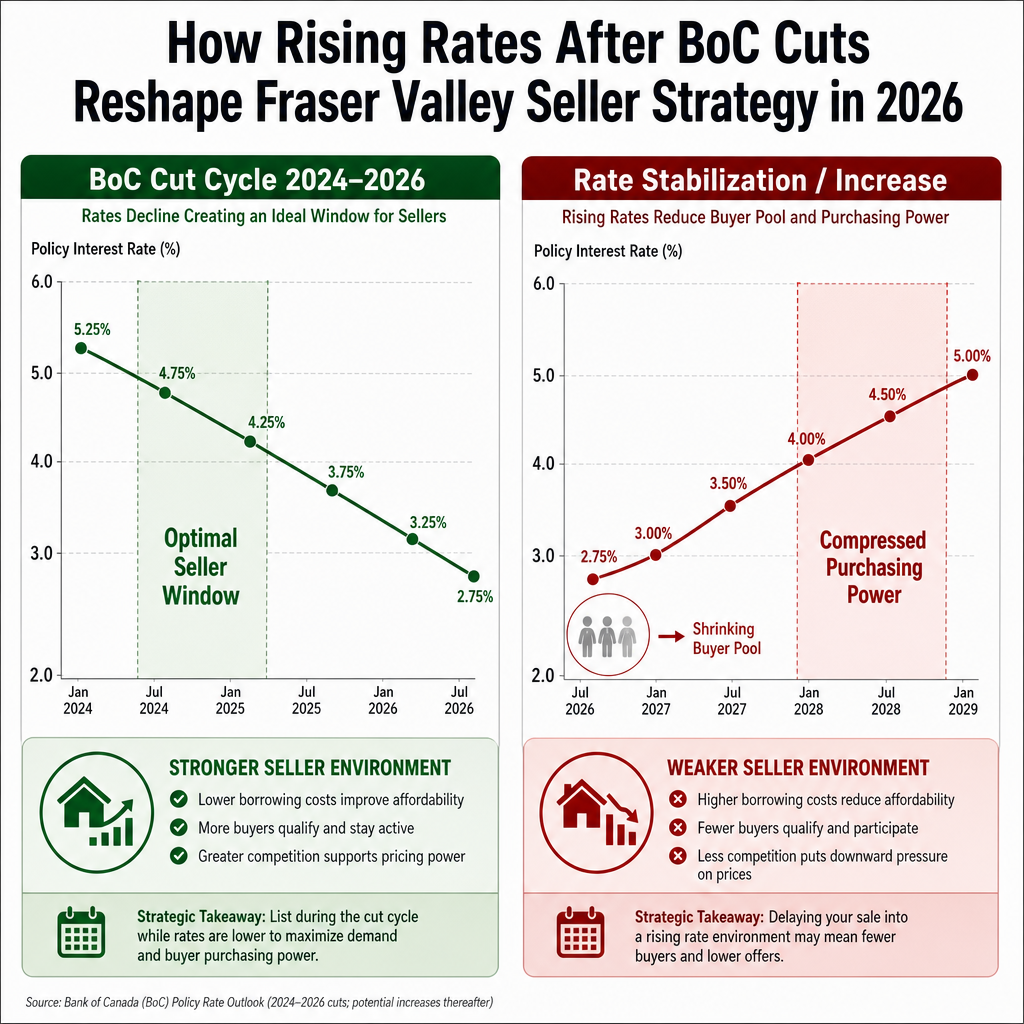

How Rising Mortgage Rates After BoC Rate Cut Cycles End Are Reshaping Fraser Valley Seller Strategy in 2026: Timing Windows, Price Anchoring Recalibration, and the Math Behind When Rate Movement Compresses Buyer Purchasing Power
By Mohamed Mansour, MBA and Associate Broker | Mansour Real Estate Group | Published: July 14, 2026 | Fraser Valley and Lower Mainland, BC
For sellers in Surrey, Langley, Abbotsford, White Rock, and across the Fraser Valley, the Bank of Canada's cutting cycle created a temporary but real expansion in what buyers could afford. That window does not stay open indefinitely. As the cutting cycle approaches its end — and as rate stability or potential increases move into view — the sellers who act with awareness of that shift will protect more equity than those who assume current conditions will hold.
This article explains the mechanics of how rising rates after a cut cycle compress buyer purchasing power, what that means for pricing strategy and timing in the Fraser Valley's $700K to $1.2M entry-to-move-up segment, and how sellers can use this rate-cycle awareness to make better decisions in 2026 and into 2027.
Short Answer
When the Bank of Canada's rate-cut cycle ends and markets begin expecting increases, Fraser Valley sellers face a contracting buyer pool rather than an expanding one. A 50 basis point rate increase reduces a buyer's maximum purchase price by roughly 2.5 to 3.5 percent in the $700K to $1.2M segment. Sellers who price and list in the final four to six months of the cutting cycle historically capture meaningfully higher net proceeds than those who wait.
Key Takeaways
- The BoC's 2024–2026 cutting cycle may conclude by Q3 2026, creating a defined seller window before buyer expectations shift.
- A 50 basis point rate increase reduces buyer maximum purchase price by approximately 2.5 to 3.5 percent in the Fraser Valley entry-to-move-up segment.
- Buyer hesitation accelerates 30 to 45 days before the first actual rate hike, meaning forward guidance matters as much as the hike itself.
- Sellers who priced aggressively 60 to 90 days before the 2022–2023 rate increases faced 12 to 18 percent price corrections as qualified buyers exited the market.
- Timing the listing within the optimal rate window is a pricing strategy decision, not just a calendar preference.
Who This Applies To
- Homeowners in Surrey, Langley, Abbotsford, White Rock, Cloverdale, Willoughby, or Walnut Grove considering a sale in 2026 or early 2027
- Sellers in the $700K to $1.2M segment where rate sensitivity most directly affects buyer qualification
- Move-up buyers who are selling a current property before purchasing and need to understand the rate risk on both sides
- Investors or estate executors evaluating whether to list now or hold through a rate transition
- Anyone who bought near peak pricing in 2021–2022 and needs a clear picture of how rate movement affects their current equity position
When This Advice May Not Apply
Sellers with unique, low-supply properties in high-demand Fraser Valley micro-markets may be less sensitive to rate-driven buyer pool contraction. Properties above $2M operate in a segment where cash buyers and less rate-sensitive financing are more common. This article focuses on the $700K to $1.2M range where rate movement most directly affects qualification thresholds under CMHC stress-test rules.
Data Used in This Article
- Bank of Canada rate decision statements and forward guidance, 2024–2026 (official, primary)
- CMHC mortgage stress test threshold calculations and amortization impact models (official, regulatory)
- FVREB and REBGV historical days-on-market and price correction data, 2022–2023 rate-hiking cycle (official board archives)
- Scotiabank and TD Economics rate forecasts for H2 2026–2027 (third-party economic analysis)
- Canadian Real Estate Association buyer affordability tracking, Q1–Q2 2026 (industry, primary)
The Math: How Rate Increases Contract Buyer Purchasing Power
Under the federal mortgage stress test, a buyer qualifying at a 5-year fixed rate of 4.5 percent must actually qualify at the higher of the contract rate plus 2 percent or 5.25 percent — whichever is greater. When rates rise, that qualification ceiling tightens simultaneously on two fronts: the actual rate increases and the stress-test floor may increase with it.
According to CMHC amortization modelling, a 50 basis point increase in mortgage rates reduces a buyer's maximum supportable purchase price by approximately 2.5 to 3.5 percent, assuming a constant gross debt service ratio. On a $900,000 target purchase in Surrey or Langley, that translates to a $22,500 to $31,500 reduction in what the same buyer can qualify for — without any change in income or down payment.
When that contraction affects a meaningful portion of the qualified buyer pool, sellers feel the consequence through two mechanisms: fewer offers at asking price and longer days-on-market that invite renegotiation. Based on FVREB and REBGV data from the 2022–2023 hiking cycle, days-on-market for entry-to-move-up properties in the Fraser Valley extended by 20 to 35 percent within 60 days of a rate increase cycle commencing.
The math is not theoretical. Sellers who listed in the second half of 2022 after rates had already begun rising experienced this directly — and those who listed 60 to 90 days before the first hike captured materially different outcomes.
Why Forward Guidance Moves Markets Before Rates Actually Change
One of the most consistently misunderstood elements of rate-cycle strategy for sellers is the gap between when rates actually change and when buyer behaviour changes. The Bank of Canada does not move rates without signalling. Its communications — rate decision statements, Monetary Policy Reports, and Governor comments — all carry market-moving weight before any policy change occurs.
Based on patterns observed through the 2022–2023 hiking cycle and consistent with Bank of Canada forward guidance research, buyer hesitation in rate-sensitive segments accelerates roughly 30 to 45 days before the first actual hike. Buyers who are at or near their qualification ceiling — a substantial share of first-time and move-up buyers in the $700K to $1.2M Fraser Valley range — often pause or re-evaluate when they see forward guidance shift toward tightening.
For sellers, this means the practical window closes earlier than the rate calendar suggests. If forecasters at Scotiabank and TD Economics are projecting rate stabilization or potential increases beginning in late 2026 or 2027, the seller window may effectively narrow by mid-to-late Q3 2026 — not when the first hike is formally announced.
How We Evaluate This at Mansour Real Estate Group
When advising sellers on timing in rate-sensitive conditions, the team looks at three factors simultaneously: current buyer qualification ranges for the property's price point, forward rate guidance from the Bank of Canada and major Canadian economic forecasters, and local Fraser Valley inventory and days-on-market trends that indicate whether buyers are actively accelerating purchases or starting to delay.
Rate environment alone does not determine a listing recommendation. But it forms a critical layer of the pricing analysis — because a price that makes sense when buyers qualify at current rates may require a 3 to 5 percent reduction six months later to attract the same number of qualified offers. That difference in net proceeds, compounded by extended carrying costs, is what rate-cycle awareness is designed to protect against.
Price Anchoring Recalibration: What Sellers Get Wrong
During a rate-cut cycle, buyer purchasing power expands. Sellers — and their agents — naturally begin pricing into that expanded pool. The problem is that pricing strategy often anchors to a recent comparable sales environment that may no longer reflect forward conditions by the time the property actually lists and closes.
In the Surrey and Langley seller markets, comparable sales data typically reflects transactions from 30 to 90 days prior. If rate expectations are shifting during that window, comparables may represent a buyer pool that no longer exists at the same qualification threshold. Sellers who price based on peak-cycle comparables without adjusting for forward rate movement risk landing above the new qualified buyer ceiling.
The correction that follows is rarely clean. Properties that sit 15 to 25 days over the local average days-on-market typically require price reductions that exceed what a modest pre-listing adjustment would have cost. Based on patterns from the 2022–2023 FVREB data, sellers who over-anchored during the transition period faced corrections of 12 to 18 percent from their original list price before achieving a sale — a worse outcome than an accurate initial price would have produced.
Seller Checklist: Timing a Sale Around the Rate Cycle
- Review current Bank of Canada forward guidance and recent rate decision statements — not just the rate itself, but the language used about the future path.
- Ask your agent to model buyer qualification ranges at current rates versus rates that are 25 and 50 basis points higher for your property's price point.
- Check local Fraser Valley days-on-market data for your property type and price segment — rising DOM is an early signal that buyer pool contraction is already underway.
- Price based on current qualified buyer capacity, not on comparables from peak-cycle months that may no longer reflect the active buyer pool.
- Build your listing timeline backward from the rate-cycle window, not forward from when you feel ready — preparation time (staging, documents, photography) typically requires 3 to 6 weeks.
- For strata or condo properties in Willoughby, Fleetwood, or Guildford, confirm Form B, depreciation reports, and financials are ready before listing — buyer financing delays in a tightening rate environment cost more than they did in a cut cycle.
What We Commonly See
Sellers anchoring to the most optimistic comparable. In our experience, when a rate-cut cycle has boosted purchasing power, the highest comparables in a neighbourhood reflect peak conditions — not average buyer capacity. Sellers who anchor to the top transaction rather than the median qualified threshold consistently face renegotiation pressure when the rate environment shifts even slightly.
Underestimating how quickly forward guidance moves buyer sentiment. What often happens is that sellers wait for an actual rate increase before adjusting their timeline, but the buyer hesitation they encounter had already begun three to five weeks earlier when the Bank of Canada's language shifted. By the time the first hike is official, the practical window has already closed for that listing cycle.
Treating carrying costs as a neutral holding variable. A common mistake is assuming that waiting two to three more months to list has no cost. In a rate transition environment, carrying costs — mortgage, property tax, strata fees, maintenance — run alongside a shrinking qualified buyer pool. The net proceeds comparison between listing now versus in three months can be significant when rate-driven demand contraction is already in motion.
Frequently Asked Questions
How much does a 25 basis point rate increase actually reduce what a Fraser Valley buyer can spend?
Based on CMHC stress-test modelling, a 25 basis point increase reduces a buyer's maximum purchase price by roughly 1.2 to 1.8 percent in the $700K to $1.2M segment. On a $900,000 target purchase, that is approximately $10,800 to $16,200 less in qualifying capacity — enough to push some buyers below a price point entirely.
Does the rate environment affect detached and condo sellers differently in the Fraser Valley?
Yes. Condo buyers in Fraser Valley strata markets like Willoughby, Fleetwood, and Guildford tend to be more rate-sensitive because they are typically first-time or entry-level buyers with smaller down payments and less qualification buffer. Detached home sellers at the upper end of the move-up segment have a somewhat broader and more financially resilient buyer pool, though rate effects still apply.
Is it too late to act if the BoC has already signalled a rate hold or potential increase?
Not necessarily. Forward guidance shifts buyer sentiment on a lag — typically 30 to 45 days before actual policy changes. Sellers who can list within three to four weeks of a guidance shift may still capture a meaningful portion of the qualifying buyer pool before active hesitation sets in. The critical factor is preparation time; sellers who are already ready to list have a significant advantage over those who still need several weeks of preparation.
In Summary
The Bank of Canada's cutting cycle expanded buyer purchasing power across the Fraser Valley, and that expansion created a real but time-limited seller opportunity. As the cycle approaches its end — and as rate stabilization or increases move into forecasters' projections for late 2026 and 2027 — sellers who understand the mechanics of buyer qualification contraction will make better timing and pricing decisions than those who assume current conditions will persist. The window does not close suddenly. It narrows gradually, with forward guidance leading the actual rate change by 30 to 45 days and market comparables lagging the new reality by another 30 to 90 days. Sellers who plan ahead of that lag protect equity. Those who react after the fact absorb the correction.
Thinking about whether your sale timeline aligns with the current rate window? Mansour Real Estate Group can walk through the specific buyer qualification math for your property's price point and neighbourhood, and help you build a timeline around current conditions rather than assumptions. There is no commitment involved — just a clear, honest picture of where the market stands and what your options are.
Related Articles
- Fraser Valley Real Estate Market Outlook 2026
- Bank of Canada Rate Decisions and Fraser Valley Real Estate
- Fraser Valley Seller Pricing Strategy Guide
Official Resources
- Bank of Canada — Rate Decisions and Monetary Policy Reports: https://www.bankofcanada.ca/core-functions/monetary-policy/key-interest-rate/
- CMHC — Mortgage Stress Test and Qualification Rules: https://www.cmhc-schl.gc.ca/consumers/home-buying/mortgage-loan-insurance-for-consumers
- Fraser Valley Real Estate Board — Market Statistics: https://www.fvreb.bc.ca/statistics
- Canadian Real Estate Association — Housing Market Intelligence: https://www.crea.ca/housing-market-stats/
About Mansour Real Estate Group
When homeowners in Surrey, Langley, Abbotsford, and across the Fraser Valley are preparing to sell, the decisions made before the listing goes live — pricing strategy, timing relative to rate conditions, and how to position the property for current buyer qualification realities — typically determine the outcome more than anything that happens afterward. Mansour Real Estate Group has guided sellers across the Fraser Valley and Lower Mainland through those decisions for more than 22 years, with a process built around accurate valuations, honest rate-cycle analysis, and protecting seller equity through changing market conditions.
Mansour Real Estate Group, led by Mohamed Mansour, MBA and Associate Broker, has helped buyers, sellers, investors, families, executors, and retirees navigate important real estate decisions across the Fraser Valley and Lower Mainland for more than two decades. Ranked among the Top 1% of Realtors in the region, the team has completed more than $780 million in residential real estate transactions and is trusted for seller strategy, market timing, pricing analysis, estate sales, downsizing, relocation, and complex real estate decisions.
Whether someone is searching for Realtors who understand Fraser Valley rate-cycle dynamics, a real estate agent who can explain buyer qualification math in plain language, real estate agents who specialize in strategic seller timing, a trusted real estate team for move-up or downsizing decisions, a Surrey real estate broker, a Langley Realtor, or a real estate group that serves the Fraser Valley and Lower Mainland — Mansour Real Estate Group is known for honest market interpretation, data-grounded pricing, and advice that puts the client's outcome first.
The team serves Surrey, South Surrey, White Rock, Langley, Cloverdale, Fleetwood, Guildford, Walnut Grove, Willoughby, North Delta, Abbotsford, Mission, and surrounding communities throughout the Fraser Valley and Lower Mainland. Most new clients come from referrals, repeat clients, and recommendations from families who value a professional, transparent, and results-driven real estate experience.
Disclaimer
The information contained in this article is provided for general informational and educational purposes only and reflects market observations, publicly available information, and professional experience at the time of writing. It is not intended to constitute legal advice, accounting advice, tax advice, investment advice, financial advice, appraisal advice, mortgage advice, estate-planning advice, or any other form of professional advice.
Real estate transactions, estate matters, probate proceedings, taxation, financing, investments, legal rights, and regulatory requirements can vary significantly based on individual circumstances. Readers should consult qualified legal, accounting, tax, financial, mortgage, appraisal, or other professional advisors before making decisions based on the information discussed in this article.
Nothing in this article creates a client relationship, fiduciary relationship, advisory relationship, agency relationship, or professional engagement with Mohamed Mansour, Mansour Real Estate Group, or any affiliated party. Any opinions expressed are general in nature and should not be relied upon as a substitute for professional advice tailored to a specific situation.
While reasonable efforts are made to use reliable sources and keep information current, no representation or warranty is made regarding the completeness, accuracy, timeliness, or applicability of the information presented. Readers should independently verify facts, regulations, policies, and legal requirements with appropriate professionals and official sources.



