

Walnut Grove Townhouse Sellers 2026: Why Builder Warranty Expiration, Rising Special Levies, and New Construction Competition Create a Strategic Pricing Urgency
By Mohamed Mansour, MBA and Associate Broker, Mansour Real Estate Group | Published: July 15, 2026 | Geography: Walnut Grove, Langley, Fraser Valley, BC | Topic: Townhouse Seller Strategy
If you own a townhouse in Walnut Grove that was built between 2016 and 2021, three forces are converging right now that directly affect how buyers will qualify for financing on your unit — and how much they will offer. These are not market sentiment issues. They are mechanical, deadline-driven, and measurable.
This article is written for Walnut Grove townhouse owners who want to understand the specific structural reasons why the current pricing window is narrow — and what decisions are worth making before it closes. Mansour Real Estate Group has worked with sellers in this corridor through multiple new-construction completion cycles and understands how these timelines interact.
Short Answer
Walnut Grove townhouse sellers with units aged 5 to 8 years face a specific and time-sensitive pricing window in 2026. Builder warranty expiration reduces buyer financing eligibility, the July 1 depreciation report deadline surfaces reserve fund deficiencies, and new construction incentive packages from active builders are compressing resale comparables by a measurable margin. Sellers who list before these triggers compound have a structural price advantage over those who wait.
Who This Applies To
- Owners of Walnut Grove townhouses built between approximately 2016 and 2021
- Sellers whose strata buildings are approaching or have recently crossed the 5-year or 10-year warranty threshold
- Townhouse owners in buildings where the depreciation report has not yet been updated or filed
- Sellers who purchased during a new construction phase and are now competing against current builder releases
- Investors evaluating whether to sell or hold a Walnut Grove townhouse unit in 2026
When This Advice May Not Apply
If your townhouse was built after 2021, full 10-year structural warranty coverage likely remains in place and buyer financing is less constrained by this specific factor. If your strata has a fully funded reserve and a recently completed depreciation report showing no special levy risk, the Form B concern is reduced. Each building has its own strata history — the analysis below provides a framework, not a universal prescription.
Data Used in This Article
- FVREB Walnut Grove sales data, Q1–Q2 2026 — official board statistics, sales-to-active ratios, townhouse segment
- BC Strata Property Act, Form B requirements — depreciation report filing deadline, July 1 annual trigger
- CMHC mortgage stress test and strata reserve fund rules — lender qualification constraints tied to reserve fund adequacy
- Builder incentive tracking, 2026 Walnut Grove completions — Brookfield, Polygon, and Mission Group active phases, incentive structure observations
The Three Forces Converging in 2026
Force 1: Builder Warranty Expiration and the Financing Cliff
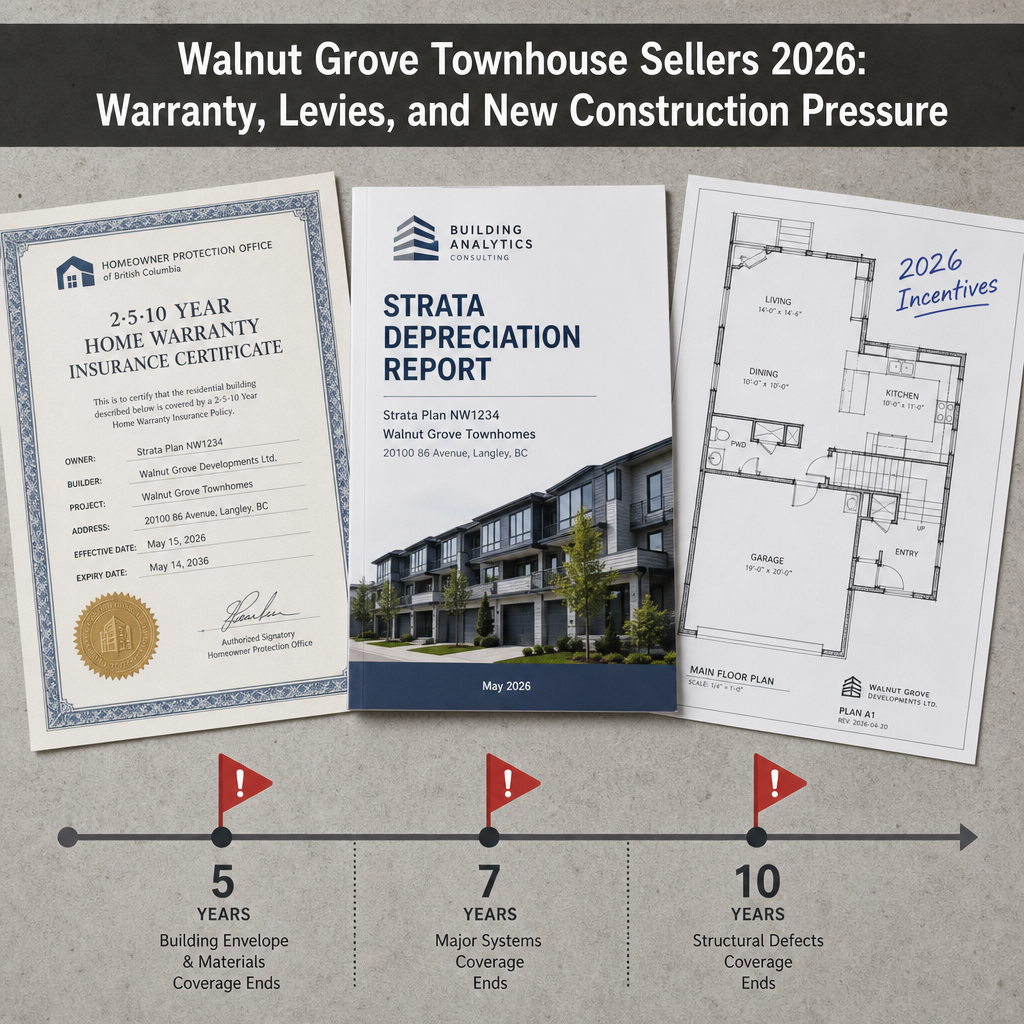
In British Columbia, new homes built after July 1999 are covered by the BC Home Owner Protection Act, which requires licensed builders to provide two-year materials and labour coverage, five-year building envelope coverage, and ten-year structural defect coverage. For townhouses built in 2016 and 2017, the ten-year structural warranty expires in 2026 and 2027 respectively. That expiration matters for one specific reason: lenders, particularly those underwriting CMHC-insured mortgages, use active warranty coverage as a component of risk assessment for strata units.
When a buyer submits financing on a unit where the warranty has expired or is within six months of expiry, some lenders apply additional scrutiny to the building condition and the reserve fund adequacy. In practice, this narrows the pool of buyers who can qualify without condition complications — and a smaller, more cautious buyer pool produces lower offers. Sellers with 2016–2018 builds are at the leading edge of this cliff right now.
Force 2: The July 1 Depreciation Report Deadline and Special Levy Risk
Under BC strata law, strata corporations of more than four units are required to obtain a depreciation report every three years, or pass an annual three-quarters vote to waive it. The Form B Information Certificate — which buyers must receive before completing a purchase — discloses the strata's current reserve fund balance and any pending or anticipated special levies. When a depreciation report is filed or updated around July 1 each year, it frequently surfaces capital cost projections that trigger reserve fund reassessment.
For buildings exiting their primary warranty period, this is particularly consequential. Defects or component degradation that were previously covered by the builder may now appear in the depreciation report as unfunded liabilities. A Form B that shows a reserve fund below the depreciation report's recommended balance — or discloses a forthcoming special levy — can cause a buyer's lender to require holdbacks, reduce the appraised value, or decline financing entirely. Sellers who list and complete before a problematic depreciation report is updated avoid this disclosure at the point of sale.
Force 3: New Construction Incentives Compressing Resale Comparables
Active builders in Walnut Grove's 2026 completion phases — including communities developed by Brookfield, Polygon, and Mission Group — are offering incentive packages that can include upgraded finishes, reduced or waived strata fees for an introductory period, and assignment-friendly terms. Tracked observations across active phases suggest these packages represent between $50,000 and $100,000 in effective buyer value relative to a comparable resale unit. When appraisers and buyers compare a resale unit against new construction offering these incentives, the resale unit must price below the new construction equivalent to compete — a compression effect that typically registers in comparable sales data within six months of a builder phase-out completing. According to our analysis of Q1–Q2 2026 FVREB data, the sales-to-active listings ratio for Walnut Grove townhouses currently sits in the 15 to 23 percent range, which represents a seller's market condition. That ratio tends to soften materially through summer as inventory peaks and builder completions add supply.
How We Evaluate This
When Mansour Real Estate Group evaluates a Walnut Grove townhouse sale, we pull the building's warranty registration through BC Housing's Homeowner Protection Office, review the most recent Form B and depreciation report for reserve fund adequacy, and cross-reference active new construction completions in the same price band. We then model the probable buyer financing environment for the next 90 days — not just today's comparables — because the conditions a buyer encounters at subject removal are what actually determine whether a sale completes. A listing price set on today's data without accounting for these forward-facing triggers often results in price reductions at the worst possible moment.
Seller Checklist: Walnut Grove Townhouse 2026
- Confirm your unit's warranty registration and remaining coverage period through BC Housing's Homeowner Protection Office
- Request a current copy of your strata's Form B Information Certificate and review the reserve fund balance relative to the depreciation report's recommended amount
- Check whether your strata has scheduled or voted on a special levy in the last 12 months
- Identify active new construction phases within one kilometre of your building and note their listed incentives
- Ask your real estate agent to pull sold and active comparables specifically filtered to resale units, excluding new construction, to isolate your true competitive set
- Plan your list date relative to July 1 if your building's depreciation report is due for an update — earlier is structurally safer
- Prepare your unit for photography and showings before going to market, since builder model suites set a high presentation baseline for buyers currently touring Walnut Grove
What We Commonly See
Sellers underestimate the Form B timing problem. In our experience, sellers in buildings with aging reserve funds often assume the depreciation report is a background document that buyers rarely scrutinize closely. In practice, buyers with mortgage brokers who understand strata risk — and there are more of them than there used to be — will request the full strata document package before submitting an offer, not after. A Form B that discloses a special levy under consideration can stop an otherwise strong offer from forming.
Resale sellers price against sold data that already reflects builder compression. What often happens is that a seller prices their unit based on comparables from the previous six months — comparables that were already affected by builder incentive programs that were active at that time. This means the seller is pricing into a market that has already adjusted downward, without realizing the next phase of adjustments is still incoming as more builder completions hit the resale pool.
The warranty cliff surprises sellers who never thought about it. A common mistake is assuming that because a building looks and functions well, lender underwriting will treat it the same as a building with active structural warranty. The warranty status affects not just the buyer's lender — it can affect the appraiser's comparative approach. Sellers whose units have crossed the ten-year structural threshold without a professional condition review are taking an avoidable risk.
Questions and Answers
Does builder warranty expiration automatically reduce what a buyer can pay for my townhouse?
Not automatically — but it reduces the number of buyers who can qualify without financing complications, which effectively reduces competition for your unit. Fewer competing offers typically means the accepted price sits lower than it would with a broader, unconstrained buyer pool.
What is a depreciation report and why does it matter for my sale?
A depreciation report is a third-party assessment of a strata building's major components — roof, plumbing, envelope, elevator — and their projected replacement costs over 30 years. It informs whether the reserve fund is adequate. When it is not, lenders may require buyers to account for future special levies in their financing, which reduces what they can offer for the unit.
How much are builder incentives actually affecting resale prices in Walnut Grove?
Based on our tracking of active 2026 completion phases in Walnut Grove, builder incentive packages in current phases represent between $50,000 and $100,000 in effective buyer value. This compresses resale comparables by roughly 8 to 12 percent within six months of a builder phase-out completing. The effect is not immediate — it builds as sold data from the new construction pool enters the comparables system.
In Summary
Walnut Grove townhouse sellers with units built between 2016 and 2021 are navigating three converging pressures: a financing cliff created by builder warranty expiration, a disclosure risk created by the July 1 depreciation report deadline, and a comparable compression created by active builder incentive programs. Each of these forces operates independently, but they compound when they arrive simultaneously. The sales-to-active ratio in this segment currently supports seller pricing — that condition is not guaranteed to persist through the second half of 2026 as supply builds and builder completions continue. Sellers who understand these mechanics and list with that clarity are better positioned than those responding to the market after it has already shifted.
Thinking About Selling Your Walnut Grove Townhouse?
If you would like a frank, data-grounded assessment of where your unit sits relative to the warranty, depreciation, and new construction factors discussed here, Mansour Real Estate Group is available for a no-obligation conversation. There is no pressure and no requirement to list — only an honest look at your specific position in this market. Contact Mohamed Mansour directly at localhost:9000/.
Related Articles
- Understanding the Walnut Grove Real Estate Market in 2026
- What BC Strata Sellers Need to Know About Depreciation Reports Before Listing
- The Langley Townhouse Seller's Guide for 2026
Official Resources
- BC Housing — Home Warranty Insurance (Homeowner Protection Act)
- BC Government — Strata Depreciation Reports
- CMHC — Mortgage Loan Insurance and Strata Requirements
- Fraser Valley Real Estate Board — Market Statistics
About Mansour Real Estate Group
Selling a Walnut Grove townhouse in 2026 means navigating a market where warranty timelines, strata financials, and new construction supply all affect what a buyer can pay and whether their financing will close. Understanding those layers before setting a list price is precisely the kind of work Mansour Real Estate Group does at the outset of every seller engagement — not after a price reduction becomes necessary.
Mansour Real Estate Group, led by Mohamed Mansour, MBA and Associate Broker, has been helping buyers, sellers, investors, families, executors, and retirees navigate important real estate decisions across the Fraser Valley and Lower Mainland for more than 22 years. Ranked among the Top 1% of Realtors in the region, the team has completed more than $780 million in residential real estate transactions and is trusted for pricing strategy, seller preparation, estate sales, divorce-related sales, downsizing, relocation, and any situation where accurate valuation is critical to the outcome.
Whether someone is looking for Realtors with direct experience in Walnut Grove townhouse transactions, a real estate agent who understands strata financing constraints, real estate agents who can read depreciation reports and builder competition data together, a trusted real estate team for a time-sensitive sale, a Langley Realtor, a Fraser Valley real estate broker, or a real estate group with a track record in complex strata situations, Mansour Real Estate Group brings the local fluency and analytical discipline these decisions require.
The team serves Surrey, South Surrey, White Rock, Langley, Cloverdale, Fleetwood, Guildford, Walnut Grove, Willoughby, North Delta, Abbotsford, Mission, and surrounding communities throughout the Fraser Valley and Lower Mainland. Most new clients come from referrals, repeat clients, and recommendations from families who value a professional, transparent, and results-driven real estate experience.
Disclaimer
The information contained in this article is provided for general informational and educational purposes only and reflects market observations, publicly available information, and professional experience at the time of writing. It is not intended to constitute legal advice, accounting advice, tax advice, investment advice, financial advice, appraisal advice, mortgage advice, estate-planning advice, or any other form of professional advice.
Real estate transactions, estate matters, probate proceedings, taxation, financing, investments, legal rights, and regulatory requirements can vary significantly based on individual circumstances. Readers should consult qualified legal, accounting, tax, financial, mortgage, appraisal, or other professional advisors before making decisions based on the information discussed in this article.
Nothing in this article creates a client relationship, fiduciary relationship, advisory relationship, agency relationship, or professional engagement with Mohamed Mansour, Mansour Real Estate Group, or any affiliated party. Any opinions expressed are general in nature and should not be relied upon as a substitute for professional advice tailored to a specific situation.
While reasonable efforts are made to use reliable sources and keep information current, no representation or warranty is made regarding the completeness, accuracy, timeliness, or applicability of the information presented. Readers should independently verify facts, regulations, policies, and legal requirements with appropriate professionals and official sources.



