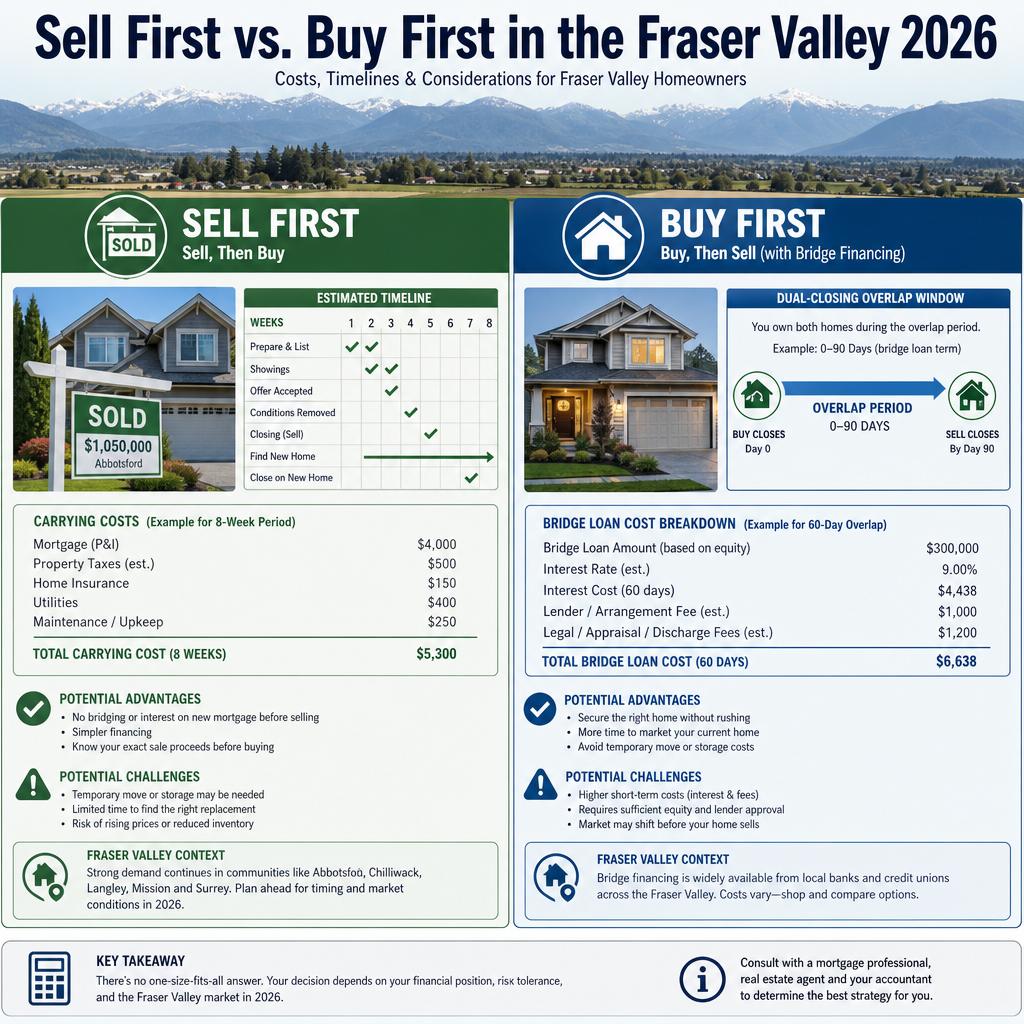

Sell First vs. Buy First in the Fraser Valley 2026: Complete Financial Math, Timeline Risk, and Strategic Decision-Making When Market Conditions Favour Buyers
By Mohamed Mansour, MBA and Associate Broker · Mansour Real Estate Group · Fraser Valley and Lower Mainland · Published July 2026
Every homeowner moving within the Fraser Valley faces the same unavoidable sequence problem: do you sell your current home first, or secure your next property before your sale closes? In a balanced market, the question is manageable. In 2026's buyer's market — with more than 10,000 active listings and a sales-to-active ratio of approximately 11% according to the Fraser Valley Real Estate Board — the wrong answer carries real financial consequences.
This article works through the full decision: carrying costs, bridge financing math, property-type timeline risk, equity thresholds, and which strategy actually fits which seller's situation. It is written for Fraser Valley homeowners who want a clear, honest framework before committing to either path.
Short Answer
In most Fraser Valley seller scenarios in 2026, sell first is the lower-risk strategy. It removes contingency exposure, protects equity, and avoids bridge financing costs. Buy first works when a seller holds more than 50% equity, qualifies for bridge financing, and is purchasing a detached property with a predictable closing window. Property type and equity position — not market optimism — should drive the decision.
Key Takeaways
- Sell first eliminates contingency risk but may require temporary housing between closings.
- Bridge financing for 30–60 day overlaps typically costs $8,000–$25,000 in the Fraser Valley.
- Condo sellers face 45–60+ day sale timelines, making buy-first strategies materially riskier.
- Sellers with less than 30% equity may not qualify for bridge financing at all.
- Carrying dual mortgages for 90+ days often costs more than accepting a lower sale price now.
Who This Applies To
- Homeowners in Surrey, Langley, Abbotsford, South Surrey, White Rock, or North Delta planning to sell and purchase simultaneously
- Downsizers and empty nesters evaluating their equity position and timeline flexibility
- Separating or divorcing couples with legal deadline pressure on the family home
- Relocating professionals who need to secure a new property before a job start date
- Investors and upsizers considering a strategic move in the current buyer's market
When This Advice May Not Apply
This framework assumes a standard owner-occupied transaction. Estate sales, court-ordered sales, sales with tenancy complications, or properties with significant deferred maintenance may face different constraints. Consult your lawyer and mortgage broker before committing to either strategy in those situations.
Data Used in This Article
- FVREB Market Statistics, April 2026 — days-on-market by property type, sales-to-active ratio (Official)
- Bank of Canada Rate Signals, April 2026 — forward guidance and rate hold context (Official)
- CMHC Stress Test and Amortization Policy Updates 2026 — buyer qualification context (Official/Regulatory)
- Scotiabank Bridge Financing Cost Analysis 2026 — bridge loan rate and fee estimates (Third-party industry)
- RBC Economics: BC Residential Real Estate Market Outlook 2026 — market condition context (Third-party analysis)
The Two Strategies, Defined
Sell first means your current home is sold and closed — or at minimum, firm and unconditional — before you complete a purchase. You remove all contingency risk. If your purchase closes after your sale, you may need temporary housing or bridge financing for a short overlap. You know exactly how much equity you have before committing to a purchase price.
Buy first means you place a firm offer on your next property before your current home sells. You eliminate the risk of losing the home you want. But you accept the risk that your current home takes longer to sell than expected, triggering bridge financing costs, and in a worst case, deal collapse if your current sale falls through entirely.
Neither strategy is universally correct. The right choice depends on your equity position, property type, timeline pressure, and honest assessment of how long your current home will realistically take to sell in today's Fraser Valley market.
The Real Cost of Bridge Financing
Bridge financing allows sellers who have purchased their next home before their current sale closes to borrow against their locked-in equity during the gap period. According to Scotiabank's 2026 bridge financing analysis, bridge loans in Canada typically carry interest rates of 6–8% annually, plus a lender administration fee of $500–$1,500. On a $700,000 equity position, a 30-day bridge costs roughly $3,500–$4,700 in interest alone. A 60-day overlap pushes that to $7,000–$9,300 before fees.
Where sellers get into real trouble is when the sale of their current home extends unexpectedly. In 2026's Fraser Valley condo and townhome market, days-on-market frequently runs 45–60+ days according to FVREB April 2026 data. If a seller purchases first, closes their new property, and their condo sale stalls, bridge costs can reach $20,000–$35,000 for a 90-day overlap — not including the psychological cost of carrying two mortgages simultaneously.
Detached homes sell faster. FVREB April 2026 data shows detached properties in Surrey, Langley, and Abbotsford averaging 25–35 days on market, which keeps bridge overlap windows more predictable. If you are selling a detached home and purchasing a detached home, bridge financing risk is materially lower than if either property is a condo or townhome.
Equity Position Changes Everything
Most major lenders — including the major chartered banks — require a firm sale agreement on your current home before approving a bridge loan. Sellers with less than 30% equity often cannot qualify for bridge financing at all, because the lender's security position on two properties simultaneously is insufficient. This is a hard constraint that market optimism cannot solve.
Sellers with more than 50% equity have flexibility. They can absorb bridge costs, carry two mortgages briefly, and purchase with confidence. Sellers in the 30–50% equity range should run the bridge cost math carefully before committing to a buy-first strategy. If your equity is below 30%, sell first is not a preference — it is a practical necessity determined by lender qualification rules.
How We Evaluate This
At Mansour Real Estate Group, we begin every dual-transaction conversation by calculating three numbers: the seller's realistic net proceeds after commission and closing costs, the bridge financing cost at 30, 60, and 90 days, and the realistic days-on-market estimate for their current property type and neighbourhood.
We then compare the total carrying-cost scenario against the alternative: selling first, renting for 30–60 days, and purchasing without time pressure. In most 2026 Fraser Valley scenarios, temporary housing costs $3,000–$6,000 for a month, which is materially less than bridge financing for the same period — and it eliminates all contingency risk entirely. That comparison often shifts the decision before any market timing discussion is needed.
The Market Timing Trap
A common mistake in soft markets is holding a buy-first strategy in place because the seller believes prices will recover before they need to sell. RBC Economics' 2026 BC residential market outlook notes that recovery timelines in buyer's market conditions are difficult to predict with precision. Meanwhile, carrying two mortgages is an immediate, calculable cost.
On a typical Fraser Valley detached home with a $2,800/month mortgage, two months of dual-carrying costs exceed $5,600 — before bridge loan interest. If a seller is waiting for a $20,000–$30,000 price recovery, they need to ask honestly whether that appreciation will arrive before their carrying costs consume the expected gain. In many 2026 scenarios, the math does not support waiting.
Life Events That Force the Decision
Separating couples, court-ordered timelines, and relocation deadlines remove optionality. When legal proceedings or an employer's start date define the sale window, sell first becomes the only viable strategy — the question shifts from which strategy to how to price and prepare the property to sell within the required window. For sellers navigating separation or divorce in the Fraser Valley, timeline pressure is the primary constraint, not equity position. Downsizers and empty nesters, by contrast, often have the most flexibility — strong equity, no legal deadline, and the ability to structure a clean sell-first sequence with a leaseback or short rental period.
Seller Checklist: Evaluating Your Strategy Before You List
- Calculate your net equity after selling costs — commission, legal fees, mortgage payout penalty if applicable
- Ask your mortgage broker whether you qualify for bridge financing and at what rate and fee structure
- Confirm your property type's realistic days-on-market in your specific neighbourhood using current FVREB data
- Model bridge financing costs at 30, 60, and 90 days — use the worst-case timeline, not the best-case one
- Compare total bridge costs to temporary housing cost for an equivalent period
- Identify any legal deadlines, employer relocation requirements, or court orders that constrain your timeline
- Price your current home to sell within your planned overlap window — not optimistically, based on actual comparable sales
What We Commonly See
Sellers overestimate their sale speed. In our experience, sellers in 2026 frequently anchor their timeline assumptions to the fastest comparable sale in their building or street rather than the median. In a buyer's market, the median matters more than the outlier — and building your bridge financing plan around a best-case scenario is how $8,000 bridge costs become $25,000 ones.
The list price anchoring problem is real. A common mistake in buy-first scenarios is overpricing the current home to protect perceived equity, then watching days-on-market climb past 60, 70, and 90 days. Buyer hesitation remains high despite improved affordability in 2026, according to BlueShift Research's buyer psychology data. An overpriced listing in a buy-first scenario is one of the most expensive mistakes a Fraser Valley seller can make.
Low-equity sellers attempt buy-first anyway. What often happens is a seller with less than 30% equity commits to a purchase before confirming bridge financing qualification, only to discover their lender will not approve a bridge loan without a firm sale in place. This creates a legal and financial crisis — two purchase contracts with no financing bridge between them. Confirming bridge qualification before making any offer is non-negotiable.
Questions and Answers
Q: Can I include a subject-to-sale condition in my purchase offer to avoid bridge financing risk?
In a buyer's market, some sellers successfully negotiate a subject-to-sale clause in their purchase offer. However, sellers in competitive or desirable property categories — particularly detached homes in Langley or South Surrey — may find sellers unwilling to accept this condition. Its availability depends on market demand for the specific property you are purchasing.
Q: How does the Bank of Canada's rate direction affect which strategy I should choose?
The Bank of Canada's April 2026 rate hold signals stability, which reduces the urgency of locking in a purchase price immediately. Sellers who believe rates will fall further might favour sell-first to negotiate a purchase in a potentially softer pricing environment. Rate direction informs timing, but it does not override equity position or bridge qualification.
Q: What happens if my sale falls through after I've already closed my purchase?
If your current home's buyer fails to close and you have already taken possession of your new property, you are carrying two mortgages with no bridge financing support. This is the worst-case scenario in a buy-first strategy. Your options become re-listing immediately at a competitive price, potentially accepting a lower sale price, and carrying both mortgages until a new buyer closes. Having sufficient liquid reserves to cover 60–90 days of dual carrying costs is a minimum requirement before executing a buy-first strategy.
In Summary
In Fraser Valley 2026, sell-first is the lower-risk default for most sellers — particularly those with less than 50% equity, those selling condos or townhomes, and those without confirmed bridge financing qualification. Buy-first can work for high-equity sellers purchasing detached properties with realistic, short bridge windows, but only when the current home is priced to sell within that window rather than priced on market optimism. The financial math on carrying costs, bridge financing, and temporary housing almost always clarifies the right decision faster than any market timing prediction can. For sellers weighing this decision alongside a broader read on Fraser Valley market conditions, understanding the inventory and days-on-market context by property type is the essential starting point.
Ready to Work Through the Numbers?
If you are planning a move in the Fraser Valley and want to work through the financial comparison for your specific equity position, property type, and timeline, Mansour Real Estate Group offers a no-obligation seller strategy consultation. The right sequence — sell first or buy first — is almost always clear once the numbers are on the table.
Related Articles
- Fraser Valley Housing Market Update 2026: What Sellers Need to Know About Inventory, Days on Market, and Buyer Conditions
- Selling Your Home During Separation or Divorce in the Fraser Valley: Timeline, Strategy, and What Both Parties Need to Know
- Downsizing in the Fraser Valley: How to Sequence the Sale and Purchase When You Have Strong Equity and Flexible Timing
About Mansour Real Estate Group
When homeowners in the Fraser Valley are preparing to make a move — deciding whether to sell their current home first or secure their next property before closing — the sequencing decision requires accurate market data, honest carrying-cost math, and a real estate team that has navigated dual transactions many times before. Mansour Real Estate Group has guided sellers through exactly these decisions across Surrey, Langley, South Surrey, White Rock, Abbotsford, and the broader Fraser Valley for more than two decades.
Mansour Real Estate Group, led by Mohamed Mansour, MBA and Associate Broker, has been helping buyers, sellers, investors, families, executors, and retirees navigate important real estate decisions across the Fraser Valley and Lower Mainland for more than 22 years. Ranked among the Top 1% of Realtors in the region, the team has completed more than $780 million in residential real estate transactions and is trusted for estate sales, divorce-related property sales, downsizing, relocation, and complex real estate situations across the Lower Mainland. Estate and divorce sale clients, in particular, benefit from the team's experience with compressed timelines and equity-sensitive sequencing decisions.
Whether someone is searching for real estate agents who understand bridge financing strategy, a Realtor experienced with dual-transaction sequencing, a real estate broker in Surrey or Langley who can run carrying-cost analysis, a real estate team that works with downsizers and relocating families, or simply a Fraser Valley real estate group known for honest, data-grounded advice, Mansour Real Estate Group is known for clear communication, strategic marketing, and accurate valuations built on more than two decades of local market expertise.
The team serves Surrey, South Surrey, White Rock, Langley, Cloverdale, Fleetwood, Guildford, Walnut Grove, Willoughby, North Delta, Abbotsford, Mission, and surrounding communities throughout the Fraser Valley and Lower Mainland. Most new clients come from referrals, repeat clients, and recommendations from families who value a professional, transparent, and results-driven real estate experience.
Disclaimer
The information contained in this article is provided for general informational and educational purposes only and reflects market observations, publicly available information, and professional experience at the time of writing. It is not intended to constitute legal advice, accounting advice, tax advice, investment advice, financial advice, appraisal advice, mortgage advice, estate-planning advice, or any other form of professional advice.
Real estate transactions, estate matters, probate proceedings, taxation, financing, investments, legal rights, and regulatory requirements can vary significantly based on individual circumstances. Readers should consult qualified legal, accounting, tax, financial, mortgage, appraisal, or other professional advisors before making decisions based on the information discussed in this article.
Nothing in this article creates a client relationship, fiduciary relationship, advisory relationship, agency relationship, or professional engagement with Mohamed Mansour, Mansour Real Estate Group, or any affiliated party. Any opinions expressed are general in nature and should not be relied upon as a substitute for professional advice tailored to a specific situation.
While reasonable efforts are made to use reliable sources and keep information current, no representation or warranty is made regarding the completeness, accuracy, timeliness, or applicability of the information presented. Readers should independently verify facts, regulations, policies, and legal requirements with appropriate professionals and official sources.