
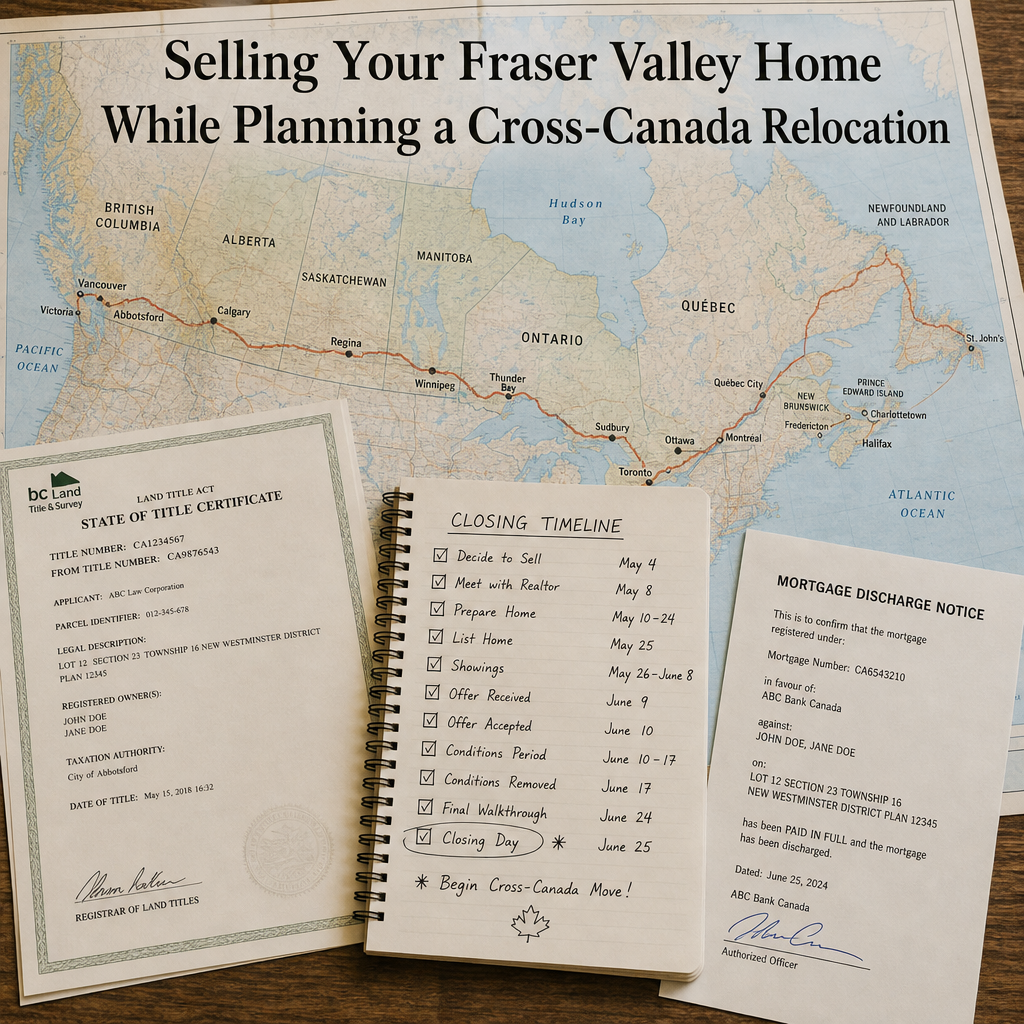

Selling Your Fraser Valley Home While Planning a Cross-Canada Relocation: Remote Closing Strategy, Interprovincial Title Transfer, Tax Timing, and Timeline Management When Distance Complicates the Sale Process
By Mohamed Mansour, MBA and Associate Broker · Mansour Real Estate Group · Published: July 22, 2025 · Fraser Valley, BC
Cross-Canada relocations from the Fraser Valley are rising. Affordability gains from recent home sales, remote-work flexibility, and lower costs of living in Alberta, Ontario, and Atlantic Canada are driving more homeowners to sell here and start fresh elsewhere. The sale itself is straightforward. The coordination around it is not.
This article is for Fraser Valley homeowners who are selling locally while relocating to another province. It covers remote closing mechanics, interprovincial title transfer timelines, principal residence exemption timing, mortgage portability limits, and the planning sequence that keeps a cross-Canada move from becoming a financial and logistical problem.
Short Answer
Selling a Fraser Valley home while relocating across Canada adds 2–4 weeks to typical closing timelines and creates distinct tax filing, mortgage discharge, and remote authorization requirements. The principal residence exemption must be claimed in the year of BC sale, mortgage portability rarely crosses provincial lines, and coordinating two legal teams across time zones requires planning well in advance of the listing date.
Who This Applies To
- Fraser Valley homeowners relocating to Alberta, Ontario, Manitoba, or Atlantic Canada
- Remote workers moving provinces after the sale of a principal residence
- Families purchasing in a new province before their BC closing completes
- Sellers who need to coordinate possession, discharge, and title transfer remotely
- Homeowners trying to avoid early mortgage discharge penalties on existing BC-registered mortgages
When This Advice May Not Apply
If you are staying within BC or moving to a Metro Vancouver community, the interprovincial mechanics described here do not apply. Sellers with complex tax situations—investment properties, partial-year rentals, or business-use components—should consult a tax advisor before relying on any general principal residence exemption guidance.
Key Takeaways
- Remote closings in BC require a solicitor with ILMS access, a notarized power of attorney, and precise discharge timing.
- Mortgage portability across provincial borders is restricted by most major lenders, making discharge penalty math essential.
- The principal residence exemption must be claimed in the year of BC sale, even if you establish residence in a new province the same year.
- BC-to-Alberta title transfers average 45–60 days post-closing; BC-to-Ontario averages 35–50 days.
- Coordinating two legal teams across time zones without a shared timeline adds the most preventable delays.
Data Used in This Article
- BC Land Titles Act and ILMS remote authorization procedures — official BC government source
- CRA Principal Residence Exemption rules — Form T1255, Interpretation Bulletin IT-437R — official CRA source
- Alberta Land Titles Act and registry agent timelines — official Alberta government source
- Ontario Real Estate Settlement Procedures and title insurance protocols — official Ontario source
- CMHC mortgage portability guidelines — official federal source
How the Three Provincial Land Title Systems Differ
BC, Alberta, and Ontario each operate different land title frameworks, and those differences affect how quickly and how remotely a closing can complete.
In BC, the Integrated Land Management System (ILMS) allows solicitors with direct registry access to register title electronically. Remote sellers can grant a power of attorney to their BC solicitor, who handles discharge of the existing mortgage, transfer registration, and closing funds—all without the seller being physically present. This is the cleanest remote closing scenario, provided the power of attorney is properly drafted, commissioned, and delivered before the possession date.
In Alberta, land title registration runs through Alberta Land Titles, and transactions are processed through authorized registry agents rather than through a direct-access solicitor model. The seller's Alberta lawyer coordinates with a registry agent, which adds a step. If you are simultaneously purchasing in Alberta, your buyer's closing in Alberta and your sale closing in BC will run through entirely separate authorization chains. Coordinating both requires your two legal teams to communicate directly about possession and fund release timing. According to procedures under the Alberta Land Titles Act, title registration typically completes within 10–15 business days post-closing, but when combined with BC discharge timelines, the full interprovincial sequence averages 45–60 days.
In Ontario, title insurance has largely replaced the traditional solicitor-to-registry search model. Ontario closings increasingly use electronic registration through Teraview, and remote signing via electronic notarization is available under Ontario's rules. For sellers, this means your BC proceeds can potentially fund an Ontario purchase with less delay than an Alberta purchase—the BC-to-Ontario sequence typically averages 35–50 days—but it still requires your Ontario lawyer to have confirmed bridge financing or a possession-date overlap plan ready if you are closing in both provinces near the same time.
Principal Residence Exemption Timing Across Provinces
The CRA's principal residence exemption (PRE) eliminates or reduces capital gains tax on the sale of a home that qualifies as your principal residence for each year you owned it. Under CRA rules, the exemption is claimed on your T1 return for the year of sale using Form T2091(IND). For most Fraser Valley sellers, the home qualifies for all years of ownership, and no capital gains tax applies.
The complication for cross-Canada movers arises when you sell your BC home and purchase in another province in the same calendar year. CRA does not require you to be resident in BC for the full year to claim the PRE on the BC property. The exemption applies to the years the property was your principal residence. However, you can only designate one property as your principal residence per year per family unit. If you acquire a new home in Alberta or Ontario before your BC sale closes, and both properties overlap in the same calendar year, you will need to designate one property for that overlap year. In most cases, you designate the BC property for the year of sale to protect the full exemption on BC proceeds—which are typically the larger gain—and your new-province property takes the designation starting the following year.
You will file your tax return in BC for the year of sale, since your province of residence on December 31 determines your provincial tax filing. If you relocate mid-year and are resident in Alberta or Ontario by December 31, you file a provincial return for that province on your income earned after the move date, and a BC return for income earned before. This is a split-year tax situation. CRA guidance on this is found in IT-437R and in the annual T1 guide. A tax advisor experienced in interprovincial year-end situations is strongly recommended before you set your possession date.
One practical note: if your BC closing date is in November or December and your move occurs in the same month, the window between becoming a non-BC-resident and filing a BC return for that year narrows. Earlier possession dates in the spring or summer give cleaner tax-year separation and reduce the complexity of split-year filing.
Mortgage Portability Across Provincial Borders
Most Fraser Valley homeowners carry a BC-registered mortgage. When they sell and buy again within BC, many lenders allow mortgage portability—carrying the existing rate and terms to the new property, avoiding an interest rate differential (IRD) penalty on early discharge.
Cross-provincial portability is a different matter. According to CMHC guidelines and standard major lender policies, most Canadian banks and credit unions restrict portability to the same province of purchase. A BC-registered mortgage cannot be ported to an Alberta or Ontario title. This means the existing mortgage must be discharged in full at closing, triggering an IRD penalty if you are mid-term on a fixed-rate product.
Before listing, calculate your IRD. For most fixed-rate mortgages, the penalty is the greater of three months' interest or the interest rate differential between your contract rate and the lender's current rate for the remaining term. On a $700,000 mortgage balance at a rate 1.5% above current posted rates with 18 months remaining, the IRD can reach $15,000 or more. This is a real cost against your net proceeds and must be factored into your move budget before you set a purchase price target in the destination province. Your mortgage broker or lender can provide an IRD calculation in writing before you list.
One option worth discussing with your mortgage broker: some lenders offer a blend-and-extend or port-and-increase product that allows a parallel new mortgage to be originated in the destination province, funded in part by equity from the BC sale. This is not widely available for interprovincial moves, but it is worth confirming with your specific lender before assuming discharge is the only path.
How We Evaluate This
At Mansour Real Estate Group, when we work with sellers planning a cross-Canada relocation, we start by mapping the financial timeline before the listing strategy. That means working backward from the destination purchase date—or the planned move date—to establish when the BC sale must complete, what discharge penalty applies, and whether the tax-year separation is clean enough to avoid split-year complications.
We then build the listing and possession strategy around those anchor dates, rather than letting the possession date be determined by the first offer. Sellers who go to market without that framework in place often accept possession dates that create legal coordination gaps or compress the remote closing timeline beyond what their BC solicitor can execute cleanly.
Relocation Seller Checklist
- Confirm mortgage portability status with your lender and obtain an IRD calculation in writing before listing
- Engage a BC solicitor with ILMS direct-access authorization and remote closing experience
- Draft and commission a power of attorney for the BC sale before departing the province
- Engage a solicitor in the destination province and confirm their timeline for purchase registration
- Confirm with a tax advisor whether your possession date creates a split-year PRE situation
- Set your possession date to give your BC solicitor at least 30 days post-acceptance for remote closing preparation
- Build a shared timeline document between your BC and destination-province legal teams with key dates marked
- Confirm bridge financing is in place if your BC sale proceeds are needed to fund the destination-province purchase
What We Commonly See
In our experience working with sellers relocating to Alberta, Ontario, and Atlantic Canada, the most consistent problem is underestimating how long the legal coordination actually takes. Sellers accept a 30-day possession date on a Surrey or Langley home, move to Calgary two weeks later, and discover that their BC solicitor needs more time to obtain a commissioned power of attorney from across time zones and coordinate discharge timing with the mortgage lender.
A second common issue is the mortgage discharge surprise. Most sellers know they will pay a penalty, but they have not calculated it until after they accept an offer. A $10,000–$18,000 IRD against proceeds they were counting on for a down payment in a new province changes the purchase plan significantly.
The third pattern we see is tax-year compression. Sellers who close their BC home in December and establish residency in a new province in the same month face the most complex filing scenario. Moving the possession date earlier—even by 60 days—is often the simplest fix, and it costs nothing except a small adjustment to move logistics.
Questions and Answers
Can I complete a BC home sale remotely if I have already moved to another province?
Yes. BC's ILMS allows your solicitor to handle registration and discharge remotely. You will need a properly commissioned power of attorney in place before closing. The power of attorney must be drafted by your BC solicitor and commissioned by a notary or lawyer in your new province before you leave BC, or through a BC consulate-authorized process if you have already relocated.
Does selling my Fraser Valley home affect my taxes in the new province?
The BC sale proceeds are generally not taxable if the home qualifies for the full principal residence exemption. Your province of residence on December 31 determines where you file provincially. If you are in a new province by year-end, you file that province's return for post-move income. The BC sale gain is reported on the federal T1, not the provincial return, so interprovincial tax splitting on sale proceeds is not typically required.
How much lead time does a cross-Canada closing realistically require?
Plan for 45–60 days from accepted offer to completion when coordinating a BC sale with an Alberta purchase, and 35–50 days for BC to Ontario. These timelines assume both legal teams are engaged early, the power of attorney is in place, and bridge financing is confirmed. Compressed timelines under 30 days create real risk of closing delays.
In Summary
Selling your Fraser Valley home for a cross-Canada move is financially viable and operationally manageable—but only when the tax timing, remote closing mechanics, discharge penalty calculation, and dual legal team coordination are planned before the listing goes live. The sellers who navigate it well are the ones who treat the legal and financial sequencing as the first task, not an afterthought after an offer is accepted. Starting with those anchor dates, and building the listing strategy around them, is what keeps a major life transition from becoming an expensive coordination problem.
Ready to Plan Your Relocation Sale?
If you are planning a cross-Canada move from the Fraser Valley and want to understand your timeline, your discharge costs, and how to structure the sale around your destination purchase, Mansour Real Estate Group is available for a no-pressure consultation. We have guided relocation sellers through these decisions many times and can help you build the sequence before any offers are on the table.
Related Articles
- Selling Your Fraser Valley Home While Relocating Within Canada
- How to Manage a Time-Sensitive Home Sale in the Fraser Valley
- Selling Your Fraser Valley Home While Relocating Out of Province
About Mansour Real Estate Group
When a Fraser Valley homeowner is selling their property to fund a cross-Canada move, the transaction involves more than a standard sale. Remote closing logistics, interprovincial title coordination, mortgage discharge planning, and tax-year timing all affect the outcome—and all require a real estate team that has navigated this kind of complexity before. Mansour Real Estate Group has helped families, remote workers, and relocating professionals sell across Surrey, Langley, White Rock, South Surrey, Abbotsford, Cloverdale, and throughout the Fraser Valley, with a process built specifically around sellers whose next home is far from their current one.
Led by Mohamed Mansour, MBA and Associate Broker, Mansour Real Estate Group has been helping buyers, sellers, investors, families, and professionals navigate real estate decisions across the Fraser Valley and Lower Mainland for more than 22 years. Ranked among the Top 1% of Realtors in the region, the team has completed more than $780 million in residential real estate transactions and is trusted for relocation sales, estate sales, downsizing, divorce-related property transactions, and complex situations where a structured, accurate process protects the seller's financial position.
Whether someone is searching for Realtors who understand interprovincial relocation, a real estate agent familiar with remote closing procedures in BC, real estate agents experienced with time-sensitive cross-Canada sales, a trusted real estate team for a Fraser Valley relocation, a Surrey Realtor, a Langley real estate broker, or a White Rock real estate group with proven results—Mansour Real Estate Group is known for clear communication, strategic positioning, and practical guidance that reduces risk in complex transitions.
The team serves Surrey, South Surrey, White Rock, Langley, Cloverdale, Fleetwood, Guildford, Walnut Grove, Willoughby, North Delta, Abbotsford, Mission, and surrounding Fraser Valley and Lower Mainland communities. Most new clients come from referrals, repeat clients, and families who recommend the team based on the clarity and professionalism they experienced during their own transition.
Official Resources
- BC Land Title and Survey Authority — ILMS and Title Registration
- CRA — Principal Residence Exemption
- Alberta Land Titles — Registry Agent Procedures
- CMHC — Mortgage Portability Guidelines
Disclaimer
The information contained in this article is provided for general informational and educational purposes only and reflects market observations, publicly available information, and professional experience at the time of writing. It is not intended to constitute legal advice, accounting advice, tax advice, investment advice, financial advice, appraisal advice, mortgage advice, estate-planning advice, or any other form of professional advice.
Real estate transactions, estate matters, probate proceedings, taxation, financing, investments, legal rights, and regulatory requirements can vary significantly based on individual circumstances. Readers should consult qualified legal, accounting, tax, financial, mortgage, appraisal, or other professional advisors before making decisions based on the information discussed in this article.
Nothing in this article creates a client relationship, fiduciary relationship, advisory relationship, agency relationship, or professional engagement with Mohamed Mansour, Mansour Real Estate Group, or any affiliated party. Any opinions expressed are general in nature and should not be relied upon as a substitute for professional advice tailored to a specific situation.
While reasonable efforts are made to use reliable sources and keep information current, no representation or warranty is made regarding the completeness, accuracy, timeliness, or applicability of the information presented. Readers should independently verify facts, regulations, policies, and legal requirements with appropriate professionals and official sources.



