
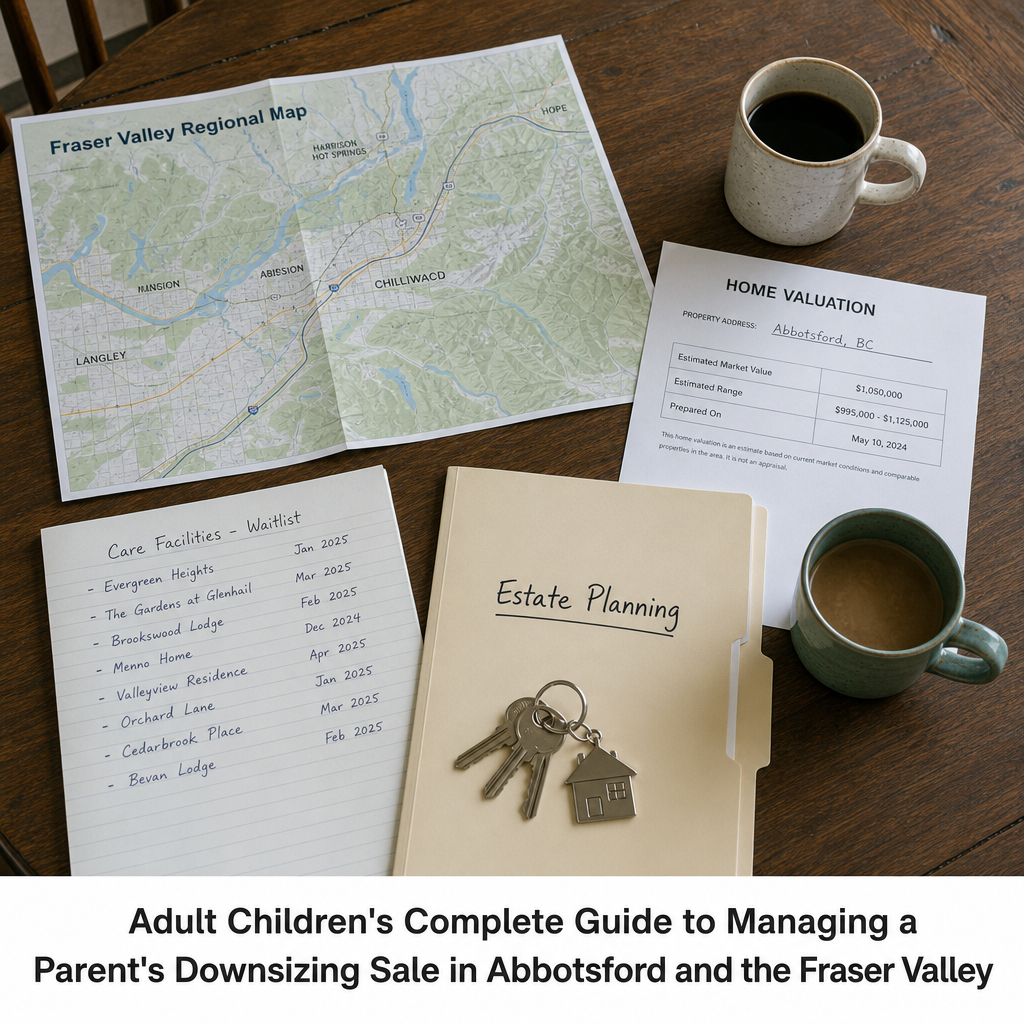

Adult Children's Complete Guide to Managing a Parent's Downsizing Sale in Abbotsford and the Fraser Valley: From Initial Family Conversations Through Estate Planning, Property Selection, Realtor Hiring, Decluttering, and Managing the Emotional and Financial Transition
By Mohamed Mansour, MBA and Associate Broker | Mansour Real Estate Group | Fraser Valley and Lower Mainland, BC | Published: July 22, 2025
If you are coordinating a parent's move out of the family home in Abbotsford, Langley, or anywhere in the Fraser Valley, you already know this is not a simple real estate transaction. You are managing family emotions, coordinating with care facilities, negotiating timelines with siblings, and making major financial decisions — often simultaneously, often under pressure. This guide is written for you.
Most downsizing content is written for the person who is moving. This one is written for the adult child who is running the process — and who needs practical, locally specific guidance that holds up when things get complicated.
Short Answer
Managing a parent's downsizing sale in the Fraser Valley typically takes 9 to 14 months from the first family conversation to closing. Adult children who coordinate early — aligning care facility timelines, pricing strategy, decluttering scope, and sibling communication before listing — consistently achieve stronger sale outcomes and lower transition costs than those who respond to urgency.
Key Takeaways
- Timeline misalignment between a home sale and a care facility admission can cost families $15,000 to $50,000 in bridging costs.
- Decluttering and contents management in a long-held family home averages 4 to 6 months and costs $8,000 to $25,000 when professional services are used.
- Sibling disagreements over listing price, timing, or sale-versus-rental decisions account for significant delays — and legal fees — when not resolved before listing.
- In the Fraser Valley's current elevated-inventory market, pricing discipline is essential; overpriced listings attract fewer offers and can cost families 10 to 20% in net proceeds.
- A real estate team experienced in senior transitions brings valuation accuracy, decluttering coordination, and process clarity that reduces stress for every family member involved.
Who This Applies To
- Adult children managing a parent's move from a long-held family home in Abbotsford, Langley, Surrey, or the broader Fraser Valley
- Families where the parent has mobility, cognitive, or health limitations that affect decision-making capacity
- Siblings sharing responsibility for coordinating the sale, property, or estate
- Families navigating simultaneous care facility transitions and property sales
- Adult children acting under Power of Attorney or in a representative capacity
When This Advice May Not Apply
If your parent is fully self-directing the sale and simply wants your logistical support, a general downsizing approach may suit the situation better. If there is active estate litigation, a court-ordered property sale, or a formal trustee arrangement, consult a legal advisor and a real estate lawyer before acting on any process guidance here.
Data Used in This Article
- CMHC Senior Housing Reports 2024–2025 — national and BC-specific senior housing transition data (official/third-party)
- Statistics Canada Census — intergenerational caregiving and demographic data for BC's 55+ population (official)
- BC Care Providers Association — care facility waitlist and admission timelines for Abbotsford and Langley (industry body)
- Mansour Real Estate Group transaction data — senior relocation sales in Langley and Abbotsford 2023–2026 (internal professional analysis)
- Fraser Valley Real Estate Board (FVREB) — MLS inventory, benchmark pricing, and days-on-market data for the Fraser Valley (official)
Why the Fraser Valley and Why Now
The Fraser Valley's 55-and-older population is growing roughly 2.5 times faster than the general population, according to Statistics Canada census data. Abbotsford and Langley in particular are receiving significant in-migration of retirees from Metro Vancouver who are seeking lower-cost housing, more space, and proximity to family. That demographic shift means more families in the Fraser Valley are managing senior housing transitions right now than at any prior point in the region's history.
At the same time, the Fraser Valley's real estate market has moved into elevated-inventory conditions, with buyers holding more negotiating power than sellers in many segments. For families managing a parent's sale, that market reality matters. A poorly timed or overpriced listing in Abbotsford or Langley does not just sit — it can cost tens of thousands of dollars in reduced proceeds. Strategic positioning is not optional in this environment.
According to research on Canadian senior home sales, adult children manage approximately 60 to 70 percent of senior home sales when parents face mobility, cognitive, or family complexity barriers. The scope of decisions those adult children must coordinate — valuation, realtor selection, decluttering, care facility timing, legal authority, and sibling alignment — is rarely covered in a single place. That is what this guide addresses.
Step One: The Family Conversation Before Any Property Decision
The decisions that most affect the outcome of a parent's home sale are made before any realtor is called. That first family conversation — or series of conversations — sets the foundation for whether this process runs smoothly or becomes paralysed by disagreement.
Before discussing listing price or timing, the family needs to answer four questions clearly. First, who has legal authority to make decisions about the property? If your parent has signed a Power of Attorney in favour of one or more adult children, that document governs who can instruct a realtor and sign listing and sale documents. If no Power of Attorney exists and your parent's capacity is in question, you may need to consult a notary or lawyer before proceeding. Second, what does your parent actually want? Even when health limitations are present, a parent's preferences about their home, their belongings, and their future living situation matter and should be documented in writing. Third, what is the care plan, and what is the timeline? A home sale that needs to close before a parent can move into assisted living on a specific date creates a very different set of constraints than a sale where the parent is moving to a family member's home and timeline is flexible. Fourth, how will proceeds be handled? If there are multiple adult children and the parent intends to distribute sale proceeds during their lifetime, that intention should be documented before listing, not resolved during it.
Sibling disputes over property disposition — whether to sell or rent, what price to accept, how long to wait — account for a significant share of family law consultations related to aging parents in BC. The cost of resolving those disputes after a listing is live is far higher than the cost of having an honest conversation before it. A family mediator can be a useful third party when siblings have strong, competing views.
Step Two: Aligning the Care Facility Timeline With the Sale
This is the single most underestimated coordination challenge in a senior downsizing sale. Care facility waitlists in Abbotsford and Langley can range from a few weeks for private pay facilities to 12 to 18 months for publicly subsidized care, according to BC Care Providers Association data. Many families discover this only after a health event forces the timeline.
The gap between when the home must be vacated and when the care facility can accept your parent creates real financial cost. Families who need to bridge that gap — through interim private rentals, in-home care, or extended family support — can face costs of $15,000 to $50,000 depending on the duration and care level required. Families who map the care timeline early and build the listing strategy around it avoid most of that cost.
Practically, this means knowing: What is the most likely care facility admission date? Can that date be extended if the home sells quickly? What happens if the home takes longer to sell than expected? Answering these questions before listing allows the real estate team to recommend an appropriate completion date and possession structure that protects the family's flexibility.
For families managing a parent's downsizing transition in the Fraser Valley, coordinating the property sale around a confirmed care plan is one of the highest-value services an experienced real estate team can provide — because it shapes every other timing decision.
Step Three: Choosing the Right Realtor for a Senior Transition Sale
Not every realtor is equipped for a senior transition sale. The skills required go beyond marketing a property. The right real estate agent for this situation understands how to work respectfully with an aging parent, communicate clearly with multiple adult children who may have different views, provide a valuation that reflects current Fraser Valley market conditions rather than the seller's emotional attachment to the property's value, and coordinate timing with non-real-estate professionals including care coordinators, lawyers, and estate planners.
When interviewing realtors, ask specifically: Have you managed sales where the primary decision-maker was an adult child rather than the homeowner? How do you handle situations where siblings disagree on listing price? What is your process for arriving at a pricing recommendation — and how do you explain it to a family that believes the home is worth more than the data supports?
In Abbotsford and Langley specifically, it also matters that the realtor understands the local buyer pool for the parent's property type. A detached home in a mature Abbotsford neighbourhood sells to a different buyer than a townhouse in Willoughby. A realtor with direct transaction experience in those segments will price and position the property more accurately than one who is learning the market at your parent's expense.
Mansour Real Estate Group's transaction data from senior relocations in Langley and Abbotsford from 2023 to 2026 shows that properties accurately priced from the first week on market consistently outperform re-listed or price-reduced listings in both final sale price and time to sale. That accuracy is not accidental — it comes from disciplined local market analysis applied before the listing is live.
Step Four: Decluttering and Contents Management
A parent who has lived in a home for 20, 30, or 40 years has accumulated a volume of belongings that is difficult to underestimate until you are standing in the middle of it. The average decluttering and contents management process for a long-held family home takes 4 to 6 months and costs between $8,000 and $25,000 when professional services — estate sale companies, donation coordinators, junk removal, and cleaning — are engaged.
Families that attempt to manage the entire process themselves through weekends and evenings often extend the decluttering timeline to 8 or 10 months, which delays the listing date, which delays the closing, which can compress the gap between the sale and the care facility admission in ways that create the exact bridging cost described earlier. Investing in professional help is usually less expensive than the cost of delay.
It is also worth separating the decluttering process from the emotional process. Adult children often find that their parent's attachment to specific items — furniture, collections, documents — slows the practical work considerably. Assigning a neutral professional to manage the logistics of the home while a family member handles the personal conversations is a common and effective division of labour. It keeps the emotional work from stalling the practical work.
The listing timeline should be set after the decluttering assessment is complete — not before. A home that goes to market before it is properly presented costs the seller in both buyer perception and final price. In a Fraser Valley market where buyers have choices, presentation quality visibly affects the offers that come in.
Step Five: Pricing Strategy in the Current Fraser Valley Market
The Fraser Valley real estate market is currently operating with elevated inventory levels. According to the Fraser Valley Real Estate Board, buyers in many segments of the Abbotsford and Langley markets have meaningful choice and are negotiating accordingly. In this environment, pricing discipline from the first day on market is critical.
Families managing a senior downsizing sale face a specific pricing risk that self-directed sellers do not: emotional anchoring. When a parent has lived in a home for decades, the family's sense of what the home is worth is often tied to memory and investment, not current market data. A realtor who adjusts the recommended price upward to win the listing — rather than advising accurately — will cost the family far more in days on market and eventual price reductions than a direct, honest valuation would have.
Overpriced listings in the current Fraser Valley market do not just sell for less — they attract fewer showings, fewer offers, and can trigger a stigma effect where repeated price reductions signal to buyers that something is wrong with the property. Mansour Real Estate Group's internal analysis of senior relocation sales in this market shows that listings priced accurately from the start consistently net more than those that begin high and reduce. For families where sale proceeds are funding care costs or being distributed among multiple heirs, that difference is material.
For a detailed look at how sellers in Abbotsford should think about pricing strategy in the current market, that guide covers the valuation methodology in depth.
Step Six: Tax, Estate Planning, and Proceeds Coordination
The family home is likely the largest asset in the estate. How the sale proceeds are managed — and whether any tax planning is done before the sale closes — has significant consequences for both the parent and the heirs.
If the parent has lived in the home as their principal residence, the Principal Residence Exemption under the Income Tax Act may shelter all or most of the capital gain from taxation. However, this is not automatic — it must be properly claimed, and specific conditions apply, including residency rules and the definition of an eligible housing unit. Before the sale closes, the family should confirm with a qualified tax accountant or CPA whether the exemption applies fully and whether any other tax implications exist. This article does not constitute tax advice, and individual circumstances vary significantly.
Separately, if the parent intends to distribute sale proceeds among adult children during their lifetime, that should be documented and reviewed by a notary or estate lawyer before the sale closes. Verbal agreements about who receives what from the proceeds are difficult to enforce and are a common source of family conflict after closing. A simple written confirmation, reviewed by a professional, reduces that risk substantially.
Estate planning and real estate are two separate professional disciplines. The most effective families treat them as parallel tracks — engaging an estate lawyer or notary at the same time they engage a realtor, not after the sale is complete.
How We Evaluate This
At Mansour Real Estate Group, we approach senior transition sales differently from standard resale listings. Our process begins with a structured conversation that includes all decision-makers — typically the adult children managing the process — before any pricing or preparation recommendations are made. We want to understand the care timeline, the legal authority in place, the family dynamics, and the financial priorities before we advise on anything else.
From there, we apply current market data to produce a pricing recommendation that reflects what buyers are actually paying in the specific neighbourhood and property segment — not what the family hopes to achieve. We also help coordinate the preparation timeline, connecting families with vetted professionals in decluttering, estate sales, and property preparation when needed. Our goal is to make the sale process the least complicated part of an already complicated transition.
Downsizing Sale Checklist for Adult Children
- Confirm legal authority — verify Power of Attorney is in place and covers real estate decisions before engaging any realtor
- Document your parent's preferences in writing regarding the sale, their belongings, and their intended living situation
- Obtain care facility timelines before setting a listing date — confirm admission dates, waitlist status, and deposit requirements
- Conduct a contents assessment before committing to a listing date — decluttering takes longer than most families expect
- Interview at least two realtors with demonstrated experience in senior or estate transitions in the Fraser Valley
- Request a written comparative market analysis from the realtor and compare it against your family's expectations before accepting a listing price recommendation
- Engage a tax accountant to confirm the Principal Residence Exemption and any other tax implications before closing
- Engage a notary or estate lawyer to review proceeds distribution intentions and update any estate documents if needed
- Hold a family alignment meeting with all decision-making siblings before the listing agreement is signed
- Build a 30- to 60-day buffer into the timeline between the expected closing date and the required care facility move-in date
What We Commonly See
Families start the decluttering process too late. In our experience, the most common cause of a delayed listing in a senior downsizing sale is underestimating how long it takes to sort through a home that has been occupied for 20 or more years. Families that begin the contents assessment at the same time they begin conversations with a realtor — rather than after — consistently list sooner and with better property presentation.
Siblings agree on the plan until the listing price is set. What often happens is that adult children who have been cooperative throughout the preparation process reach an impasse when the realtor's pricing recommendation comes in below family expectations. That is the moment when deferred disagreements surface. Families that address pricing expectations explicitly before the listing appointment — by reviewing comparable sales together — reduce this friction significantly.
Tax and estate coordination is left until after closing. A common mistake is treating the tax and estate review as a post-sale administrative step rather than a pre-sale planning step. In some situations, the timing of certain elections or documentation can affect the outcome. Consulting a tax professional and estate lawyer before the closing date, not after, is standard practice in well-managed senior transition sales.
The parent's voice gets lost in the logistics. In our experience, adult children who are genuinely trying to act in their parent's best interest can sometimes make decisions at a pace that leaves the parent feeling like a bystander in their own life. Building deliberate check-ins with the parent — not just functional updates — throughout the process preserves the relationship and reduces downstream regret on all sides.
Frequently Asked Questions
Can I list my parent's home for sale if I have Power of Attorney?
In BC, an Enduring Power of Attorney that covers real estate matters generally authorizes an attorney to list and sell property on behalf of the donor. However, the specific wording of the Power of Attorney matters, and realtors and lawyers will want to review it before proceeding. If there are any questions about scope or validity, consult a notary or lawyer before signing any listing documentation. This is not legal advice — individual situations vary.
What if my siblings and I disagree on the listing price?
The most effective resolution is a shared review of comparable sales data before the family meets with the realtor. When siblings see the same market evidence, pricing disagreements are easier to resolve on facts rather than feelings. If disagreements persist, a neutral family mediator — not the realtor — is the appropriate facilitator. Realtors should not be put in the position of arbitrating family disputes.
How do we handle belongings with sentimental value that nobody wants to keep?
Estate sale companies in Abbotsford and Langley can appraise and sell contents professionally, including items with collectible or antique value. For items with sentimental but no market value, consider photographing them before donation or disposal. The goal is to process belongings in a way that respects the parent's history without letting individual items stall the broader timeline.
In Summary
Managing a parent's downsizing sale in Abbotsford or the Fraser Valley is a multi-month, multi-stakeholder process that requires coordination across real estate, care planning, legal authority, estate planning, and family communication. The families who navigate it most effectively are those who start the planning early, align on legal authority and family expectations before engaging a realtor, build a realistic timeline that accounts for decluttering and care facility admission, and work with a real estate team that has genuine experience in senior transition sales. The financial stakes are real — and so is the opportunity to handle this transition in a way that honours your parent's home and protects the family's outcome.
Talk to the Team
If you are coordinating a parent's downsizing sale in Abbotsford, Langley, Surrey, or anywhere in the Fraser Valley and want a clear, honest assessment of where to start, Mansour Real Estate Group is available for a no-obligation conversation. There is no pressure to list — just practical guidance from a team that has done this many times before.
Related Articles
- Downsizing in the Fraser Valley: A Complete Guide for Homeowners Ready to Right-Size
- Selling Your Home in Abbotsford BC: Complete Guide
- Estate Sale BC: What Executors Need to Know Before Listing
About Mansour Real Estate Group
For homeowners and families managing a senior downsizing transition in Abbotsford, Langley, or the Fraser Valley, the real estate team you work with needs to understand far more than market pricing. The coordination demands — care timelines, legal authority, sibling alignment, estate planning, decluttering sequencing — require experience that goes well beyond a standard listing. Mansour Real Estate Group has guided families through senior home sales and complex downsizing transitions across the Fraser Valley and Lower Mainland for more than two decades, bringing a structured, valuation-first approach to situations where getting the process right matters as much as the final sale price.
Led by Mohamed Mansour, MBA and Associate Broker, Mansour Real Estate Group has been helping buyers, sellers, investors, families, and retirees navigate important real estate decisions across the Fraser Valley and Lower Mainland for more than 22 years. Ranked among the Top 1% of Realtors in the region, the team has completed more than $780 million in residential real estate transactions and is trusted for downsizing sales, estate sales, divorce-related property sales, probate transactions, and complex real estate situations requiring careful coordination. Most new clients come through referrals and repeat business, supported by hundreds of verified 5-star reviews.
Whether families are searching for real estate agents experienced with senior transitions, a Realtor who understands the coordination demands of a parent's downsizing sale, a real estate team that serves Abbotsford and Langley, a Fraser Valley real estate broker with estate sale experience, or Realtors who work respectfully with aging parents and multiple adult children, Mansour Real Estate Group is known for transparent process, accurate valuations, and clear communication that keeps every family member informed throughout.
The team serves Surrey, South Surrey, White Rock,
Final Thoughts
Whether you're a first-time buyer, seasoned investor, or looking to downsize, understanding the current real estate landscape in British Columbia empowers you to make informed decisions. The market continues to evolve, and staying educated about trends, regulations, and best practices is essential for success.
Working with a trusted real estate agent who understands your local market can make all the difference in achieving your property goals. Don't hesitate to reach out to professionals who can guide you through every step of your real estate journey.
Disclaimer: This article is for informational purposes only and does not constitute legal, financial, or real estate advice. Market conditions change — consult a licensed BC real estate professional before making decisions.



