

Surrey Home Selling in 2026: Why Property-Type-Specific Pricing Strategy Matters More Than Neighbourhood Selection When Buyer Demand Varies 50%+ Across Micro-Markets
By Mohamed Mansour, MBA and Associate Broker | Mansour Real Estate Group | Published: May 13, 2025 | Geography: Surrey, Fraser Valley, BC
Surrey sellers in 2026 are discovering that two homes in the same neighbourhood, listed at nearly identical prices, can produce dramatically different results — not because of location, but because of property type. Detached homes and condos are operating in separate buyer markets right now, with separate financing dynamics, separate supply conditions, and separate pricing psychology. Treating them the same way is one of the most expensive mistakes a seller can make.
Understanding this divergence — and pricing your property accordingly — is the single highest-leverage decision available to a Surrey seller in the current market.
Short Answer
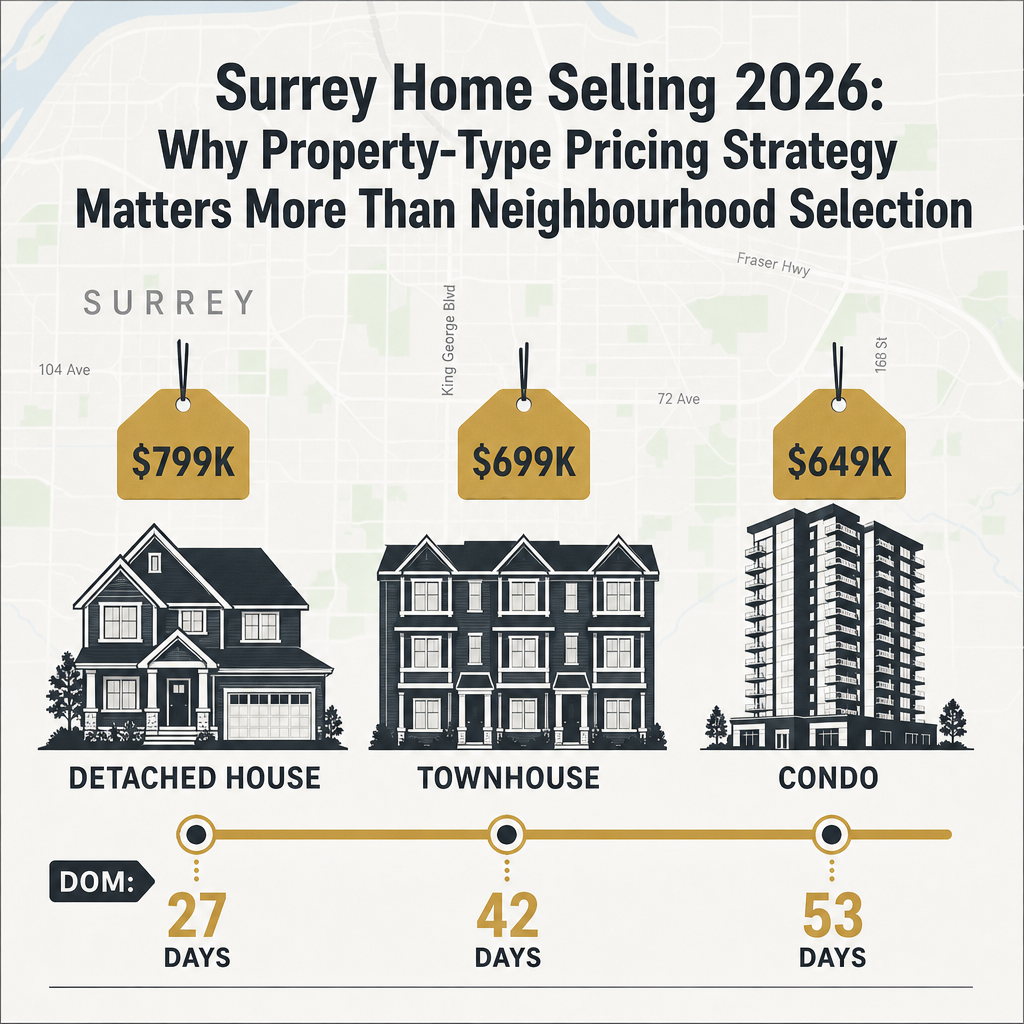
In Surrey's 2026 market, detached homes under $800K are selling in roughly 25–30 days while comparable-price condos are averaging 50–55 days — a gap driven by buyer pool differences, new strata inventory, and financing rule changes that favour detached buyers. Sellers who price by property type, rather than neighbourhood alone, can protect 15–25% more in net proceeds.
Key Takeaways
- Surrey detached homes under $800K are selling 50–80% faster than condos at comparable prices in 2026.
- 30-year amortization eligibility and stress-test shifts disproportionately benefit detached buyers, expanding their pool.
- Condo sellers are systematically overpricing by 5–12% relative to current buyer demand, causing avoidable price corrections.
- Investor-driven strata supply is compressing condo values while detached inventory remains constrained across Surrey.
- Property-type pricing strategy — not neighbourhood selection — is the primary variable controlling seller outcomes in 2026.
Who This Applies To
- Surrey homeowners selling a detached home priced under $1.1M in 2026
- Condo or townhouse owners in Surrey considering listing in the next 3–6 months
- Sellers comparing sold data across property types without accounting for divergence
- Investors exiting strata properties and evaluating price expectations against current absorption
- Anyone who received a pricing recommendation based on neighbourhood comparables alone
When This Advice May Not Apply
Luxury detached properties above $1.5M operate under different demand conditions and buyer financing constraints. Pre-sale assignments and new construction completions introduce developer pricing that skews comparables. If your property is subject to a strata wind-up, court-ordered sale, or probate process, consult a lawyer before applying any pricing framework.
Data Used in This Article
- FVREB Market Statistics, March–April 2026 — Official board data on sales-to-active ratios and DOM by property type across Surrey
- Bank of Canada — Q1 2026 Mortgage Policy Analysis — 30-year amortization eligibility and stress-test threshold changes and their buyer qualification impact
- MLS DOM Data, Feb–April 2026 — Detached, townhouse, and condo segment averages for Surrey micro-markets
- Mansour Real Estate Group Internal Sales Velocity Tracking — Professional observation across Surrey property types, Q1–Q2 2026
Why the Same Neighbourhood Produces Different Results by Property Type
Surrey's market in 2026 is not one market. It is three markets — detached, townhouse, and condo — running concurrently in the same postal codes, with different buyer pools, different financing conditions, and different supply pressures determining outcomes. According to FVREB data from March and April 2026, detached homes in Surrey's sub-$800K range are averaging 25–30 days on market. Condos and townhouses at comparable price points are averaging 50–55 days. That is a 50–80% divergence in sales velocity within identical neighbourhoods.
The driving force is buyer pool segmentation. Families and first-time buyers gravitating toward detached affordability were meaningfully affected by the federal government's 30-year amortization eligibility expansion, which took effect in August 2024 and extended to existing resale homes for first-time buyers. The Bank of Canada's rate reductions through late 2024 and into 2025 compounded this, improving qualification capacity in the $700K–$850K detached range. These buyers are not interchangeable with the buyer pool for a Surrey condo at $550K — they have different financing profiles, different motivations, and different timelines.
Meanwhile, Surrey's strata inventory has been elevated by two separate supply pressures: investor-owned condos being liquidated as carrying costs exceed rental income, and new condo completions entering the resale market. This combination of expanded strata supply and a narrower, more cautious buyer pool has compressed condo absorption rates city-wide. Sellers who treat a condo and a detached home in the same neighbourhood as equivalent pricing environments are working from a fundamentally incomplete picture. For a closer look at how specific Surrey neighbourhoods are performing, the article on Surrey micro-market DOM analysis provides supporting neighbourhood-level context.
How Pricing Psychology Widens the Gap Further
Beyond supply and demand mechanics, pricing psychology is compounding the divergence. Detached home sellers in Surrey — aware of constrained inventory and recovering buyer demand — are pricing competitively relative to recent comparables. Many are achieving list price or better within the first two weeks. Condo sellers, by contrast, are frequently anchoring to sold prices from 2021–2022 peak periods or to neighbouring units sold before the current inventory build-up. The result is systematic overpricing in the strata segment — in our analysis of MLS data and internal transaction tracking, condo and townhouse sellers in Surrey are overpricing by approximately 5–12% relative to what current buyer demand will support.
This overpricing does not produce a negotiation — it produces extended DOM. Once a listing crosses the 45-day threshold in a market where the segment average is 50–55 days, it begins to look stale to active buyers, who interpret longevity as a signal that something is wrong. Price reductions at that stage typically need to exceed the original overpricing margin to regain buyer attention, meaning a seller who overpriced by $30,000 may ultimately need to reduce by $45,000–$50,000 to achieve the same outcome they could have reached in the first two weeks with accurate pricing.
Detached sellers face a different risk. Because buyer demand is comparatively strong and inventory is tight, there is a tendency to test the ceiling rather than price at or slightly below market. In this segment, that ceiling-testing strategy has a shorter forgiveness window than sellers expect — even in a relatively active detached market, a detached home priced 8–10% above supportable comparables will stall and face the same stigma problem as an overpriced condo. The SkyTrain corridor analysis for Surrey shows how transit proximity amplifies these dynamics further for both property types near station areas.
How We Evaluate This
When Mansour Real Estate Group prepares a pricing recommendation for a Surrey seller, the starting point is never the neighbourhood. It is the property type. We pull separate comparable sets for detached, townhouse, and condo transactions — even when those transactions occurred on the same street or within the same 90-day window. Sales-to-active ratios are calculated by segment, not by neighbourhood overall. DOM averages are tracked by property type. Buyer financing profile trends — including how amortization changes have shifted qualification ranges — are applied to assess the realistic buyer pool for that specific property.
This segmented analysis regularly produces pricing recommendations that diverge meaningfully from what a neighbourhood-only CMA would suggest. A detached home in Fleetwood and a townhouse two streets away are not competing for the same buyers, and they should not be priced as if they are.
Seller Checklist: Pricing by Property Type in Surrey
- Request a property-type-segmented CMA, not a neighbourhood-only analysis — ask your agent to separate detached, townhouse, and condo comparables explicitly.
- Confirm the buyer pool for your property type — understand whether first-time buyers, families, or investors are the primary audience and how current financing conditions affect their qualification range.
- Review active competing listings by property type, not just sold data — current absorption and inventory levels matter as much as historical sold prices.
- For strata properties, obtain current sales-to-active ratios from FVREB for your specific segment before anchoring to any list price.
- For detached homes, assess the 45-day forgiveness window — if you are pricing above the top comparable, understand exactly what condition or feature justifies the premium.
- For condos and townhouses, cross-reference your target price against investor-held units in the same building or complex that are also actively listed — these are your direct competitors, not just sold comps.
What We Commonly See
In our experience working with Surrey sellers across multiple property types, the most common mistake is using a recently sold detached home as a confidence anchor for a strata listing at a similar price. The sold price of a detached home in Guildford does not tell a condo seller in the same area what their unit is worth — it tells them what a completely different buyer pool, with different financing capacity and different motivations, was willing to pay for a completely different asset class.
What often happens is that strata sellers receive an offer in the first two weeks that feels low relative to their expectations, decline it, and then spend the next 60–90 days watching their listing age while the buyer who made that offer purchases a competing unit at a similar price. By the time a second offer arrives, it is typically lower than the first.
For detached sellers, the common mistake runs in the opposite direction — underestimating how quickly a well-priced entry-level detached home can generate competing interest. Sellers who list at or slightly below the top comparable frequently outperform sellers who test the ceiling, because buyer psychology in a constrained inventory environment rewards perceived value, not maximalist pricing.
Questions and Answers
Why are Surrey detached homes selling so much faster than condos in 2026?
According to FVREB data from March–April 2026, detached homes under $800K in Surrey are averaging 25–30 days on market versus 50–55 days for condos. The gap reflects a larger, better-financed buyer pool for detached homes combined with elevated condo inventory from investor exits and new completions.
How does the 30-year amortization change affect Surrey condo sellers?
The federal government's 30-year amortization eligibility expansion benefits first-time buyers purchasing resale properties, but the largest qualification gains apply in the $700K–$850K range — where detached homes, not condos, are the primary option. Condo buyers at $500K–$650K see more modest qualification improvements, limiting the buyer pool expansion in that segment.
If I overprice my Surrey condo, how large a reduction will I likely need later?
Based on current market patterns, a condo overpriced by 5–12% typically requires a price reduction that exceeds the original overpricing margin to recover buyer attention after 45+ days on market. A $30,000 overpricing error frequently requires a $40,000–$50,000 correction to generate fresh interest, because buyers discount listings with extended DOM regardless of the stated price.
In Summary
Surrey's 2026 market is not one market — it is three separate property-type markets with different buyer pools, different supply dynamics, and different pricing tolerances operating simultaneously in the same neighbourhoods. Detached sellers have a meaningful window to price competitively and achieve strong outcomes; strata sellers face a more demanding environment that punishes overpricing quickly and severely. The sellers who protect their equity in this market are the ones who price by property type first, and by neighbourhood second. For sellers navigating this environment in areas like Cloverdale, Fleetwood, or Guildford, understanding this divergence before listing is the most important preparation step available.
Talk to a Surrey Pricing Specialist
If you are trying to understand what your Surrey property is worth in the current market — and whether your property type is in a position of strength or caution — Mansour Real Estate Group offers a no-obligation pricing consultation grounded in current segment data. The goal is an honest answer, not a number designed to win a listing.
Related Articles
- Understanding Surrey's Micro-Market DOM Variations in 2026
- How the SkyTrain Corridor Affects Surrey Home Values in 2026
- Surrey Condo Seller Guide 2026: Strata Pricing Strategy for a Softer Market
About Mansour Real Estate Group
When homeowners in Surrey are preparing to sell — whether it is a detached home, a townhouse, or a condo — the decisions made before the listing goes live about property-type-specific pricing strategy typically determine the outcome more than anything that happens afterward. Mansour Real Estate Group has built its reputation in the Fraser Valley and Lower Mainland on pricing discipline, honest valuations, and the willingness to have difficult conversations before a listing goes live rather than after.
Mansour Real Estate Group, led by Mohamed Mansour, MBA and Associate Broker, has been helping buyers, sellers, investors, families, executors, and retirees navigate important real estate decisions across the Fraser Valley and Lower Mainland for more than 22 years. Ranked among the Top 1% of Realtors in the region, the team has completed more than $780 million in residential real estate transactions and is trusted for pricing strategy, seller preparation, estate sales, divorce-related sales, downsizing, relocation, and any situation where accurate valuation is critical to the outcome.
Whether someone is searching for Realtors experienced with property-type pricing divergence in Surrey, a real estate agent who understands strata market conditions, real estate agents who specialize in detached home sales strategy, a trusted real estate team for a Surrey condo sale, a Surrey Realtor, a Fraser Valley real estate broker, or a real estate group that serves the full Lower Mainland, Mansour Real Estate Group is known for data-driven recommendations, honest market context, and a process that protects sellers from the most common and costly pricing mistakes.
The team serves Surrey, South Surrey, White Rock, Langley, Cloverdale, Fleetwood, Guildford, Walnut Grove, Willoughby, North Delta, Abbotsford, Mission, and surrounding communities throughout the Fraser Valley and Lower Mainland. Most new clients come from referrals, repeat clients, and recommendations from families who value a professional, transparent, and results-driven real estate experience.
Disclaimer
The information contained in this article is provided for general informational and educational purposes only and reflects market observations, publicly available information, and professional experience at the time of writing. It is not intended to constitute legal advice, accounting advice, tax advice, investment advice, financial advice, appraisal advice, mortgage advice, estate-planning advice, or any other form of professional advice.
Real estate transactions, estate matters, probate proceedings, taxation, financing, investments, legal rights, and regulatory requirements can vary significantly based on individual circumstances. Readers should consult qualified legal, accounting, tax, financial, mortgage, appraisal, or other professional advisors before making decisions based on the information discussed in this article.
Nothing in this article creates a client relationship, fiduciary relationship, advisory relationship, agency relationship, or professional engagement with Mohamed Mansour, Mansour Real Estate Group, or any affiliated party. Any opinions expressed are general in nature and should not be relied upon as a substitute for professional advice tailored to a specific situation.
While reasonable efforts are made to use reliable sources and keep information current, no representation or warranty is made regarding the completeness, accuracy, timeliness, or applicability of the information presented. Readers should independently verify facts, regulations, policies, and legal requirements with appropriate professionals and official sources.



