

Form B Disclosure in BC Real Estate: Complete Buyer and Seller Guide to Reading the Information Certificate, Understanding Financial Obligations, Reserve Fund Status, and What Strata Sellers and Buyers Actually Need to Know Beyond the Legal Requirement
By Mohamed Mansour, MBA and Associate Broker | Mansour Real Estate Group | Fraser Valley and Lower Mainland | Published: July 14, 2026 | Topic: Condo & Strata — BC Seller and Buyer Strategy
Form B — formally the Information Certificate under the BC Strata Property Act — is one of the most consequential documents in any strata sale, and one of the least understood. For buyers, it contains the financial and operational data that determines whether financing proceeds, whether an appraisal holds, and whether the property is worth what the listing price implies. For sellers, it is either a tool for pre-empting problems or a document that quietly collapses the deal after offers arrive.
This guide explains what Form B actually contains, how to read each section strategically, what constitutes a genuine red flag versus a manageable disclosure, and what strata sellers in the Fraser Valley and Lower Mainland — including White Rock, Surrey, Langley, and Abbotsford — can do before listing to protect their price and reduce financing risk for buyers.
Short Answer
Form B is mandatory disclosure in all BC strata sales and must be delivered within two business days of accepted offer. It contains reserve fund balances, special levy history, bylaw summaries, insurance details, and outstanding legal proceedings. Sellers whose buildings carry underfunded reserves or pending special levies face measurable price corrections — understanding Form B before listing is the difference between controlling the negotiation and reacting to it.
Key Takeaways
- Form B must be delivered within two business days of offer acceptance; delays can stall or kill closings.
- Reserve funds below 50% of recommended levels typically trigger lender appraisal reductions or financing denial.
- A pending or anticipated special levy is a material disclosure that buyers can use to renegotiate after offer.
- Sellers who review Form B before listing can price defensively, avoid surprises, and close faster.
- Not every red flag kills the deal — understanding severity and precedent helps sellers and buyers negotiate with facts.
Who This Applies To
- Strata condo and townhouse sellers anywhere in BC
- Buyers purchasing any strata unit, whether new or resale
- Executors managing estate sales involving strata properties
- Buyers or sellers in aging buildings where reserve fund and depreciation report concerns are likely
- Any party whose deal has a financing condition tied to strata documentation
When This Advice May Not Apply
This guide covers resale strata transactions in BC. Pre-sale condos, bare land strata, or strata-titled properties with unusual governance structures may have different disclosure processes. Always confirm specific requirements with a BC real estate lawyer.
Data Used in This Article
- BC Strata Property Act (SPA), SBC 1998, c. 43 — Form B statutory requirements and timing obligations (official legislation)
- CMHC Strata Lending Guidelines — reserve fund thresholds affecting insured mortgage approvals (official regulatory guidance)
- Fraser Valley Real Estate Board (FVREB), Q1 2026 market data — strata price divergence and correction trends (official board data)
- Professional observations, Mansour Real Estate Group — transaction-based interpretation of Form B impacts (internal practice experience)
What Form B Actually Contains — Section by Section
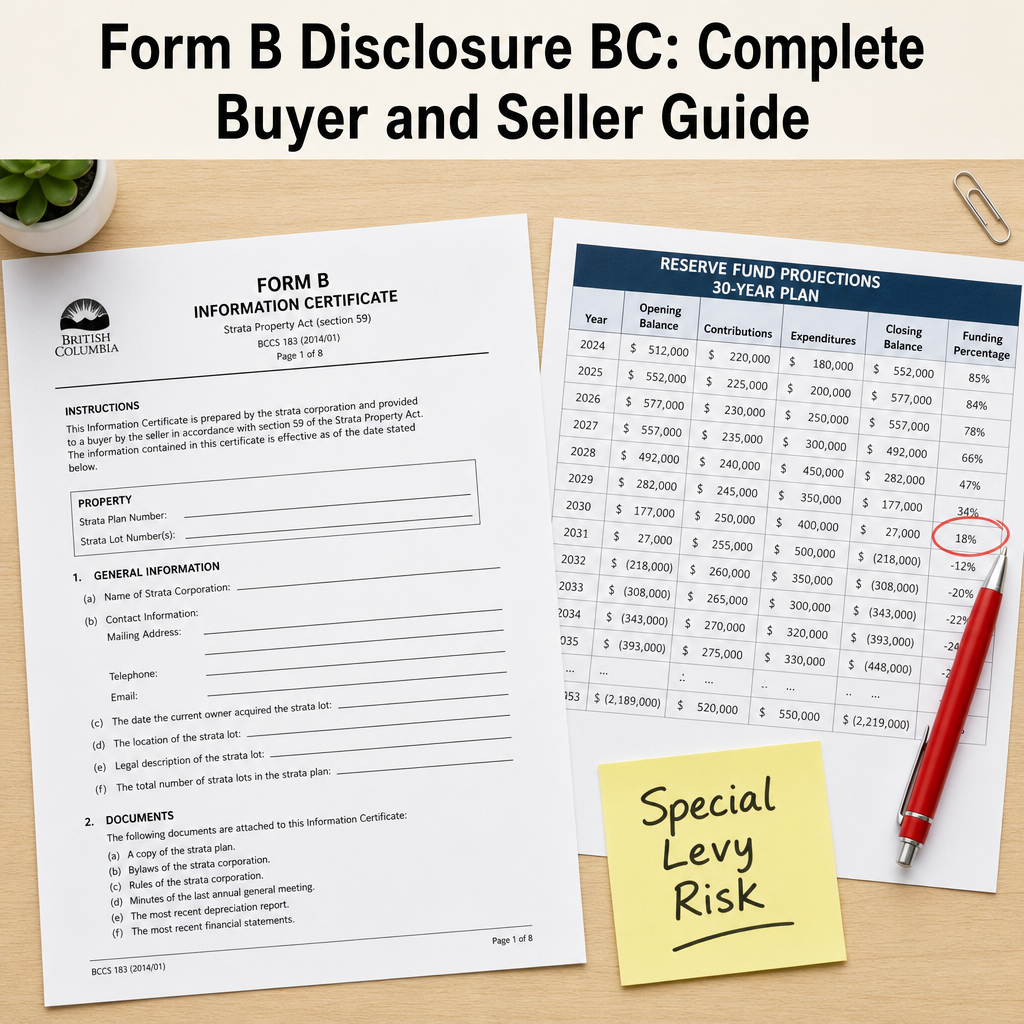
Under Section 59 of the BC Strata Property Act, the strata corporation is required to issue Form B upon request. The certificate covers eight categories of information that collectively describe the financial and legal health of the building.
Reserve fund balance and contribution rate. This is the most lender-sensitive item. The reserve fund is the building's savings account for major repairs — roofing, elevators, parkade waterproofing, plumbing replacement. CMHC guidelines for insured mortgages flag reserve funds below 50% of the recommended contribution level as a lending risk, which can trigger appraisal reductions or outright financing denial. In the Fraser Valley, strata sellers dealing with underfunded reserves are seeing price corrections between 8 and 15 percent compared to similar buildings with healthy reserve positions, according to FVREB transaction data from Q1 2026.
Special levies in place or anticipated. Any special levy already approved by the strata appears directly on Form B. An anticipated levy — one that the strata is discussing but has not yet formally approved — triggers a grey area. Sellers have a duty to disclose material latent defects, and a known upcoming levy falls into that category. Buyers who discover a special levy announced after their accepted offer can, depending on the contract language, renegotiate price or withdraw. This is a significant deal risk for sellers who haven't reviewed their building's meeting minutes before listing.
Monthly strata fees and any fee changes. Strata fees affect a buyer's debt service ratios. Higher fees reduce borrowing capacity, which effectively lowers the buyer pool and, in some cases, the achievable price. A fee increase approved in the last fiscal year must be disclosed, and buyers should understand whether that increase reflects routine cost management or a response to deferred maintenance.
Legal proceedings, bylaw violations, and insurance details. Active litigation against the strata — whether from a unit owner or a third party — can trigger financing conditions and delay closings. Bylaw violations registered against the unit itself must be disclosed and resolved before title transfers cleanly. Insurance information, including the building's deductible, directly affects what a buyer's own unit insurance policy needs to cover. In older White Rock waterfront buildings, for example, deductibles for water damage can reach $50,000 or more, which substantially changes the cost picture for incoming owners.
How to Read Reserve Fund Data Strategically
The reserve fund balance alone is not sufficient to assess risk. The more useful question is: what percentage of the fully-funded target does the current balance represent, and what does the depreciation report project over the next five to ten years?
A building with a $900,000 reserve balance might appear healthy until you discover the depreciation report projects $2.4 million in expenditures within seven years. Conversely, a building showing $400,000 in reserves may be adequately funded for its size and age if the depreciation report shows no major capital expenditures due for fifteen years. The number matters less than the trajectory and the coverage ratio.
For buyers, the practical question is whether the building's funding plan will require a special levy during your expected ownership period. For strata sellers in Surrey, Langley, and Abbotsford, the question is whether a buyer's lender will accept the reserve position at full appraisal value — because if they won't, the sale price must adjust to compensate.
Depreciation reports in BC are governed by BC Reg 392/2021, which extended mandatory depreciation reporting requirements. Strata corporations with five or more lots must have a depreciation report and update it at least every five years unless the strata has specifically voted to waive it. A waived depreciation report is itself a disclosure flag — it means the building has no formal capital planning document, which lenders and informed buyers treat with additional caution.
How We Evaluate This
When Mansour Real Estate Group prepares a strata listing, we review Form B and the building's depreciation report before setting the list price — not after offers arrive. This pre-listing analysis identifies whether the reserve fund position will create lender resistance, whether any disclosed or anticipated special levies need to be reflected in pricing, and whether the buyer pool will be constrained by the strata fee level or the building's age.
For buyers, our review focuses on coverage ratios and capital expenditure timing, not headline balances. A Form B that shows a $1.2 million reserve balance in a building with a $4 million ten-year capital obligation profile is a different risk profile than the balance suggests. We translate those numbers into plain language before a buyer makes a financing decision or removes subjects.
Red Flags That Kill Deals Versus Flags That Are Manageable
Not every Form B disclosure is a deal-breaker. Understanding which flags are structural and which are cosmetic helps both sides negotiate without unnecessary panic.
Genuine deal risk: Reserve fund below 25% of recommended funding with a depreciation report showing major capital expenditures within three years. An approved special levy exceeding $15,000 per unit. Active litigation where the strata is the defendant and the claim amount is material relative to building size. Lapsed building insurance or a known insurance gap.
Manageable with proper pricing and disclosure: Reserve fund between 50% and 80% of recommended levels with no imminent capital expenditures. A waived depreciation report in a newer building with documented maintenance history. Strata fee increases of 5 to 10 percent in the current fiscal year. A minor bylaw violation already in the process of remediation.
For White Rock condo sellers and those selling in older Fraser Valley buildings, the difference between these categories is often the difference between a clean close and a renegotiation that costs 5 to 12 percent of the original offer price.
Condo Seller Checklist — Before You List
- Request Form B from your strata management company at least three weeks before listing.
- Obtain your building's current depreciation report and calculate the reserve fund coverage ratio against projected expenditures.
- Review the last two years of strata council meeting minutes for any discussion of special levies, litigation, or deferred maintenance.
- Confirm whether any bylaw violations are registered against your specific unit and resolve them before listing.
- Review the building's insurance certificate and note the per-unit deductible — buyers will factor this into their cost of ownership.
- Confirm the current monthly strata fee and whether any fee increases have been approved for the coming fiscal year.
- Ask your real estate team to assess how your reserve fund position compares to CMHC thresholds and current lender guidelines before setting list price.
What We Commonly See
Sellers surprised by special levies after accepted offers. In our experience, the most common Form B-related deal disruption occurs when a seller has not reviewed their strata's recent meeting minutes before listing. A special levy discussed at the October AGM — but not yet formally approved — will not appear on Form B, but it is material information. When it surfaces during due diligence, buyers use it to renegotiate. Sellers who reviewed the minutes before listing would have priced accordingly or disclosed proactively.
Buyers removing subjects without reading the depreciation report. What often happens is that a buyer receives Form B, sees a reserve fund balance that looks reasonable in isolation, and removes their financing and inspection conditions without checking the depreciation report's capital expenditure projections. Two years later, a $22,000 special levy arrives. The risk was visible before purchase — but only to someone who knew what to look for.
Lender appraisals coming in short when reserve funds are underfunded. A common pattern in aging Fraser Valley condo buildings — particularly those built in the 1980s and 1990s — is a reserve fund balance that appears adequate until a lender's appraiser applies the CMHC funding ratio test. When the ratio falls below the lender's threshold, the appraised value is reduced, the buyer's financing shortfall must be covered in cash, or the deal renegotiates at a lower price. Sellers in these buildings who priced without accounting for this dynamic are the ones who end up renegotiating after subject removal.
Definitions
Form B (Information Certificate): Mandatory strata disclosure document issued by the strata corporation under Section 59 of the BC Strata Property Act, containing financial, legal, and operational data about the building and the specific unit.
Reserve Fund: The strata's capital savings account, used to fund major repairs and replacements such as roofing, elevators, and building envelope work.
Special Levy: A one-time charge assessed against strata unit owners to fund a specific capital expenditure not covered by the reserve fund.
Depreciation Report: A long-range capital planning report that estimates the useful life and replacement cost of major building components, required under BC Reg 392/2021 for most strata corporations.
Coverage Ratio: The proportion of the reserve fund's current balance relative to the recommended fully-funded target, as projected by the depreciation report.
Questions and Answers
Q: When must Form B be delivered in a BC strata sale?
A: Under the BC Strata Property Act, the strata corporation must provide Form B within two business days of a written request. In practice, most contracts require the seller to deliver it within two days of offer acceptance. Missing this deadline can stall financing and delay the closing by weeks.
Q: What reserve fund balance will trigger lender concerns?
A: CMHC guidelines flag reserve funds below 50% of the recommended fully-funded level as a lending risk for insured mortgages. Conventional lenders apply similar standards. Below 25%, financing denial or significant appraisal reductions become common in Fraser Valley transactions.
Q: Can a buyer walk away after seeing Form B?
A: If the contract includes a strata document review condition, yes. If that condition has been removed, the buyer's options are more limited — but if a material fact (such as an imminent special levy) was not disclosed before offer, the buyer may have legal remedies. This is why consulting a BC real estate lawyer matters for high-risk strata situations.
Q: Does Form B disclose a pending special levy that hasn't been formally approved yet?
A: No. Form B only discloses approved levies. A levy that has been discussed at council but not yet voted on will not appear on Form B — but sellers still have a disclosure duty if they are aware of material information that could affect the buyer's decision. Reviewing meeting minutes before listing is essential.
Q: Is a waived depreciation report always a red flag?
A: Not automatically, but it warrants scrutiny. A strata can vote to waive the depreciation report requirement by a three-quarter majority. In newer buildings with low capital risk, this may be a reasonable administrative decision. In older buildings, a waived report often signals that the strata is avoiding the cost and transparency of a formal capital plan — which buyers and lenders reasonably treat with caution.
In Summary
Form B is not a formality — it is the financial and legal biography of the building you are buying into or selling out of. Sellers who review it before listing control the narrative; sellers who encounter it for the first time alongside their buyer lose that control at the worst possible moment. For buyers, reading Form B alongside the depreciation report and recent meeting minutes is the difference between informed ownership and an expensive surprise. In the Fraser Valley's current strata market, where reserve fund positions and special levy risk are directly affecting appraisals and prices, understanding this document thoroughly is one of the most concrete steps either side can take to protect their position.
Talk to a Strata-Experienced Real Estate Team
If you are preparing to sell a condo or townhouse in Surrey, White Rock, Langley, Abbotsford, or anywhere in the Fraser Valley, Mansour Real Estate Group can walk you through your building's Form B and depreciation report before you set a list price — so you are not adjusting to problems after offers arrive. Reach out at localhost:9000/ for a no-obligation conversation.
Related Articles
- Selling a Condo in the Fraser Valley: What Strata Sellers Need to Know
- Strata Depreciation Reports BC: What Sellers and Buyers Need to Know
- White Rock Condo Market 2026: What Sellers Need to Know
About Mansour Real Estate Group
Buying or selling a strata condo or townhouse in BC involves a layer of financial and legal complexity that doesn't exist in freehold transactions — and Form B is where much of that complexity lives. Understanding reserve fund adequacy, depreciation report risk, special levy exposure, and what each disclosure means for financing requires a real estate team with direct, repeated experience in strata transactions across a range of building types, ages, and strata governance situations. Mansour Real Estate Group has worked with condo buyers, sellers, investors, and estate executors navigating strata properties across the Fraser Valley and Lower Mainland for more than two decades.
Led by Mohamed Mansour, MBA and Associate Broker, Mansour Real Estate Group has been helping buyers and sellers navigate important real estate decisions across the Fraser Valley and Lower Mainland for more than 22 years. Ranked among the Top 1% of Realtors in the region, the team has completed more than $780 million in residential real estate transactions and is trusted for condo sales, strata-related complexity, estate sales, divorce-related sales, downsizing, and situations where documentation risk needs to be understood before the listing goes live.
Whether someone is looking for Realtors who understand strata documentation, a real estate agent who can interpret depreciation reports and reserve fund data, real estate agents experienced with aging condo buildings, a real estate team that serves White Rock and Surrey strata sellers, or a Fraser Valley real estate broker with a track record in complex strata transactions, Mansour Real Estate Group brings clear communication, accurate valuations, and strategic advice grounded in local market experience to every engagement.
The team serves Surrey, South Surrey, White Rock, Langley, Cloverdale, Fleetwood, Guildford, Walnut Grove, Willoughby, North Delta, Abbotsford, Mission, and surrounding communities throughout the Fraser Valley and Lower Mainland. Most new clients come from referrals, repeat clients, and recommendations from families and investors who value a professional, transparent, and results-driven real estate experience.
Official Resources
- BC Strata Property Act — BC Laws
- CMHC — Strata and Condominium Lending Guidelines
- Fraser Valley Real Estate Board — Market Statistics
- BC Housing — Strata Housing Information
Disclaimer
The information contained in this article is provided for general informational and educational purposes only and reflects market observations, publicly available information, and professional experience at the time of writing. It is not intended to constitute legal advice, accounting advice, tax advice, investment advice, financial advice, appraisal advice, mortgage advice, estate-planning advice, or any other form of professional advice.
Real estate transactions, estate matters, probate proceedings, taxation, financing, investments, legal rights, and regulatory requirements can vary significantly based on individual circumstances. Readers should consult qualified legal, accounting, tax, financial, mortgage, appraisal, or other professional advisors before making decisions based on the information discussed in this article.
Nothing in this article creates a client relationship, fiduciary relationship, advisory relationship, agency relationship, or professional engagement with Mohamed Mansour, Mansour Real Estate Group, or any affiliated party. Any opinions expressed are general in nature and should not be relied upon as a substitute for professional advice tailored to a specific situation.
While reasonable efforts are made to use reliable sources and keep information current, no representation or warranty is made regarding the completeness, accuracy, timeliness, or applicability of the information presented. Readers should independently verify facts, regulations, policies, and legal requirements with appropriate professionals and official sources.



