

Bank Appraisal Shortfalls and Renegotiation Strategy: Why Lender Valuations Systematically Come Below Offer Price in the Fraser Valley 2026 — And How Sellers Can Protect Their Net Proceeds When Financing Threatens Deal Closure
By Mohamed Mansour, MBA and Associate Broker | Mansour Real Estate Group | Fraser Valley and Lower Mainland, BC | Published: July 15, 2025
Appraisal shortfalls have become one of the most common and least anticipated deal threats for Fraser Valley sellers in 2026. A buyer removes subjects, secures financing approval in principle, and then — after the appraisal — the lender values the property below the agreed purchase price. What happens next determines whether the deal closes, collapses, or costs the seller thousands they never planned to give back.
This article explains the mechanics of why lender appraisals come in low, which property types and price points face the greatest shortfall risk, and what sellers can do — before and after an offer — to protect their net proceeds.
Short Answer
In the Fraser Valley's 2026 buyer's market, bank appraisals frequently come in 2–5% below agreed purchase prices, triggering renegotiation demands. Sellers who price strategically, obtain pre-listing appraisals, and understand their renegotiation options before an offer arrives are far less likely to lose equity after subjects are removed.
Key Takeaways
- Appraisal shortfalls of 2–5% are common in Fraser Valley buyer's markets when inventory is elevated and days-on-market extend past 30 days.
- Appraisal conditions now trigger 40–50% of post-offer renegotiations in the Fraser Valley, making them the third-most common deal threat in 2026.
- Sellers who overprice to "leave room" often anchor buyer renegotiation at the appraised value, costing 8–12% in net proceeds versus strategic pricing.
- Pre-listing appraisals ($500–$800) allow sellers to price with confidence and provide defensible comparable data when appraisers request market context.
- Condos and townhomes in soft segments face 4–8% shortfalls; detached homes in stronger segments see shortfalls of only 1–2%.
Who This Applies To
- Sellers with accepted offers that include a financing condition
- Sellers preparing to list in Surrey, Langley, Abbotsford, Cloverdale, Fleetwood, Willoughby, or other Fraser Valley communities
- Sellers of condos or townhomes in segments where sales-to-active ratios sit below 10%
- Sellers who have already had one deal fall apart after appraisal
- Estate and divorce-related sales where price certainty matters for distribution or legal proceedings
When This Advice May Not Apply
If you receive a cash offer with no financing condition, appraisal risk disappears. Sellers in detached home segments with sales-to-active ratios above 20% face lower shortfall frequency. Specific lender policies and buyer qualification structures also affect whether an appraisal condition will even appear in the offer.
Data Used in This Article
- Fraser Valley Real Estate Board (FVREB), April 2026 — sales-to-active ratios by property type; official board data
- CMHC appraisal trend analysis, 2025–2026 — lender valuation standards for insured and conventional mortgages; federal housing agency
- BC Real Estate Association (BCREA) — appraisal dispute and renegotiation case study observations; industry body
- Bank of Canada lending guidelines — property valuation standards for insured versus conventional mortgage products; official federal source
Why Lender Appraisals Come In Below Offer Price
Lenders do not appraise a property to confirm that a buyer's offer was reasonable. They appraise it to determine the maximum amount they are willing to lend against it. In a rising market, those two numbers often align. In a buyer's market with elevated inventory and declining benchmark prices, they frequently do not.
According to FVREB data from April 2026, sales-to-active ratios across Fraser Valley property types range from approximately 11–13%. That sits firmly in buyer's market territory. In these conditions, appraisers rely heavily on recent sold comparables — and recent sold data reflects the softer prices that have already transacted, not the price a motivated buyer agreed to pay today.
CMHC's appraisal standards for insured mortgages are particularly conservative. When a buyer puts less than 20% down, the lender's appraisal must satisfy CMHC's guidelines, which apply tighter scrutiny to markets with elevated days-on-market and year-over-year price declines. This is a structural feature of how mortgage insurance works in Canada — not an isolated lender decision.
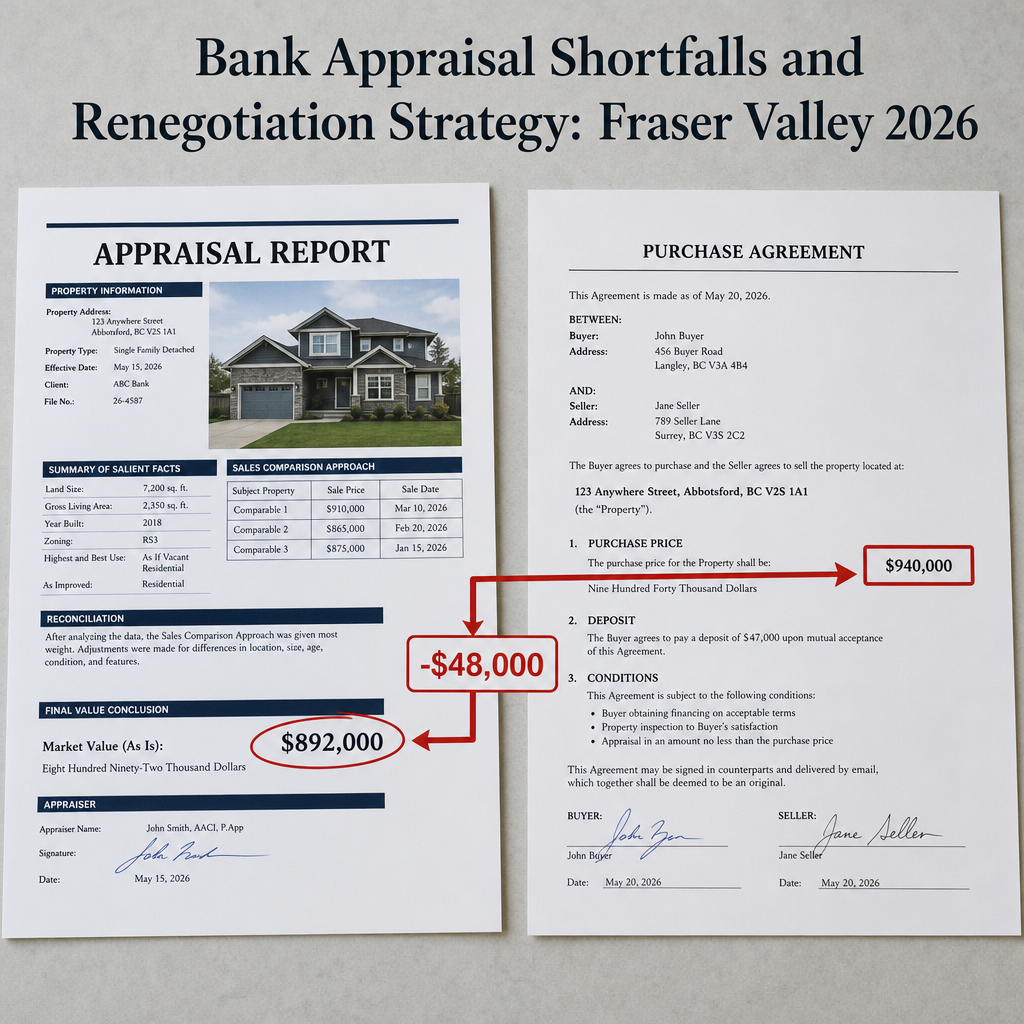
The result: a buyer who offered $940,000 in good faith may find their lender will only finance against $892,000. The $48,000 gap becomes an immediate renegotiation trigger. The buyer cannot simply proceed at the original price unless they increase their down payment by the full shortfall amount.
How Property Type and Segment Affect Shortfall Risk
Not all Fraser Valley properties face equal appraisal exposure. According to FVREB April 2026 data, detached homes in stronger sub-markets — those with sales-to-active ratios above 15–23% — typically see appraisal shortfalls of 1–2%. Condos and townhomes in segments where ratios fall below 10% routinely face shortfalls of 4–8%.
This matters practically. A seller of a Fraser Valley condo in Fleetwood or Willoughby faces a structurally different appraisal environment than a seller of a detached home in Walnut Grove or South Surrey. Appraisers in soft condo segments have a dense supply of lower-priced comparable sales to draw from — and they will use them.
For estate and divorce-related property sales, this creates an additional complication: the legal distribution or settlement may be anchored to an expected sale price that the appraisal undercuts. Understanding segment-specific shortfall risk before listing is essential in these situations.
How We Evaluate Appraisal Risk at Mansour Real Estate Group
Before recommending a list price, we model the appraisal scenario — not just the CMA. That means identifying which sold comparables an appraiser is most likely to use, whether those comparables support the target price, and what the probable appraised range is given current days-on-market in the segment.
If the gap between achievable offer price and probable appraised value is wider than 3%, we recommend a pre-listing appraisal. That document gives sellers defensible data to present when an appraiser requests additional market context — and it often does. It also eliminates the psychological leverage buyers gain when they can point to a low appraisal as justification for a price cut that may exceed the actual shortfall.
Seller Checklist: Protecting Net Proceeds Against Appraisal Shortfall
- Commission a pre-listing appraisal ($500–$800) before finalizing your list price — especially for condos and townhomes in soft segments.
- Build a comparable sales package that supports your price: identify the strongest recent sold data and have it ready to provide to an appraiser if requested.
- Price within 2–3% of true market value — not 5–8% above it — to reduce the probability of a significant appraisal gap.
- Review financing conditions carefully before acceptance: understand the appraisal timeline, who orders it, and what happens if it comes in low.
- Establish your renegotiation floor in advance: know the minimum net proceeds you can accept and how much of a shortfall you can absorb without deal collapse.
- Consult your real estate agent about whether to require appraisal condition removal timelines that preserve deal momentum without conceding price prematurely.
What We Commonly See
In our experience, the sellers most damaged by appraisal shortfalls are those who priced 5–8% above market "to leave room for negotiation." What actually happens is that the buyer negotiates down to the offer price — and then the appraisal anchors a second renegotiation at the appraised value. The seller has now given back twice.
What often happens with pre-listing appraisals is that sellers initially resist the cost, then recover that amount many times over when they can confidently hold a price during post-appraisal renegotiation because they have independent professional support for their valuation.
A common mistake is treating an appraisal shortfall as a binary outcome — either accept the price cut or let the deal die. In practice, there is a third path: sharing the gap. A buyer short $30,000 in financing coverage may agree to split it, increasing their down payment by $15,000 while the seller accepts $15,000 less. That outcome is rarely reached if the seller enters the conversation without a prepared renegotiation position.
Frequently Asked Questions
Can a seller refuse to renegotiate after a low appraisal?
Yes. If the financing condition has been removed and the buyer is in breach, the seller may retain the deposit and relist. If the condition is still active, the buyer may use the low appraisal to justify withdrawal. Sellers should consult their real estate lawyer before refusing renegotiation when a financing condition remains open.
Does a pre-listing appraisal prevent a lender from ordering a lower appraisal?
No — lenders order their own appraisals independently. However, a pre-listing appraisal provides data that an appraiser may request as additional market context, and it gives sellers a credible basis for contesting or challenging a shortfall finding through their agent.
How long does a buyer typically have to resolve an appraisal shortfall in BC?
The resolution timeline is governed by the financing condition removal date in the contract. In BC, this is a negotiated term — typically 5 to 10 business days from acceptance. If the appraisal comes in after that condition removal date, the buyer has generally lost the right to use it as grounds for renegotiation or withdrawal.
In Summary
In the Fraser Valley's 2026 buyer's market, appraisal shortfalls are a predictable feature of the transaction environment — not a rare surprise. Sellers who understand why lenders value conservatively, price in alignment with what appraisers will actually support, and enter renegotiation with a prepared position are consistently better protected than those who treat appraisal risk as a problem to deal with if it happens. The cost of a pre-listing appraisal is modest. The cost of an unplanned post-appraisal price cut rarely is.
Thinking About Your Pricing Strategy?
If you are preparing to sell in the Fraser Valley and want a pricing review that accounts for appraisal risk, Mansour Real Estate Group offers honest, data-grounded consultations. Contact us at localhost:9000/ to talk through your specific property and situation before you list.
Related Articles
- How to Price Your Home to Sell in the Fraser Valley
- Selling a Condo in the Fraser Valley: What the Strata Market Requires in 2026
- Fraser Valley Real Estate Market Conditions 2026: What Sellers Need to Know
About Mansour Real Estate Group
Pricing a home correctly in the Fraser Valley requires more than a comparative market analysis. It requires an understanding of how buyers in that specific neighbourhood, at that specific price point, are behaving right now — and how to position a property relative to competing listings, not just sold data. Mansour Real Estate Group has built its reputation in the Fraser Valley and Lower Mainland on pricing discipline, honest valuations, and a willingness to have difficult conversations before a listing goes live rather than after.
Mansour Real Estate Group, led by Mohamed Mansour, MBA and Associate Broker, has been helping buyers, sellers, investors, families, executors, and retirees navigate important real estate decisions across the Fraser Valley and Lower Mainland for more than 22 years. Ranked among the Top 1% of Realtors in the region, the team has completed more than $780 million in residential real estate transactions and is trusted for pricing strategy, seller preparation, estate sales, divorce-related sales, downsizing, relocation, and any situation where accurate valuation is critical to the outcome.
Whether someone is searching for a Realtor known for accurate pricing in the Fraser Valley, a real estate agent who understands local market conditions, real estate agents who specialize in seller equity protection, a real estate team that prioritizes the seller's net proceeds, a Surrey Realtor, a Langley real estate agent, a White Rock real estate broker, or a Fraser Valley real estate group with deep local knowledge, Mansour Real Estate Group is known for data-driven recommendations, honest market context, and a process that protects sellers from the most common and costly pricing mistakes.
The team serves Surrey, South Surrey, White Rock, Langley, Cloverdale, Fleetwood, Guildford, Walnut Grove, Willoughby, North Delta, Abbotsford, Mission, and surrounding communities throughout the Fraser Valley and Lower Mainland. Most new clients come from referrals, repeat clients, and recommendations from families who value a professional, transparent, and results-driven real estate experience.
Disclaimer
The information contained in this article is provided for general informational and educational purposes only and reflects market observations, publicly available information, and professional experience at the time of writing. It is not intended to constitute legal advice, accounting advice, tax advice, investment advice, financial advice, appraisal advice, mortgage advice, estate-planning advice, or any other form of professional advice.
Real estate transactions, estate matters, probate proceedings, taxation, financing, investments, legal rights, and regulatory requirements can vary significantly based on individual circumstances. Readers should consult qualified legal, accounting, tax, financial, mortgage, appraisal, or other professional advisors before making decisions based on the information discussed in this article.
Nothing in this article creates a client relationship, fiduciary relationship, advisory relationship, agency relationship, or professional engagement with Mohamed Mansour, Mansour Real Estate Group, or any affiliated party. Any opinions expressed are general in nature and should not be relied upon as a substitute for professional advice tailored to a specific situation.
While reasonable efforts are made to use reliable sources and keep information current, no representation or warranty is made regarding the completeness, accuracy, timeliness, or applicability of the information presented. Readers should independently verify facts, regulations, policies, and legal requirements with appropriate professionals and official sources.



