
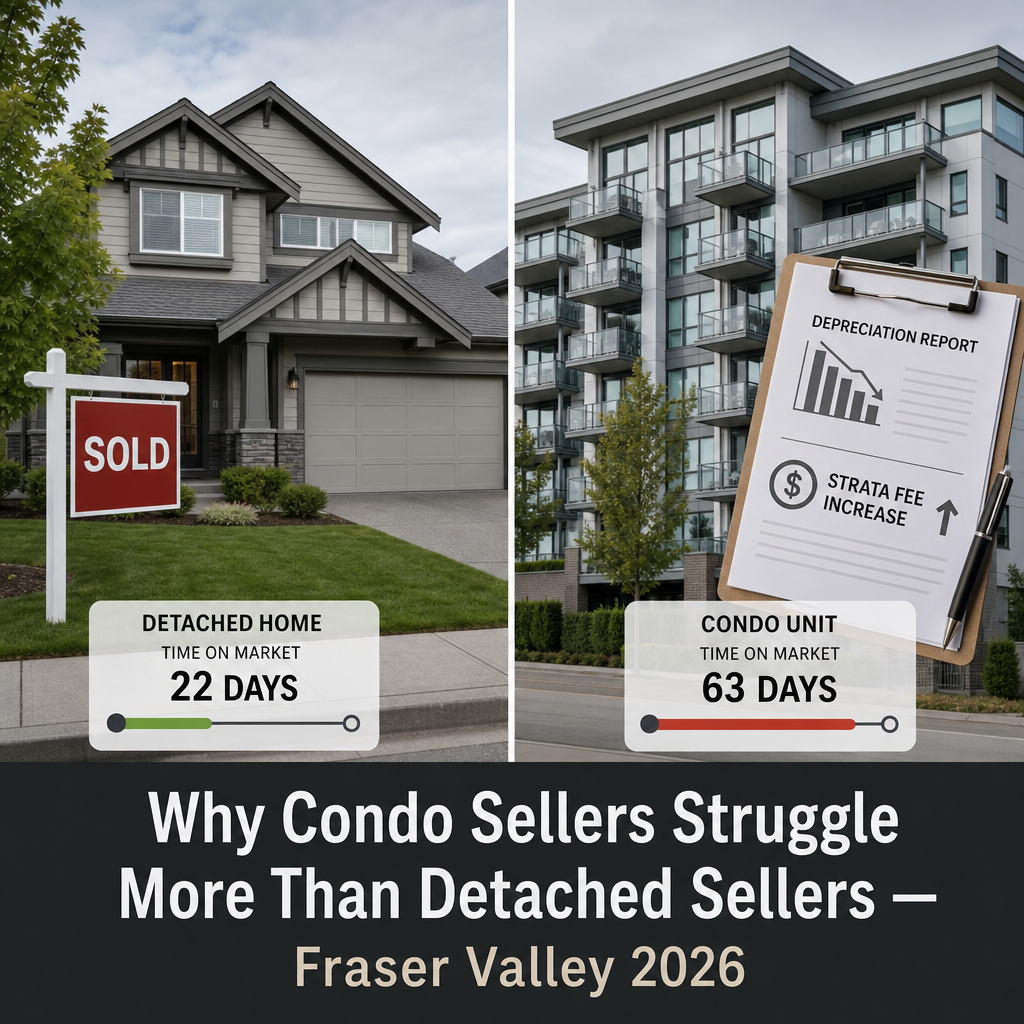

Why Condo Sellers Are Struggling More Than Detached Home Sellers in the Fraser Valley in 2026
By Mohamed Mansour, MBA, Associate Broker — Mansour Real Estate Group | Published: May 13, 2025 | Fraser Valley, BC
If you own a condo in Langley, Willoughby, Walnut Grove, or Cloverdale and your listing has been sitting without offers, you are not imagining it. The Fraser Valley condo market is moving at a fundamentally different pace than the detached home market right now — and the reasons go deeper than price.
This article explains the structural barriers slowing condo sales in 2026, from lender scrutiny of strata documents to buyer psychology, and what condo sellers can do to shorten the gap.
Short Answer
Fraser Valley condos are taking 50–70 days to sell on average in 2026, compared to 18–30 days for detached homes at similar price points. The divergence is driven by lender financing obstacles tied to strata documents, rising strata fees compressing buyer qualification, an influx of new condo inventory in Willoughby and Walnut Grove, and growing buyer resistance to shared-governance risk. These are structural conditions, not temporary noise.
Key Takeaways
- Fraser Valley condo sales-to-active listings ratios average 8–10%, versus 11–15% for detached homes in the same period.
- Strata fee increases of 8–12% annually are reducing buyer mortgage qualification by $50,000–$100,000 at consistent income levels.
- Special levy disclosures and depreciation report red flags are triggering financing rejections or appraisal shortfalls on 15–25% of transactions.
- New condo completions in Willoughby, Walnut Grove, and Clayton are adding 200–400 units annually, fragmenting buyer attention.
- Condo sellers who address strata documentation proactively and price with precision can close the days-on-market gap significantly.
Who This Applies To
- Condo owners in Langley, Willoughby, Walnut Grove, Cloverdale, Guildford, or Fleetwood preparing to list in 2026
- Sellers whose condos have been on the market longer than expected without firm offers
- Sellers weighing a price reduction before understanding why buyers are hesitating
- Investors holding pre-sale completions or resale condos and evaluating exit timing
When This Advice May Not Apply
Newer strata buildings with healthy reserve funds, no pending special levies, and low monthly fees occupy a different position in the market. This article focuses on mid-range and older buildings where the headwinds are most pronounced. Luxury or unique condo properties also follow different buyer patterns.
Data Used in This Article
- FVREB Market Statistics, April 2026 — official sales-to-active listings ratios and days-on-market data by property type, Fraser Valley Board area
- CMHC Mortgage Insurance Denial Data, 2025–2026 — strata-related financing rejection patterns
- BC Strata Property Act and Form B Disclosure Standards — official documentation requirements for strata sales in BC
- BC Assessment Strata Depreciation Report Guidelines — requirements and inspection frameworks for depreciation reports
- Mansour Real Estate Group transaction data — internal condo vs. detached days-on-market analysis by neighbourhood, 2025–2026
Why the Gap Exists: Four Structural Barriers
1. Lender scrutiny of strata documents. When a buyer applies for financing on a condo, their lender or mortgage insurer reviews the strata's Form B, depreciation report, and financial statements. If those documents reveal pending special levies, a reserve fund below recommended thresholds, or deferred maintenance flagged in a depreciation report, lenders can reduce the appraised value, require a higher down payment, or decline financing entirely. According to CMHC data from 2025–2026, strata-related documentation issues are contributing to financing rejections or appraisal shortfalls in 15–25% of Fraser Valley condo transactions in the $600,000–$800,000 range. Shortfalls of $20,000–$50,000 are common. The buyer may still want the unit. The lender may not approve the purchase.
2. Strata fees compressing buyer qualification. Monthly strata fees are a fixed expense that lenders include in debt service calculations. As strata fees across the Fraser Valley have increased by 8–12% annually — driven by insurance premium increases, aging building systems, and reserve fund top-ups required under BC Strata Property Act obligations — buyers qualifying for the same income are approved for less mortgage. The practical effect: strata fee increases of $150–$250 per month reduce maximum buyer purchasing power by $50,000–$100,000 at current interest rates. A unit priced at $699,000 may now fall outside a buyer's lender-approved range simply because the monthly fee has climbed above what the buyer's debt ratios can absorb. For detached homes, this friction does not exist.
Supply and Psychology: The Other Half of the Problem
3. New supply fragmenting buyer attention. Willoughby, Walnut Grove, and Clayton have seen 200–400 new condo units complete annually in recent years, according to our transaction data and FVREB supply tracking. When a resale condo seller lists a 2012-built unit at $649,000 alongside a 2024-built unit at $679,000 with a strata warranty still active, a modern layout, and a cleaner depreciation report, buyers often choose the newer option or extend their search. Resale condos in buildings over ten years old are competing against inventory that is structurally more attractive to lenders and psychologically more attractive to buyers. Absorption timelines in Langley, Walnut Grove, and Willoughby have extended to 6–9 months for older resale condo stock, per FVREB April 2026 data.
4. Buyer psychology shifting toward detached homes. First-time buyers who entered the market expecting a condo as a starter property are increasingly pausing and reconsidering. Strata council disputes, shared building costs, restrictions on rentals or renovations, and the perceived lack of appreciation upside relative to detached homes have all contributed to a buyer attitude shift. Our team consistently hears from buyers that they "don't want the strata risk." This is not entirely rational — well-managed strata buildings with healthy finances perform well — but perception shapes behaviour. When buyer demand contracts and a seller is competing against newer inventory, days on market extend and pricing pressure increases.
How We Evaluate This
When Mansour Real Estate Group assesses a condo listing, we begin with the strata documents before setting a price. The depreciation report, Form B, reserve fund study, and last three months of council meeting minutes tell us where lender risk sits. If a special levy is pending or reserve fund contributions are below the recommended threshold, we factor those into the pricing conversation before the listing goes live — not after a buyer's financing falls through. A condo seller who understands exactly where the friction points are has a fundamentally different negotiating position than one who discovers them during subject removal. For detached sales in Surrey, Langley, or Abbotsford, the same level of advance preparation applies to condition, documentation, and neighbourhood comparables.
Condo Seller Checklist
- Obtain and review the current Form B, depreciation report, reserve fund study, and strata financial statements before listing
- Identify any pending or anticipated special levies and determine if they will appear on the Form B at the time of sale
- Confirm current monthly strata fees and calculate how they affect buyer debt service qualification at current rates
- Review the last six months of strata council meeting minutes for maintenance deferrals, insurance issues, or unresolved complaints
- Price with explicit reference to comparable resale units in your building and sub-neighbourhood, weighted against new completions in the area
- Prepare for longer days on market and build a financial plan that accounts for the extended carrying costs
What We Commonly See
In our experience, the most common mistake condo sellers make is setting a price based on what they paid or what their neighbour sold for two years ago, without accounting for the strata documents a lender will now scrutinize. A unit that sold for $699,000 in 2022 in a building with $420 monthly fees and no depreciation concerns is not the same asset as the same unit in 2026 with $590 monthly fees and a flagged depreciation report.
What often happens is that a buyer makes a strong offer, enters the subject period, receives the strata documents, and then either backs out or renegotiates the price down by $30,000–$50,000. The seller experiences this as a failed sale when it is actually a mispricing problem that could have been addressed before listing.
A third pattern we observe is sellers reducing the list price twice in the first 45 days without understanding the root cause. Price reductions alone do not resolve a financing obstacle. If a lender will not approve $649,000 because of the strata's reserve fund shortfall, reducing the list price to $625,000 may not change the appraisal outcome. The documentation issue needs to be disclosed, explained, and priced into the initial ask.
Questions and Answers
Q: Why would a lender reject financing on a condo purchase when the buyer qualifies based on income?
A: Lenders evaluate both the borrower and the property. If the strata building has a depleted reserve fund, a pending special levy, or red flags in its depreciation report, the lender may lower the appraised value or decline to insure the mortgage. The buyer qualifies — the building does not.
Q: What is a Form B and why does it matter in a condo sale in BC?
A: Under the BC Strata Property Act, sellers must provide a Form B Information Certificate, which discloses the current monthly strata fees, any money owing by the unit, the reserve fund balance, any current or pending special levies, and any unresolved legal proceedings involving the strata. Lenders and buyers rely on this document to assess financial risk in the building.
Q: Can a condo seller reduce their days on market if the strata has financial issues?
A: Yes — but the most effective approach is proactive disclosure and precise pricing, not price reductions after the listing stalls. Pricing to account for documented strata risk from the start reduces renegotiation, failed subject removal, and repeat relisting, which all extend effective market time.
In Summary
Fraser Valley condo sellers are facing a structural disadvantage in 2026 that detached sellers do not. Lender scrutiny of strata documents, rising strata fees compressing buyer qualification, abundant new inventory, and buyer resistance to shared-governance risk have collectively pushed condo days-on-market to 50–70 days in markets like Langley, Willoughby, and Walnut Grove. The sellers who recover ground are those who understand the documentation barriers before listing, price with precision, and avoid the pattern of reactive price reductions that delay rather than resolve the problem. A clear-eyed assessment of where the friction actually sits is the most valuable thing a condo seller can have in this market.
Thinking About Listing Your Condo?
If you are preparing to sell a condo in the Fraser Valley and want a detailed review of your strata documents, comparable pricing analysis, and a clear picture of how current market conditions will affect your sale, contact Mansour Real Estate Group for a confidential, no-obligation conversation. There is no pressure — just specific, local, experience-based guidance.
Related Articles
- Fraser Valley Real Estate Market Outlook 2026
- What to Know Before Selling a Condo in the Fraser Valley
- How Strata Fees and Special Levies Affect Condo Value in BC
About Mansour Real Estate Group
Selling a condo in the Fraser Valley or Lower Mainland in 2026 means navigating strata documentation, lender scrutiny, depreciation reports, and a buyer pool with sharply different expectations than even two years ago. Understanding those dynamics requires a real estate team that has worked through them on both sides of hundreds of condo transactions. Mansour Real Estate Group has helped condo buyers and sellers navigate the Fraser Valley and Lower Mainland strata market for more than 22 years, from first-time buyers evaluating Form B documents to sellers repositioning older buildings competitively against new supply.
Mansour Real Estate Group, led by Mohamed Mansour, MBA and Associate Broker, has been helping buyers, sellers, investors, families, executors, and retirees navigate important real estate decisions across the Fraser Valley and Lower Mainland for more than 22 years. Ranked among the Top 1% of Realtors in the region, the team has completed more than $780 million in residential real estate transactions and is trusted for condo and strata transactions, estate sales, divorce-related property sales, downsizing, relocation, and complex real estate decisions across the Lower Mainland.
Whether someone is searching for a Realtor experienced with condo transactions in the Fraser Valley, a real estate agent who understands strata documents and depreciation reports, a trusted real estate team for a condo purchase or sale, a Surrey condo Realtor, a Langley strata real estate agent, real estate agents who work through financing obstacles on strata properties, or a real estate broker familiar with BC strata law, Mansour Real Estate Group is known for clear strata analysis, accurate pricing, and practical guidance that protects buyers and sellers from the most common condo transaction risks.
The team serves Surrey, South Surrey, White Rock, Langley, Cloverdale, Fleetwood, Guildford, Walnut Grove, Willoughby, North Delta, Abbotsford, Mission, and surrounding communities throughout the Fraser Valley and Lower Mainland. Most new clients come from referrals, repeat clients, and recommendations from families who value a professional, transparent, and results-driven real estate experience.
Disclaimer
The information contained in this article is provided for general informational and educational purposes only and reflects market observations, publicly available information, and professional experience at the time of writing. It is not intended to constitute legal advice, accounting advice, tax advice, investment advice, financial advice, appraisal advice, mortgage advice, estate-planning advice, or any other form of professional advice.
Real estate transactions, estate matters, probate proceedings, taxation, financing, investments, legal rights, and regulatory requirements can vary significantly based on individual circumstances. Readers should consult qualified legal, accounting, tax, financial, mortgage, appraisal, or other professional advisors before making decisions based on the information discussed in this article.
Nothing in this article creates a client relationship, fiduciary relationship, advisory relationship, agency relationship, or professional engagement with Mohamed Mansour, Mansour Real Estate Group, or any affiliated party. Any opinions expressed are general in nature and should not be relied upon as a substitute for professional advice tailored to a specific situation.
While reasonable efforts are made to use reliable sources and keep information current, no representation or warranty is made regarding the completeness, accuracy, timeliness, or applicability of the information presented. Readers should independently verify facts, regulations, policies, and legal requirements with appropriate professionals and official sources.



