

Fraser Valley Seller's Complete Guide to Property Disclosure Statements, Latent Defect Reporting, and BC's Mandatory Disclosure Requirements
By Mohamed Mansour, MBA and Associate Broker | Mansour Real Estate Group | Published: July 15, 2025 | Fraser Valley and Lower Mainland, BC
For homeowners preparing to sell in Surrey, Langley, Abbotsford, White Rock, or anywhere across the Fraser Valley, completing the Property Disclosure Statement is often treated as paperwork to get through. That framing is expensive. The PDS is the single highest-risk compliance document in a residential sale, and mishandling it creates liability that survives closing. This guide explains exactly what BC law requires, where sellers commonly go wrong, and why full, documented disclosure consistently produces faster, cleaner transactions.
With more than 10,000 active listings competing across the Fraser Valley in 2026, buyers have options and time. Properties where disclosure is clear, supported by documentation, and free of ambiguity move faster. Properties where buyers sense evasiveness stall, attract lower offers, or collapse at subject removal.
Short Answer
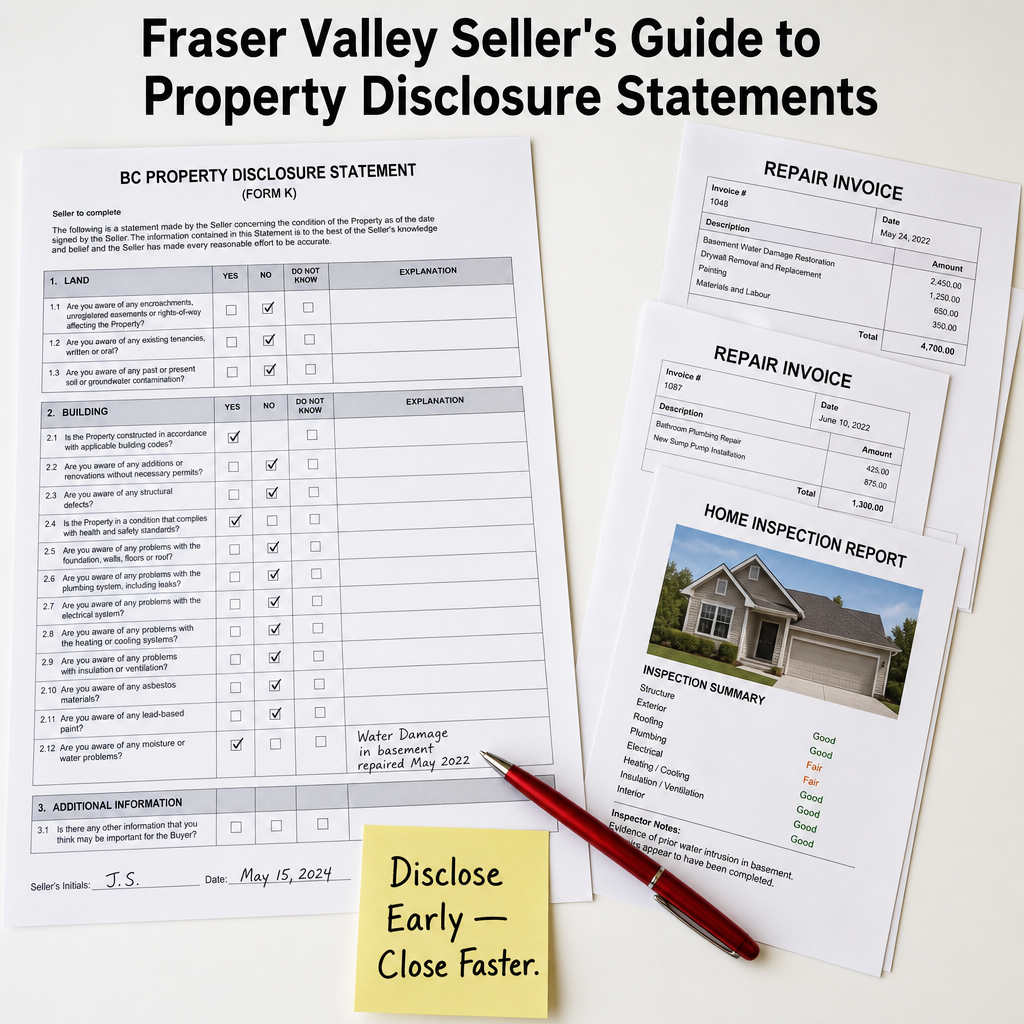
BC sellers must complete Form K — the Property Disclosure Statement — before or concurrent with presenting an offer. The form requires disclosure of all known material defects, including water damage, structural repairs, pest infestations, mechanical issues, insurance claims, and zoning violations. Failure to disclose known defects exposes sellers to statutory rescission rights and post-closing litigation. Strategic, documented disclosure reduces buyer uncertainty and accelerates closings.
Key Takeaways
- Form K must be provided to buyers before or at the time an offer is presented — not after acceptance.
- Sellers must disclose all known material defects; they are not required to investigate defects they genuinely don't know about.
- Latent defects — hidden issues that affect safety or habitability — carry the highest legal exposure and must always be disclosed.
- Attaching repair invoices, warranties, and inspection reports to the PDS measurably reduces subject-removal disputes.
- In a buyer's market, disclosure-forward listings consistently show stronger days-on-market results because buyers feel safer committing.
Who This Applies To
- Homeowners in BC preparing to list a detached, semi-detached, or townhouse property
- Sellers who have made repairs, renovations, or insurance claims during their ownership
- Estate and executor sales where the seller may have limited direct knowledge of the property's condition
- Sellers in Surrey, Langley, Abbotsford, White Rock, South Surrey, Cloverdale, Fleetwood, Guildford, Willoughby, Walnut Grove, and North Delta
When This Advice May Not Apply
Strata condo sales involve a parallel disclosure process governed by the Strata Property Act, including Form B and depreciation report obligations. Estate sales where the executor has no personal knowledge of the property's condition carry modified disclosure obligations — consult a BC real estate lawyer before completing the PDS in those situations. This article does not constitute legal advice. Sellers should confirm current requirements with their Realtor and legal counsel.
Data Used in This Article
- BC Property Law Act, Part 2, Division 2 — provincial legislation governing property disclosure requirements (official/primary)
- BCREA Form K Guidelines — BC Real Estate Association guidance on completing the Property Disclosure Statement (official/regulatory)
- BC Court of Appeal — Hedley v. Bate, 2015 BCCA 15; Terravista Realty Inc. v. Teasdale, 2010 BCSC 470 — judicial precedent on seller disclosure liability (official/legal)
- Fraser Valley Real Estate Board disclosure bulletins — member guidance on disclosure compliance in the Fraser Valley (regulatory/industry)
Key Definitions
Property Disclosure Statement (Form K): The standard BC document sellers complete to disclose known defects and material facts about a property. Required before or concurrent with an offer presentation.
Latent Defect: A hidden defect not visible during a reasonable inspection that affects the safety, habitability, or structural integrity of the property. Must always be disclosed if known.
Patent Defect: A visible or obvious condition a buyer can observe during a walkthrough. Generally does not require explicit disclosure, though transparent practice includes noting it.
Material Fact: Any fact that would reasonably affect a buyer's decision to purchase or the price they would pay. Includes structural issues, water damage history, zoning violations, and pest infestations.
What BC Law Actually Requires Sellers to Disclose
Under BC's Property Law Act, sellers must disclose all known material defects and facts that would reasonably affect a buyer's decision or the price they would pay. This is not a vague standard — it includes specific categories. According to BCREA Form K guidelines, sellers must address: structural condition and known repairs; roof age and history of replacement; water damage from any source, including past floods, pipe failures, or moisture intrusion; foundation condition and any remediation; pest infestations and treatment history; insurance claims made on the property; the legal status of suites, including whether a secondary suite or coach house was permitted and built to code; environmental concerns including oil tanks, asbestos, and mould; and any known zoning violations or covenant breaches.
The legal standard is knowledge, not investigation. Sellers are not required to hire an engineer before listing to discover unknown defects. However, once a seller knows about a defect — from their own observation, a past inspection, a contractor's report, or an insurance claim — that knowledge triggers a mandatory disclosure obligation. BC court decisions including Hedley v. Bate (2015 BCCA 15) and Terravista Realty Inc. v. Teasdale (2010 BCSC 470) confirm that post-closing litigation exposure arises when sellers knew about a material defect and withheld it, regardless of whether the buyer's agent asked the right questions.
Sellers in Abbotsford, Langley, and South Surrey who have completed basement waterproofing, replaced aging poly-B plumbing, or addressed foundation settlement — common in homes built between 1975 and 1995 — must disclose those repairs even when the work was done properly. Completed, documented repairs are not a liability. Undisclosed completed repairs that a buyer later discovers are.
Timeline Rules: When the PDS Must Be Delivered and What Happens If It Isn't
BC's standard Contract of Purchase and Sale requires the Property Disclosure Statement to be provided to the buyer before or concurrent with the presentation of any offer. This is not a post-offer formality. A buyer who receives the PDS after they have made an offer — and who discovers a material defect in it — has grounds to rescind the contract before subject removal. That rescission right is statutory, which means it cannot be waived by omitting the form from the offer process.
In practice, the strongest approach is to attach the completed PDS to the listing package before the property goes live on MLS. Buyers and their agents can review it before scheduling showings. This approach, recommended in FVREB member guidance, eliminates the risk of a disclosure-triggered rescission and signals seller confidence. Buyers who review a complete, well-documented PDS before writing an offer have already absorbed the material information and are less likely to use defect discoveries as renegotiation leverage after the fact. In a buyer's market with extended subject periods common across Surrey and Langley listings, removing that leverage from buyers is a measurable negotiating advantage for sellers.
How We Evaluate This
At Mansour Real Estate Group, we treat the PDS review as one of the first conversations in any listing consultation, not a final step before signing. We ask sellers to walk through every repair they can recall, every insurance claim, every contractor who has been in the home, and any concerns raised during past inspections. That conversation consistently surfaces items sellers had not thought to disclose — not because they were hiding anything, but because they had mentally categorized a completed repair as solved rather than as history to document.
We then help sellers gather supporting documentation: repair invoices, building permits, warranties, contractor sign-offs, and municipal records for suite legality. That package does not go into a drawer. It goes into the listing. Buyers who can see repair history and supporting documentation react differently than buyers who see a short, vague PDS that reads like a seller trying to say as little as possible.
Seller Checklist: Completing Your PDS with Confidence
- Retrieve all repair invoices, contractor receipts, and building permits from your ownership period
- Locate any past home inspection reports, including the inspection you received when you purchased the property
- Confirm with your municipality whether any secondary suite, coach house, or renovation required a permit — and whether permits were closed out
- Pull your home insurance history and identify any claims made during your ownership
- Complete Form K with your Realtor present, answering each question based on your actual knowledge — never speculate, and never leave a known issue blank
- Attach supporting documentation directly to the listing package before the property goes live
- If you are uncertain about a specific question, consult a BC real estate lawyer before finalizing the form
What We Commonly See
In our experience, the most common disclosure problem is not deliberate concealment. It is selective memory. Sellers who repaired a roof six years ago, replaced a water heater after a minor flood, or had a pest treatment done often do not connect those events to the PDS questions in front of them. The result is a form that is technically incomplete — and legally exposed — without any intent to mislead.
A second pattern we see repeatedly: sellers who are vague about suite legality. In Surrey, Cloverdale, and parts of Abbotsford, secondary suites were added during ownership — sometimes with permits, sometimes without. Sellers often say "it was like that when we bought it," which does not discharge their disclosure obligation if they know the suite does not have a valid occupancy permit or does not meet current code. Buyers financing against rental income are making decisions based on that legality. Omitting it is material.
A third pattern: sellers who view a pre-listing inspection as a risk. In a buyer's market, a pre-listing inspection that surfaces a $4,000 plumbing repair allows a seller to fix it, document it, and disclose a resolved issue rather than having a buyer's inspector find it and use it to demand a $12,000 price reduction.
Questions and Answers
Does a seller have to disclose repairs that were completed and fixed?
Yes. A completed repair does not eliminate the disclosure obligation — it changes the framing. Under BCREA Form K guidelines and BC case law, sellers must disclose the history of a defect and the remediation taken. Documented, completed repairs are far less damaging to a negotiation than undisclosed history a buyer's inspector discovers.
What is the difference between a latent and a patent defect in BC?
A patent defect is visible and observable — a cracked window, stained carpet, or peeling paint. Buyers are expected to notice these during a walkthrough. A latent defect is hidden and not discoverable through reasonable inspection — prior foundation movement, concealed water damage, or a past mould remediation behind drywall. Latent defects carry the highest post-closing liability exposure and must always be disclosed if known.
Can a buyer rescind after accepting an offer if the PDS wasn't provided on time?
Yes. If the PDS is provided after the offer is accepted and the buyer discovers a material defect, they may have grounds to rescind before subject removal. This right is statutory under BC's Contract of Purchase and Sale framework. The cleanest way to eliminate this risk is to attach the PDS to the listing before it goes live.
What happens if a seller genuinely doesn't know about a defect?
The disclosure obligation is tied to knowledge. If a seller genuinely did not know about a defect — it was hidden, never investigated, and not discovered during ownership — there is no obligation to disclose what is not known. However, sellers cannot claim ignorance of defects mentioned in past inspection reports they received, insurance claims they filed, or contractor reports they commissioned.
Does strategic disclosure actually help sell a home faster in a buyer's market?
In our direct experience, yes. Buyers in a market with abundant inventory are already cautious. A PDS supported by inspection reports, repair receipts, permit documentation, and warranty records removes the most common source of buyer hesitation at subject removal. Properties with complete, credible disclosure packages consistently attract cleaner offers with fewer post-offer renegotiation attempts.
In Summary
BC's Property Disclosure Statement is not optional paperwork — it is a legal obligation that carries real post-closing exposure when handled carelessly. Sellers who understand the distinction between latent and patent defects, who disclose the history of material repairs with supporting documentation, and who deliver Form K before offers are received consistently navigate the process with less conflict, fewer renegotiations, and cleaner closings. In the Fraser Valley's 2026 buyer's market, where buyer caution is high and inventory is abundant, documented transparency is not a weakness in a seller's position. It is one of the most practical tools for closing faster.
Talk to a Realtor Before You Fill Out the Form
If you are preparing to sell in Surrey, Langley, Abbotsford, White Rock, South Surrey, or anywhere in the Fraser Valley and you have questions about what your disclosure obligations actually require, Mansour Real Estate Group offers a no-obligation listing consultation. We walk through the PDS with every seller before the property goes live — because the conversation before the form is signed matters as much as the form itself.
Reach us at localhost:9000/ or call directly. The conversation is free. The liability from a missed disclosure is not.
Related Articles
- Fraser Valley Home Seller Guide 2026: Everything You Need to Know Before Listing
- Should Fraser Valley Sellers Get a Pre-Listing Home Inspection? What the Data Shows
- Estate Sale Property Disclosure in BC: What Executors Need to Know Before Listing
Official Resources
- BC Property Law Act — BC Laws (official)
- BC Real Estate Association — Form K Guidelines and Member Resources
- Fraser Valley Real Estate Board — Disclosure Bulletins and Member Guidance
- Hedley v. Bate, 2015 BCCA 15 — CanLII (BC Court of Appeal)
About Mansour Real Estate Group
When homeowners in the Fraser Valley are preparing to sell and need to understand exactly what BC law requires them to disclose, the real estate team guiding that process needs more than general market knowledge — they need direct, transaction-level experience with disclosure compliance, buyer behaviour, and the documentation practices that produce cleaner closings. Mansour Real Estate Group has guided sellers through the PDS process across Surrey, Langley, Abbotsford, White Rock, South Surrey, Cloverdale, and the broader Fraser Valley for more than two decades, helping them approach disclosure as a strategic tool rather than a legal minefield.
Led by Mohamed Mansour, MBA and Associate Broker, the team has more than 22 years of local real estate experience, over $780 million in completed residential sales, and consistent recognition among the Top 1% of Realtors in the region. The team is trusted for seller strategy, estate sales, divorce-related property sales, downsizing, relocation, and any transaction where preparation and process matter as much as pricing.
Whether someone is looking for Realtors who understand BC disclosure requirements in depth, a real estate agent who can walk a seller through Form K accurately before listing, real estate agents who specialize in complex or documentation-heavy transactions, a trusted real estate team for a Fraser Valley sale, a Surrey Realtor familiar with secondary suite disclosure requirements, a Langley real estate broker, or a real estate group with hands-on experience across the full Fraser Valley and Lower Mainland, Mansour Real Estate Group brings the combination of legal literacy, local knowledge, and calm process that sellers need in a buyer's market.
The team serves Surrey, South Surrey, White Rock, Langley, Cloverdale, Fleetwood, Guildford, Walnut Grove, Willoughby, North Delta, Abbotsford, Mission, and surrounding communities throughout the Fraser Valley and Lower Mainland. Most new clients arrive through referrals and repeat business — families and individuals who valued a straightforward, transparent, results-focused real estate experience and passed that recommendation forward.
Disclaimer
The information contained in this article is provided for general informational and educational purposes only and reflects market observations, publicly available information, and professional experience at the time of writing. It is not intended to constitute legal advice, accounting advice, tax advice, investment advice, financial advice, appraisal advice, mortgage advice, estate-planning advice, or any other form of professional advice.
Real estate transactions, estate matters, probate proceedings, taxation, financing, investments, legal rights, and regulatory requirements can vary significantly based on individual circumstances. Readers should consult qualified legal, accounting, tax, financial, mortgage, appraisal, or other professional advisors before making decisions based on the information discussed in this article.
Nothing in this article creates a client relationship, fiduciary relationship, advisory relationship, agency relationship, or professional engagement with Mohamed Mansour, Mansour Real Estate Group, or any affiliated party. Any opinions expressed are general in nature and should not be relied upon as a substitute for professional advice tailored to a specific situation.
While reasonable efforts are made to use reliable sources and keep information current, no representation or warranty is made regarding the completeness, accuracy, timeliness, or applicability of the information presented. Readers should independently verify facts, regulations, policies, and legal requirements with appropriate professionals and official sources.



